Perspective in a Tudor house in Barking

NOT FAR FROM the busy A13 road that links London with Tilbury and places further east, and surrounded by a sea of unremarkable dwelling houses in the London Borough of Barking & Dagenham, stands an unexpected historical Tudor architectural treasure: Eastbury Manor.

Part of a wall painting in Eastbury Manor

This beautiful Tudor mansion, built between 1560 and 1573 for Clement Sisley (or Sysley) and his family, stands on land that had been owned by Barking Abbey until its dissolution in 1539.  He was a wealthy businessman connected with high-status families. Married thrice, each of his wives’ dowries added to his prosperity. The manor house remained connected with his extended family until it was sold in 1628. After that, the house and its associated extensive land had a series of owners and tenants until sometime in the 19th century when the building began to deteriorate. The various inhabitants made use of the place’s formerly large grounds for agricultural purposes: principally, grazing. The National Trust (‘NT’) bought the house in 1918, and this purchase is responsible for its survival. Owned by the NT, it was Barking’s local museum between 1935 and 1941. Now, still the property of the NT, it is maintained by the London Borough of Barking and Dagenham.

According to an article written by Hazel Stainer (https://hazelstainer.wordpress.com/2019/05/17/eastbury-manor-house/), Eastbury Manor was noted by the author Daniel Defoe during his travels in 1724:

“A little beyond the town, on the road to Dagenham, stood a great house, ancient, and now almost fallen down, where tradition says the Gunpowder Treason Plot was first contriv’d …”

I checked my copy of Defoe’s book and discovered that the editor of my edition (Pat Rogers) had doubts about this connection with Guy Fawkes et al. Rogers noted that the conspiracy was largely planned in Northamptonshire.

The house, which stands on land rich in clay, is built of bricks made locally, on-site. It is built to an H-shaped plan: two parallel wings are linked by a central portion perpendicular to near their northern ends. The central part and the two wings enclose a charmingly intimate courtyard, whose fourth (southern) side is bounded by a wall connecting the two wings. Although a modern staircase and lift have been added, the house’s original timber spiral staircases were housed in octagonal towers that encroach onto the northwest and northeast corners of the courtyard: they are classed as ‘external staircases’.

The house and its garden have many fascinating features typical of Tudor architecture. For example, in the Great Hall on the ground floor, there is a huge fireplace. It is large enough for several adults to stand within it. Our informative guide directed us to look up into the large chimney. There, we could see platforms that were built to allow workmen to climb into the chimney to clean it in the era long before there were chimneysweeps with special equipment. The Tudor brick wall surrounding one of the gardens has 17 small niches. These were designed as bee boles, in which skeps, baskets where bees lived, were placed.  Interesting as these and many other things are, the most amazing feature is to be seen in the so-called Painted Chamber on the first floor, which we reached using the original timber staircase.

Discovered beneath layers of paint after a fire during the 19th century, are the sizeable fragments of two exceptional wall paintings. It is believed that these were commissioned by the London Alderman Sir John Moore who died in 1603. His coat of arms is depicted on one of the pictures. Moore, who took an interest in international trade and the then proposed East India Company, used the house as his country home.

The paintings depict trompe-l’oeil walls with columns, classical figures, and archways. The latter frame depictions of countryside and nautical scenes. Apart from their great age and skilful execution, these frescos are remarkable for their use of perspective.  The lady who was showing us around the Manor mentioned that these wall paintings are some of the earliest surviving examples of  pictures in England displaying the kind of perspective that is now commonly used in Western European art. So-called ‘true geometric perspective’ was developed by Italian painters during the 14th and 15th centuries. Its use spread to other parts of Europe and would have been known in England by the time of Moore’s occupancy of Eastbury Manor. The surviving wall paintings were executed before his death in 1603, but by whom we might never know. It is quite possible that the artist had either been abroad or had come from overseas. Whoever painted these lovely images had a good grasp of what was then regarded as the latest way of portraying the illusion of depth and distance. Whether there are earlier examples of surviving paintings created in England (using tru perspective) than those at Eastbury Manor, I do not know. So, until I am wiser on the subject, I will accept what we were told. I have seen older surviving wall paintings in English churches, but none of them display even the slightest hint of true geometric perspective.

All in all, it is well worth venturing into the rather dull suburbs of Dagenham and Barking to visit Eastbury Manor. It might not be as glorious as other surviving Tudor edifices, such as Hatfield House, but it is no less a wonderful reminder of an era long-since passed.

The Black Chapel in the park

EVERY SUMMER SINCE 2000 except for the year 2020, the Serpentine Gallery in London’s Kensington Gardens has hosted a special event. On each of these years between June and October, a temporary pavilion has been erected near to the original Serpentine Gallery (now known as Serpentine South). No two pavilions have looked the same. However, what they have in common is that each one of them is the first ever completed structure erected in England by the pavilion’s designer/architect.  

This year (2022), the pavilion, called “Black Chapel”, was designed by the American artist Theaster Gates (born in Chicago in 1973). In the past, we have seen exhibitions of his works hosted in the White Cube Galleries at both Masons Yard and in Bermondsey. Many of his exciting artworks have impressed us greatly. So, it was with high expectations that we went to see his pavilion.

At first sight, we were disappointed by the Black Chapel. It is a huge black cylinder with three apertures. Two of them are entrances and the third is a circular orifice in the centre of the tall structure’s circular, domed ceiling. A segment of the cylinder is walled off and serves as a café servery. Benches line the lower parts of the wall of the rest of the building. Seven large, flat rectangular, metallic paintings (or plates) are attached to a part of the internal wall, and there is a large bell just outside one of the pavilion’s two entrances.

Today, many people like to have art explained to them. For me, it is my visceral reaction to an artwork that is more important than its intended meaning or the artist’s intentions. The ‘meaning’ of a work of art is, for me, secondary to the way I am affected by it. For those, who seek meaning in art, this is what the Serpentine’s website has to say about the pavilion:

“The structure, realised with the support of Adjaye Associates, references the bottle kilns of Stoke-on-Trent, the beehive kilns of the Western United States, San Pietro and the Roman tempiettos, and traditional African structures, such as the Musgum mud huts of Cameroon, and the Kasubi Tombs of Kampala, Uganda. The Pavilion’s circularity and volume echo the sacred forms of Hungarian round churches and the ring shouts, voodoo circles and roda de capoeira witnessed in the sacred practices of the African diaspora.”

Interesting as this might be, it neither increases nor diminishes my appreciation of the Black Chapel. Theaster Gates’s Black Chapel is less exciting visually than some of the past pavilions. Although our initial impressions of this seemingly simple structure were not particularly favourable, after spending a little time in it, the place grew on us and now we hope to visit it again.

Two similar churches, one in Kensington and the other in Wiltshire

ENNISMORE GARDENS MEWS IS about 380 yards west of Exhibition Road near South Kensington. It is the site of a church with an Italianate façade, now the Russian Orthodox Cathedral of the Dormition of the Mother of God and All Saints. A tall bell tower stands to the right of the façade as you look at it from the street. Pevsner described the style of the façade as “Lombardic Romanesque”. He noted:

“The Early Christian/Italian-Romanesque style was a speciality of the 1840s…”

Russian Orthodox church in Kensington, London

Although many of the fittings in the church are typical of Russian Orthodox places of worship (e.g., iconostasis and icons), the interior is not typical of edifices built specifically for the Orthodox church. The coloured panels above the arches (supported by iron pillars) lining the nave are not typical of the kinds of images usually associated with the Orthodox Church. They have captions in both English and Latin, but not in Cyrillic. The church was designed as the Anglican Church of All Saints in 1848-1849 by Lewis Vulliamy (1791-1871). The tower was constructed in 1871. Most of the decoration within the building is in the late 19th century Arts and Crafts style.

The Anglican parish, which was based in the former All Saints, merged with another in 1955. Then the church was let to the Russian Orthodox faith and its name changed to its present one. In 1978, the Sourozh Diocese purchased the edifice. The Sourozh is under the control of the Patriarchate of Moscow. The church in Ennismore Gardens Mews has a multi-national Orthodox congregation.  I asked a bearded priest how the cathedral differed from the Russian church in Harvard Road, Chiswick. He replied:

“We are the Orthodox Church based in Moscow, but the other one in Chiswick is the Orthodox Church based outside Russia … it is very complicated.”

Wilton in Wiltshire is almost 80 miles southwest of the Russian church in Ennismore Gardens Mews. Famed for its fine carpet manufacturing, the town has a church, St Mary and St Nicholas, whose façade looks not too different from that of South Kensington’s Russian Orthodox Cathedral. The Wilton church has a similar bell tower, but it placed on the left side of the façade. The church was commissioned by Sidney Herbert, 1st Baron Herbert of Lea (1810-1861), a close ally and supporter of Florence Nightingale of Crimean War fame. Sidney was a son of George Herbert, 11th Earl of Pembroke and his Russian spouse Catherine (née Yekaterina Semyonovna Vorontsova). The church, completed in 1845, was designed by Thomas Henry Wyatt (1807-1880) and his assistant David Brandon (1813-1897).

With many features borrowed from Italian Romanesque architecture, and some from Byzantine designs, the edifice at Wilton, despite being an Anglican parish church, felt to me slightly more like an Orthodox church than the converted ex-Anglican, now Orthodox, church in Ennismore Gardens Mews. However, the interior fittings in the church in Wilton borrow from what can be found in traditional Italian churches rather than in typical eastern Orthodox churches. But, the mosaic covered cupola over the chancel in Wilton’s Anglican church, with its depiction of Christ with two saints resembling what is often found in Byzantine churches, contrasts with the undecorated cupola over the chancel in what has now become the Russian Orthodox Cathedral in Kensington.

Placed side by side, many differences could be discerned between the church in south Kensington and that in Wilton. But it is the similarities between two churches designed by different architects that are remarkable.

A church transformed

THE VICTORIAN GOTHIC Westbourne Grove Church (with a Baptist congregation) is on the corner of the Grove and Ledbury Road. Built on the site of an earlier church, this building was constructed in 1866. On examination, it is obvious that it has been modified considerably. According to the church’s website, westbournegrovechurch.org, in 2001:

“… the church worked with the Manhattan Loft Corporation to redevelop the site. Our vision was to use the church building to serve the local community, as an expression of God’s generosity and love. The church retains space spread over the entire ground and first floors of the building, while the project was funded by development of apartments in the top four floors of the converted building.”

The church now shares its building with retail outlets and residential units, the rents from which help finance the church’s activities and maintenance.

The parts of the ground and first floors used by the congregation have been redesigned imaginatively and beautifully in a simple contemporary idiom. Airy spaces simply but attractively decorated, flow neatly between each other giving the interior of the church a cubist sculptural feel. The rooms at the base of the two towers on the south façade of the church are used for exhibitions and meetings. In short, the spaces used for ecclesiastical and pastoral purposes provide a wonderful example of successful modern interior design. The current vicar is Chris Thackery. His wife Charlotte is an architect, and was involved in overseeing, and advising on, the modernisation of the church.

A visit to see this wonderful new church is well worth making. It is not far from Portobello Road and is a treat for lovers of imaginative architectural design.

From bank to beauty parlour

AL SAQI BOOKSHOP in London’s busy Westbourne Grove occupies a shop with a façade that would not look out of place on a palazzo on the Grand Canal in Venice. I have already described the interesting history of this building elsewhere (https://adam-yamey-writes.com/2020/10/18/the-story-of-a-bookshop/).

62-64 Westbourne Grove, London

Further west along the Grove, well past the Planet Organic ‘wholefood’ store and Alounak, one of the Grove’s several Persian restaurants, we reach number 62-64, whose façade is almost as grand as that of Al Saqi. Unlike the latter, this building’s history is harder to ascertain. Currently, it is the premises of Aveda, a beauty salon also called Gina Conway Salon Spa.  The ground floor façade of this edifice includes neoclassical columns with Doric capitals, and decorative mouldings, which include the letters ‘C’, ‘L’, and ‘M’. These are intertwined to form a logo. The first floor is fronted by three large arches separated by decorative mouldings and the top storey has three sets of windows set back behind lintels supported by short columns with Doric capitals. The salon, although modernised to suit its current purpose, has its original elaborately decorated moulded plaster ceiling and wall mouldings, some of which depict the heads of angels or putti.  Nobody in the salon had any ideas about the history of this attractive building.

A photograph in the London Metropolitan Archives describes number 62 as having an Edwardian façade. When this image was created in 1974, the building was a branch of the Midland Bank, which occupied its western two thirds. The eastern third of the place was the premises of The French Kitchen and Tableware Supply Company. The bank was already in existence at this address in 1940.  What was there before the bank occupied the edifice and when exactly it was built, I have not yet discovered. The building is marked as a bank on a detailed map surveyed in 1914, but not on one surveyed in 1893. However, Allan & Mortons Street Directory of 1867 revealed that number 62 was then the address of Dr Barry, who practised homeopathic medicine.  Both the 1893 and the 1914 maps mark the building west of number 62-64 on the corner of the Grove and the western arm of Newton Road as being a bank at those times. This building currently houses Farmacy, a vegan eatery.

The logo ‘LCM’ on the old bank stands for ‘London, City, and Midland’, a bank founded in 1898, which was renamed the London Joint City and Midland Bank in 1918 and then the Midland Bank in 1923 (www.gracesguide.co.uk/London_City_and_Midland_Bank). In the absence of any more information and in view of the fact that the architectural historian Pevsner regarded it as “Edwardian”, it might be safe to conclude that the present building at 62-64 Westbourne Grove was originally constructed to house a bank sometime during the reign of Edward VII, i.e., between 1901 and 1910, and certainly before 1918.

A gothic church for the poor next to a canal

SPIRAL RAMPS LEAD up to the Ha’penny Bridge, which allows pedestrians to cross the Paddington Arm of the Grand Union Canal, where it runs between Delamere Terrace on one bank and Blomfield Road on the opposite one. A few yards west of the bridge and south of the waterway, there is a Victorian gothic church with a tall tower decorated with layers of red brickwork separated by layers of white masonry and topped with a white spire. It is St Mary Magdalene’s church.

The church was designed by George Edmund Street (1824-1881) and completed in 1878. It was built in what was then an area with poor quality housing, where several hard-up families lived crowded together under one roof. The parish in which it is located began life as an offshoot of All Saints in Margaret Street (near Oxford Circus). Like All Saints, St Mary Magdalene’s was established as an Anglo-Catholic church. Its website, grandjunction.org.uk, revealed that Anglo-Catholicism:

“… emphasises the Catholic heritage and identity of the Church of England. In the mid-nineteenth century Anglo-Catholicism was very controversial and provoked riots. Anglo-Catholic churches were often built in very poor areas, and their clergy believed that their services, full of light, colour, music and ritual, were likely to appeal to the poor.”

Like All Saints Margaret Street, the interior of St Mary Magdalene’s is a masterpiece of Victorian gothic extravaganza, a riot of colour. The nave has a magnificent painted ceiling which includes faces of various saints. This was painted by Daniel Bell, a Victorian artist. Sculptures of saints carved by Thomas Earp (1823-1893) look down on the nave. The floor of the vast nave is decoratively tiled. Street did not believe in fixed pews such as are found in many other Victorian churches and were rented out to parishioners to raise money. He believed in ‘free seating’, especially in a church like St Mary Magdelene’s that was built to serve the poor. The apse is unusual in that it is polygonal, reminiscent of apses that the widely travelled Street had seen in French and Flemish churches.

An unusual feature of this out of the ordinary church is that although the nave is flanked by a south and a north aisle, the latter is barely wide enough to accommodate one person, whereas the south one is almost as wide as the nave. The reason for the narrow north aisle was related to building regulations in force when the church was being constructed.

If it is open, and it was when I visited the church, it is worth entering the undercroft. This area beneath the church is flanked on its south side by a chapel that was undergoing restoration in February 2022. This is the chapel of the Holy Sepulchre created to commemorate the church’s founder and first vicar Fr Richard Temple West (1827-1893). Containing much decorative artwork and resembling a mediaeval chantry chapel, it was created by the architect Ninian Comper (1864-1960).

Outside the church, there is a WW1 memorial, added by Martin Travers in 1929. It is a gold-coloured crucifixion with a stone base on which are inscribed the Latin words “Infinitum est”, which is neither classical nor biblical; it means ‘It is not finished’, which are ominous words on a war memorial and are most portentous on a memorial to the first of (so far) two world wars.

Added on to the west end of the church, there is a modern extension, which houses a pleasant refreshment outlet called the Grand Junction Café. This is a good place to rest for a while after the excitement of seeing inside the spectacular church.

Art deco in a north London suburb

THE HAMPSTEAD GARDEN SUBURB (‘HGS’), which I mention briefly in my new book about Hampstead, “Beneath a Wide Sky: Hampstead and its Environs”, began to be built as a Utopian experiment in providing housing for all social classes in about 1904. Many of the earlier homes were built in styles that alluded to traditional vernacular architecture such as is found in East Anglia and other rural areas. Many of the older houses incorporate Arts and Craft style decorative features.

Kingsley Close

Lyttelton Road, a stretch of the A1 trunk road, passes through a part of the Suburb known as the Market Place, one of the few parts of HGS with shops. The main road separates an older part of the suburb south of it from a newer section north of it.  Close to the Market Place but south of the main road, there is a cul-de-sac, Kingsley Close, which contains houses built in 1934 in the art deco (‘moderne’) style. They have curved suntrap windows made by Crittals. The residences were designed by the architects Herbert Welch (1884–1953), Nugent Francis Cachemaille-Day (1896–1976), and Felix Lander (1890-1960). Welch did much designing in HGS and in nearby Golders Green. According to the website, http://www.encyclopedia.com/education/dictionaries-thesauruses-pictures-and-press-releases/welch-herbert-arthur, Welch:

“… also designed the handsome curved terraces of shops and apartments in Golders Green Road that demonstrate the early C20 change of style from vernacular revival to Neo-Georgian. In collaboration with Frederick Etchells (the translator of Le Corbusier’s works into English), Welch, with Nugent Francis Cachemaille-Day (1896–1976) and Felix J. Lander (1898–1960), designed the pioneering International Modern Crawford’s Office Building, High Holborn, London (1930), with long bands of windows subdivided by steel mullions, much influenced by the Weissenhofsiedlung.”

The Weissenhofsiedlung was an estate built for an exhibition in Stuttgart in 1927. Apart from influencing Herbert Welch, it also stimulated the design and construction of the Lawn Road Flats (the Isokon) in Hampstead, which is described in my new book.

“Handsome” is not how I would describe the terrace of shops mentioned in the quote. However, I feel that the houses in Kingsley Close are more pleasing to my eyes. There are other art deco homes in the HGS, which I hope to write about in the future.

Book available here: https://www.amazon.co.uk/dp/B09R2WRK92

Art deco in Kensington

FROM THE LATE 19th century until a few years ago, High Street Kensington was a healthily flourishing retail centre. In its heyday, it boasted of three large department stores, Pontings, Barkers, and Derry & Toms. The impressive buildings that housed the latter two still stand and are fine examples of art deco architecture located close to the Underground station, which has been in service since the late 1860s. In recent years, the advent of on-line shopping, high rents, and the proximity of the Westfield Mall at Shepherds Bush (opened 2008), which has good parking, have conspired together to make High Street Kensington less appealing to shoppers. Consequently, at any one time a large proportion of shops remain empty awaiting new tenants. Sadly, what was once (especially in the 1960s and ‘70s) a bustling high street with trendy shops like Biba and the ‘funky’ Kensington Market, both gone, has become slightly dreary.

Barkers building

Barker’s former shop, a lovely art deco edifice, which opened in 1933, was designed by Bernard George (1894-1964). Between 1928 and 1962, he was the chief architect for Barker’s of Kensington in-house design group.  It is worth examining this building closely to enjoy is many attractive details.

Art deco discovered

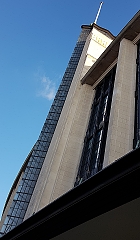
BOMBAY IS RICH in fine examples of buildings in the art deco style, which flourished roughly between the end of WW1 and the end of the 1930s. There is a good collection of buildings in this style along Marine Drive in Bombay, the Oval Maidan, and elsewhere in the city. London has some fine examples of structures that exhibit features of this kind of decorative style, but, apart from along a stretch of the A4 road, there are few concentrations of art deco buildings in London, such as can be found in Bombay. In London, the art deco buildings are mostly scattered around the city.

At the end of December 2021, we were walking with friends along the bank of the Thames between the London Apprentice pub at Isleworth and Richmond Bridge when I spotted a row of houses built in the art deco style. I had never seen them before. They line the south side of Park House Gardens in Twickenham. The detached house nearest the river, number 66, is larger and more attractive than the others in the street. The rest of the art deco residences on the street are rather mundane pairs of semi-detached homes, constructed to a pattern that I have seen elsewhere in London’s suburbs. Most of them have curved art deco period Crittall windows, which have panes of glass framed in metal rather than wood.

Park House Gardens was laid out in the early 1930s when:

“…gravel pits were filled in with, according to the local people, rubble and other material from the foundations of the Old Hotel Cecil in the Strand. The first houses were then built in Park House Gardens at prices of up to £1600 for semi-detached with garages, about the price of a garage today.” (www.twickenhampark.co.uk/a-brief-history.html)

The Cecil Hotel was in the Strand. Of its many guests, one was Mahatma Gandhi.

Another source (https://haveyoursay.citizenspace.com/richmondce/easttwickenham-spd/supporting_documents/East%20Twickenham%20SPD_Oct%2015.pdf) dates the houses differently:
“The buildings are semi-detached with Art Deco details though they do not appear to have been built until c. 1950s.”

Apart from the above information, I have found nothing else about these art deco style houses and would love to learn more.

Lift your eyes

IT IS TEMPTING to concentrate on the wonderful collection of exhibits in Cambridge’s Fitzwilliam Museum, but you should spare some of your attention for the magnificent decoration of some of its galleries. Look up from the paintings and display cases to see superb ceiling decorations above you, and also around you when using the grand staircase. You are sure to be amazed.

The museum is housed in a neo-classical edifice initially designed by George Basevi (1794-1845), architect of London’s Grosvenor Square. After Basevi’s death, the planning of the structure was completed by Charles Robert Cockerell (1788–1863). Built to house the collection bequeathed to the University of Cambridge by Richard FitzWilliam, 7th Viscount FitzWilliam (1745-1816), the present museum was opened to the public in 1848. Over the years since then, the museum has been enlarged by adding newer buildings and now it is home to about 500,000 artefacts.

Years ago, I remember reading (I cannot remember where) a comparison of a museum in the USA designed by Ludwig Mies van der Rohe (1886-1969) with another one, the Guggenheim in Manhattan, designed by Frank Lloyd Wright (1867-1959). Both buildings are elegant but that by Mies Van der Rohe modestly allows the exhibits to grab the viewer’s attention more than the architecture, whereas the unusual design of Wright’s building competes with the artworks for the viewer’s attention. The internal decoration of the older galleries of the Fitzwilliam are sufficiently eye-catching to be able to compete with the exhibits housed in them, but somehow, they hardly do this. That is why I am asking you to take your eyes off the exhibits if only to glance briefly at the décor of the galleries,