Quilts in a wonderfully designed library

OUR FRIEND MIKAEL is an accomplished creative quilter (maker of quilts). Some of her artistic quilting is on display alongside works by other quilters in London’s Swiss Cottage Library until the 26th of July 2023. I must admit that when I learned that we were going to see an exhibition of quilts, my heart sank a bit. However, I am glad we went. I had no idea how creative and imaginative quilt makers can be. Well displayed in Swiss Cottage Library, there is a collection of extremely artistic contemporary quilts, which are well worth seeing. Far from simply being scraps of material stitched together, the quilters have used their imaginations and skills to create artworks which are not only beautiful but superbly innovative.

Until I entered Swiss Cottage Library today, I cannot recall having been inside it since about 1965 when I left the nearby Hall School, aged 13. I have passed its distinctive exterior often but never bothered to go inside. I was at the school between 1960 and 1965, and I remember visiting the then new library after it opened in November 1964. It was designed in the Modernist style by Basil Spence (1907-1976), who was born in Bombay. He based his library on the design of several that he had visited in Scandinavia. All that I can recall of the new library was that its shelves contained a far better range of books than our local library in Golders Green. Being a pupil in the area, I was able to borrow books from the Swiss Cottage Library, which I used to visit often because I found it to be so wonderful.

Although I can remember the superb collection of books that existed in 1964-1965, I could not recall the appearance of the library’s interior. It was only today when we visited the quilting show that I appreciated what a superb job had been done by Basil Spence and his team. Even though it was designed in the early 1960s, the style of the well-lit spacious interior has not dated at all. The interior of the library is far more intelligently conceived than most new British buildings created in the last few years. It is uplifting to wander around the various peaceful spaces within the library. If it were nearer home, it would be a place where I would want to go regularly to read and write.

I am grateful that Mikael invited us to see the quilting exhibition not only because it contained aesthetically pleasing works of art but also because I got to go back inside the library. Although I was not particularly interested in architecture when I was 11, my fascination with it began to grow a few years later. There was even a brief period in my life when I toyed with the idea of becoming an architect. Even though I did not pursue that profession, my love of good architecture – both modern and historical – has persisted. I believe that now, in my retirement, my appreciation of great buildings (such as Swiss Cottage Library) is greater than it has ever been. Even if you miss the quilting exhibition, it is worth making a detour to see Spence’s wonderful creation – both inside and outside.

Inspired by the Pharaohs

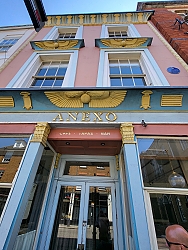
THE TOWN OF HERTFORD is full of delightful old buildings. A house on the town’s Fore Street has a façade decorated with features that bring to mind Ancient Egypt. Known as the Egyptian House, it was built in about 1825 for the grocer JM Gilbertson, who was Mayor of Hertford in 1832. In many ways it resembles a building with an Egyptian style façade. which I have seen in Penzance (Cornwall), This was constructed in about 1835. Both of the house in Hertford and that in Penzance were built later than the now no longer existing Egyptian Hall London’s Piccadilly, which was built in 1812, and was the inspiration for the Egyptian Revival Style of the later edifices in Hertford and Penzance.

The Egyptian House in Hertford is colourfully painted, as is the building in Penzance. Sadly, the Egyptian Hall in Piccadilly was demolished in 1905 to make space for the construction of a block of flats. The Egyptian Revival Style became fashionable during the time of the Egyptian campaigns (end of the 18th century) in the Napoleonic Wars.

Currently, Hertford’s Egyptian House is home to Anexo – a “tapas restaurant and charcuterie bar”. It serves fare that would have been unknown in Ancient Egypt. I wonder what the Pharaohs would have thought about a place like this.

Edwin Lutyens and a London suburb

THE ARCHITECT EDWIN LUTYENS, who designed a set of important government buildings in India’s New Delhi, was also one of the principal planners of Central Square and its surroundings in London’s Hampstead Garden Suburb (‘HGS’). Here is a little bit about this that I have published about this in my book “Golders Green & Hampstead Garden Suburb: Visions of Arcadia”:

Designed to be the throbbing communal heart of HGS, Central Square is a failure. Pevsner and Cherry noted in their “Buildings of England: London 4: North”:

“Unwin’s first plans had included shops along the approaches, but as built by Sir Edwin Lutyens, appointed consultant architect in 1906, the shops were omitted and the square became a high-minded enclave of churches and public buildings with a fringe of smart houses.”

The writers pointed out that without shops, the square never became a true social centre. In fact, most of the time it is an almost deserted open space.  Lutyens (1869-1944) did not get on well with Henrietta Barnett. In her book “The architect and his wife: a life of Edwin Lutyens” (published in 2002), Jane Ridley wrote:

“Lutyens was no progressive. He had no interest in using architecture to change the way people lived, to eliminate servants or smooth social divisions … He disliked the bossiness of social reformers such as Mrs Barnett. Ugly, squalid towns such as Manchester depressed him, but he didn’t see town planning as a motor for change. All he wanted was to build beautiful buildings: ‘Loveliness alone is akin to godliness and whilst ugliness is countenanced and excused Hell is possible.’”

Later in her book Ridley recorded that Lutyen’s wife Emily had written to him after he had fled abroad in 1908 (having had disagreements with Henrietta):

“‘I am glad you went,’ she wrote, ‘as you needed rest and change, only you must work up the Hampstead affair and not let grass grow under your feet, or Mrs Barnett will put you in the wrong again.’”

Despite his differences with Mrs Barnett, Lutyens left his architectural mark on the square. These are his buildings built before he drew up plans for most of his buildings in British India, notably in New Delhi. As Mary Lutyens described in her book “Edwin Lutyens” (published in 1991), his work in the suburb was of importance for his future career:

“At the beginning of 1912 Lord Crewe, Secretary of State for India, approached Reginald Blomfield, President of the Royal Institute of British Architects, to recommend an architect to serve on a commission of three experts to advise the Government of India on the siting and laying out of the new capital. Blomfield recommended Lutyens on the strength of his country houses …his work in Johannesburg … and for Hampstead Garden Suburb. Sir Richmond Ritchie, Permanent Secretary for India, then sent for Lutyens and asked him if he would be willing to serve on the Commission. Incidentally, in connection with the above, Lutyens was already married to the daughter of a Viceroy of India…”

Central Square and its surroundings remain a rather sterile centre of what its founders hoped would be a garden suburb with a vibrant community spirit. If you are lucky, you can spot someone walking a dog or a few children playing on the lawns. Otherwise, this part of London is peaceful and, dare I say it, rather dull.

You can read more about Hampstead Garden Suburb in my book, which is easily available from Amazon:

ART AND ARCHITECTURE IN A MAYFAIR GALLERY

ONE OF THE MANY JOYS of visiting London’s commercial art galleries is, apart from seeing the works of art on display, viewing the architecture of the galleries. Today, the 1st of Aoril 2023, we made a brief visit to the Bernard Jacobson Gallery in Mayfair’s Duke Street St James. Most of the exhibition space is in the basement. However, who ever designed the place has done something both spectacular and intelligent. Part of the ceiling of the basement has been removed to reveal above it a two or three storey high lightwell,which admits ample daylight to augment the artificial illumination in the rest of the basement.

The exhibition we viewed, which continues until the 28th of April 2023, is of paintings by the German artist Bernd Koberling (born 1938). His large works, executed in a variety of materials, are colorful abstracts. Even though they are abstracts, they bring to mind plants and other natural phenomena including reflections in watery surfaces.

I liked the pictures, but could not help being distracted by the gallery’s eye-catching design.

The silent screen

HOBSON STREET IN the heart of Cambridge is one way and is used by traffic avoiding the pedestrianised section of Sidney Street. Hobson Street is lined with buildings of various ages. One of these, which has always attracted me, is a disused cinema whose facade has Art Deco features.

Built in about 1930 to replace an earlier cinema constructed in 1921, it was The Central Cinema. Its white tiled facade has Egyptian and Art Deco details.

In 1972, the cinema closed and was converted, as many other old cinemas have been, into a bingo hall. This establishment thrived until 2009 when the British government banned smoking in public places. Apart from three days when the building was occupied by squatters for 3 days, the old cinema has been boarded up and disused.

Various plans have been proposed for its future use, but none of them have been carried out. One of the problems is that because it is a protected edifice, any future plans have to preserve its original features. And as most of the new ideas for the old cinema involve adding windows, and adding them would infringe the protection order, all of the new plans have had to be abandoned. The protection order has saved the building but hindered its future development.

A temple in Mandvi: architectural revival or survival?

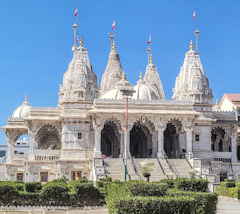
THE SWAMINARAYAN TEMPLE in Mandvi (Kutch, Gujarat) was constructed between 1991 and 1999 to replace a smaller Mandir on the site. Without going into the details of its very fine architectural and decorative features, this edifice was financed by local Kutchi followers of Swaminarayan. The Rajasthani Marble that forms the temple’s structure was hand carved by workmen, all of whom were followers of Swaminarayan. The stones that make up the building were carved in Rajasthan, transported to Mandvi where they were put together to make the edifice. This is similar to how the great temple in London’s Neasden was constructed.

Swaminarayan Mandir in Mandvi

The temple at Mandvi looks very similar to ancient Hindu temples I have seen elsewhere in India. As you look around it, you can see how the very old temples looked when they had just been built many centuries ago. Apart from the fact that Mandvi’s Swaminarayan Mandir looks recently built, a layman like myself, would find it difficult to age the building.

In 19th century England, many new churches were built in the gothic style. Like the newish temple at Mandvi, may of them faithfully reproduce the churches built in mediaeval times. The only thing that differentiates the 19th century Gothic Revival churches from their mediaeval predecessors is that they look too new to be as old as them.

In a book about Gothic Revival written by the art historian Kenneth Clark (1903-1983), he suggests that in England the use of gothic style in architecture never actually died out, and this suggested to me the Gothic Revival was really gothic survival. As far as I can gather, the same is the case for Hindu mandir architecture. If this is really the case, new temples such as Mandvi’s Swaminarayan Mandir is not the revival of the use of an ancient style of architecture, but an example of its survival. Put another way, the new temple at Mandvi is a reincarnation of its predecessor.

Still standing but for how much longer?

COMMERCIAL STREET IN Bangalore (Bengaluru) is one of the main arteries of a busy shopping district – a bazaar area – in the centre of the city. It is close to an area occupied by military establishments, descendants of a former British military base, to which Sir Winston Churchill (no friend of India) was attached briefly when he was a young man. Another main road, Kamaraj Road, in the area used to be known as Cavalry Road. And another reminder of the area’s military proximity is Infantry Road that runs into the Commercial Street area.

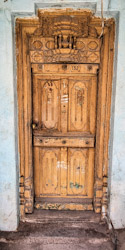
There is a network of narrow lanes that run through the bazaar district. These are lined with shops of varying sizes, tradesmen, artisans, cafés, and other businesses. Numerous motorcyclists and autorickshaws thread their way through the crowds of pedestrians thronging the streets. I suspect that only a small number of these people notice or are interested in the architecture of the buildings lining these lanes. I am one of that small minority.

Many of the buildings in the bazaar are either modern or post 1947. There are still some earlier edifices still standing. Some are gradually falling to pieces and others are in good condition.

Recently, I was taking pictures of some of the older buildings and their traditional decorative features when a man came up to me and said:
“Very old. Historic buildings. Old, very old.”
How old they are, I do not know, but it is likely that they were already standing when India became independent in 1947. I did not ask the man, who commented on the buildings’ age, exactly when they were built. One of my reasons for not doing so was a consequence of an instance in Junagadh (a city in Gujarat) some years ago. We were looking at an interesting mausoleum in the centre of Junagadh, wondering about its age, when we asked a bystander when it was built. He answered:
“I don’t know. I wasn’t born then.”

The few intact attractive, old buildings in the Commercial Street bazaar area are lovely to behold. Given how many of them have already been replaced, I wonder how much longer those remaining will survive.

A Modulor in Bangalore

THE BOWRING INSTITUTE is a private members’ social club in central Bangalore (Bengaluru). It was established in 1868, and has been standing on its present site since 1888. The club has recently undergone a tasteful restoration and improvement. The old 19th century buildings can be seen in their full glory, looking as if they have only just been constructed.

One external wall of a club building has been adorned with a huge panel decorated with two Modulors. The Modulor is a symbol created by the great pioneer of 20th century architecture, Le Corbusier. It looks like a man with one arm raised and was designed by Le Corbusier to be “ a visual bridge between two scales: the metric and the imperial…” It was also connected with his philosophy that the proportions of structures should be related to those of the human body.

Le Corbusier had several connections with India. For example, he was intimately involved in the design of the city of Chandigarh and created a few wonderful buildings in Ahmedabad.

That said, I have yet to discover why the Modulor was placed twice on a panel at the Bowring Institute so long after its creator’s death. I would like to think that it is a fitting reminder of the considerable influence that Le Corbusier has had on 20th century Indian architects, including Balkrishna Doshi, whose studio and offices are in Ahmedabad.

Glorious detail in a gothic revival church

I HAD PASSED it often, but never entered it until recently when I attended a concert within it. I am talking about a church on Holland Road in West London not far from Shepherds Bush, St John the Baptist. This Anglican church is an exceptional example of gothic revival style. Designed by James Brooks (1825-1901) with John Standen Adkins (an assistant of Brooks), it was constructed between 1872 and 1910.

Although the façade facing Holland Road is not exceptional, the church’s interior is highly breathtakingly decorative. Unlike mediaeval churches, which took centuries to complete, St John the Baptist was constructed in much less time. Yet, its decorative details, which imitate what is best in many older churches, rival those found within the old ones. The workmanship and fine details in St John’s remind one of the best productions of craftsmen, who flourished many centuries earlier. However, unlike the earlier churches, which inspired the designers of St John’s, the interior of the church on Holland Road looks too good to be true. Completed in a relatively short period, the variety that adds to the charm of gothic churches built in earlier times and more slowly is lacking in St John’s and other fine examples of late Victorian gothic revival buildings. What we see at St John’s is the realisation of the architects’ concept of an ideal ‘mediaeval’ church. What was achieved at St John’s is probably something like the results early creators of (mediaeval) churches hoped to create, but never lived long enough to see fully realised.

The attention to detail in the better gothic revival churches, such as St John’s, is marvellous. The result is an ensemble of decorative features rich in meticulously executed intricate details. While I was listening to the concert in St John’s, my eyes took in the details of the church, and I began thinking it was amazing that the elaborate attention to fiddly ornate minutiae was carried out only a few years before architectural trends turned through 180 degrees from excessively decorative to the greater simplicity of much 20th century architecture.

Art Deco in Victoria

I HAVE WALKED past London’s Victoria Coach Station many times without looking at it particularly carefully. Yesterday, the 28th of September 2022, I was early for a meeting at the Embassy of Albania, which is not far from Victoria Station. So, I walked slowly, stopping to look at the Coach Station. I had never noticed before that it is a fine example of Art Deco architecture.

The Coach Station, which opened for use in March 1932, was designed by Wallis, Gilbert, and Partners.

I suppose that my interest in Art Deco buildings was initiated by visits to Bombay (Mumbai), where there are many splendid examples of this style of architecture. Gradually, I am discovering that London also has a rich collection of Art Deco buildings. The Coach Station is a fine and well-maintained example.