An artist who campaigned against slavery

HE WAS PASSIONATE about sketching and painting. However, his father, a wealthy Quaker brewer in Hitchin (Hertfordshire), insisted that his son should dedicate himself to working in the family business and use his spare time to create his art. The artist was Samuel Lucas (1805-1870). There is a wonderful exhibition of his creations at the beautifully laid out North Hertfordshire Museum in central Hitchin until the 12th of November 2023.

After schooling and an apprenticeship in London’s Wapping, Samuel worked in the family business in London before returning to work in Hitchin in 1834. As for his artistic ability, this appears to be self-taught. However, he was a keen visitor to the Royal Academy exhibitions in London. In 1837, he married Matilda Holmes, who had been a pupil of the artist John Bernay Crome (1794-1842). She was keen on sketching, but none of her works have survived. I speculate that it is not beyond possibility that Matilda, a water colourist, might have helped Samuel develop his superb water colour techniques.

Samuel’s sketches range from extremely detailed to impressionistic, resembling the work of JMW Turner to some considerable extent. The finished oil paintings, some of which were displayed at the Royal Academy, are beautifully composed, full of detail, and of great visual interest.

Two of the exhibits interested me more than the others. One of them is a pen and ink sketch depicting Thomas Whiting of Hitchin reading Harriet Beecher Stowe’s anti-slavery novel “Uncle Tom’s Cabin” (published 1852) to a gathering of people in a hall in Hitchin. Nearby, there was one of Samuel’s oil paintings. This shows seven men seated around a small table listening to a man standing with his left hand on the table. The standing man is Bishop Samuel Wilberforce (1805-1873). He is addressing members of the Oxford Mission amongst whom is the novelist Lord Lytton of Knebworth (Hertfordshire). The bishop was a son of the anti-slavery activist William Wilberforce. Bishop of Winchester from 1870 until 1873, he was both against slavery and Darwin’s Theory of Evolution. Samuel Lucas’s painting depicts him when he was Bishop of Oxford, which he became in 1845, and remained until he was shifted to Winchester. The Oxford Mission was an Anglican missionary organisation, which became important in Bengal in the late 19th century.

The two pictures described relate to Samuel Lucas’s involvement of the anti-slavery movement. In 1840, he was Hitchin’s delegate to the Anti-Slavery Convention held in London at Exeter Hall on the 12th to 23rd June 1840. During this period, he and his wife hosted some of the delegates who had come from the USA. The convention is portrayed in a painting by Benjamin Haydon (1786-1846), which is now in the National Portrait Gallery. The gallery’s website has a photograph of this painting, which has been displayed so that the viewer can identify each of the people in it. Samuel Lucas can be found near the back of the gathering near a pillar.

Lucas was against slavery, as were many of his fellow Quakers. In addition to this activity, his artistic creations, and his involvement in the family business, he was also an active contributor to the life and development of Hitchin. One of the largest of his paintings in the gallery, but not included in the exhibition, is a depiction of Hitchin’s Market Place. Each of the many people shown in the painting is a portrait of an actual person. The museum has an interactive guide to identify the people. One of them was Isaac Newton (1785-1861). This gentleman was not the famous scientist but the owner of a family firm of painters, plumbers, and glaziers. One of the many folks in the picture has a dark complexion. This is a portrait of Samuel ‘Gypsy’ Draper (1781-1870). He was a violinist, who played for dances and fairs in the area in and around Hitchin for about 20 years. Some of the local Quakers disapproved of him, but Samuel Lucas placed him at the front of the crowd in the centre of the painting. Had we not visited the North Hertfordshire Museum out of pure curiosity, I doubt that we would have ever come across the life and works of Hitchin’s Samuel Lucas. We spent most of our time looking at the superb exhibition about him, so that we had hardly any time left to see the rest of the museum. A fleeting glimpse of the other galleries in the lovely modern building was enough to persuade us that we need to return to see more.
A tree, a composer, Midsummers Night Dream, and the Barbican in London

BURNHAM BEECHES IS an area of woodland not far from Slough and Windsor. Rich in beech trees, it was purchased by the Corporation of London in 1880. The German composer Felix Mendelssohn (1809-1847) visited Britain several times between 1829 and 1847. While staying in England, Felix enjoyed spending time in Burnham Beeches. It is said that there was one old beech tree under which the composer liked to sit. Legend has it that it was in the shade of this tree that he gained inspirations for some of his compositions including some of the well-known “Incidental music to ‘A Midsummer Night’s Dream’” (composed 1842).  In January 1990, when the tree was about 500 years old, it fell over during a storm.

Part of the fallen tree was presented to the Barbican Horticultural Society. Like Burnham Beeches, the Barbican (a post WW2 development in the City of London) is managed by the Corporation of London. The remnant – part of the tree’s trunk – stands on a section of the elevated walkway not far from Barbican Underground Station. Next to it, there is a plaque detailing its history and its probable connection with the composer.

What I have described so far appears in many websites detailing the curiosities of London. However, not one of them mentions that there is yet another fragment of this tree within the barbican. This piece of the dead tree is smaller than that on the walkway, and can be found, somewhat hidden by vegetation, within the Barbican’s magnificent conservatory.

I wondered what had attracted Mendelssohn to Burnham Beeches. In an article by Helen J Read, published by the Buckingham Archaeological Society on its website (www.bucksas.org.uk), I learned that Felix was often a guest of Mr and Mrs Grote, who lived close to Burnham Beeches. They often entertained musical and literary figures. Amongst their many guests was the Swedish singer Jenny Lind, who first performed in London in 1847. The singer also had a favourite tree, which, like Mendelssohn’s, was destroyed in a storm.

Regarding Mendelssohn and his tree, Ms Read wrote:

“Mr and Mrs Grote also entertained the composer Felix Mendelssohn. His favourite part of the Beeches was a mossy slope between Grenville Walk and Victoria Drive, at that time covered with pollarded trees. Many maps mark this area as Mendelssohn’s slope, and it is thought that the music for Puck and Oberon from ‘A Midsummer Night’s Dream’ was inspired by this area. After Mendelssohn’s untimely death, Mrs Grote erected a headstone in his memory but the headstone was removed  … 

…  There is no specific mention in the earlier maps or guides of any particular tree favoured by the composer, but a plaque was later erected on an old pollard tree. The tree blew over and the plaque was moved to one nearby until the storm of 1987, when this tree lost all its branches.”

Judging by what Ms Read wrote, it seems to me that there is a possibility that the fragments of tree, now commemorated at the Barbican as being Mendelssohn’s Tree, might not be remnants of the one beneath which he sat. Even if these bits of timber are not from his favourite tree, they make a charming memorial to a composer whose music gives pleasure to so many people.

Art from India displayed amongst the plants

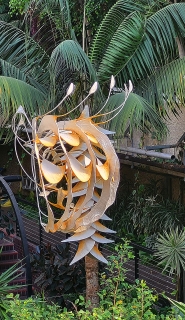
I ENJOY SEEING SCULPTURES displayed in gardens or other plant-filled locations. Until March 2024, the wonderful conservatory in London’s Barbican Centre is hosting a selection of sculptures by Ranjani Shettar. She was born in Bangalore (Bengaluru, India)) in 1977, and now lives and works in rural Karnataka. Her current exhibition in the Barbican is called “Cloud Songs on the Horizon”. The works on display were made especially for this site.

Her works are made of various materials (wood, stainless steel, muslin, and lacquer) and she employs techniques that have been adapted from traditional Indian crafts. Ms Shettar’s organic sculptures look like magnified plants or parts of plants. As she said once:

“Nature’s beauty is ever present, art helps to uncover, perceive and appreciate it.”

Seeing her exhibits in the Conservatory, certainly confirms this. However fine the artworks, putting them amongst plants helps emphasise the greater beauty of nature’s creations. The beauty of the sculptures competes with that of the plants, but the latter almost always win. So, placing one’s artworks within an area rich in plant life is a brave thing to do. I felt that Ms Shettar had done it successfully. Her creations have a harmonious relationship with the plant life surrounding them.

Whether or not you visit the exhibition, which I enjoyed, seeing the Barbican’s Conservatory – the second largest in Greater London – is always a worthwhile experience.

Why give them that name?

THERE IS A SHORT crescent lined with elegant residential houses near to the Kensington Temple church close to the centre of London’s Notting Hill Gate. A few yards west of this there is a short cul-de-sac called Horbury Mews.  The crescent also bears the name Horbury. Although I have passed them often, it was only today that I wondered about ‘Horbury’.

Both the Crescent and the Mews were built on land that was leased to William Chadwick in 1848 by Felix Ladbroke, heir of the property developer and landowner James Weller Ladbroke (died 1847). William, a developer, built many houses on the Ladbroke Estate in Kensington. His heir WW Chadwick constructed the houses on Horbury Crescent between 1855 and 1857. The mews nearby bear the date 1878, which is prominently displayed on one of its buildings. The mews was constructed on a former nurseryman’s grounds. They served to house horses and servants of the nearby houses. Today, they are homes for the well-off.

The name Horbury derives from the nearby Kensington Temple, which was built in 1848-49, and was then called ‘The Horbury Chapel’. The name was chosen because the hometown one of its first deacons was Horbury in Yorkshire.

So, two street names in a little part of Kensington commemorate a small town in Yorkshire. I did not expect to discover that.

A survivor on Oxford Street near Selfridges

I HAVE PASSED IT SO many times whilst travelling by bus along London’s Oxford Street, and wondered what it is. I am referring to a well-maintained brickwork tower-like structure surmounted by a recumbent stone lion. It is a few yards east of Selfridges department store. Eighteenth century in appearance, it looks incongruous standing flush against an undistinguished modern brick building. The object of interest stands on the eastern corner of the intersection of Oxford Street and a short cul-de-sac, Stratford Place, about which I will write more in the future.

Stratford Place runs in a north/south direction. Its eastern side is lined with a row of Georgian terraced houses. Prior to the twentieth century and the development of Oxford Street as a shopping district, the row of Georgian houses would have extended south with the southernmost of them having a façade on Oxford Street. In 1890, the Georgian villa that stood on the eastern corner of Oxford Street and Stratford Place was demolished. All that remained was the lion-topped gate house (or porter’s lodge), which I have seen so often whilst travelling past on the bus. The west side of Stratford Place was demolished to build a huge Lyons Corner House eatery. The demolition included the loss of the western gatehouse that used to face the still standing one, which has been preserved.

A landmark in London’s Soho since 1949

DURING THE LATE 1950s and much of the 1960s, my mother created artworks in the sculpture workshops of St Martins School of Art, which was then located on Charing Cross Road near to Foyles bookshop. My mother was a keen follower of the recipes of Elizabeth David (1913-1992), who introduced Mediterranean food to British kitchens. Near to St Martins in Old Compton Street, there were many food shops that supplied the ingredients that were required to follow Ms David’s recipes accurately. There used to be a French greengrocer between Charing Cross Road and Greek Street. This was one of the only places where ‘exotic’ salads such as mâché (lamb’s lettuce) could be purchased. Further west along Old Compton Street, there was a Belgian butcher, Benoit Bulcke, which cut meat in the French style, which my mother preferred. She claimed that English butchers were not ‘up to scratch’. Both these shops have long since disappeared. Another Soho establishment, which we used to visit regularly, was Trattoria da Otello in Dean Street. We went there so often that we were treated like old friends. Now, sadly, that wonderful restaurant is no more.

Three Old Compton Street shops frequented by my mother are still in business. They are the Algerian Coffee Stores, whose appearance has barely changed since the early 1960s when I first remember entering it; and a supplier of Italian foods: I Camisa & Son. Lina Stores, which my mother also used to visit still exists, but its branch on Brewer Street (and other newer branches) seems to have become more like restaurants than Italian delicatessens.

During school holidays, I used to accompany my mother on trips from Golders Green, where we resided, to the West End. On most of these excursions, food shopping in Soho was on our itinerary. So, as a youngster I got to know these various food shops quite well. As an innocent child, I associated Soho with food shopping rather than its other more colourful activities.

Every visit to Soho involved a stop at Bar Italia on Frith Street. There, I would be treated with a cappuccino while my mother drank an espresso. From when I first knew it in the early 1960s (or possibly the late 1950s), the overall appearance of Bar Italia has barely changed. As a friend remarked on a recent visit, the cracked Formica counter opposite the bar is typical of how cafés would have been fitted out back in the 1950s.

Bar Italia is almost three years older than me. It was founded in late 1949 by Lou and Caterina Polledri. Lou was born in the Italian city of Piacenza. According to the Bar’s website, some of the above-mentioned Formica was put in place in 1949, when the establishment was for its time ‘state-of-the-art’. The floor is that which was laid down by members of the Polledri family in 1949.

When it opened, Soho had a large Italian community, which much appreciated the Bar Italia as a home-away-from-home. At the far end of the small establishment, there is a television that broadcasts Italian TV, mostly sporting events. Each time I visit the place, the screen sems to have been replaced by a larger one. However, I cannot recall whether there was a television in place when I visited as a child. What I do remember is that next door to Bar Italia, there used to be a Greek restaurant called Jimmy’s, which, for some reason, my mother never took us there.

Once a local for the Italian community, Bar Italia has become somewhat of a Soho landmark and tourist attraction. In addition to coffee and alcoholic drinks that would be available in any local bar in Italy, Bar Italia now also serves hot meals. It also sells Portuguese ‘natas’, which are not typical fare in bars in Italy.  Apart from this change, the prices of its excellent coffee have shot up to levels higher than most London cafés charge. Whereas one can expect to pay from on average £2.80 to “£3.20” for an espresso, Bar Italia is now charging over £4.20. I mention this, but do not begrudge them because by patronising Bar Italia we are helping to preserve a delightful historical London landmark.

NOW watch this lovely little video about the place:

Inspired in the twenty-first century by fifteenth century art

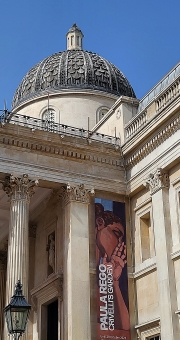
THE WORD ‘INSPIRATION’ has at least two meanings. One of them is ‘to breathe in (i.e., inhale air). When air is inhaled, many of the oxygen molecules it contains are converted to become other substances, some of which is carbon dioxide that is exhaled. Another meaning of the word is to be mentally stimulated, often by something one has perceived in the world around us. What results from this form of inspiration might not much resemble whatever it was that caused it. Today (the 6th of August 2023), we visited a small exhibition in one room of London’s National Gallery. Showing until the 29th of October 2023, the exhibition is called “Paula Rego: Crivelli’s Garden”.

The exhibition contains two major works: “La Madonna della Rondine (The Madonna of the Swallow)” painted in about 1490 by Carlo Crivelli (c1435-1495); and “Crivelli’s Garden” painted in the early 1990s by Paola Rego (1935-2022) when she was the National Gallery’s first Associate Artist between 1990 and 1992. There are also some sketches that Rego made for her enormous painting, originally designed to be a mural.

Both the Crivelli and the Rego paintings are excellent, but quite different in style. However, Rego was inspired to create her mural after seeing Crivelli’s altarpiece. Although both paintings are of religious subjects, there is no obvious similarity between the two of them. As Paola Rego said in 1992:

“If the story is ‘given’ I take liberties with it to make it conform to my own experiences and to be outrageous.”

And that is what she has done after having been inspired by Crivelli’s masterpiece.

The paintings at the base of Crivelli’s altarpiece (the ‘predella’) include scenes set in gardens. According to the National Gallery’s website, what Rego did was to reimagine:

“…Crivelli’s house and garden to explore the narratives of women in biblical history and folklore based on paintings across the collection and stories from the medieval Golden Legend. Her figures inspired by the Virgin Mary, Saint Catherine, Mary Magdalene and Delilah, share the stage with other women from biblical and mythological histories.”

She has populated her picture with portraits of people she knew including (to quote the website again):

“…friends, members of her family and staff at the National Gallery whom she asked to sit for her, including Erika Langmuir, Lizzie Perrotte and Ailsa Bhattacharya who were members of the Education Department at the time.”

The resulting work is both beautiful and fascinating, but quite different from the 15th century work which had inspired her.

Whether your artistic preferences are for art created during the Italian Renaissance or in the late 20th century, this small exhibition will not disappoint you. If you enjoy both, as I do, then this inspiring show of artistic inspiration is a ‘must see’ event.

From Zambia to the moon and Mars

UNTIL THE 14TH OF JANUARY 2024, there is a fascinating exhibition at London’s Tate Modern gallery. Called “A World in Common: Contemporary African Photography”, this is a display of a wide variety of photographic works (still and cinematographic) showing various aspects of life in the African continent past and present. Although many of the exhibits were both eye-catching and fascinating, one – a series of photographs by Cristina de Middel (born 1975) – interested me especially. Titled “Afronauts series 2012”, it commemorates a project, which few people remember outside Zambia.

Between 1960 and 1969, the founder of the Zambia National Academy of Science, Space Research and Philosophy, Edward Festus Mukuka Nkoloso (1919–1989), worked on Zambia’s space programme. During a period when the USSR and the USA were competing to make advances in space exploration, Nkoloso felt that Zambia and the rest of Africa should join the space race. His aim was to launch a rocket, which would transport two cats, an astronaut, and a Christian missionary, to the moon. 17-year-old Ms Matha Mwambwa was chosen to be the first ‘afronaut’. After landing on the moon, they were to have been sent onwards to Mars.

Nkoloso set up a training camp near Lusaka. A website (https://www.rmg.co.uk/stories/topics/zambian-space-programme) describes this:

“In an attempt to achieve this mission to the Moon Nkoloso recruited twelve astronauts, and put them through rigorous training of his own devising. He put them in an oil drum, spun them round trees and rolled them down hills in order to prepare them for weightlessness. He taught them to walk on their hands as he believed this to be the way to walk in space. He made them swing on a rope, before cutting the rope to allow them to experience freefall.”

Despite seeking funding from various countries – always unsuccessfully – the programme failed. In addition to lack of funding, other disasters hit the project before it could take-off from the ground. These are described in the website already quoted:

“Mwamba fell pregnant and returned home. Other astronauts left, reportedly going on drinking sprees and never returning or moving onto other pastimes such as tribal song and dance. And with no astronauts and no money, the Moon can seem awfully far away.”

De Middel’s exhibit at the Tate Modern is loosely based on the story of Zambia’s space programme. She has combined fact with fiction to produce a series of photographs depicting fantasy images of the failed project. Some of her photographs show afronauts wearing glass domes on their heads instead of astronauts’ helmets. De Middel’s elderly grandmother made the costumes worn by the subjects posing as afronauts. The artist’s image show simulations of space travel that are very distant from the images issued by NASA and other space exploration agencies. In a way, the exhibit asks the question: “Who is it that gets to explore space?”

I am pleased that I saw the exhibition, which is well-displayed and often thought-provoking. However, I am extremely happy that by visiting this show, I learned about an almost forgotten competitor in the space race. Recently, India landed a mission on the moon. Maybe, it is now Africa’s turn to make space exploration history.

Farewell to an old friend in the heart of London

OVER THE PAST 45 YEARS (or more), we have eaten at least once a year at the India Club restaurant in London’s Strand. Occupying the first and second floors of the old-fashioned Hotel Strand Continental, the Club’s bar on the first floor is reached via a steep, narrow staircase. Opposite it, there is an office and reception area where our friend Mr Marker, or one of his daughters, greets us. Another narrow staircase ascends to the dining area on the second floor.

The Club was founded either just before India became independent in 1947, or in the very early 1950s. Close to the Indian High Commission, Bush House, and the London School of Economics, it was designed to be a home-away-from-home for Indians in London. The Club’s website (www.theindiaclub.co.uk/our-story) mentioned that the Club:

“… was originally set up by the India League, to further Indo-British friendship in the post-independence era, and it quickly became a base for groups serving the Asian community … The Indian Journalist Association, Indian Workers Association and Indian Socialist Group of Britain were just some of the groups which used 143 Strand for their events and activities. The building was also a base for the new wings of the India League which ran a free legal advice bureau and a research and study unit from this address.”

One of its founding members was Krishna Menon (1896-1974) who was independent India’s first High Commissioner to London. Soon after it was founded, the Club became popular with non-Indians as well as those for whom it was founded. Supplying Indian cuisine at very reasonable prices, the restaurant became a popular eatery. Until a few years ago, alcohol was only available to paid-up members of the Club. To become a member, and thereby have the use of the bar, an annual membership fee of only £1 was payable. Later, the Club’s restaurant must have obtained an alcohol licence because the requirement to become a member (for the purposes of purchasing booze) was dropped.

Both the restaurant and the bar have always looked like they must have done when the Club was first opened so many decades ago. Consequently, the place has an old-fashioned look about it. Should one of its founding members wander in today, they would have found little changed, except the prices. For us, and I suspect many other regulars, part of the charm of the Club was its unchanging appearance. It seemed to me that the management have deliberately not done anything to spoil the early postwar atmosphere of the place. The Club is adorned with paintings and photographs, mainly depicting notable Indians who lived during the period when India was becoming independent. To quote the website again:

“The interior of 143 Strand, particularly the characterful and distinct entrance, stairwells, reception area, first floor bar and second floor restaurant, remain in the same condition as they were during the occupation of the property by the India League. As a result,143 Strand’s interior allows it’s historical and cultural associations to be experienced first-hand by the public. It is the only building in the capital connected to the India League that has not been redeveloped or re-purposed. It therefore remains living history.”

As for the food served at the Club, over the years it has varied in quality according to who was working in the kitchen. Always satisfactory and good value, the Club’s food could never be described as exceptionally good. The menu included both vegetarian and non-veg dishes. I always enjoyed rounding off the meal with the excellent kulfi they served.

A few weeks ago in August 2023, a friend in Bombay (Mumbai) sent me an upsetting newspaper article. It quoted the Club’s owner Mr Marker as saying:

“It is with a very heavy heart that we announce the closure of the India Club, with our last day open to the public on September 17.”

Bearing this in mind, yesterday (Monday, the 4th of September 2023), a small group of us decided to have a last supper at the Club – to say farewell to this wonderful relic. When we arrived at the Club at 6pm, I could hardly believe my eyes. There was a queue of people waiting to dine at the Club. The line stretch from the pavement, up both flights of stairs, to the restaurant, which was chock full of diners. I had never seen the dining room with such a large crowd. The bar was also full of people waiting to get a table. When we learned that we would have to wait at least 45 minutes to be seated, we decided to go elsewhere (to Sagar Indian vegetarian restaurant in Panton Street).

It was various news items about its imminent closure that drew us and all the other people to the Club. Some of them, like Lopa and I, were regulars, but I wondered how many of the other folk queuing that Monday evening had ever eaten at the Club. Did its impending closure, like the film “Oppenheimer” and the play “Dr Semmelweis” – both about figures known mostly to scientists, draw the crowds to a fairly unfamiliar place that had suddenly become attractive because it was soon to be no more?