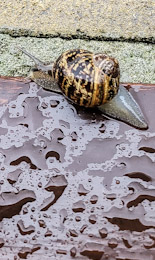
Take it slowly
There is no hurry at all
When you’re a tiny snail

Take it slowly
There is no hurry at all
When you’re a tiny snail
IN JANUARY 1994, we had a Hindu wedding ceremony in the Indian city of Bangalore. Although the ceremony was attended mostly by family and a few close friends, the reception that followed it had about 350 guests, most of whom I had never met before. So, as an attempt to introduce me to some of them, my parents-in-law arranged a series of parties to introduce me to some of them before the ‘big day’. The gatherings were held in the spacious living room of my in-laws’ home in Koramangala – a suburb of Bangalore. As with many parties held in India, the proceedings began with a long session of drinks and snacks (‘finger food’). The parties end with food served at a buffet. Once, this late supper has been consumed, the guests leave, and the occasion ends abruptly.

My in-laws had a bar counter in their living room. At each party, an off-duty employee from the Bangalore Club was hired to serve as barman. Back in 1994, my preferred alcoholic drink was vodka. I enjoyed drinking it either with lumps of ice or with a drop of water.
At one of the series of parties, I went up to the bar and asked for vodka with water. I was handed a tall glass (approximately 330 ml, I guess) filled with a transparent, colourless liquid. I sipped it. It was rather dilute vodka – not very exciting! When I had finished the glass, I returned to the bar, and said:
“Another vodka, but less water this time, please.”
I did not watch the barman preparing my drink. He handed me a freshly filled glass, which was the same size as the one I had just emptied.
I took a small taste of my second drink. I could not believe what I tasted: it was neat vodka. The barman had poured me a third of a litre of pure vodka. I could not believe my luck. As the evening moved on, I took sips of my reservoir of vodka, and chatted to various people – I hope reasonably coherently.
Eventually, the drinking part of the evening’s proceedings were over, and people began to partake of the dishes on the buffet. Being a member of the family, I waited until the guests had taken their food, before approaching the tables where it was displayed. As I reached a counter, I felt my ankles weakening, and I thought that I might have been just about to topple over, which would not have looked good. Luckily, the vodka had not affected my brain. So, sensing the imminent risk of falling, I gripped the counter with my hands, and thereby averted embarrassing the family.
Now, my drinking habits are not the main point of this short tale. It is the meaning of the word ‘less’ in English spoken in India that is important. If, for example, you want to order coffee without sugar in India, you should say:
“Sugar less.”
That does not mean that you want less sugar in your coffee. It means you do not want any sugar in your beverage. It has taken me years of visiting India to realise this meaning of ‘less’. That is, ‘less’ means ‘none’. I did not know this in January 1994 when I asked for less water in my vodka. I suspect what happened was that English was not the barman’s mother tongue. So, hearing, the word ‘less’, when I had asked for ‘less water’, he had believed that I wanted not a drop of water in my drink.
HERE WE ARE in England’s West Country once again. Apart from coming to enjoy the scenic delights of Somerset, Devon, and Cornwall, we have another reason for visiting the area. That reason is socialising. During the last few years, many of our good friends who used to live in London, or not far from it, have moved westwards.

Some old friends, who lived near Windsor for several decades have sold up and now live in Dorset, which is on the way from London to the West Country. Long before the 1980s, my good friend (and fourth cousin) Peter Bunyard shifted to a very remote spot in the heart of Cornwall. More recently, another cousin shifted to the Clifton district of Bristol. Also, living not far from Bristol are two friends, who used to live in Ealing. Another couple, who had homes near Reading and in Kensington have moved to Topsham on the River Exe. Not far from them, living in Sidmouth, are some other close friends who lived in Hertfordshire. A dentist with whom I used to work in a practice in Rainham, Kent, and her husband have just moved from their home near Maidstone (Kent) to the city of Bath. And only a couple of days ago, I received a text message from another of my former colleagues, who is moving from Acton (in west London) to the North Devon coast.
In addition to those who have drifted west, we have other friends who have lived in the West Country seemingly forever. One couple lives in Cornwall close to the River Tamar. The other couple live in a house overlooking the River Dart in Dartmouth. An yet another couple live in Torquay.
All these people are good friends with whom we have a great deal in common, and enjoy seeing. However, now they have drifted west, and not all of them visit London much, if at all. So, we like to make an annual – and always enjoyable – trip to the west to see some, if not all, of them. They seem to enjoy seeing us, so I do not think they moved away from London to avoid meeting us! If more of our friends shift westwards, we might even begin to think of following them.
MUCH HAS CHANGED in Hampstead since I used to visit it every weekend during the early 1960s. The same is true for many places in London.

The Pimpernel on Heath Street, where my parents enjoyed espresso coffees, has long since closed. Likewise, my parents’ favourite Cellier du Midi in Church Row. Tragically, the High Hill Bookshop on the High Street disappeared many years ago, only to be replaced by yet another branch of Waterstones.
The venerable Everyman Cinema still functions, but now it is far more plush than it used to be when I was a lad. Of Hampstead’s many second-hand bookshops, only one, Keith Fawkes, remains. However, only recently I spotted Mr Fawkes sitting outside his shop, which has now been rebranded as ‘House Clearance Specialists’.
Another remnant of the Hampstead of my childhood is the Shahbhag Indian restaurant on Rosslyn Hill. Founded in 1954, my parents patronised it occasionally during the 1960s. I ate there once or twice in the late 1960s, but not since. By the 1970s, I had Indian friends, who introduced me to restaurants where the Indian food was far more authauthentic was offered at the Shahbhag. Unfortunately, many of these better eateries, many of which were on or near Warren, no longer exist.
During a recent stroll through Hampstead, I noticed that the Shahbhag was still in business. Seeing this sparked off the memories I have just described.

Some prefer not
To put trust in banks and bankers
They only use cash
REGULARLY ON SUNDAY mornings, you will see a group of people standing at the northern edge of Kensington Gardens’ so-called Round Pond. It is not truly round, but squarish with rounded corners. This group of men and women will be seen standing close to trolleys on which there might be large model sailing boats. Often, the boats, which are radio-controlled, will be sailing in the pond’s water. These model boat enthusiasts are members of the London Model Yacht Club, which was founded in London in 1876.

Prior to 1876, there were other model boating clubs in London. In the 1820s, a group of model boat enthusiasts used to sail their craft in a pond in Green Park. This pond exists no more. In 1834, when the pond was made inaccessible by railings, the boaters moved to the Serpentine in Hyde Park. The first formal London Model Yacht Club was founded in 1846. Following disagreements, this club was disbanded in 1871. In 1876, the Model Yacht Sailing Association was established. It and another club, the London Model Yacht Club (Est. 1884) have been sailing on the Round Pond since the late 1880s. Before that, they had been using a pond in Hackney. For those interested in the detailed history of model boat sailing in London, please visit www.lmyc.org.uk/history.
Next time you are in London at around 10.30 am on a Sunday morning, visit the Round Pond to watch the model boats ashore and on the water.
YESTERDAY (16th SEPTEMBER 2023), we met one of my cousins in Hampstead village. We ate a very satisfactory lunch at The Flask pub in Flask Walk. We chose items from the ‘brunch menu’. Each of the three dishes we ordered was tasty and generous in portion size. The dish with wild mushrooms was exceptionally good.

Long ago, there were two pubs with the word Flask in their names in Hampstead: The Upper Flask and the Lower Flask. The Upper Flask was located close to where East Heath Road meets the top (northernmost) end of Heath Street, close to Whitestone Pond. It was a meeting place for noteworthy cultural figures, but it was closed in 1750. The pub in Flask Walk, where we ate lunch, was known as The Lower Flask. Here is something about it from my book “Beneath a Wide Sky: Hampstead and its Environs”:
“Once upon a time, Hampstead had two pubs or taverns whose names contained the word ‘Flask’. This is not surprising because the word ‘flask’ used to be common in the naming of pubs. One of them, the erstwhile Upper Flask, has already been described. The other, the once named ‘Lower Flask’, now renamed, is on Flask Walk, not far from Hampstead high Street. The Upper Flask was a remarkable establishment, as already described. It figures several times in ‘Clarissa’, a lengthy novel by Samuel Richardson (1689-1761), first published in 1747. The Lower Flask pub (in Flask Walk) is also mentioned in the novel, but unflatteringly, as:
“… a place where second-rate persons are to be found often in a swinish condition …”
Unlike the Upper Flask, the Lower Flask is still in business, but much, including its name and clientele, has changed since Richardson published his novel. Located at the eastern end of the pedestrianised stretch of Flask Walk, the Lower Flask, now The Flask, was rebuilt in 1874. Formerly, it had been a thatched building and was a place where mineral water from Hampstead’s chalybeate springs was sold. Oddly, despite visiting Hampstead literally innumerable times during the last more than 65 years, it was only on Halloween 2021 that I first set foot in the Flask pub, and I am pleased that I did. The front rooms of the pub retain much of their Victorian charm and the rear rooms, one of them with a glass roof, are spacious.”
Although the Flask Pub is interesting enough, there are plenty more interesting places to see along Flask Walk and in other parts of Hampstead. You can discover these by reading my book, which is available from Amazon websites such as:
https://www.amazon.co.uk/BENEATH-WIDE-SKY-HAMPSTEAD-ENVIRONS/dp/B09R2WRK92/
IN EARLY OCTOBER 2022. I published a book about London’s Golders Green and its neighbour Hampstead Garden Suburb. It was the part of northwest London where I spent my childhood and early adult life. I wrote about areas’ past and present, and my memories of living there. The book sells reasonably well by my modest standards, but was not reviewed until early September 2023. Then someone in Germany awarded the book 5 stars (out of 5 stars), and reviewed it on Amazon as follows:
“A very informative and often funny book! I immensely enjoyed reading it.”
Brief as it is, this reviewer encapsulated what I was aiming to do when writing my book. That was, to write something that was both elucidating and amusing.
I am always happy when someone takes the trouble to review one of my books. Naturally, I would prefer a favourable review, but a critical one is also welcome. That a reader bothers to post a review shows that he or she has read the book and reflected on its contents. I find that very gratifying.
The book about which I have been writing is called “GOLDERS GREEN & HAMPSTEAD GARDEN SUBURB: VISIONS OF ARCADIA” and is available as both a paperback and a Kindle from Amazon websites, such as:
JUST BEFORE I VISITED New York City in early 1992, I needed to buy a new coat. I entered Cordings gentleman’s clothing store on London’s Piccadilly and was greeted by a salesman. He listened carefully whilst I explained that what I was seeking had to be warm, windproof, waterproof, lightweight, and furnished with pockets both outside and inside the garment. After a moment’s consideration, he said to me:
“What you need is a Dannimac, Sir.”
I asked him whether I could see one and try it on. He replied:
“There’s only one problem, Sir.”
“What’s that?” I asked.
“They don’t make ‘em anymore.”

So, I set off for New York with an old coat that needed replacing. One day, I entered a clothing store on the lower east side of Manhattan. I explained my requirements to the very talkative salesman. When I explained my pocket requirement. He said abruptly:
“You want pockets on the inside and the outside? What are you? A private detective? A secret agent?”
That was the first, and so far, only time, someone has suggested that I did that kind of work. The man showed me some feather-filled puffy jackets made by North Face. They fulfilled all my criteria. I chose a beige one, and happily parted with over 100 US Dollars. I used that North Face for over 25 years until its appearance became too disreputable, and then, sadly, I disposed of it.
Having acquired my fine new coat, I had to get rid of the old one, which I had brought from England. I recall that there were few if any rubbish bins on the streets. As for my friend’s flat, where I was staying, there seemed to be nowhere to dispose of even the smallest bit of rubbish. On my return to the UK, my future wife, who had lived in New York City, explained that there must have been a rubbish disposal shoot in the flat or the building. I did not want to dump the old coat in the street, So, in the end, I handed it to one of the many people begging for money in the city.
AT THE END OF WW1, in 1919, there were two ways of travelling by air. Either by aeroplane or by airship (powered balloons, such as the famous Zeppelins). Airships could travel without stopping for longer distances than ‘planes, but they moved less quickly. You might be wondering how I discovered this, and why am I suddenly telling you about it. Well, yesterday, my wife bought me a copy of “The New Illustrated” in a charity shop. It was a slightly used copy of Volume 1, number 1, published on the 15th of February 1919. Edited by John Alexander Hammerton (1871-1949), it was a successor to his journal “War Illustrated”, which was disbanded in February 1919, a few days before “The New Illustrated” was launched. The first issue of the new magazine came with a “Map of the World’s Airways”, given away as a gift. It is from this map that the information in this essay is derived.

The map of the world shows routes taken both by airships and aeroplanes, and the flying times between stops. For example, from Cairo to Aden was 25 hours by airship non-stop, and about 13 ½ hours by ‘plane, not including a stop in Suakin (in northeast Sudan). By air across the Atlantic, there were two choices: airship from London to St Johns (Canada), 36 ¾ hours, then ‘plane St Johns to New York with one stop, about 12 hours flying time; or airship from London to Halifax (Canada), 46 ¾ hours, then ‘plane to New York 6 hours non-stop. The timings given on the map assumed that an airship travelled at 60 mph, and a ‘plane at 100 mph. The map only displayed what it called “All British” routes.
These days, we travel between Bangalore (not far from Madras) in India and vice vera taking about 11 hours non-stop, or about 12 hours (flying time) with a stop in the Arabian Gulf States. In 1919, the traveller from London to British India had two choices. From London to Karachi (now in Pakistan) by ‘plane took two days and 10 hours, and stopped in Gibraltar, Malta, Cyprus, Baghdad, Basra, and Bahrein Island. Alternatively, you could fly by ‘plane from London to Bombay in two days and 17 hours, stopping on the way in Gibraltar, Malta, Cairo, Suakin, Aden, and Socotra Island. From Bombay to Madras was another seven hours by ‘plane. Long as these journeys might seem to us today, we must remember that travelling by sea was far slower. For example, when my wife travelled on a P&O liner – a regular passenger service, not a cruise – from Bombay to Tilbury in 1963, the trip took at least a fortnight.
If, by chance, you had wished to circumnavigate the world, you could do it by airship in 16 days and 18 hours via India, or 18 days and 10 hours via South Africa.
While I was writing this, I remembered the father of some close friends. He worked for the Shell oil company. I remember him telling us that when he used to fly to Africa and the Far East during the 1950s, the ‘planes did not fly at night. So, each flight was made in stages. Every evening during the journey, the passengers would disembark and were put up in a hotel until the flight was resumed the following morning. Seeing the 1919 map reminded me of what he told us many years ago.
 yamey
yamey 