A DEEPSTHAMBH IS a Hindu architectural feature found near temples or temple compounds. It is a tower with many small niches into which small oil lamps (diyas) are placed and lit to celebrate special Hindu occasions. A good place to see a number of these is at Bombay’s Banganga Tank in the Walkeshwar area.
Two deepsthambhs next to Banganga Tank
The tank is a rectangular pool surrounded by steps that lead into the water contained within it. At one corner of the tank water flows from a spring vigorously into the pool. The tank is full of large fish, which the locals feed. Being in a strictly vegetarian neighbourhood, these fish are safe from being caught and eaten. The tank is surrounded by houses and many smallish temples. The Tank is a few yards from the rock strewn seashore.
The tank was first built in 1127 AD by Lakshman Prabhu, a minister in the Sihara Court of Thane. This makes the Tank one of the oldest surviving features of what is now Mumbai. It was rebuilt in 1715. According to legend, the spring that now feeds the Tank appeared suddenly when Rama stopped at this spot during his search for Sita.
Banganga Tank is a pleasant spot at which to linger. So near to the hustle and bustle of Mumbai, here is a place that us both beautiful and relatively peaceful. It gives me a good feeling.
THERE IS A PHOTOGRAPH in the “Times of India” (Mumbai edition: 19th of December 2023). It is a good image showing a group of women wearing saris, and seated on a wall next to the sea close to the Gateway of India. The picture on its own is a pleasure to see, but what enhanced my enjoyment of it was its wonderfully witty title: “SAREE SOIREE AT THE GATEWAY”
DURING THE FEW DAYS we have been in Bombay, we have visited 10 art galleries. With one exception, the exhibitions have been both beautifully displayed and contained exciting works of art. The exception is an exhibition of Pop Art being held at the recently constructed Nita Mukesh Ambani Cultural Centre in the Bandra Kurla district of Bombay.
The spacious gallery occupies parts of four floors of a glitzy cultural centre-cum-shopping mall. To view the exhibition, one needs to book a time-slot, and part with 800 Rupees (about £8) per person. When we visited on a Sunday afternoon, the few visitors to the gallery were vastly outnumbered by security personnel and charming, but seemingly poorly informed, young ladies who are employed to provide information about the exhibits.
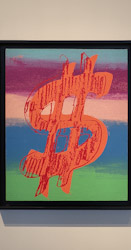
The flyer for the exhibition promises the visitor the opportunity to see works by 12 exponents of Pop Art. However, the majority of the items were creations of Andy Warhol. Almost my favourite piece was a large creation by Robert Rauschenberg.
Each of the very spacious, well-lit galleries had surprisingly few artworks. Of the four galleries, I thought that the one on the third floor was best. It contained, amongst a few other things, the Rauschenberg, and a work by Claes Oldenburg, and yet more Warhol images.
Would I recommend making a visit to this exhibition? Probably, I would not. If you are familiar with Pop Art it offers little to add to what you already know and/or like. If you are not familiar with this kind of art, I am not sure that the exhibition would provide you with much if any insight. And at 800 Rupees per person, you might be better off buying a decent book about this exciting era of art.
NEAR BOMBAY’S FLORA Fountain there are several booksellers on the pavement. They stock both new (original and pirated copies) and old books. In general, the vendors are amenable to bargaining with their customers.
Today (in December 2023), I found a second-hand, oldish book about the history of Bombay. It looked as if it would satisfy my requirements. I asked the price. It was 800 Rupees. Because I have become accustomed to hagling over the price I offered 600. I was hoping that we would eventually agree on a price of about 700. The bookseller was adamant. He would sell it for 800 and no less. He kept saying it had been 1000 when it was new … long ago. I walked away, and viewed other bookstalls nearby.
Keen to have the book, I returned and offered 750. The stubborn vendor said to me: “What is 50 Rupees to you? You are rich man.” I walked away, and joined my wife who had just engaged a taxi to take us elsewhere. Seeing me board the taxi, the bookseller ran up to our vehicle, and proposed that we pay 780. My wife, who was not yet in the vehicle, offered him 750, which he accepted.
The man was right. What was 50 Rupees to me? Only about 50 pence. However, that was not the point. Getting the book was one thing but the pleasure of fighting to reduce the price, and succeeding, is another. And the sense of achievement after serious bargaining leaves me with a curiously fine sense of contentment.
I HAVE SEEN PHOTOGRAPHS of baobab trees, but until we visited the café of the formerly named Prince of Wales Museum in Bombay, I had never seen one ‘in the flesh’. A member of the mallow family of plants, baobabs are native to Madagascar.
Baobab tree in Bombay
These trees with curious looking conical trunks were imported to India by Arab traders. Although this is the case, this baobab in Bombay is the first such tree I have seen during my 30 years of frequent visits to India.
As we sat with our cold drinks, I looked up at the high branches of the baobab, and saw something flapping about. At first, I thought it was a black plastic bag caught in the branches. Then I noticed that it was a large bat stretching its wings. I saw it was not alone, but one of a large number of bats hanging on the high branches. These large creatures had black wings and dark brown bodies.
Despite the fact we had just seen a wonderful exhibition of ancient sculptures (from India, Ancient Rome and Greece, and Assyria), finding the baobab and seeing the bats in it, made my day.
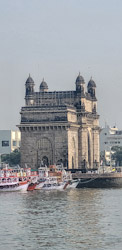
WE HAVE BEEN VERY fortunate to get a booking at the Royal Bombay Yacht Club, located next door to the world famous luxurious Taj Mahal Hotel. Our bedroom is directly opposite the front of the Gateway of India – Bombay’s best known landmark.
The Gateway was built to celebrate the arrival in India of the British King George V – Emperor of India. However, as it was only completed in 1924, the king only got to see a cardboard model of the archway. Construction of this edifice only began in 1915, when the land on which it now stands was first prepared. The Gateway’s foundations only began to be built in 1920.
The magnificent archway was designed by George Wittet (1878-1926), an architect who worked mainly in Bombay. The Gateway was designed in an Indo-Saracenic style with many features borrowed from 16TH mosques found in Gujarat.
The Gateway is a brilliant piece of architecture. In its position next to the sea, it ‘works’ successfully. It has become not only an icon of Bombay but also, I believe, of India. I find it ironic that like that other icon of India, the Taj Mahal in Agra, its construction was inspired not by Indians but by invaders of the Indian Subcontinent. Despite that, Indians love it and flock to see it.
NOBODY KNOWS WHEN the Bahucharaji stepwell was constructed. Legend has it that this well, located in Surat’s Vishal Nagar area, was built by Vanjara people, who came from outside Surat. These people used to visit the city, and set up camp there. This stepwell is said to have been dug by them to provide a supply of water.
The Vanjaras (Banjaras) are descendants of nomadic traders. Found in many parts of India, they used to have an important role in the economy of the Subcontinent. Wikipedia related that: “… the Banjaras had a monopoly on the movement of salt prior to the arrival of the East India Company. More generally, they also traded in cattle, moving the beasts around the country’s bazaars, and they rented out their carts. Although some older sources have suggested that they did not use credit, Habib’s analysis of historic sources suggests that they did and that some were reliant on it.”
A Hindu goddess called Mataji appeared in the dream of a Vanjara and inspired the construction of the stepwell. After the vav (stepwell) was constructed, a temple was built within it. This is dedicated to Mataji.
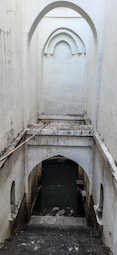
The entrance to the stepwell is within a temple compound, in which footwear must be removed. We visited the place on a Sunday morning in December 2023. A steady stream of worshippers of all ages entered the stepwell’s ground level entrance. As they descended the steps towards the water in the bottom of the vav, they sounded the temple bells suspended above the staircase. Before reaching the water, the steps pass two shrines each containing effigies of Hindu deities. At one of them, a lady in a beautiful sari was involved in a lengthy puja conducted by a priest. She was accompanied by a large-ish group of people. I noticed that some of them were holding on to her sari.
We squeezed past the group and descended further into the vav until we reached a railing from which we had a clear view of the water far below us. Several tortoises were resting on the step closest to the water in the well.
After admiring the beautifully maintained vav, we left the temple compound. Outside it, we spotted some beautiful cockerels wandering around. A few days earlier in Surat when we were visiting another temple dedicated to Mataji, we saw cockerels and were told that the goddess favoured these creatures. Above the entrance to the Bahucharaji Stepwell compound, there is a bas-relief depicting Mataji astride a cockerel.
As for Mataji, I will not try to explain her because, for me trying to explain anything about Hinduism is nearly impossible. All I can say is that for Hindus, it seems that their beliefs and rituals are simply a part of the rhythm of daily life, rather than something compartmentalised as is often the case for Europeans.
AFTER THE CITY of Ahmedabad was established in about 1420, Mahmud Begada, a Sultan of Gujarat, captured the city of Champaner (near Pavagadh) in 1482. He spent more than 20 years developing it and creating glorious buildings – some fabulous mosques, fortifications, city wall and gates, etc. He renamed the city Muhammabad.
The name ‘Champaner’ was given to the place in the 8th century AD to honour a general serving the Chavda dynasty that founded the city. I have not yet found out how long it was called Muhammabad, but it is no longer known by that name. Now, it is known as Champaner.
In 1535, the then Sultan of Gujarat, Bahadur Shah, fled the city just before it was defeated by the Mughals led by their emperor Humayun. Today, the city is in ruins, and has become a UNESCO World Heritage Site.
We had visited the site twice before, and revisited it a third time in November 2023. Prior to making this trip, we had been advised by a friend to see a ruined mosque located a short distance away from the rest of the ruins. To reach this, the Kamani Masjid, we hired an autorickshaw.
Ek Minar ki Masjid
The Kamani mosque is situated in a jungle away from the main road. We left the latter and drove along a dirt track through the dense vegetation. The sound of our vehicle’s engine disturbed a flock of grazing peacocks, who rushed away from us.
The Kamani Masjid stands in a clearing. It has lost its roof but the rows of pillars and arches that once supported it remain standing and are a beautiful sight. The decorative base of a minaret stands at one corner of this magnificent array of arches. This relatively unvisited ruined mosque is well worth visiting not only because of its beauty but also its peaceful location.
Our autorickshaw driver, realising our interest in historical buildings, suggested that we visit another mosque, which we had not seen before. Called the Ek Minar ki Masjid (ie ‘One Minaret Mosque’), it lives up to its name. Built in the 16th century, at the same time as other mediaeval mosque in Champaner, all that remains today is the large plinth on which it stood, a small fragment of wall, and a single intact minaret. The base of the minaret, like that at Kamani and other mosques built in that era, is decorated with geometric patterns. Standing alone, it is a splendid example of a 16th century minaret.
After seeing the two isolated Masjid, we visited the famous helical stepwell, which we had seen before. On previous visits, the water level had been low and we could see the full extent of the long staircase that spirals down the sides of the circular well. This latest visit we saw only the first few steps because the well was almost full.
Champaner and its archaeological ruins are one of many good reasons to visit Gujarat – a state in India, which does not attract its fair share of foreign visitors, unlike, for example Rajasthan, Goa, and Kerala.
KHWAJA SAFAR SULEMANI (1500 – 1546) was born in either Otranto or Brindisi. He entered life as a Christian, named Cosa Zaffar in Italian. But later, after being converted to Islam, his first name became Khwaja Safar. I have written about him before because his most likely heritage interests me. He is most likely to have been the son of Catholic Albanian parents, who fled to Italy to escape the Ottomans who had invaded what is now Albania.
Khundhavan Khan Rojo – a detail
Khwaja was captured by an Ottoman general at sea when he was 15. The Sultan in Istanbul was impressed by him. To cut a long and complicated story short, he was put in charge of vessels to attack the ships of the Portuguese, who were trying to monopolise trade between India and Europe. The Ottomans carried goods from India to places in their Empire on the coasts of Egypt and the Arabian peninsula. From there, they were carried overland to Europe. Their competitors, the Portuguese, carried goods from India to Portugal via the Cape of Good Hope, thereby bypassing transit through lands held by the Ottomans. This proved very damaging to the economy of the Ottomans.
During the Ottoman attack on the Portuguese colony of Diu (on the south coast of Saurashtra – part of modern Gujarat state), Khwaja, whose fighting skills were highly regarded by his opponents, was killed by a cannon ball near, or in Diu. Interestingly, the Portuguese, with whom he joined forces briefly before turning against them, erected a monument in his honour. It stands in Diu, and I have seen it.
And that summarises all I knew until we visited the superb museum housed in the restored fort of Surat. There, I learned that Khwaja’s body was brought from Diu to Surat, where it was buried.
After his burial, a mausoleum was built over his grave. Probably established by his eldest son, Rajab, this lovely edifice, called the Khudhavand Khan Rojo (or Rauza), contains architectural features typical of 15th century mosques in Ahmedabad. It includes structural elements that were influenced by Hindu and Jain temples. By the way, Khwaja became known as ‘Khudhavand Khan’, the title he was given when Sultan Mahmud III made him Governor of Surat.
I entered the domed mausoleum, which contains six gravestones, all covered, as is usual, with coloured cloths. None of these is the grave of the man who was born of Albanian parents in the south of Italy. His body lies somewhere beneath the mausoleum.
As is often the case when I visit India, I come across completely unexpected things. Although I had known about Khwaja’s death in Diu, it was a delightful surprise to come across his final resting place in Surat – a city across the sea from Diu, but not too distant from it.
At first sight, it seems ironic that Khwaja’s Albanian parents fled from the Ottomans, yet their son became prominent in the Ottoman Empire. However, it is not so strange. Many Albanian boys (including Skanderbeg) were abducted, or taken as hostages, by the Ottomans, and later both served in the empire’s army, some of them becoming high officials.







 yamey
yamey 