An advantage of wearing a hijab in an airport in a Gulf State

THINGS DID NOT BEGIN well for me when I arrived at Bangalore Airport’s recently opened Terminal 2 prior to boarding an Emirates airline flight to Dubai, where we were to catch another flight to London. We arrived at the airport in good time – before the check-in desks were open. After finding somewhere to sit, I walked to the Chaayos refreshment stall and asked for two cups of south Indian filter coffee. The server must have misheard me and only charged me for one. When this arrived instead of the two, I was expecting, I paid for another cup. While it was being made, I carried the first to my wife. I returned to the stall and picked up the second cup. It was filled to the brim, very hot, and the cup was poorly insulated. Just before I reached where we were sitting, my hand moved slightly, and the boiling hot coffee fell on my palm. This was extremely painful. I dropped the cup and the rest of its contents. I rushed to the washrooms, and after finding a tap that worked, I rinsed my palm in cold water. Meanwhile, my wife managed to get me some ice to put on the scalded part of my hand.
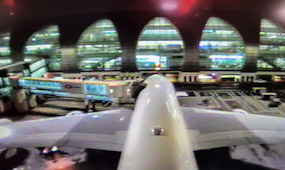
Dubai Airport

After dropping off our baggage and collecting boarding passes (printed on extremely thin paper), we headed for the security check. This involves divesting oneself of anything that contains metal before walking through a metal-detecting arch and then being frisked by a security official. Because the trousers I was wearing were too big, I had to keep one hand on them to stop them falling down. Meanwhile, I was somewhat shocked, and my hand was still smarting after the scalding.

After the frisking, I went over to the conveyor belt that carried our hand baggage and other items slowly through an x-ray machine. After rescuing both my wife’s and my own cabin baggage, telephones, wallets, coats, neck cushion, and my trouser belt, I secured my trousers with the latter. It was then that I realised that my boarding pass was nowhere to be seen. I was horrified – in so many decades of flying, I had never lost a boarding pass.

We reported the loss to the security supervisor – a female officer. She rang for an official from Emirates airline. While waiting for him to arrive, she said to my wife in Hindustani:
“He should not worry. They won’t leave him behind.”
After an agonising wait – actually, it was no longer than about 15 minutes – the official arrived. By then, I was feeling both anxious and extremely upset. The Emirates man explained that I would be issued a new boarding pass at the boarding gate. Not entirely happy with that, we left the security area, and headed for the departure lounges. On the way, we came across an empty baggage trolley, and began loading it with our carry-on bags and coats. As we were doing that, something fell to the ground – it was my missing boarding pass. In an instant my mood of melancholy and apprehension switched to one of immense happiness and relief. I rushed back to the security supervisor to tell her the good news. As the Emirates man was still around, I told him and shook his hand.

The flight to Dubai was pleasant. There was nothing to complain about. At Dubai, we had to pass through another security check. This time, I decided not to remove my belt before passing through the metal detector. Instead, I untucked my shirt and covered my belt with it. Despite there being a large metal buckle on the belt, the detector did not detect it. Nobody stopped me. Meanwhile, passengers’ hand baggage was passing through an x-ray machine so quickly that I doubt there was time to examine the series of x-ray images in any detail – if at all.
After enjoying exorbitantly expensive hot drinks, which I did not manage to spill, we entered a departure lounge dedicated to our flight to London. Before entering the lounge’s seating area, an official examined each passenger’s passport and boarding pass. Most passengers, including my wife and I, had to head for a line of trestle tables. By each of them there was a male or female security official. A few passengers were sent straight into the seating area, bypassing the tables.

The officials standing at the tables first searched the contents of bags – rather cursorily. Then, using an electronic wand, they frisked the passenger. After that, each passenger was asked to present their hands, palms facing upwards. An explosives detector sponge was rubbed on each palm, on the clothing, within the footwear (which had to be removed), on the mobile ‘phones, and other carry-on items. After placing the (re-usable) sponges in a machine, we were allowed to sit down and await the flight. My wife told me that the security lady who examined her was both rude and rough.

This process took quite a while. I sat watching it and gradually, I and my wife became aware of something curious. About a third of the passengers on our flight were women wearing hijabs (Muslim head coverings). This was not surprising in an airport in a Gulf State. What was astonishing was that not one of them had to be searched at the tables. They were allowed to board the flight without having been checked as thoroughly as the other passengers had been. Given that very recently, soldiers wearing hijab were able to enter a hospital in Gaza and attack it with firearms, was it wise to assume that because they were wearing hijab, the passengers on our flight to London were beyond suspicion, whereas all the other passengers – both male and female – needed to be regarded as potential terrorists?

The flight to London could not be faulted. And in case you are wondering, by the time we landed at Heathrow, my scalded palm was neither painful nor inflamed.

Breakfast with German food on a roof in Bangalore

PROPERTY ALONG LAVELLE Road in Bangalore (Bengaluru) is currently the most expensive real estate in the city. The thoroughfare was named in memory of the Irish soldier Michael Fitzgerald Lavelle (1831-1895), who discovered gold, and then established goldmines, at Kolar ), which is about 44 miles east of the centre of Bangalore (see, for example: http://www.advertiser.ie/mayo/article/130402/micky-lavelle-the-gold-king-of-kolar ).

One of the entrances to the Bangalore Club, where I often stay when in the city, is on Lavelle Road. Many a time have I walked from the Club along Lavelle Road towards the delightful Airlines Hotel open-air café. On the way, I pass a four-storey building with a narrow façade facing Lavelle Road. This side of the building has four small balconies. Today, it is an office block, but quite a few years ago, it was the home of Bangalore’s Max Mueller Bhavan (a German cultural centre – a branch of the Goethe Institut). This organisation first established its presence in Bangalore in 1960. It provides lessons in German language and culture, and also puts on events relating to German cultural life.

The building on Lavelle Road has a flat roof. When it housed the German cultural centre, there was a straw canopy covering the roof. Beneath the canopy, there were tables and chairs and a kitchen. This covered area was a restaurant, which was called ‘Café Max’. It served German food. The chef and manager of this eatery was an easy-going, informal, young German man. He served what was described as ‘German breakfasts’ every morning. These consisted of eggs and sausages accompanied by delicious German-style breads and cakes, which he and his team baked. Although we never partook of them, he also prepared lunches with dishes from the repertoire of the German cuisine. He had a bookshelf filled with cookbooks, and every morning he could be seen studying them before deciding the day’s menu. Although the restaurant on the roof was intended mainly for the use of people attending the centre for language courses, it was also open to ‘outsiders’ like me.

When it was located on Lavelle Road and withing a very short distance – two minutes’ walk – from the Bangalore Club, I attended several screenings of German films at the Max Mueller Bhavan. Now that the organisation has moved to Indiranagar, I visit it far less often. Every time I walk past the former Lavelle Road Max Mueller Bhavan, I look up towards its roof and remember the German ‘Früstücke’ I used to enjoy there.

An artist from Bengal and the freedom struggle of Mahatma Gandhi

BENGALI ARTIST NANDALAL Bose (1882-1966) was chosen as the artist to provide illustrations for the ceremonial manuscript of the Constitution of India. A few copies of these images are currently (January 2024) on display at Bangalore’s National Gallery of Modern Art (‘NGMA’).

Bose was part of an international group of artists who were endeavouring to revive classical Indian culture and art. Because of this, he came into contact with Japanese artists. Their painting techniques influenced the way Nandalal painted. This can be seen in many of his works on display at the NGMA in a temporary exhibition of a selection of his Haripura Panels, which is on until April 2024.

The ear cleaner at work

In 1938, the 51st session of the Indian National Congress was held in Haripura (now in Gujarat). Mahatma Gandhi asked Nandalal Bose to paint a series of panels depicting Indian village life in such a way that the images would be easily accessible to the common people (villagers etc.). Bose obliged, creating about 400 colourful paintings on handmade paper, using organic (rather than industrial) coloured paints. 77 of these are in the exhibition at Bangalore’s NGMA.

Each of the 77 panels is a delight to behold. They look as if they have been done quickly and highly competently by an artist with a decisive mind. On many if them, the influence of Japanese painting can be discerned. However, on every panel the subject matter is unmistakably Indian. Some of the panels depict scenes from village life (fir example, a potter at work, a tailor, wrestlers, making butter, etc) and others show animals and mythological scenes. One panel depicts an ear cleaner – a man is shown cleaning a lady’s ear with a long thin instrument. Villagers visiting the pandal (temporary shelter), which was decorated with these panels, would have had no trouble recognising Bose’s scenes of daily rural life. And political delegates would have been reminded of Gandhi’s professed allegiance to the ‘common’ people of India. Seeing these wonderful panels made me think of Socialist Realism images, but Bose’s paintings have a human touch that is lacking in politically inspired art such as Socialist Realism.

The exhibition at the NGMA is well hung and nicely lit. The panels hang in the galleries which were once rooms in the elegant Manikvelu Mansion. Several informative panels provide interesting information about Bose, his art and his association with Gandhi and his attempt to rid India of British domination.

Biryani in Bangalore, Calicut, and Surat

SO FAR – THAT is since January 1994, the very best biryani I have eaten was at Paragon in Calicut (Kerala) in 2006. It was a Moplah recipe – Arabic and Indian flavours combined most harmoniously. Last December, I enjoyed an almost as good biryani in the restaurant of the Sifat International Hotel in Surat (Gujarat).

Biryani at Bheema’s

When in Bangalore, where we find ourselves often, we like to visit Bheema’s restaurant on Church Street. It serves Andhra-style cuisine. I have never been disappointed with the biryani dishes served there. Although not as supremely superb as the two biryanis I have mentioned already, Bheema’s delicious biryanis are way above average – in my humble opinion.

An interesting exhibition of painting combined with photography: doctored images

THE MUSEUM OF ART and Photography (‘MAP’) on Kasturba Road is a relatively new addition to Bangalore’s cultural scene. When it opened in February 2023, we were amongst its first visitors. Privately financed by the Poddar family, it is housed in a recently constructed edifice. I prefer the appearance of its interior to that of its exterior.

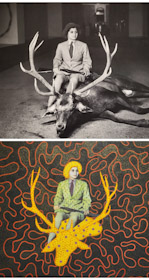
MAP describes itself as a museum of art and photography. The institution is home to a large collection of photographs created over the many years since the technique was invented. Much photography is in my opinion also art. However, the present exhibition at MAP, which is on until the 24th of March 2024, combines a traditional art form – painting – with photography. The show is called “What the camera didn’t see”.

The British born artist Alexander Gorlizki (born 1967) , who holds a higher degree from the Slade School of Art (at University College London) and now works in NYC, has teamed up with Pink City Studio – a group of miniaturist painters in Jaipur – to present historic photographs in a new light.

The exhibition at MAP consists of several old photographs from the museum’s collection and new reproductions or prints of these vintage images. Gorlizki and his colleagues have taken the reproductions and painted over them in the traditional Mughal miniature style, but leaving faces in the photographs uncovered by paint.

The resulting ‘doctored’ photographs are mostly quite whimsical and witty. The highly imaginative ideas of the artists are skilfully and beautifully superimposed on the reproductions of the old photographs. Thus, the art of the original photographers has been metamorphosed by contemporary painters in Jaipur in collaboration with their curator, Alexander Gorlizki. The results, which are on display at MAP, are both amusing and most pleasing aesthetically . This is an exhibition well worth seeing.

One Night at the Call Center and its author

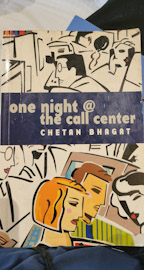
THE AUTHOR CHETAN Bhagat was born in 1974 in New Delhi. He was educated at two prestigious institutions: Indian Institute of Technology (Delhi) and the Indian Institute of Management (Ahmedabad). After graduating he had various jobs including working at the Hong Kong office of the bankers Goldman Sachs. There, he was unhappy with his boss, whom, according to Wikipedia, he:
“ … characterized the villain in his second novel One Night @ the Call Center.”

The novel about the call centre was first published in 2005. The villain is Bakshi, the head of a department of a call centre that services customers in the USA. As its title suggests, the book is about one night at the call centre and its main characters are five young people working under Bakshi. I will not give the plot away, but I can tell you that the story is both entertaining and, in parts, profound. All that I will reveal is that the problems that the five workers are experiencing and described in the novel become insignificant after they receive a telephobe call … from God. But, do not worry: the book is not a religious tract. The book deals with many things, including the perception that some young Indians have: that their country is inferior to the USA.

Chetan Bhagat is a highly creative and imaginative story teller. His plots are rich in unexpected twists and turns. He has a great eye for detail and a good understanding of the minds of young Indians and they way they perceive today’s world.

Recently, a couple of people suggested that Bhagat’s humour is inadvertent rather than intentional. I completely disagree with this point of view. He concocts humorous situations in his novels with great care and expertise, and inserts them in his stories skilfully. Like Chinese sweet and sour dishes, Bhagat’s novels contain a harmonious blend of humour and seriousness, both complementing each other intelligently.

What I particularly enjoy about Bhagat’s writing – and by now I have read four of his novels – is his easy-going narrative style. As I read his books, I felt as if he was a good friend sitting and chatting with me in a bar or cafe. His books are easy to read yet full of profound observations about life, expressed effectively but with a light touch.

MY FAVOURITE VISITOR ATTRACTION IN BANGALORE

IF YOU HAVE ONLY a short time to look at Bangalore, there is one place that you must try not to miss. I am not referring to Tipu’s summer palace or the Bull Temple or Lalbagh Garden or Cubbon Park or many of the other oft-mentioned places in the city. My first choice of ‘must-see’ places is the Bangalore NGMA (National Gallery of Modern Art), which is located on Palace Road.

Manikvelu Mansion

The NGMA opened its doors to the public in February 2009. It is housed in the elegant former Manikvelu Mansion and the beautiful modern extensions that have been added to it in such a way that the beauty of the old building has not been impaired.

The NGMA stands Inn spacious grounds with a landscaped garden. Within the garden, there are modern sculptures – part of the NGMA’s permanent collection.

The modern extensions contain galleries for displaying artworks, a shop, an auditorium, a library and a very pleasant café under a deep veranda. Even if you have little interest in seeing artworks, the harmonious ensemble of architectural styles is well worth seeing.

The galleries, located both in the old mansion and on the new extensions, are well lit and vary in size. Usually, some of the permanent collection is displayed as well as an often fascinating temporary exhibition. Currently (January 2024), there is a wonderful temporary exhibition of paintings by the Bengali artist Nandalal Bose – I will write about that soon.

Situated not far from bustling Shivajinagar and busy Cunningham Road, the NGMA is a peaceful haven – a place to enjoy some of the best of modern Indian art. In a city where so many modern developments are of dubious aesthetic value, the NGMA on Palace Road is a feast for the eyes.

One Uber or two at a club in Bangalore

WE NEEDED TO TRAVEL in an Uber cab from Bangalore’s Catholic Club to the Bangalore Club – not far, but we had heavy baggage. A uniformed security guard kindly agreed to book a cab. He was, he told us, from Assam – a member of the large Assamese Bodo community.

Before he ordered the taxi, he looked at us – a European man and an Indian lady, and asked us if we needed one car or two. My wife explained that we are married, and only needed one car.

I believe that the reason the guard asked us how many cars we required was that, coming from a traditional community at the Eastern edge of India, it must have seemed unlikely to him that people from totally different communities, such as my wife and I, would ever become joined in matrimony.

I was struck by his enquiry because when we have travelled in many parts of Gujarat, people have often expressed surprise, and even disbelief, when they learn that a ‘desi’ (Indian) woman has married a ‘gora’ (pale coloured) such as I am. I have described this kind of incredulity in great detail in my book about travelling in India: “The Hitler Lock and Other Tales of India”, which is available from Amazon:
https://www.amazon.co.uk/HITLER-LOCK-OTHER-TALES-INDIA/dp/B0CFM5JNX5/

AT THE CLOSE OF A JOYFUL DAY HANGING IN BANGALORE AND A MYSTERY

UNTIL RECENTLY, PHOTOGRAPHY was not permitted in the Bangalore branch of the NGMA (National Gallery of Modern Art). On a recent visit in January 2024, we discovered that photography was now permissible.

I have been visiting the NGMA regularly since it first opened a few years ago (2009). Each time I have been, with one exception, I have noticed a painting by Lawrence Alma-Tadema (1836-1912). It depicts a lady leaning over a parapet beside a lake with mountains in the distance. It bears the title “At the Close of a Joyful Day”. It is currently hanging on a wall beside several portrait paintings by a Parsi artist named Pithawala. I have always wondered how this painting by Alma-Tadema has ended up as part of the collection of India’s NGMA.

According to an article published in “American Art News” (New York, 25th of April 1908), the painting had been the part of the “Coghill collection” and had sold at London’s Christie’s auction house for £966. The purchaser was not mentioned. I have not yet discovered anything relevant about the above-mentioned collection.

In connection with the sale of a painting by Alma-Tadema in 2019, the Sotheby’s auction house website mentions a letter that Alma-Tadema wrote in 1894 to the German egyptologist George Ebers. Here is an interesting excerpt from the website:

“… Alma-Tadema commented of one of his compositions, “It is a single figure girl, which has ascended to the highest point of a building to see far away out of the picture over some sort of Starnberger See, a second use of the study I painted when with you mingled with recollections… so you see my mind is still often with the dear friend at Tutzing” (letter from Alma-Tadema to Ebers, December 29, 1893, as quoted in Swanson, p. 77). While he is referring to ‘At the close of a joyful day’ (1894 …), the artist could just as easily be describing the mis-en-scene of the present work.” (That is the work in the auction.)
This essay, published to accompany an auction held in New York in February 2019, mentioned that “the current location [of ‘At the Close of a Joyful Day’] is unknown”.

Well, at least, I know where to find it.

What I would really like to know is how the painting reached India. Who owned it after it was sold in 1909, and how did it end up in the NGMA collection.

[The painting’s NGMA accession number is 02186]