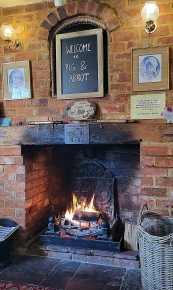
A warm welcome
Awaits the hungry visitor
At this rustic pub
Pig and Abbot pub, High St, Abington Pigotts, Royston SG8 0SD

A warm welcome
Awaits the hungry visitor
At this rustic pub
Pig and Abbot pub, High St, Abington Pigotts, Royston SG8 0SD
THE BRITISH MUSEUM is chock-full of exciting exhibits. To view them all would take many months, if not years. During a recent visit in March 2014, we were heading through the museum on our way to view a special exhibition of drawings and prints by four post-WW2 German and Austrian artists when we passed a painting that caught my eye. The exhibition was fascinating but not as much as the painting we passed as we were heading towards it.

The colourful painting (oil on cloth) was created in Ethiopia sometime between 1940 and 1949. So, by the British Museum’s standards it is relatively modern. The picture depicts two large armies facing each other. On the left side of the image, we can see the Ethiopian forces, and they are facing the Italians on the right side. Between the two armies, there are several dead or injured combatants. And amongst this carnage, there are two armed men on horses – they are riding towards the Italians. The faces of the Ethiopians are not all the same in appearance, whereas there is almost no variation of the faces of their Italian opponents.
Although it was painted in the 1940s, the picture illustrates the Battle of Adwa, which raged on the 1st of March 1896. The Ethiopians defeated the Italians. By the end of the 19th century, most of Africa had been invaded and occupied by various European nations. The exceptions were Liberia and Ethiopia. In 1889, Italy, having occupied to coastal territory of Eritrea, signed a treaty with King Menelik of Shewa. It was signed in Italian and translated into Amharic. The Italian version made Ethiopia a protectorate of Italy – virtually, an Italian colony. However, the Amharic version read differently – it agreed that the Ethiopians could use the ‘good offices’ of the Italians in their relations with foreign powers, if they wished.
The Italians decided to go to war with the Ethiopians to enforce the Italian version of the treaty. The Battle of Adwa put an end to the treaty with the Italians, who then recognised Ethiopia as an independent state. This situation lasted until the 1930s when Mussolini decided to invade the country.
In the painting at the British Museum, Emperor Menelik II of Ethiopia is depicted in the top left corner in his royal crown. In the bottom left of the painting, seated on a horse, and surrounded by Ethiopian soldiers, sits Empress Taitu of Ethiopia. Look carefully, and you can see that this veiled lady is holding a large revolver.
The painting is in a short corridor, which also has exhibits relating to the Copts of Egypt. As the painting fascinated me so much, I took little notice of the exhibits near to it. So, as if one needs one, yet another reason to revisit the British Museum.
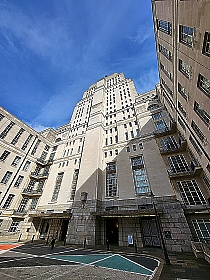
Senate House in London’s Bloomsbury was designed in the Art Deco style by Charles Holden (1875-1960), who also designed many buildings for the London Underground including quite a few stations on the Piccadilly Line. It was once, London’s tallest building.
Senate House was built between 1932 and 1937, and is the administrative centre of the University of London. Currently, there is a small exhibition about the planning of the building on the first floor.
MY MOTHER WAS ANXIOUS about water. Because I do not think that she could swim, I believe that she considered it very important that I should learn how to propel myself through water. As a result, my parents paid for me to have many private swimming lessons (usually on Saturday mornings) – most of them were a waste of their hard-earned money. I was a slow learner because I was frightened by the thought that I might sink and drown.
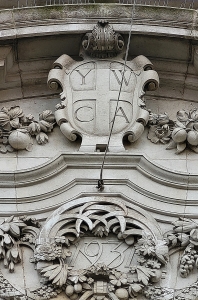
Today (the 4th of March 2024), we were walking from Tottenham Court Road Underground station to the British Museum via Great Russell Street. Along that thoroughfare, we passed a pre-WW2 brick building, which now houses the luxurious Bloomsbury Hotel. If you look above its main entrance, you can see carved stone masonry that indicates that the building, completed in 1933, was once a branch of the YWCA – it was The YWCA Central Club. The architect was Sir Edwin Lutyens of Hampstead Garden Suburb and New Delhi fame. It remained a YWCA until the 1970s, then became a hostel, and now it has been converted into its present reincarnation. While the building served as the YWCA it had a swimming pool in its basement. It was in this pool that I finally learned to swim – I was about 12 years old.
The Saturday morning classes were conducted by a Mr Brickett. Each of his pupils began by buying a set of his inflatable arm bands, which were worn on the upper halves of the student’s arms. Each lesson, Mr Brickett inflated the arm bands, and using these, we swam (or made our way) across the width of the pool – without letting our feet touch the bottom. On each successive lesson, Mr Brickett inflated the armbands less than on the previous lesson. Eventually, we were making our way across the pool with uninflated armbands. When we could do this, we had to swim one width (about 10 yards) without the armbands, and then we were given a fancy certificate with a Union Jack printed on it.
I have only just learned that Mr Brickett, who taught me how to swim, was Reg Brickett, who, along with his brother Sidney, was a founder member and then President of the Swimming Teachers Association of Great Britain. Reg was the inventor of the arm bands, which were sold as ‘Brickett’s Swim Easy arm floats’ (www.playingpasts.co.uk/articles/swimming/the-valuable-and-unremitting-services-of-swimming-coach-walter-brickett/). Reg and his brother were sons of the famous British Olympic swimming coach Walter Septimus Brickett (1865-1933). He was responsible for training over 100 British swimming champions. Well, I did not know any of this when I was awarded my (now sadly lost) certificate.
We entered the attractive lobby of the Bloomsbury to ask about the pool. The pool is no longer in use, but still exists. It has been covered by a floor, and the room that housed it has been redecorated, and is now used to host functions and meetings. Although I swim extremely rarely, I do not think that I will ever forget my lessons with Mr Brickett at what was once the YWCA.
GOLDERS HILL PARK lies halfway between Golders Green and Hampstead – both in north London. It occupies what used to be the extensive grounds of a former country house that was built in the 18th century and destroyed during WW2 (in 1940). Its fine landscaping was influenced by the great garden designer Humphry Repton (1752-1818). I have been visiting the park since my early childhood in the 1950s, when, if I remember correctly, my parents used to play tennis on the still existing tennis courts. The park has many attractions including a pond with an attractive stone bridge; a walled garden; many fine old trees; plenty of shrubs and flowers; a bandstand, which was certainly in use during my childhood; a good café-cum-restaurant; a wooded area; a stumpery; a deer enclosure; and a small zoo. The deer enclosure and the zoo were in existence when I was a young child. Today’s visitors can watch the deer and view animals such as wallabies; ring tailed lemurs; at least one kookaburra; donkeys; and a variety of exotic birds. The pond mentioned above is often visited by ducks.

Today (the 3rd of March 2024), we visited the park on a crisp, cold, sunny morning. The dew-covered lawns were full of blooming crocuses, and some of the bushes had burst into flower. Most of the trees, being deciduous, were devoid of leaves. By chance, I looked up at one of these leafless trees and saw a children’s kite caught up in its branches. Seeing this, my thoughts shifted 5000 miles from Golders Hill to Gujarat (in western India).
Wherever you go in Gujarat, you are likely to see kites caught up in the branches of trees. Unlike the kite I saw today, those in Gujarat are not the toys of small children, but part of a festival celebrated once a year, The Hindu festival, which celebrates the increase of day length a month after the winter solstice is known as ‘Uttarayan’ in Gujarat. The occasion is celebrated by kite flying. During this period of kite flying, riders of bicycles, motorcycles, and other two-wheelers face a real but, to the outsider, unusual hazard that could result in serious injury, if not death. I have described this festival and its hazards in some detail in my anthology of 101 vignettes of life and travel in India –“The Hitler Lock and Other Tales of India”.
Seeing the kite in Golders Hill Park reminded me of what I have seen in Gujarat during my several visits to that Indian state. However, although this year Uttarayan began on the 15th of January – not so long ago – I find it hard to believe that the kite I saw in the park was stranded in the tree during celebration of that festival.
[The book (& Kindle) is available from Amazon:

A large volume
With well over nine hundred leaves
It’s great fun to read
HUMOUR, IMAGINATION, PLAYFULNESS, wit, social criticism, and creativity – these are all words that can be applied to the works of the artist Peter Blake, which are on show in a superb exhibition at the Waddington Custot gallery in London’s Cork Street until the 13th of April 2024.
Blake was born in 1932 in Dartford (Kent). He studied art at Gravesend Technical College, and then at the Royal College of Art in Kensington. He is a leading British exponent of Pop Art, which, according to Wikipedia:
“… is an art movement that emerged in the United Kingdom and the United States during the mid- to late-1950s.The movement presented a challenge to traditions of fine art by including imagery from popular and mass culture, such as advertising, comic books and mundane mass-produced objects. One of its aims is to use images of popular culture in art, emphasizing the banal or kitschy elements of any culture, most often through the use of irony.”
One of Blake’s most familiar works is the album sleeve for the Beatle’s LP “Sgt. Pepper’s Lonely Hearts Club Band”, which he designed along with Jann Haworth, his wife between 1963 and 1979. I wonder how many Beatle’s fans know that Blake was involved with making the image on this.
The exhibition at Waddington Custot is dedicated to Blake’s sculptural works. There has not been one during the last 20 years. Although there are many of his sculptures in the gallery’s three interconnecting rooms, many of his ingeniously witty collages are also on display. Employing images from comics, old books, and other printed matter, these collages are so carefully assembled that unless one looks at them closely and extremely obliquely, it is difficult to realise that these artefacts are not prints but collages.
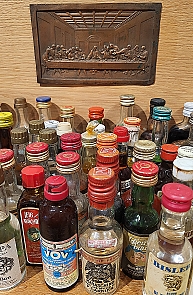
The sculptures are with only a very few exceptions, wonderful assemblages or tableaux constructed with found objects. For example, one of these is a shelf overloaded with miniature booze bottles, all positioned beneath a miniature image of Leonardo da Vinci’s depiction of the Last Supper. There are several model sailing boats, on which Blake has placed plastic models (toys) of people expressing a range of behaviours. Other sculptural assemblies are more complex and need to be seen rather than described. I mentioned ‘exceptions’ at the beginning of this paragraph. This refers to four objects – they look like large stones (one of which is a carved stone head) – which Blake called “Found Sculpture”. Each of these is mounted on its own plinth. By doing so, the artist has ‘elevated’ these natural objects to the status of ‘fine art’, and as the gallery’s hand-out said, they challenge:
“… conventional notions of artistic materials …”
I loved the exhibition. Every exhibit is both interesting and beautiful … and great fun. As the show’s hand-out correctly stated, Blake’s sculptures are:
“… by turns quirky, endearing or engaged with conceptual concerns.”
His creations:
“… offer starting points for imagined narratives, each with a glimmer of Blake’s typically gentle, English sense of humour.”
And this is quite correct. Skilfully conceived and executed, Blake’s works provide nourishment for both the eye and brain in a delightfully digestible form. If you view the exhibition with an open state of mind, you are bound to gain great enjoyment from it.
DURING THE 1970s and 1980s, we used to make visits to a restaurant in north London’s Willesden Lane. Founded in 1964 and specialising in South Indian cuisine, it was called Vijay. It still exists at the same address. Out of curiosity and ‘for old times’ sake’, we paid it a visit last night (the 29th of February 2024).
Entering Vijay was like stepping back in time. It was uncanny; nothing seemed to have changed. The walls are still lined with raffia work panelling, the wooden Kerala-style ceiling, and the pictures on the wall (mostly colourful depictions of Hindu deities) looked exactly as we remembered. Naturally, none of the staff were recognizable.
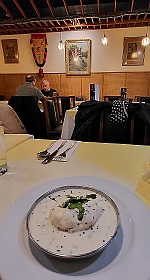
Back in the ‘70s and ‘80s, we used to eat at Vijay to enjoy South Indian dishes that were not easy to find elsewhere in London. If I remember correctly, in those days Vijay only had this kind of food on its menu. Today, the menu still has South Indian dishes, but also many offerings of food that is definitely not typical of South India. It offers a wide selection of North Indian dishes – such as most British people would hope to find in an ‘Indian restaurant’. One of the hors d’oeuvres, which you would never find on India, but is common in British Indian restaurants is fried pappads (poppadums) served with a tray of chutneys and pickles to accompany them, Vijay now offers this. Probably, Vijay has added North Indian dishes to their menu because, for many potential customers, South Indian dishes are far less familiar.
Yesterday, we ordered a few dishes. They were enjoyable enough but not outstanding, However, it was great fun sitting in a place that had hardly changed since we last visited it at least 30 years ago.
I DO NOT KNOW whether it was deliberate or accidental that currently (until the 7th of April 2024) there are two contrasting (or, maybe, complementary) exhibitions on in the galleries of London’s Tate Britain.
On the first floor, there is an exhibition called “Sargent and Fashion”. It is a collection of paintings by the American-born artist John Singer Sargent (1856-1925), who was born in Florence (Italy) and died in London (UK). The aim of the show is, according to the Tate’s website, to show:
“… how this remarkable painter used fashion to create portraits of the time, which still captivate today.”
The exhibition includes some of Sargent’s portraits alongside a few of the items of clothing that his subjects wore whilst he was creating their portraits. In this well laid out show, the viewer gets to see that Sargent was an excellent painter, whose portraits manage to radiate the natures of the sitters’ personalities. I doubt that most of Sargent’s subjects would have been disappointed with the pictures he produced for them. Many of the paintings are portraits of women. Almost all of them were depicted wearing elegant clothes, and are superbly executed conventional portraits. They celebrate aspects of the ‘respectable’ (i.e., wealthy) society of his times.

Beneath the Sargent exhibition, on the ground floor of Tate Britain, there is an exhibition showing how women in Britain broke out of their conventional male-dominated lifestyle during the 1970s and 1980s. Called “WOMEN IN REVOLT Art, Activism and the Women’s movement in the UK 1970–1990”, it is according to the Tate’s website, it is:
“… a wide-ranging exploration of feminist art by over 100 women artists working in the UK. It shines a spotlight on how networks of women used radical ideas and rebellious methods to make an invaluable contribution to British culture. Their art helped fuel the women’s liberation movement during a period of significant social, economic and political change.”
During a long part of the period covered by the show, Britain had its first female Prime Minister, Margaret Thatcher (in office from 1979-1990). Although she fought her way through hitherto male bastions to emerge as the country’s first lady Prime Minister and showed what women were capable of doing in the world of politics, she was not a feminist icon, as Natasha Walter wrote in The Guardian (online 5th of January 2012):
“Obviously Thatcher was no feminist: she had no interest in social equality, she knew nothing of female solidarity … We should never forget her destructive policies or sanitise her corrosive legacy. But nor should we deny the fact that as the outsider who pushed her way inside, as the woman in a man’s world, she was a towering rebuke to those who believe women are unsuited to the pursuit and enjoyment of power. Girls who grew up when she was running the country were able to imagine leadership as a female quality in a way that girls today struggle to do. And for that reason she is still a figure that feminists would be unwise to dismiss.”
However, as Baroness Burt of Solihull said in the House of Lords on the 5th of February 2018:
“… my next figure is 1979, which, of course, was the date when we got our first female Prime Minister. Personally, I would feel more inclined to celebrate this milestone if she had encouraged other women to come forward, to use some of the talented women that she had at her disposal. But, sadly, she got to the top and pulled the ladder up behind her, which is a great shame, because the whole point of having representation from all parts of society is to make for better government.”
As several exhibits on display at the Tate (until the show ends on the 7th of April 2024), Mrs Thatcher was intensely disliked by artists encouraging ‘female liberation’.
Before entering the exhibition, I was a little worried that all I would see was propaganda and other polemic material. Well, there was plenty of that kind of thing, and much of it was both interesting and often visually intriguing – sometimes quite witty. The exhibition, which is excellently curated, also includes many paintings, sculptures, videos, and other artistic items. These have mostly been created by female artists with whom I am not familiar. And all of them are both visually engaging and satisfying. Several of these were of Indian heritage, and others have ‘black’ African heritage. There are also cases containing printed material that propagated feminist ideas. Included amongst these were a few copies of the magazine Spare Rib, which I remember seeing at friends’ houses many years ago. My future wife was one its readers. Published between 1973 and 1993, its aim was to challenge the traditional roles of females (of all ages) and to explore new ways in which they could engage in society. In fact, this was the aim of many – if not all – of the works in the exhibition.
We visited both exhibitions today (the 28th of February 2024), to experience the contrast between them. Both are excellent in their own ways and achieve what the curators intended. They are both well worth visiting. However, to my taste, the exhibition on the ground floor was far more exhilarating and inspiring, that the more conventional show on the floor above it.
HAMPSTEAD IS RICH in historical curiosities. One of them is an unexceptional little road that has an interesting story.
Just south of Tesco’s supermarket (the former Express Dairy) on Hampstead’s Heath Street there is a narrow cul-de-sac called Yorkshire Grey Place. It enters Heath Street across the road from The Horseshoe pub and Oriel Place. I have often wondered about this short, uninviting blind-ended lane and its history. Just under 50 yards in length, it runs west from Heath Street.

At long last, I began looking on the Internet for some history (if any) of this bleak little roadway lined on both sides with high buildings. It gets its name from a pub that used to exist near it – The Yorkshire Grey. The pub was already in existence by 1723, but was demolished in the 1880s (https://londonwiki.co.uk/Middlesex/Hampstead/YorkshireGrey.shtml) – in 1886, according to FE Baines in his “Records of Hampstead” (publ. 1890). An online history of Hampstead (www.british-history.ac.uk/vch/middx/vol9/pp15-33) provided the following information about the pub and its surroundings:
“North of Church Row the Yorkshire Grey had been built by 1723 and cottages called Evans Row probably faced it c. 1730. In 1757 the inn and 14 houses occupied by a brickmaker, clockmaker, carpenter, apothecary, and others were ‘late freehold’ but in 1762 they were described as copyhold (one alehouse, two houses, and 11 cottages).”
This area was one of the slums of Hampstead – it was devoid of water supply and drainage.
During the planning and construction of Fitzjohns Avenue, which began in 1875 and was only completed by about 1887, there was some discussion about whether it should end on the High Street or give direct access to the road up to Hampstead Heath. Prior to the late 1880s, the recently built Avenue stopped south of Hampstead village. Its route from there into the centre of Hampstead village was subject to some controversy. This was described in “Hampstead, Building a Borough 1650-1964” by FML Thomson, as follows:
“… The shopkeepers in the High Street feared loss of trade if any traffic was diverted to a new route, and held out for a scheme which would debouch Fitzjohn’s Avenue into High Street at the King William IV ; while the gentry wanted the direct route to Heath Street and the Heath, arguing that this gave a bit of slum clearance of Bradley’s Buildings, Yorkshire Grey Yard, and Bakers’ Row as a bonus. The dissension continued when the scheme was revived with a number of public meetings in 1881, dominated by the gentry element which was increasingly exasperated at having its carriages bottled up in Fitzjohn’s Avenue without any proper exit.”
As it turned out, the “gentry element” had their way, and the slum clearance that affected Yorkshire Grey Yard was carried out – the pub disappeared as a result. In relation to this, the online history of Hampstead, already quoted revealed:
“In 1883 the Metropolitan Street Improvement Act authorized redevelopment of the whole area at the joint expense of the local authority and M.B.W. In 1888 High Street was widened, Fitzjohn’s Avenue (then Greenhill Road) was extended to meet Heath Street, and soon afterwards Crockett’s Court, Bradley’s Buildings, and other slums, including Oriel House and other tenemented houses, were replaced by Oriel Place, shops, and tenement blocks.”
The pub has long gone, but I managed to find two pictures depicting it. One is a painting showing the place in about 1863 (https://artuk.org/discover/artists/lester-harry). It was the work of Harry Lester. The other is a black and white photograph in the book by FE Baines, which was published a year after the pub was demolished. A detailed map surveyed in 1868 showed that the pub was quite a large building with a substantial yard next to its east facing façade. To its west, the yard opened on Little Church Row (now part of Heath Street). This and a blind-ending road called Yorkshire Grey Yard are shown on the map. Immediately south of the pub, there was another cul-de-sac running from east to west – it was unnamed. I believe that this is what is now called Yorkshire Grey Place.
The map drawn in 1868 shows the layout of the area around today’s branch of Tescos before Fitzjohn’s Avenue was conceived. Another map drawn in 1915 shows how the topography of the area changed following the completion of the Avenue. The Yorkshire Grey pub existed before the nearby, still existing, Horseshoe pub was established – it appears on the 1915 map. Originally named ‘The Three Horseshoes’, it moved from Hampstead High Street to its present address in 1890. Had the Yorkshire Grey pub survived, it would have been about 110 feet away from the Horseshoe.
Once again, wondering what is in a name – in this case Yorkshire Grey Place – has opened my eyes to an interesting bit of the history of Hampstead. Finally, it is interesting to note that the Victorian building that houses Tesco’s was built in 1889 – three years after the Yorkshire Grey pub was demolished to make way for buildings along the northern continuation of Fitzjohns Avenue. So, next time you are queuing to pay in Hampstead’s Tesco, remember that you are standing on land where once the patrons of the Yorkshire Grey once trod.
You can read much more about Hampstead and its surroundings in my book, which is available from Amazon:
https://www.amazon.com/BENEATH-WIDE-SKY-HAMPSTEAD-ENVIRONS/dp/B09R2WRK92/
 yamey
yamey 