Aphrodite and a spring

LONDON’S PARKS ARE filled with surprises of historical interest. The Terrace Gardens overlooking a bend in the River Thames at Richmond are no exception. A short path leads from a larger one to a cave in the side of a well vegetated slope. The entrance to the cave is topped with a semi-circular arch and its is closed by a locked iron gate. There is little to be seen inside the small cave. The pathway leading to the entrance is lined by barrel shaped concrete blocks

An informative plaque at the start of the path explains the history of this small, rather well-concealed cave, now known as Spring Well. From this we learn that the cave, formerly believed to have been an icehouse, was part of Richmond Wells. The latter were:

“…a place of entertainment from 1690 to 1750. In 1755, the buildings were demolished and replaced by Cardigan House as a residence for the sixth Earl of Cardigan.” (https://historicengland.org.uk/listing/the-list/list-entry/1001551).

The Wells were closed because local residents felt that they attracted rowdy and badly behaved visitors.

Cardigan House was purchased by John Willis (1820-1899) in the 19th century. Willis was the proprietor of a shipping company, John Willis & Sons of London, which owned several clippers. One of these boats, a tea clipper, can still be seen in its full glory downstream from Richmond at Greenwich: The Cutty Sark, visited by many tourists. The barrel shaped concrete blocks near the entrance to the cave are possibly, according to the information panel nearby, moulded from barrels carried by the Cutty Sark. I like the idea, but who knows whether this was really the case after such a long time.

Near to the now disused spring, another surprise awaits the visitor. It is a sculpture of a voluptuous naked woman seated on a dolphin. Carved in Portland stone in 1952 by Allan Howe, she depicts the goddess Aphrodite (‘Venus’ in Latin). From her seat on the dolphin, the goddess has a wonderful view of the Thames far below her. When she was unveiled, many locals regarded her as being in ‘bad taste’, but she has survived the test of time and is perfectly acceptable nowadays.  A statue of Aphrodite might not be regarded as a great surprise in a park, but the local people’s name for here, ‘Bulbous Betty’, might be.

A bridge near Regents Park

PARKWAY LEADS GENTLY uphill from Camden Town Underground station to a short road called Gloucester Gate, which leads to the Outer Circle that runs around Regents Park. Much of Gloucester Terrace runs along what looks like a bridge, which is lined on its north side by red-coloured, decorative stone parapet.

St Pancras, Regents Park, London

The bridge traverses a grassy dell that does not appear to contain any kind of watercourse. I wondered why such an elaborate bridge had been built to traverse what appears to be merely a grassy hollow. Well, when it was built, it did cross a waterway, the Cumberland Market Branch of the Regent’s Canal  known as ‘The Cumberland Arm’ (www.londonslostrivers.com/cumberland-arm.html). This waterway, built in 1816, ran for about half a mile from the Regents Canal to a basin near Euston Station, running for most of its length parallel to Albany Street. During WW2, the Cumberland Arm, which had up until then been used to transport freight, was used to supply water to firefighting appliances. By the end of the war, the canal had been filled with rubble from buildings destroyed by bombing and then covered with topsoil. All that remains of the Cumberland Arm is a short blind-ending stretch of water near Regents Park Road, on which there is a large floating Chinese restaurant and a few moorings for narrow boats.

The Gloucester Gate bridge with its decorative parapet and elaborate cast-iron lampstands also includes two interesting memorials. One of these relates to the fact that the bridge was constructed by the St Pancras Vestry, the then local authority governing the area (www.andrewwhitehead.net/blog/the-most-pointless-bridge-in-london). There is a bronze bas-relief depicting the martyrdom of St Pancras. It was a gift of William Thornton and sculpted by the Italian Ceccardo Egidio Fucigna (c1836-1884), who died in London. St Pancras (c289-303/4) was born a Roman citizen. He converted to Christianity and was beheaded for his beliefs when he was 14 years old (https://en.wikipedia.org/wiki/Pancras_of_Rome). The bronze relief on Gloucester Gate bridge shows a young man being mauled by an animal, possibly a lion. Why this motif was chosen when the saint was beheaded puzzles me.

Near the St Pancras panel, also on the bridge, there is an old but elaborate drinking fountain. A metal plate attached to it has faded letters that read:

“Saint Pancras Middlesex.

This fountain and works connected therewith were presented to the Metropolitan Drinking Fountain Association on the (?) day of August 1878 by

Matilda

Richard Kent esq. Junior Churchwarden 1878.

The figure … cast in bronze was designed by Joseph Durham ARA.” (https://victorianweb.org/sculpture/durham/1c.html)

The fountain, known as ‘The Matilda Fountain’, is part of a miniature cave made with granite boulders. A sculpture of a milkmaid stands above the cave. At her feet, there is a wooden pail with two handles. The girl with a rich crop of hair on her head is depicted shielding her eyes from the sun with her right hand as she stares into the distance. Cast in bronze, the female figure and the pail were sculpted by Joseph Durham (1814-1877). Matilda might possibly have been Richard Kent’s wife, but the plaque does not specify this. The sculpture is not unique; several other copies of it, all by Durham, exist. One of these, dated 1867 and called “At the Spring/Early Morn”, can be seen in Blackburn’s Town Hall (https://victorianweb.org/sculpture/durham/1d.html).

Today, the bridge is redundant since the canal was filled-in long ago. However, it is used by many people walking to and from Regents Park and its zoo and a steady stream of vehicular traffic crosses it. Although it has outlived its original purpose, the bridge serves as a reminder of a once important element of London’s continuously evolving transportation system.

In the footsteps of Mahatma Gandhi

RECENTLY, I WALKED in Mahatma Gandhi’s footsteps, neither in India nor in South Africa nor in London, but in southeast England.

I am sure that many years ago, at least once, I travelled by ferry across the English Channel from Folkestone in Kent to a port in France. Whether I was travelling by car or by train I cannot recall. Had I been travelling by rail I feel sure that I would have remembered the pier at Folkestone, but I cannot now recall it. If I reached the ferry by train, it would have had to have been before 2001, when the last ferry sailed from Folkestone.

The first ferry service from Folkestone to Boulogne began in 1843 (https://folkestoneharbourarm.co.uk/history/the-harbour-in-the-19th-century/). Passengers reached the boat from the mainline railway station by local transport. In 1847, a long viaduct was constructed to take a steeply inclined mile long branch line from the main line, which was 111 feet above sea level, to the shoreline. This track crossed the viaduct and a swing bridge, which still exist and separate the Inner harbour from the Outer Harbour. At the seashore, the track ran onto a newly constructed pier, The Harbour Arm, from which passengers and freight could be embarked and disembarked. The pier, which was only fully completed in 1904, had a station, a customs house, and warehousing facilities.

During WW1, the Harbour Arm played an important role in the conveyance of military personnel and materials between war-torn Europe and the UK. In December 1915, the famous spy Margaretha Geertruida Zelle (‘Mata Hari’; 1876-1917) was prevented from boarding a vessel at Folestone bound for France by Captain S Dillon of the Secret Intelligence Service. Another famous person, of far greater historical significance than Mata Hari, stepped of a vessel, the SS Biarritz, onto the Harbour Arm on the 12th of September 1931. This passenger was a Gujarati, the only member of the Indian National Congress, Mohandas K Gandhi (1869-1948), going to London to attend the Round Table Conference. A picture taken at the time (www.alamy.com/mahatma-gandhi-alighting-at-folkestone-kent-england-united-kingdom-uk-12-september-1931-old-vintage-1900s-picture-image346793736.html) shows him, dressed in white robes and a dhoti, stepping along a gangplank. The curved platform of the station on the pier, which still exists, is clearly visible in the picture. He is shown walking towards a group of policemen and reporters, some of whom are holding unfurled umbrellas. His arrival at Folkestone on a rainy day is also recorded in a short but amusingly commentated newsreel film (https://youtu.be/P6njRwz_dMw), which also illustrates the rapturous reception he received in the streets of London.

Far more recently, another arrival at Folkestone has hit the headlines. On the 19th of October 2021, a large puppet called Little Amal (‘amal’ meaning ‘hope’ in Arabic), over ten feet in height, first made its appearance in the UK in Folkestone. Little Amal has been carried on foot all the way across Europe from Turkey (www.creativefolkestone.org.uk/whats-on/the-walk-one-little-girl-one-big-hope/) as part of an exercise to raise the public awareness of the plights of refugee children fleeing their native lands. On British soil, she plans to tour the country for a while. Little Amal did not arrive, as Gandhi did, on a cross-channel ferry bound for Folkestone, but she did make her first an appearance on the Harbour Arm (www.kentonline.co.uk/folkestone/news/little-amal-coming-to-town-255932/). She was greeted by the actor Jude Law.

Folkestone harbour was heavily bombed during WW2 and then the pier was repaired after the war ended. Passenger services to France resumed in 1946, but limitations of the harbour’s depth, which prevented the docking of larger ferries, and the development of roll, on roll-off ports elsewhere, led to Folkestone’s gradual decline as a port. These factors and the completion of the nearby Channel Tunnel resulted in the ending of Folkestone’s life as a passenger port by 2000. After this date, the Harbour Arm and its buildings fell into decline and became dilapidated.

In 2014, the Department of Transport closed the railway line ad the facilities on the Harbour Arm. The following year, it was acquired by the Folkestone Harbour & Seafront Development Company (www.folkestoneseafront.com/). This organisation has tastefully restored the Harbour Arm and its buildings as well as the viaduct leading to it across the water. The rails on the viaduct have been preserved but submerged in the walkway in such a way that their top surfaces can be seen. The sinuous platforms and their canopies have been repaired, as have the signal box (now a café) and the old Customs House. Beyond the station, the pier runs out to sea towards a lighthouse. All along the pier, there are several eateries. Also, there is an artwork by Antony Gormley.  What was once a busy transport hub has now become a delightful leisure facility, which along with Folkestone’s transformation as an artistic ‘creative hub’ has turned the town into a place well worth visiting, a far cry from what it was when Gandhi set foot on its pier. My wife and I wondered whether Little Amal, who is quite tall, will have as much influence on the future of the world as did the short man from India, who arrived in his dhoti at Folkestone in 1931.

I am pleased to have walked where Gandhi once stepped in Folkestone because I have also followed in his footsteps in various places in India including his birthplace Porbandar in Gujarat, Rajkot, Bhavnagar, Bombay, Madras, and Bangalore. In London, I have often walked by Friends House on Euston Road, passing the very door through which he left the building to greet his admirers back in 1931. In all these places, there are ample monuments and other reminders of the Great Soul (the Mahatma), but, as far as I know, Folkestone is yet to materially commemorate his brief presence there.

Street market in Portobello Road

THIS IS AN EXTRACT from my latest book, “Walking West London”, which can be downloaded in its entirety (as a pdf file), free of charge and with no strings attached, from: https://adamyamey.co.uk/walking-west-london/ (just click on the green button, labelled “Download”). The sample below relates to the street market on Portobello Road:

NO LONGER A COUNTRY LANE (PORTOBELLO)

Lovers of street markets, whether they be searching for antiques, bric-abrac, jewellery, telephone covers, clothing, snacks, cafés, flowers, fruit, or vegetables, will enjoy browsing the diverse stalls and small shops that line Portobello Road. This street, which used to be called ‘Portobello Lane’ runs from Notting Hill Gate to just south of the main railway line that begins at Paddington Station. In days gone by, it ran from the gravel pits at Notting Hill Gate to the now long-since demolished Portobello Farm,which stood roughly between Orchard Close and Blagrove Road in NorthKensington.

Before the mid-19th century Portobello Lane, as it was then called, was to quote the historians Florence Gladstone and Ashley Barker (writing in1924):

“‘… one of the most rural and pleasant walks in the summer in the vicinity of London’, and within living memory it led ‘through fields to Kensal Green … cornfields and meadow land on each side … ‘”

Well, Portobello Road is no longer bucolic. It is lined with buildings along its entire length. Currently, it begins with a short section that leads off Pembridge Villas. It is here that you can stop for a drink at the Sun inSplendour pub, which was built in the early 1850s. After running a few yards westwards, Portobello Road heads off in a north-westerly direction, which it maintains with barely any deviation for the rest of its length. Number 22 was the first London home of the writer George Orwell. He lived there as a lodger in the winter of 1927.

After crossing Chepstow Villas, the road slopes downwards and soon after this the market area commences. On most weekdays, much of the market is dedicated to daily domestic needs, mostly food. On Fridays and Saturdays, the number of stalls and the variety of goods on offer increases dramatically. In normal times (i.e., when there is no pandemic), Portobello Road is choked with crowds of people from all over the world, especially on Saturdays.

In the 1860s, the Metropolitan Line (now the ‘Hammersmith and City Line’) was built. It crosses Portobello Road close to the Ladbroke Road station, which was originally known as ‘Notting Hill’ station. Rail access probably accounted for the urban development of what was once ‘Portobello Lane’. The market in Portobello Road probably began operating in the second half of the 19th century. Until the 1940s, it served people’s daily needs. Then, in the 1940s, traders selling anything from junk to antiques began trading along the road, alongside the purveyors of daily  requirements, and that has how it has remained.

The architecture of Portobello Road is far from distinguished. Much of it is ‘bog standard’ Victorian suburban sprawl, but this is hardy disturbing as the eye has plenty of other things to distract it along the multicultural, bustling, colourful, sometimes quirky market street.

Next, I will point out several things worth noticing if you can take your eyes off the shops, the buskers, and the stalls in the market. The Electric Cinema on Portobello Road was first opened in 1910, making it one of the oldest still working cinemas in the UK. It was one of the first buildings in the area to receive a supply of electricity. It has an Edwardian façade. Despite having been closed for several short periods during its lifetime, it still shows films. Since its extensive repairs in 2000, it has become a luxurious space in which to watch films. It is near to Talbot Road that leads to the church of All Saints.

The Victorian church was built between 1852 and 1861 …

END OF SAMPLE. If you have enjoyed it, please download a copy of my book to learn more about London west of Park Lane.

An invisible abbey and Vietnamese food

THERE IS A SUPERB Vietnamese eatery on London’s Bermondsey Street, called Caphe House. After eating a tasty banh mi, a baguette filled with meat and fresh vegetable, a dish no doubt inspired by the French occupation of Vietnam, and a pho, a clear broth with meat, vegetables, and noodles, we crossed the road to examine a sculpture. This eye-catching artwork had not been present when last visited Caphe House, sometime before the pandemic and well before October 2019. It consists of a row of seven piles of stone carvings of differing heights, resembling short totem poles. Made of Portland stone, Bath stone, marble and other materials found in the River Thames, this was created in 2020 by Austin Emery and members of the local community.  Over 100 members of the community made carvings in a workshop, and these have been assembled by Emery to create what we saw, an artwork named “Cornerstone”. Cornerstone also incorporates fragments from Southwark Cathedral, Westminster Abbey, London Bridge Station, and bones from the Thames.

Cornerstone, a sculpture in London’s Bermondsey

After admiring this unusual and intriguing sculpture, I spotted a notice nearby. It relates to the history of Tanner Park, where the sculpture stands, and includes the following:

“… Originally part of the grounds of Bermondsey Abbey the site of the Park was later in use as a Tannery …”

Reading this notice, I realised that this was the first time I had seen mention of an abbey at Bermondsey.

There had been an abbey in Bermondsey since the early 9th century (https://en.wikipedia.org/wiki/Bermondsey_Abbey). This was centred on the site of the present-day Bermondsey Square, about 390 yards south of the Cornerstone sculpture. The abbey to which the notice at Tanner Park refers was a Benedictine abbey, which was dedicated to St Saviour and was founded in the early 11th century. A wealthy religious establishment, it was, like so many other similar institutions,  dissolved by King Henry VIII in the 16th century, in 1537. But where was it?

By 1822, only tiny fragments of the abbey were still standing. Today, nothing remains, although occasional archaeological digs have exposed parts of it, albeit temporarily.  Fathome’s map of Southwark compiled in 1643-48 shows that then the abbey was still standing intact in its grounds (https://www.british-history.ac.uk/old-new-london/vol6/pp117-133). According to one writer (https://knowyourlondon.wordpress.com/2018/07/06/bermondsey-abbey/), who does not give the source(s) of his information, the site of the abbey was:

“The abbey lands extended from the present church of St Mary Magdalene, across today’s Tower Bridge Road.”

A map included by this writer marks the abbey church as lying along Abbey Street with the nave to the west of Tower Bridge Road and the chancel east of it. A wall plaque (www.londonremembers.com/memorials/bermondsey-abbey) which I have not yet seen informs that the abbey:

“… occupied ground between Bermondsey Street, Abbey Street, and Grange Walk…”

The church of St Mary Magdalen stands on Bermondsey Street just before its crossing with Abbey Street. This stands on the site of a church that existed in 1290 and which served lay workers of the abbey. This was demolished in 1680, but the late mediaeval tower was kept. It was rebuilt ten years later. During the 19th century, the exterior was covered with rendering and various other architectural modifications were made both internally and externally (https://en.wikipedia.org/wiki/St_Mary_Magdalen_Bermondsey). Apparently, the church’s mediaeval arches are visible inside the tower behind the organ and the church also contains some mediaeval stone capitals that might well have been parts of Bermondsey Abbey. St Mary Magdalen is the oldest surviving building in the area. It is open occasionally. I have entered it once, but that was long before I knew about the mediaeval remnants it contains.

Despite the fact that Bermondsey Abbey is now merely a historical memory, Bermondsey Street is an interesting place to visit. Amongst its attractions are Peter Layton’s glass studio, where you can watch glassblowers creating fantastic artworks in glass; Rachel Eames Gallery, which often has good exhibitions of contemporary artists’ works; The Fashion and Textile Museum; The White Cube (Bermondsey), which hosts spectacular shows of contemporary art; and the Cornerstone sculpture, described already. I suggest starting your visit with an early lunch at Caphe House, rounding it off with Vietnamese filter coffee, and ending it with another good coffee at the cheekily named, quirkily decorated Fuckoffee café.

Images of Africa in south London

THE WHITE CUBE Gallery in London’s Bermondsey Street is overshadowed by the recently constructed (2013) glass-clad skyscraper, popularly known as ‘The Shard’. The gallery, a single-storeyed structure, contains a long wide corridor flanked by three vast exhibition spaces and a smaller bookshop.  The exhibition spaces are deliberately sparsely decorated so as not to distract viewers from the usually wonderful contemporary artwork on display. At the end of the corridor, there is an auditorium in which videos relating to the existing temporary exhibition are screened. The current exhibition, which fascinated me and closes on the 7th of November 2021, is dedicated to displaying works by Ibrahim Mahama.

Mahama was born in Tamale, Ghana in 1987. He lives and works in the country of his birth but has exhibited widely in Africa and Europe. Not only are the works, which we saw at White Cube, exciting and intriguing visually but they also provide an interesting insight into the artist’s perception of modern Ghana and its past, when it was known as The Gold Coast.

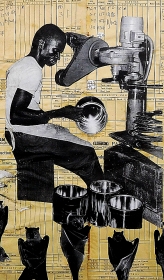
Many of the works on display are gigantic collages, which from afar look like interesting abstracts or even modern tapestries. Closer examination of these reveals that the artist has glued fragments of photographs onto a background of usually either old maps of his country and/or a latticework consisting of numerous production order dockets issued by The Ghana Industrial Holding Company. Photographs of fruit bats in various poses often run around the fringes of the collages or appear within their main body. Photographs of aspects of life in Ghana are glued onto the backgrounds. Often, they have been trimmed so that the backgrounds intrude, and the photographs appear to merge or mingle with them. I felt that this was particularly effective when the map backgrounds mingled with the trimmed photographs, making me think that the maps were being brought to life. Also, they give the impression of modern Ghana emerging from the out-of-date maps. I was also impressed by one collage showing images of flying bats glued onto a sea of old order dockets: wildlife contrasting with man’s industrial enterprise.

One half of the largest display space is dedicated to a fantastic art installation. About 100 old-fashioned wooden school desks are arranged in rows facing a line of black boards to create the illusion of an enormous classroom. On each desk, there is an old-fashioned electric sewing machine.  Every few minutes some of the sewing machines begin operating, creating a wonderful, loud noise, which varies as different groups of machines are activated and then silenced. Sewing machines, so the leaflet issued by the gallery inform us, were often used in Ghana by labourers wanting to learn a new trade. This exhibit aims, amongst other things, to resurrect the ghosts that Mahama feels reside within these discarded machines.

In the auditorium, a short video projected onto two neighbouring screens continues the artist’s interest in sewing machines. On one of the screens, the video shows in close-up the innards of sewing machines being cleaned and oiled. Simultaneously, the video on the neighbouring screen shows workmen doing messy maintenance work through a manhole cover and beneath the ground. The circular manhole cover is mirrored in the other video by the small circular orifice through which the innards of the sewing machine are maintained. Odd subjects, but well filmed and fascinating visually.

I am neither an art critic nor a sociologist, nor whatever it takes to ponder the deeper meaning and messages that the artist is trying to convey, but I enjoyed the exhibition greatly without having to worry about its deeper intellectual content. Visually, everything on display was exciting and often quite novel: a feast for the eyes and ears. If you can get to see this show, I am sure that you will not leave it unaffected by its impact. And, after feasting your ears and eyes at the gallery, I recommend a short walk down Bermondsey Street to treat your taste buds and olfactory sense to Vietnamese food, magnificently prepared, at Caphe House.

They are only there for the beer

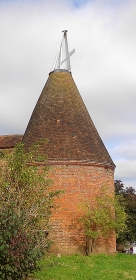
DESPITE LIVING IN KENT for eleven years and having visited the county numerous times, it was only in October 2021 that I first stepped inside an oast house. Dotted all over the county with their tall conical (sometimes pyramidical) roofs surmounted by distinctive cowls, they play(ed) an important role in the production of beers.

An oast house with conical roof

Hops are the flowers (or seed cones) of the hop plant known by botanists as Humulus lupulus, a member of the Cannabaceae family of plants, whose members include Cannabis, the plant which is the source of marijuana. Only the flowers of the female hop plant are used in beer making. When dried to a well-defined degree, hops are added to the beer-making process both to add flavour and because of their antibacterial effects that prevent unwanted organisms growing whilst the beer is being brewed.

Traditionally in England, hops are dried out in oast houses. Picked hops are laid out on perforated drying floors in the upper levels of the oast house. A wood or charcoal fired kiln on the ground floor of the oast house produces hot air that drifts upwards through the layers of drying hops and then escapes through the cowl at the top of the oast house’s conical roof. The cowl has a vane that catches the wind and rotates the cowl so that the wind continuously draws the smoke from the kiln up through the oast house. The air that carries the smoke upwards is drawn into the oast house through perforations in the brickwork at the lower levels of the building. The tall conical design of the roof increases the draught of air through the hops. The drying process must be carefully monitored so that the hops are removed before they are dried out too much.

The earliest known record of hop cultivation was in a document dated 736 AD. It referred to hops being grown in Germany. The use of hops in beer production seems to have taken off in a big way by the 13th century. Before hops became used routinely in beer production, a mixture of herbs and flowers, known as ‘gruit’, was used for the same reason as hops. In Germany, hops became favoured over gruit in the early 16th century because unlike the latter, which were subject to taxation, the former were not (https://en.wikipedia.org/wiki/Hops).

Hops were introduced to England during the 16th century. The oldest description of an oast house (more accurately, a building for drying hops) was written in 1574. What was described was different in design to what we recognise as an oast house today. The earliest surviving oast house was built sometime during the following century. Today, hops are no longer dried in oast houses. They are processed in industrial premises that are not nearly as picturesque as oast houses, many of which have now been repurposed as dwellings and for other uses.

On the estate of Sissinghurst Castle, a former manor house rather than a castle, a set of former oast houses has been tastefully modified by the National Trust to create an exhibition space that includes information about oast houses and hop drying. Although the kilns are no longer present, the internal structures of the tall roofs have been preserved. By entering the exhibition space, I managed to see inside an oast house for the first time. I would be curious to see within an oast house that still contains its kiln and other equipment, but what I saw at Sissinghurst began to quench my thirst for knowledge about these curious looking buildings, which were only there for the beer and can be seen throughout the landscape of Kent.

The Zigzag path

MUCH OF FOLKESTONE, a seaside town in Kent, is perched on slopes leading down to cliffs overlooking the shoreline. The Leas, a wide promenade running along the top of the cliffs to the west of the centre of the town, affords fine views of the beaches and rocks far beneath it. Various staircases, a lift (out of action nowadays), and paths lead from The Leas down to the seashore and the park that runs alongside it. The most fascinating of these, The Zigzag Path, begins close to a cast-iron bandstand a few yards west of the statue of the scientist/physician William Harvey. I loved it so much that I walked down it three times in the three days we spent in Folkestone recently.

With five hairpin bends and a couple of short tunnels as well as blind ending caves, The Zigzag Path takes pedestrians down from the Leas at 150 feet above sea level to lower than 42 feet above the sea. The path is like a winding mountain road in miniature and provides endlessly changing views of the seashore and the trees and other vegetation growing near it. In more detail:

“The path is in five sections, and covers a substantial vertical area of about 75 metres across and 50 metres high.   It incorporates steps, seats, plant pockets, low walls, and with tunnels, arches and caves at each turn.” (https://pulham.org.uk/2014/10/13/chapter-40-1920-21-the-leas-zigzag-path-folkestone-kent/).

The steep path was built for Folkestone Corporation in the early 1920s. The first attempt was not brilliant. So, the Corporation employed Mr Pulham of the company of James Pulham & Son, who specialised in the construction of rock gardens, follies, and grottoes (https://en.wikipedia.org/wiki/James_Pulham_and_Son). The company’s founder, James Pulham (1820-1898) was the inventor of a manmade (anthropic) rock-like material known as Pulhamite.  This composite material simulates the appearance of natural rock so successfully that sometimes geologists are fooled by it. Pulhamite is a mixture of sand, Portland cement, and clinker, which is sculpted over a core consisting of rubble and crushed bricks (https://en.wikipedia.org/wiki/Pulhamite). The Zigzag Path was built with Pulhamite. While walking down the path, I spotted several places where the surface of the Pulhamite had worn away leaving fragments of brick exposed. If I had not seen this, I would have found it difficult to believe that the path was not created using natural rock. Recently, interesting ironwork railings have been added to the side of path facing the sea. These incorporate metal features that resemble plant tendrils wrapping around a support.

The wonderful Zigzag Path is just one of many of the Pulham’s ornamental creations. A full listing can be found in “Rock Landscapes: The Pulham Legacy: The Pulham Legacy: Rock Gardens, Grottoes, Ferneries, Follies, Fountains and Garden Ornaments” by Claude Hitching and Jenny Lilly. A visit to Folkestone would not be complete without experiencing the beautiful and rather fantastic Zigzag Path, preferably by descending it. If you decide to ascend it, you will have done sufficient exercise not to need to visit the gym that day.

Blood on the wall

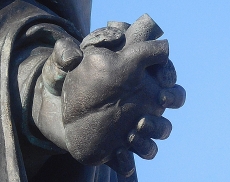
GRIPPING A HEART with the fingers of his left hand and his right hand on his chest, he stands in knee breeches, motionless on a plinth and staring out to sea. This bronze figure is a statue of the great scientist and first to give a scientific description of the way blood circulates through the heart and blood vessels, William Harvey (1578-1657), who was born in Folkestone, Kent, where his sculptural depiction stands. The commemorative artwork was created by the sculptor Albert Bruce-Joy (1842-1924) and made in 1881.

The heart in Harvey’s hand

Son of a Folkestone town official, William Harvey began his education in the town, where he learned Latin. Next, he attended The Kings School in nearby Canterbury before matriculating at Gonville and Caius College in Cambridge. After graduating in Cambridge in 1597, he enrolled at the University of Padua in northern Italy. There, he graduated as a Doctor of Medicine in 1602. Harvey became a physician at London’s St Bartholomew Hospital, and later (1615) became a lecturer in anatomy. In addition to his teaching activities, he became appointed Physician Extraordinary to King James I. It was in 1628 that he published his treatise, “De Motu Cordis”, on the circulation of the blood, work that remains unchallenged to this day. In 1632, he became Physician in Ordinary to the ill-fated King Charles I. In 1645, when Oxford, the Royalist capital during the Civil War, fell to the Parliamentarians, Harvey, by now Warden of Oxford’s Merton College, gradually retired from his public duties. He died at Roehampton near London and was buried in St. Andrew’s Church in Hempstead, Essex.

Folkestone, formerly a busy seaport, has restyled itself during the last few years. It has become a hub for the creative arts. Works by various contemporary artists, some quite well-known including, for example, Cornelia parker, Yoko Ono, and Antony Gormley, are dotted around the town and can be viewed throughout the year. Every three years, even more art can be found all over the town as part of The Creative Folkestone Triennial. This year, 2021, it runs from the 22nd of July until the 2nd of November. As one wanders around the town, one can spot artworks in both obvious locations and some less easily discoverable places. This year, the London based artistic couple Gilbert and George have exhibited several of their colourful and often thought-provoking images. And this brings me back to William Harvey.

High on a wall just a few yards behind the statue of Harvey, there are two images by Gilbert and George. Both were created in 1998. One is titled “Blood City” and the other “Blood Road”. Both relate to blood, its corpuscles, and its flow. It is extremely apt that they have been placed close to the image of the man who did so much to increase our understanding of blood and its circulation through the human body.