Will this village near Heathrow Airport disappear?

SITUATED AT THE northwest corner of Heathrow Airport (and within sight of it), is the former village of Longford. Now in the Borough of Hillingdon, it lies on what was once the main road between London and Bath. Its name derives from a ford which used to cross the River Colne. James Thorne, writing in 1876, noted that there were then three roadside inns and that:

“The fishery here is in good repute among anglers; as is also the Kings Head Inn.”

Today, there are only two pubs in Longford, The Kings Arms and The White Horse. The Kings Head, marked on a map surveyed in 1875, no longer exists. It stood just east of the Duke of Northumberland’s River, near the boundary fence of The Thistle Terminal 5 Hotel. Nearby, next to a bus stop (Stop J), stands the now disused Longford Pump. This is almost 10 feet tall and was used to top up the tanks of steam-powered traction engines. Of the two surviving inns, The White Horse looks to be the oldest. According to a notice attached to this picturesque old pub, it was probably built as a smokehouse (for curing meat) in 1534 and became an inn in 1601.

Cottage in Longford

Across the road from The White Horse, there is a magnificent half-timbered building. This Elizabethan (16th century) edifice is Yeomans House. The historian Wendy Tibbits wrote (www.wendytibbitts.info):

“In 1542 Leland in his ‘Itineraries’ describes a building about a mile north of the wooden bridge over the Colne between Longford and Colnbrook, which suggests it could be the building now known as Yeomans. At the time it was the manor house of Colham and owned by the Earl of Derby who died there on 23 May 1521. He had built the Tudor Manor House on the site of a medieval house. At that time the manor of Colham had extensive land extending from Hillingdon southwards … In the mid-eighteenth century this house was owned by Thomas Streeting who died there in 1773. It was inherited by his daughter, Elizabeth, who had married the other prominent Longford farmer, Thomas Weekly. Thomas, his wife, and their nine children were living in the Weekly house, a hundred meters along the Bath Road, and so they decided that the Elizabethan would be divided into three dwellings and rented to their farm labourers’ families …”

Between The White Horse and The Kings Arms, there is a charming, thatched cottage. Almost opposite this, there is a three-storey brick building, now next to the entrance of the Heathrow Medical Aeromedical Centre. According to Ms Tibbits, this is the house built by a wealthy London cloth merchant, Thomas Weekly, about 10 years after the 1666 Great Fire of London. The Weekly family lived here from the late 17th century until 1899. The house had its own farm, which was compulsorily purchased during WW2 to use the land for the construction of an airfield in the neighbouring, now demolished, hamlet of Heathrow.  

The Kings Arms Pub faces Heathrow Close. Immediately to the east of the hostelry, there is an old long barn with a sagging roof. This is one of the few reminders of the era when Longford was in the midst of agricultural terrain. To the west of this pub, the old road to bath crosses the River Colne over a bridge with elegant cast-iron railings and roundels, each with a crown and beneath it, the following: “WR IV 1834”. This is marked on old maps as “The King’s Bridge”.

Longford contains the remnants of what was once a small country village. Ms Tibbits noted that:

“… its four inns provided travellers with hospitality. Six miles from Windsor Castle the village was the usual stopping place for the Royals to change their horses on the way to and from London and Windsor … Highwaymen prayed on the coach travellers who had to cross the notorious Hounslow Heath to get to Longford, but if any villagers were aware of the culprits they kept it to themselves.”

Sadly, like nearby Harmondsworth, Longford’s future might well be bleak. Should the projected extension of Heathrow Airport finally get the ‘go-ahead’, much of Longford, if not all of it, will be demolished. This would be a great pity as it would involve the displacement of a small community and the loss of several buildings of historical interest.

Art beneath your feet

MOST VISITORS TO London’s Tate Britain and National Gallery tend to look at the paintings hanging on the walls and sculptures on pedestals. Fewer people look down to see what they are walking on. The floors of the main entrance portico of the National Gallery and of Gallery II at the Tate Britain are well worth examining.

National Gallery, London (UK)

The mosaics on these floors were created by the Russian artist Boris Vasilyevich Anrep (1883-1969). Born in St Petersburg, he studied law at the Imperial School of Jurisprudence in that city, graduating in 1905. In 1908, he abandoned law and went to Paris (France) to study art. Between 1910 and 1911, he studied at the Edinburgh School of Art. While in France, Boris met several British artists and intellectuals, many of them members of the Bloomsbury Set. His fascination with mosaics began in about 1904 after seeing the early Christian mosaics in Ravenna (Italy). In 1917, Boris settled in England, where he created many of his mosaics.

The floor of Gallery II at what is now the Tate Britain, but was formerly ‘The Tate Gallery’, was damaged by bombing during a Zeppelin raid in WW1. In 1921, Anrep was commissioned to make a mosaic floor for this gallery. By 1923, it was ready. The dramatic-looking creation consists of scenes representing William Blakes “Proverbs”. Each of the vignettes in the octagonal gallery, which used to house pictures by Blake, includes one of Blake’s proverbs. They are surrounded by a depiction of the flames of Hell.

The floors of the Portico at the national contain a much greater area of mosaics than that of the gallery in Tate Britain. Anrep created the mosaics between 1926 and 1952. Some of them are becoming worn out after having been walked on for so many years since the were put in place. A website (https://artuk.org/discover/artists/anrep-boris-18831969) explained that the mosaics in the National Gallery consist of:

“… four floors on and around the main staircase, executed between 1926 and 1952. The subjects are ‘The Awakening of the Muses’, ‘The Modern Virtues’, ‘The Labours of Life’, and ‘The Pleasures of Life’; portraits of many well-known contemporaries are incorporated in them, for example the philosopher Bertrand Russell representing Lucidity and the film actress Greta Garbo as Melpomene, the Muse of Tragedy.”

Sir Winston Churchill is also depicted, as are other well-known personalities (for details, see: https://mikepitts.wordpress.com/2016/06/10/lookdown-boris-anrep/).

The attractive, intriguing mosaics at both the National and the Tate Britain are far less famous than many of the works to which most visitors make a beeline. However, Anrep’s mosaics should not be overlooked. In fact, I believe they are worth lingering over at least as long as one might when viewing, say, a Rembrandt in the National, or a Turner in the Tate.

Incidentally, after Anrep died, his body was cremated at Golders Green Crematorium, a place which I have described in my book “Beneath a Wide Sky: Hampstead and its Environs”.

Hampstead and the Tate Britain Gallery

THE TATE BRITAIN pleases me far more that its younger relative, The Tate Modern, and its cousins in Liverpool and St Ives. I do not know why, but I feel far more comfortable in the old institution on London’s Millbank. Today (31st of March 2022), I took a leisurely wander through some of the Tate Britain’s galleries. I was on the lookout for works by artists, who have been associated with Hampstead in north London. My only disappointment was that there were no works by John Constable (1776-1837) on display. Buried next to Hampstead’s parish church, he worked and lived (for several years) in Hampstead. I had better luck with one of his contemporaries, George Romney (1734-1802). His “A Lady in a brown Dress: The Parson’s Daughter” hangs in the Tate. “Roadside Inn” was painted in about 1790 by George Morland (1763-1804), who used to visit Hampstead to teach. The gallery also contains a picture, “Punch or May Day”, by the painter Benjamin Haydon (1786-1846), who is known to have visited Hampstead, where he met the essayist and critic Leigh Hunt and walked with the poet Wordsworth.

By Mark Gertler

It was the painter William Rothenstein (1872-1945), who found accommodation for, and looked after the great Indian literary genius Rabindranath Tagore, when he stayed in Hampstead briefly in 1912. The artist, who also lived in Hampstead for a while, is represented by at least two of his paintings in the Tate Britain: one was painted in 1891 and the other in 1899-1900.

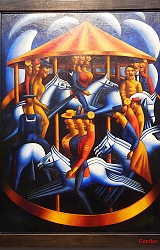
It was during the first five decades of the 20th century that Hampstead became a mecca for artists, who are remembered today and whose works are displayed in Tate Britain. “The Merry-Go-Round”, a colourful painting created by Mark Gertler (1891-1939), who had a studio in Hampstead, depicts a fairground attraction on Hampstead Heath. It was painted in 1916. Gertler studied at the Slade School of Art at the same time as the painter Stanley Spencer (1891-1959), who had a studio in Hampstead’s Vale of Health for a while. It is therefore apt that Gertler’s painting hangs next to one by Spencer: “The Resurrection, Cookham”.

Another juxtaposition is a wooden sculpture by John Skeaping (1901-1980) and a painting by Ben Nicholson (1894-1982). Both worked in Hampstead in the 1930s and both were married to the sculptor Barbara Hepworth (1903-1975). She divorced Skeaping to marry Nicholson. One of her sculptures is on display close to another artwork by her second husband. I spotted one more work by Hepworth. That was a painting, a sketch for a sculpture she was planning in 1957. The three artists all worked at various times in the Mall Studios near Parkhill Road.

David Bomberg (1890-1957), who, like Gertler and Spencer, studied at the Slade, lived in West Hampstead between 1928 and 1934. There are several of his dazzling, colourful paintings hanging in the Tate Britain.

Henry Moore (1898-1986), who lived for a while in Hampstead, is the best represented of all the artists who lived or visited that locality. Tate Britain has many of his sculptures on display and some of the sketches he made during WW2. These images depict people sheltering in deep Underground stations to be safe from the bombs being dropped by the Luftwaffe. Moore lived for a while in the modernist and relatively bomb-resistant Lawn Road Flats (‘The Isokon’) near South End Green (and, incidentally, near the Mall Studios). I have read that it is likely that Moore made some of his dramatic wartime sketches in the nearby Belsize Park and Hampstead Underground stations.

It was fun visiting the Tate and seeing pictures by some of the artists, whom I have written about in my new book about Hampstead: “Beneath a Wide Sky: Hampstead and its Environs”. This work contains two chapters detailing Hampstead’s myriad artistic connections. If you wish to learn more about this and about other aspects of Hampstead and its surroundings, my book (and Kindle edition) can be obtained from Amazon (https://www.amazon.co.uk/dp/B09R2WRK92).

A battle scene under the hammer

SRIRANGAPATNA (SERINGAPATNAM) IS A town on an island in the River Kaveri in the state of Karnataka in southern India. I have been there several times as it is near a holy spot (the ‘sangam’, where three streams meet) where ashes of deceased Hindus, including those of my parents-in-law, are ceremoniously deposited in the waters of the Kaveri. The town near the sangam was the capital of the realm ruled by Tipu Sultan (1750-1799). This former capital of a great ruler is full of impressive architectural reminders of his era. One of these, which I have visited at least twice, is a Summer Palace, the Daria Daulat Mahal (literally, ‘Wealth of the Sea Palace’) built for Tipu in 1784. This lovely, large pavilion in the middle of a formal garden is decorated with huge painted murals depicting various subjects. Some of them show scenes of battles in which Tipu was involved, often with his enemy the British East India Company. Filled with fascinating details, these are well worth visiting.

On the 30th of March 2022, a wonderful artwork was auctioned at Sotheby’s auction house in London’s New Bond Street. Created in 1784, it is a painting measuring 31.6 feet by 6.6 feet. It is one of three copies of a work commissioned by Tipu for the Daria Daulat pavilion. It depicts the Battle of Pollilur fought on the 10th of September 1780 between the British troops of the East India Company and the Mysore Army led by Haider Ali (c1720-1782) and his son Tipu Sultan. Writing for the Sotheby’s website (https://www.sothebys.com/en/buy/auction/2022/arts-of-the-islamic-world-india-including-fine-rugs-and-carpets/the-battle-of-pollilur-india-seringapatam-early), the author and historian William Dalrymple explained:

“At Pollilur, Tipu Sultan inflicted on the East India Company the most crushing defeat the Company would ever receive, and one which nearly ended British rule in India.”

He added, referring to the British:

“Out of 86 officers, 36 were killed, 34 were wounded and taken prisoner; only 16 captured were unwounded. Baillie received a back and head wound, in addition to losing a leg. Baird received two sabre cuts on the head and a pike wound in the arm. His ADC and young cousin, James Dalrymple, received a severe back wound and “two cuts in my head”. Around two hundred prisoners were taken. Most of the rest of the force of 3,800 was annihilated.”

Of the painting being auctioned at Sotheby’s, he wrote:

“The painting extends over ten large sheets of paper, nearly thirty-two feet (978.5cm) long, and focuses in on the moment when the Company’s ammunition tumbril explodes, breaking the British square, while Tipu’s cavalry advances from left and right, “like waves of an angry sea,” according to the contemporary Mughal historian Ghulam Husain Khan. The pink-cheeked and rather effeminate-looking Company troops wait fearfully for the impact of the Mysore charge, as the gallant and thickly moustachioed Mysore lancers close in for the kill. To the right, the French commander Lally peers triumphantly through his telescope; but Haidar and Tipu look on majestically and impassively at their triumph, while Tipu, with magnificent sang-froid sniffs a single red rose as if on a pleasure outing to a garden to inspect his flowers.”

As with all other items to be auctioned at Sotheby’s, the painting was put on display to the public for several days before the auction. We were lucky to have been able to view it, as we arrived only a few minutes before the public viewing period ended. One of the technicians at the auction house let us get close to the painting so that we could examine it much better than is possible when visiting the Summer Palace at Srirangapatna. I took the opportunity to take close-up photographs of details of this incredible record of late 18th century warfare. [You can view my photographs on the following website: http://www.ipernity.com/doc/adam/album/1319222] Some of them are quite gory, including decapitated heads with blood issuing from their severed necks. Many of the British can be seen being impaled by what looked like very thin, needle-like spears. I spotted one Indian soldier being struck on his head by a bayonet wielded by a Britisher. Some of the Mysore Army soldiers brandish rifles fitted with bayonets.

The British soldiers are mainly dressed in red jackets. Their opponents are depicted wearing clothes in a variety of colours. Most of the Indian soldiers have dark-coloured eyes but, as my wife spotted, some of the British have pale coloured (blue?) eyes.  Many animals appear in the picture: horses, camels, elephants, and bullocks. In addition to rifles and spears, there are other weapons in the painting including: cannon, swords of various kinds, and archery bows. Seen as a whole and in detail, the painting portrays great activity and a sense of the confusion that reigns in a battle. Whereas the British appeared to be maintaining orderly formations, their opponents can be seen making a terrifyingly massive onslaught in an apparently less organised, but ultimately successful, way.

Although words are inadequate to convey the impression made on me by this painting, I am glad that I was able to see it before it is sold. It was last exhibited for a few months in 1999 in the National Gallery of Scotland (Edinburgh), and before that for a few months in London in 1990. If it is sold to a private individual, it might not be available for public viewing again for a long time.

A back to front church

JUST TWO AND a half miles north of Heathrow Airport and one mile north of Harmondsworth lies the former village of West Drayton, formerly known simply as ‘Drayton’, now part of the London Borough of Hillingdon.

Both the mainline railway and the Grand Union Canal run through West Drayton. During the second half of the 19th century, this settlement in middle of flat agricultural land was also home to grain mills, brickworks, ropemaking, and docks connected with activities on the canal. There is still some industry in the area, but now it is mainly residential.

Tudor gateway and St Martins Church at West Drayton

West Drayton’s parish church of St Martin was first mentioned in writing in 1181. The present building, with a flint covered exterior and a bell tower topped with a small cupola, mainly dates from the 15th century. Whereas most of the building is 15th century, at least one part of it, a two-arched piscina in the southeast corner, is 13th century. Currently, the church is entered through a modern doorway at the east end of the south wall instead of the older south entrance near the west end of the southern wall. On entering the church, I felt immediately disoriented. This is because, as I realised quickly, the church is arranged back to front. The high altar is at the west end of the church almost at the base of the bell tower and the pews face in that direction. Some years ago, the altar was moved from the chancel, where it had been for many centuries, to the western end of the nave. The reason for this, the vicar and her husband told me, was that it was done so that nobody in the congregation would have a restricted view of the altar during services. However, the attractively carved 15th century stone font stands where it was before the position of the altar was reversed: in the southwest corner of the nave. Another curiosity in the church is the hanging pyx suspended above the high altar. This gothic revival style container (based on the appearance of a mediaeval pyx in a church in Suffolk), which holds the sacrament and can be lowered during services, was designed by Andrew Low, manufactured at Pinewood (film) Studios, and placed in St Martins in 1975.

This oddly arranged church contains several carved stone memorials on its interior walls. Many of them commemorate members of the De Burgh family. Their bodies and those of the Paget family are sealed in a vault below what was originally the chancel.

With only a brief interruption during the 17th century, the manor and estate of West Drayton was owned by the Paget family between 1546 and 1786. In 1786, Henry Paget (1744–1812), 1st Earl of Uxbridge, sold the manor to a London merchant Fysh Coppinger (died 1800), who changed his surname to De Burgh, that of his wife. His memorial is in the church. Henry Paget’s eldest son, Henry William Paget, 1st Marquess of Anglesey (1768-1854), lost his right leg during the Battle of Waterloo (1815). It was replaced by a wooden prosthesis. His amputated leg was buried in Belgium, whereas the rest of his body was interred in Lichfield Cathedral.

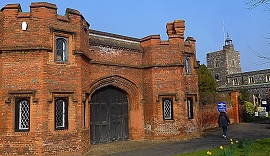
The church and its small cemetery are enclosed within an old wall with Tudor brickwork. This is part of a large wall, which once enclosed private grounds. Following the passing of an Act of Parliament, Sir William Paget (1506-1563), at one time secretary to Jane Seymour (c1508-1537), one of the wives of King Henry VIII, enclosed his grounds with a brick wall in the 1550s. The Act stipulated free public access to the church.  Parts of this wall can be seen around the churchyard and alongside Church Road. The Paget family built a mansion on the land that had been enclosed. This building, West Drayton Manor House, was demolished in 1750 by the then Earl of Uxbridge. Although the spacious brick mansion, where the Paget family once lived, is no longer, the red brick gatehouse to the grounds still stands. According to Bob Speel (www.speel.me.uk), this Tudor grand entrance with two octagonal turrets was built in the 16th century. Close to the old gatehouse, there is a newish housing estate, a small enclave called Beaudesert Mews, which was built on land on which at least a part of the long-since demolished manor house might have stood.  The name ‘Beaudesert’ relates to the above-mentioned Sir William Paget, who had the title ‘1st Baron Paget de Beaudesert’.  

By the 19th century, the De Burgh family were living in Drayton Hall, an early 19th century building, which now serves as Council Offices and is surrounded by Drayton Park, near the church. A new building attached to it contains offices of at least one commercial enterprise. West Drayton retains a rectangular grassy space, The Green, once the village green. Several of the buildings around it look as if they were present well before the area was engulfed by London’s western spread. Unlike nearby Harmondsworth and Longford, West Drayton is not under threat of suffering demolition if or when Heathrow Airport is expanded.

Just around the corner … in South Kensington

PEOPLE USUALLY ASSOCIATE South Kensington with its magnificent set of museums. However, there is far more than that in the district, and within a few yards of the museums. Here are a few places of interest near to the Victoria and Albert Museum (the ‘V&A’).

The V&A stands on the northeast corner of Exhibition Road and Cromwell Gardens (a short stretch of the A4) and faces the Ismaili Centre on the southeast corner. This attractive building built for the religious community that is led by the Aga Khan was designed by the Casson Conder Partnership and completed in 1985. According to the website of the Ismailis, https://the.ismaili, the building’s pleasing exterior:

“… has used materials and colours which are compatible with those of the surrounding buildings while at the same time in keeping with the traditional Islamic idiom and its colours of whites, light greys and blues.”

Monument in he Yalta Memorial Garden

An open space, The Yalta Memorial Garden, on the east side of the centre contains a monument to remember “… the countless men, women, and children, from the Soviet Union and other East European states, who were imprisoned and died at the hands of Communist governments after being repatriated at the conclusion of the Second World War…” The memorial consists of a column on the top of which there is a sculpture by Angela Conner (born 1935) depicting 12 faces of men, women, and children. Nearby, a house on the northeast corner of Thurloe Square and facing the V&A, bears a plaque informing that the museum’s first Director Henry Cole (1808-1882) lived there.

The Brompton Oratory, or to give its full name, the Church of the Immaculate Heart of Mary, is a huge Roman Catholic church with a neoclassical façade and a dome. It stands east of the V&A. It was designed by the architect Herbert Gribble (1846-1894), a convert to Roman Catholicism, and constructed between 1880 and 1884. The architectural style is mainly Roman Baroque. This enormous edifice was the largest Roman Catholic church in London until Westminster Cathedral was constructed in the first decade of the 20th century.

Cottage Place runs along the east side of the Oratory towards the Holy Trinity Brompton church north of it. A building that looks like many of the older Underground station entrances on the Place has a façade decorated with blood-red glazed terracotta tiles. Between 1906 and 1934, when it was closed, it was the entrance to Brompton Road station on the Piccadilly Line. It was a stop between the still functioning Knightsbridge and South Kensington stations. It was closed because it was hardly ever used by passengers.  An article in the Guardian newspaper, published in February 2014, related that during WW2, the disused station was used as a command centre for anti-aircraft batteries. It also suggested that the Nazi Rudolf Hess (1894-1987) was interrogated here. Between the station’s closure and about 2014, the building was owned and used by the Ministry of Defence.

The Holy Trinity Brompton Church, a gothic revival structure, was designed by Thomas Leverton Donaldson (1795-1885), and completed in 1829. It was established to accommodate the growing population of this part of Kensington, which until then had to worship in the church of St Mary Abbots in Kensington, almost one mile away. In 1852, a part of the church’s land was sold for building the Oratory upon it. The large grassy space north of Holy Trinity, now a park, was formerly the church’s graveyard.

Although none of the places I have described rival the splendour of the V&A and especially its fantastic collection of artefacts, they are worth exploring if you happen to be in the neighbourhood. A problem in London is that there are so many places of the greatest interests to visitors, which often means they have so little time to explore the lesser-known curiosities that form part of the rich tapestry of London’s past and present.

Return to the Himalayas

SOUTHALL LIES NOT far from Heathrow Airport. Despite its architecture being mostly typical of dull London suburbs that developed between the two World Wars, it is far from being a run-of-the mill west London suburb. Recently, in March 2022, we visited Southall after several years since we last went there.

The centre of what was once the tiny village of Southall is about 1.7 miles north of Osterley Park house. The manor of Southall was owned by the Archbishop of Canterbury in the 14th century. Separated by countryside from its neighbours, it lay on the road from London to Uxbridge and Oxford. It was only in the 1870s that the village began expanding southwards to the Great Western Railway line. Today, the place has been fully incorporated into London and retains little or nothing of its former rustic nature.

Detail of the roof of the Himalaya Palace in Southall

On arriving by train at Southall station, the observant traveller will notice that the station name signs are bilingual; they are in both Latin and Punjabi scripts. Southall is sometimes aptly referred to as ‘Chota Punjab’ (Little Punjab). The three Punjabi brothers, Charan Singh Bilga, Jagar Singh Bilga, and Lave Singh Bilga, began living in Southall in 1938. They were followed by Pritam Singh Sangha, who opened a shop in Southall in 1954, having arrived in the area in 1951. His shop was then the only shop in west London, if not in the whole of the metropolis, purveying Indian provisions.  Pritam Singh Sangha in partnership with his friend and business associate, Jarnail Singh Hura (also known as “Ghura”), established the first known business in Southall and Fakir Singh purchased numerous houses which he rented out to his countrymen.”

Vivek Chaudhary, writing in the Guardian in April 2018, recorded:

“By the time my own father arrived in 1960, local authority records show that there were approximately 1,000 Punjabis living in Southall, nearly all men. He would joke that one of the reasons why they settled here was because of its proximity to Heathrow airport, only three miles away, and “if the gooras [whites] ever kicked us out, it would be easy to get on a plane and return home”. It was a light-hearted reference to the uncertainty that was generated by the chronic racism of the time. It was the R Woolf rubber factory in neighbouring Hayes that attracted Punjabis to Southall – the general manager had served with Sikh soldiers during the second world war and was only too happy to recruit them…”

He added:

“Punjab was partitioned by the British in 1947; part of it fell within Pakistan with the remainder in India. Punjabis can be Sikh, Hindu or Muslim, and while all three demographics settled in this outpost of west London, it was the Sikhs who came in the largest numbers and gave Southall its distinct identity.”

Chaudhary mentioned that at the time he wrote his article, although at one stage Southall’s population was 70% Punjabi, this has decreased to about 50% and the descendants of many of the original settlers:

“…have prospered and moved to wealthier pastures, replaced by new communities from Afghanistan, Sri Lanka and Somalia. At its heart, though, this corner of west London remains an indelibly Punjabi town.”

And so, it is. Southall is like the Punjab and other places in India or Pakistan, but with the often-dull English weather and rather pedestrian suburban architecture. The main streets, South Road and the Broadway (Uxbridge Road), are lined with shops, small bazaars consisting of several tiny shops, and eateries. Judging by the profusion of colourful, often glittering, Indian (and Pakistani) style party clothing on sale, one might be excused for thinking that the people of Southall do nothing apart from attending ‘glitzy’ weddings.   If you wish to sample shopping as it is in India without leaving the country, then Southall is the place to do it in London. It seemed to my wife and me that the quality of the clothing on sale was high, better than much that is available in India. A Sikh salesman explained that what is on sale in Southall is made in India but unlike what is on sale over there, this is export quality.

One building is worthy of special mention in Southall, apart from the area’s gold-coloured domed Sikh gurdwaras. This is the former Himalaya Palace cinema. Built in 1929, it is unique in Britain in that its façade is in the form of a Chinese Temple. It has a pagoda roof which is flanked by dragons. It used to screen films from India’s Bollywood studios until it closed in 2010. It has now become an indoor market called Palace Shopping Centre. Fortunately, the building is protected by a preservation order and the façade is likely to remain a wonderful landmark in the foreseeable future. Not far away in a less distinguished building is another mall, the Himalaya Shopping Centre. Entering these malls, and the others in Southall, is like stepping into a typical indoor shopping bazaar anywhere in India. The air in these Southall shopping centres has the special fragrantly perfumed odour I associate with India.

Near the former cinema, stands the former Southall Town Hall, which was constructed in 1898. On its wall, there are commemorative three plaques placed by an anti-racism group called Southall Resists 40. They are dedicated to Gurdip Singh Chaggar, who was killed in 1976; Blair Peach who was killed in 1979; and ‘Misty in Roots & People Unite Musicians Cooperative’. Each of the three bears the words “Unity against Racism”.

An experiment in modern living

HERE ARE TWO brief extracts from my new book about Hampstead. They are from the chapter about the ‘modern artists’ who lived in Hampstead between the two World Wars and, also, the Lawn Road Flats, the Isokon, a revolutionary block of flats, built in the 1930s. The extracts are as follows:

Extract 1

“…  the painter Paul Nash (1889-1946) lived at number 3 Eldon Grove between 1936 and 1939. Close by at 60 Parkhill Road the artist Piet Mondrian (1872-1944) lived and worked between 1938 and 1941. Prior to moving to Parkhill Road, Mondrian had lived with a remarkable engineer and furniture entrepreneur Jack Pritchard (1899-1992).

Jack and his family lived at 37 Belsize Park Gardens, having moved there from Platts Lane. Pritchard, who studied engineering and economics at the University of Cambridge, joined Venesta, a company that specialised in plywood goods. It was after this that he began to promote Modernist design. In 1929, he and the Canadian architect Wells Coates (1895-1958) formed the company, Isokon, whose aim was to build Modernist style residential accommodation. Pritchard and his wife, a psychiatrist, Molly (1900-1985), commissioned Coates to build a block of flats in Lawn Road on a site that they owned. Its design was to be based on the then revolutionary new communal housing projects that they had visited in Germany, including at the influential Bauhaus in Dessau. The resulting Lawn Road Flats are close to both Fleet Road and the Mall Studios in Parkhill Road. Completed in 1934, they were, noted the architectural historian Nikolaus Pevsner, ‘… a milestone in the introduction of the modern idiom to London’ …”

Extract 2

“… T F T Baker, Diane K Bolton and Patricia E C Croot, writing in “A History of the County of Middlesex: Volume 9, Hampstead, Paddington”, noted that the Lawn Road Flats were built partly to house artistic refugees, who had fled from parts of Europe then oppressed by dictators, notably by Adolf Hitler. Some of them had been associated with the Bauhaus. These included the architect and furniture designer Marcel Breuer, the architect Walter Gropius (1883-1969), and the artist and photographer Laszlo Moholy-Nagy (1895-1946). All three are regarded as masters of 20th century visual arts.

Despite both having come from bourgeois backgrounds, the Pritchards aimed to free themselves from middle-class conventions. The concept and realisation of the Lawn Road Flats were important landmarks in their quest to achieve a new, alternative way of living. The atmosphere that prevailed in the community that either lived in, or frequented, the Lawn Road Flats and its Isobar was predominantly left-wing, and extremely welcoming to cultural refugees from Nazi Germany. Probably, it had not been anticipated that the place would become a convenient place for Stalin’s Soviet spies to use as a base. According to a small booklet about the flats, “Isokon The Story of a New Vision of Urban Living”, published in 2016, the flats were home to the following espionage agents …”

“BENEATH A WIDE SKY: HAMPSTEAD AND ITS ENVIRONS” by Adam Yamey is available from Amazon (https://www.amazon.co.uk/dp/B09R2WRK92), bookdepository.com (https://www.bookdepository.com/BENEATH-WIDE-SKY-HAMPSTEAD-ITS-ENVIRONS-2022-Adam-Yamey/9798407539520), and on Kindle.

The blind beggar and his dog

AN ELIZABETH AND AN ELISABETH figured in my mother’s life during my childhood years. One was the cookery writer Elizabeth David (1913-1992), whose recipes my mother followed faithfully. The other was the sculptor Elisabeth Frink (1930-1993). Although she never met the cookery writer, she was a good friend of the sculptor. Between 1954 and 1962, Frink taught sculpture at St Martins School of Art, which was then located in Charing Cross Road. During that period, my mother, a sculptor, worked in the sculpture workshops in St Martins. It was probably then that she and Elisabeth became friends. ‘Liz Frink’, as we knew her, visited our home in Hampstead Garden Suburb as a dinner guest regularly and I remember meeting her on these occasions. My memory of these meetings was revived when visiting London’s East End this month (March 2022).

We were walking eastwards along Roman Road from Globe Road towards the Regents Canal when we passed the Cranbrook Estate, a collection of six rather bleak looking blocks of flats. The buildings are arranged around Mace Street, which is in the form of a figure of eight. The estate was built on land which had formerly accommodated a factory, workshops, and terraced houses. The blocks were completed by 1963. They were designed by Douglas Bailey and Berthold Lubetkin (1901-1990). Born in Georgia (Russian Empire), Lubetkin lived in Russia during and after the 1917 Revolution. He studied in Moscow and Leningrad (now St Petersburg), where he became influenced by Constructivist architectural principles. In the 1920s, he practised architecture in Paris, and by 1931, he had emigrated from the USSR to Great Britain, where he mixed with the artistic community then based in Hampstead (see my book: https://www.amazon.co.uk/dp/B09R2WRK92). In London, he founded Tecton, an architectural practice. He is particularly well known for his Penguin Pool at London Zoo and his luxurious block of flats in Highgate: High Point. The flats he designed on the Cranbrook Estate were for social housing.

Various other buildings and features have been added to the estate. One of these is a triangular garden surrounded on two sides by rows of single storey houses (bungalows for the elderly). In the middle of this, the Tate Garden, there is a pond with a fountain. Perched on what looks a bit like a diving board made of concrete discs piled one above another, there is a sculpture of a man and a dog. As soon as I saw this, I was reminded of Elisabeth Frink’s sculptures. Later, when I investigated it, I discovered that it is a sculpture by her. Entitled “Blind Beggar and his Dog” and cast in bronze, Liz Frink created this in 1958, which was when she and my mother must have already become friends. A sculpture depicting the Blind Beggar and His Dog, who figure in a tale that gained popularity in Tudor times, was commissioned in 1957 by Bethnal Green Council. Incidentally, there is a Blind Beggar pub in Whitechapel Road, where in 1966, the gangster Ronnie Kray shot dead a member of a rival gang, George Cornell.

We had visited the area near the Cranbrook Estate to see a small exhibition. As it had not taken long to view it and it was a warm sunny day, we took the opportunity to roam around the area. Had we not done that, I doubt that I would have become aware of this sculpture by an old friend of my mother.