
A survivor at Heathrow Airport

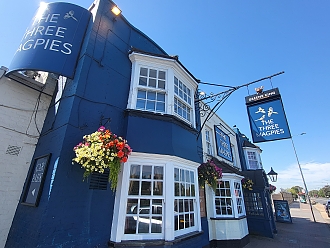
UNLESS YOU WERE thirsty or hungry or in desperate need of a toilet, you would most probably drive past the Three Magpies pub without giving it a thought. The pub is near Heathrow Airport on the A4 road (the Bath Road), which links London to the west of England. However, this pub is of great historic interest.

Few people who land at Heathrow, London’s main airport, ever consider what was there before the airport was built.  The Three Magpies is part of the history of that place.
The origin of the name ‘Heathrow’ is obscure, but Gordon Maxwell and other authors mentioned that Edward Ironside wrote in 1791 that the hamlet, Heath Row, had a very considerable fishery for lamperns, a small kind of lampreys, which were used as bait by the English and the Dutch in the cod and turbot fishery barges. Maxwell noted that all traces of this old-time industry had vanished. He also provided a first-hand description of the village after which Heathrow Airport is named:

In Heath Row are some old cottages … which might be in the heart of Devonshire, for their antiquity, their picturesqueness, and lonely situation. Very few people ever see them, for so few go along this road …

A detailed 19th century map shows minor a road heading south from a point on the Bath Road a few yards west of an inn or pub. It led straight to Heath Row Hall and then veered slightly southeast to Perrot’s Farm, located next to a bifurcation. This thoroughfare ran approximately along the same course as today’s Tunnel Road East, through which passengers arrive and depart from Terminals 2, and 3. The western branch of this bifurcation led west to the small hamlet of Heathrow (aka Heath Row). On an 1862 map, this consisted of several buildings each in their own spacious grounds.  Terminals 2, and 3 and surrounding buildings stand on what was once the hamlet of Heathrow and its tiny neighbour Perry Oaks.

Nothing remains of Heath Row and Perry Oaks. They were demolished when Heathrow Airport began to be developed first as an RAF base during WW2, and then after that, a civil aerodrome. The inn I mentioned above – that on the Bath Road (the A4) – is the only survivor of the era before the airport began to be constructed. Established in the eighteenth century (before 1765), it was called ‘The Magpie’. Today, it is called ‘ TheThree Magpies’.

Unlike the hamlets that have long since disappeared, the Three Magpies continues to do business, However, its future is uncertain as a local historian explained in her detailed blog (wendytibbitts.info/the-… ):

Since the airport opened to the public in 1946 the area it covers has increased many times and the once remote pub is now surrounded by hotels. But it is a survivor. Even if the third runway gets built it is not scheduled for demolition, but will be stranded between the northern and third runways with no passing trade.  There is every hope that the airport expansion plans will be quietly forgotten, but a more worrying prospect is the fact that Greene King are considering closing many of their pubs.  It will be very sad if we lose this ancient pub which continues to be a welcome place for a drink and a good meal.”

I have driven past the pub several times (I have never been there when it is open), stopped to take photographs of it, but never been inside it. So, it seems that I should hurry back to try its fare before the new runway begins to be constructed.

Will this village near Heathrow Airport disappear?

SITUATED AT THE northwest corner of Heathrow Airport (and within sight of it), is the former village of Longford. Now in the Borough of Hillingdon, it lies on what was once the main road between London and Bath. Its name derives from a ford which used to cross the River Colne. James Thorne, writing in 1876, noted that there were then three roadside inns and that:

“The fishery here is in good repute among anglers; as is also the Kings Head Inn.”

Today, there are only two pubs in Longford, The Kings Arms and The White Horse. The Kings Head, marked on a map surveyed in 1875, no longer exists. It stood just east of the Duke of Northumberland’s River, near the boundary fence of The Thistle Terminal 5 Hotel. Nearby, next to a bus stop (Stop J), stands the now disused Longford Pump. This is almost 10 feet tall and was used to top up the tanks of steam-powered traction engines. Of the two surviving inns, The White Horse looks to be the oldest. According to a notice attached to this picturesque old pub, it was probably built as a smokehouse (for curing meat) in 1534 and became an inn in 1601.

Cottage in Longford

Across the road from The White Horse, there is a magnificent half-timbered building. This Elizabethan (16th century) edifice is Yeomans House. The historian Wendy Tibbits wrote (www.wendytibbitts.info):

“In 1542 Leland in his ‘Itineraries’ describes a building about a mile north of the wooden bridge over the Colne between Longford and Colnbrook, which suggests it could be the building now known as Yeomans. At the time it was the manor house of Colham and owned by the Earl of Derby who died there on 23 May 1521. He had built the Tudor Manor House on the site of a medieval house. At that time the manor of Colham had extensive land extending from Hillingdon southwards … In the mid-eighteenth century this house was owned by Thomas Streeting who died there in 1773. It was inherited by his daughter, Elizabeth, who had married the other prominent Longford farmer, Thomas Weekly. Thomas, his wife, and their nine children were living in the Weekly house, a hundred meters along the Bath Road, and so they decided that the Elizabethan would be divided into three dwellings and rented to their farm labourers’ families …”

Between The White Horse and The Kings Arms, there is a charming, thatched cottage. Almost opposite this, there is a three-storey brick building, now next to the entrance of the Heathrow Medical Aeromedical Centre. According to Ms Tibbits, this is the house built by a wealthy London cloth merchant, Thomas Weekly, about 10 years after the 1666 Great Fire of London. The Weekly family lived here from the late 17th century until 1899. The house had its own farm, which was compulsorily purchased during WW2 to use the land for the construction of an airfield in the neighbouring, now demolished, hamlet of Heathrow.  

The Kings Arms Pub faces Heathrow Close. Immediately to the east of the hostelry, there is an old long barn with a sagging roof. This is one of the few reminders of the era when Longford was in the midst of agricultural terrain. To the west of this pub, the old road to bath crosses the River Colne over a bridge with elegant cast-iron railings and roundels, each with a crown and beneath it, the following: “WR IV 1834”. This is marked on old maps as “The King’s Bridge”.

Longford contains the remnants of what was once a small country village. Ms Tibbits noted that:

“… its four inns provided travellers with hospitality. Six miles from Windsor Castle the village was the usual stopping place for the Royals to change their horses on the way to and from London and Windsor … Highwaymen prayed on the coach travellers who had to cross the notorious Hounslow Heath to get to Longford, but if any villagers were aware of the culprits they kept it to themselves.”

Sadly, like nearby Harmondsworth, Longford’s future might well be bleak. Should the projected extension of Heathrow Airport finally get the ‘go-ahead’, much of Longford, if not all of it, will be demolished. This would be a great pity as it would involve the displacement of a small community and the loss of several buildings of historical interest.