Mistress

A man might have one ‘mistress’ or even several. However, there is no male version of this word in English. The word ‘mistress’ sometimes carries negative connotations, but it also suggests a more formal or longterm relationship than a casual one. In any case, having a mistress implies a relationship with a woman, who is not married to the man.

So given that there is no male version of a mistress , how does a woman refer to a man with whom she is having a relationship out of wedlock?

The word ‘partner’ is sometimes used. So, is ‘boyfriend’, ‘lover’, ‘guy’, ‘common law husband’, or even ‘paramour’. None of these words carry exactly the same interpretations as ‘mistress’.

To me, boyfriend suggests young love. When I was practising as a dentist, some quite elderly women used to mention their ‘boyfriends’, who were often at least as old as they were. To my ears, ‘boyfriend’ sounded wrong in these cases. ‘Partner’ seemed a better choice of word.

Years ago, a friend of my father, the late Cyril Sofer, used to refer to girls’ close male friends as their ‘chaps’. Although I like this term, it is still not a male version of the word ‘mistress’ with all of its implications.

Dot busters

The red dot and Hindu identity…

yamey's avatarGUJARAT, DAMAN, and DIU

Many women of Indian origin, most but not all of them Hindus, wear a red dot (bindi or tikka) on their foreheads.

Many Indians have migrated to the USA. Some have them have met resentment and even violence against them by their ‘white’ neighbours. From the mid 1980s until 1993, a gang known as the “Dotbusters” operated in New Jersey. They attacked and sometimes murdered anyone, who, in their ignorant eyes, looked “Indian”. Wearing a bindi helped these thugs identify their female victims.

In 2001, some Muslim terrorists destroyed the Twin Towers in Manhattan. This fuelled anti-Muslim sentiments in the USA. Ignorant people assumed that anyone who looked Indian might well be an Islamic foe of the USA. However, many people knew that anyone wearing a bindi was likely to be Hindu rather than Moslem.

In the last few decades, there have been serious inter-communal riots in Gujarat, in which…

View original post 122 more words

Some know, others don’t

I know it is not a good idea to make generalisations, but it is quite fun to do so occasionally. So, here goes! This time, I am going to generalise about taxi drivers’ knowledge in London, Bombay, Bangalore, and Ahmedabad.

The drivers of London’s characteristic black (usually) cabs are only allowed to work when they have “The Knowledge”. That is, they have passed an examination that requires the candidate to have a very detailed knowledge of the streets of London. A London cabbie only very rarely does not know the way.

London’s minicab and Uber drivers do not have to be tested on The Knowledge, but they are usually very adept at using GPS systems.

In Bombay, there is a huge number of yellow and black cabs. In my experience, the drivers usually know their way around the city. Some of them raise all kinds of objection s before they give in to your wish to hire them, but once aboard they will take you where you want without requiring navigational assistance.

I find the best way to get around Bangalore is to travel in an autorickshaw. Their drivers often know the way, and if they do not, they will ask fellow autorickshaw drivers, who can point them in the right direction. Uber and it’s competitor Ola exist in Bangalore, but their drivers, often from out of town, are often clueless about the city’s geography and find GPS hard to understand.

It is our experience with autorickshaw drivers in Ahmedabad that prompted me to write this blog. We have made many trips in their vehicles. An enormous proportion of the drivers will tell you that they know how to reach a place, but in reality they have no clue. They will not admit their ignorance and are often reluctant to stop and ask for directions from bystanders.

One driver in Ahmedabad, who was completely lost, got annoyed with us, his customers, and said: “Why are you going somewhere if you don’t know how to get there? I should leave you here, and you can find your own way.”

I did say that I would be generalizing. In all fairness, I must record that some of the autorickshaw drivers in Ahmedabad have been very knowledgeable about their city, but these have been in the minority.

So, when you visit the truly wonderful city of Ahmedabad, you will find it helpful to be able to access Google maps on your mobile phone while travelling around.

Chilling with ceramics

Using ceramics to keep cool…

yamey's avatarGUJARAT, DAMAN, and DIU

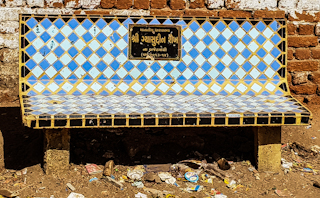
All over Gujarat, in villages and towns and in between, I have seen concrete benches whose surfaces are covered with ceramic tiles or selected flat fragments of broken ceramic plates.

Fragments of ceramic tiling are also used to cover outer surfaces of buildings. A notable example is the curious Amdavad ni Gufa in Ahmedabad designed by architect BV Doshi.

Also, I have seen floors inside buildings covered with a mosaic of tiled fragments, rather than wood, clay, carpeting, or marble.

Why is ceramic tiling used so much in Gujarat. The answer is related to Gujarat’s usually hot climate. I am not a physicist, but the following seems to be the explanation. Ceramic tiles conduct heat well and dosperse heat rapidly from its point of contact.

A surface feels cool to the touch if heat flows from your body to it. The faster the heat is conducted from your body, the…

View original post 192 more words

A lovely discovery

I always enjoy finding bookshops that are out of the ordinary. Although bookselling chains such as Waterstones in the UK and Crossword in India are well stocked with popular titles that are likely to sell well, it is the quirky or niche bookshops that I particularly seek out. The one-off bookshops usually keep a far more interesting range of books than the chains.

Here is a short description of a lovely specialist bookshop hidden away in a residential district of Ahmedabad, not far from the River Sabarmati, on whose bank Mahatma Gandhi set up one of his famous ashrams.
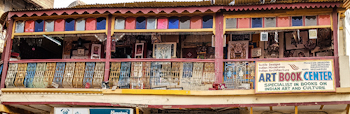
This small gem of bookshop, the Art Book Centre, in Ahmedabad is a wonderful discovery. It was recommended to us by Mr Shukla who is the General Secretary of the Ahmedabad Textile Mill Owners Association, which is housed in a masterpiece by the architectural genius Le Corbusier.

The bookshop, a true life Aladdin’s cave, is on the first floor of a residential building. It is reached by a steep ladder like staircase typical of those found in houses all over Gujarat. The steps lead to a balcony which is festooned with colourful folkloric items. A doorway leads from there into the shop itself.

The walls of the small, cosy shop are lined with neatly stacked book cases. Piles of books rise from the floor. On the walls and in between the book cases, there are numerous folkloric artworks and practical items including beautifully embroidered and printed textiles. We were welcomed by Manarbhai and Ketan, one of his two sons. They invited us to sit down.

Manarbhai worked for many years as a typist in the Mathematics Department of the University of Gujarat. He was no ordinary typist. He was able to type mathematical equations, which was no easy feat in the era before computerised word processors became available.

Manarbhai began his book business as a part time enterprise. In 1970, he converted part of his home into what is now his shop. At first, he only opened his shop on weekends. Now, it is open every day between 10 am and 6 pm.

The shop specialises mainly in books on art and architecture. It contains many books about textiles. Many of the volumes available are rare editions. If what you wish is not stocked, Manarbhai and his sons will do their best to source it, and then send it to you anywhere in the world.

It soon became apparent to us that Manarbhai and Ketan are extremely knowledgeable about books in the fields on which they specialise. They are also sensitively intelligent salesmen. Very quickly, they assessed our particular interests and began showing us books that were in harmony with them. We came away with a valuable selection of books that will help satisfy our curiosity about the fascinating history of the city of Ahmedabad.

This is a bookshop for true book lovers and collectors. It should be on every bibliophile’s itinerary. What Manarbhai cannot find for your bookshelf is probably not worth having.

Address: near Jain Temple, Madalpur, Ellis Bridge, Ahmedabad 380006


This article is adapted from http://www.gujarat-travels.com

It might be you one day

Public animal feeding in India… and reincarnation

yamey's avatarGUJARAT, DAMAN, and DIU

All over Gujarat (and in other parts of India that I have visited), I have seen wild creatures being fed in urban areas. Wild dogs are offered biscuits and other scraps. Pigeons and crows are given grain and water, often in special feeding and drinking vessels. Cattle are fed foliage at Hindu temples, and so on.

When I asked someone about this very prevalent public animal feeding, he told me that all of it was due to members of the Jain communities. I was unsure about the accuracy of this response. So, I asked other people about it. One autorickshaw driver in Ahmedabad, a Muslim, assured us that it was not just the Jains who care for the untamed creatures in the city; everyone cared for these animals.

Recently, when visiting a mosque in the centre of Ahmedabad, I spotted three bowls filled with clean water in front of the…

View original post 265 more words

Ganesh in the graveyard

How many gardeners do you know, with whom you can have a conversation about theology?

yamey's avatarGUJARAT, DAMAN, and DIU

One Tree Hill Garden is a luxuriant little park on the shore of Kankaria Lake in Ahmedabad. At one end of the park, there is a small graveyard. The graves, which date back to the 17th century, mark the final resting places of some of the Dutch folk who worked in the trading post that the Dutch East India Company established in Ahmedabad at that time.

The graves are crumbling and most of them have lost their inscriptions. A few stones bear the incomplete remains of now barely legible inscriptions.

In about 2000, a Dutch foundation constructed several attractive Islamic looking concrete shelters over some of the gravestones.

I noticed that someone had placed a plastic model of the Hindu deity Ganesh next to one of the dilapidated graves. We showed this to a couple of the garden’s workers, one a Hindu and the other a Muslim, and mentioned that…

View original post 101 more words

Weaving in Patan

PATOLA: A very complex traditional weaving process used to make durable valuable fabrics for Indian saris etc …

yamey's avatarGUJARAT, DAMAN, and DIU

Many people visit Patan in Gujarat to see the spectacular pre 14th century Rani ki Vav, one of the largest stepwells in the state. It was built by the Solanki dynasty.

Patan is also the home of a very special form of weaving called ‘Double Ikat Patola’. The fabrics produced are extremely durable, very colourfast, and display the pattern equally on the front and reverse.

When finished, even the experienced weaver cannot tell which surface of the material is front, and which is back. The textiles are woven to form saris. These are very costly and take many months to manufacture. The method of fabricating this kind of cloth is so complicated that, despite much research, no one has been able to produce a machine to replicate the process that has been done by hand for many centuries in the workshops in Patan.

We were very fortunate to have been…

View original post 516 more words