
Leave in good time
Why rush for that bus
Or risk missing an aeroplane.

Leave in good time
Why rush for that bus
Or risk missing an aeroplane.

Back in 1983, I visited Bulgaria. I had been advised that it was very unwise to exchange currency in the country any other way than by using the state’s official foreign exchange desks. So, as soon as I disembarked at the railway station at Sofia, I changed some of my UK Pounds into Bulgarian Leva. Even at the official exchange rate, one Pound had a more than adequate spending power.
My friend and I took a taxi to the city centre. When we arrived, the meter , I asked the driver how much we needed to pay. He answered:
“One Deutschmark, One Dollar, One Swiss Franc, or one Pound.”
I said that I wanted to pay in Bulgarian Leva. He said:
“Two Leva”
But, I protested:
“The meter says only one Leva”
The driver turned around and said:
“Two people: two Leva”
I repeat this true tale to emphasise how little local money was valued in comparison with so-called ‘hard currency’. Also, in a few months when the UK leaves the European Union, probably without a trade deal, the Pound, which is already sinking in value, might cease to be a hard currency. Who knows, but here in the UK we might prefer to be paid not in our own currency but in one of the harder currencies such as the US Dollar or the Euro.
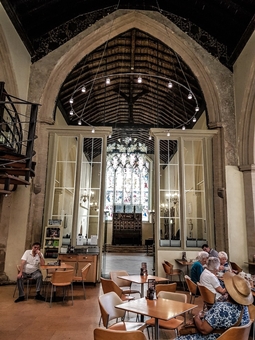
Many churches in England contain cafés or have become cafés. The picture shows a converted church in central Cambridge. And here is a haiku:
Tea in a café
Gothic arch-es all around
Once it was a church

While looking for something to eat on the train between Cambridge and London, I spotted a sandwich in a colourful wrapping (illustrated above). It was a ‘LGBT’ sandwich containing Lettuce, Guacamole, Bacon, and Tomato. Well, the initials ‘LGBT’ usually refer to ‘lesbian, gay, bisexual, and transgender’. The colours of the sandwich’s wrapping are those associated with the LGBT ‘community’.
I wondered whether M&S, the suppliers of this colourfully wrapped sandwich were:
Who knows? I did not buy this sandwich, but selected a similar one, the BLT, which lacks guacamole.
Many of us have great faith in reviews of artistic events such as film, theatre, and other performances. Can one trust professional critics and reviewers? Do their tastes match yours? If they do not and you follow their reccommendation, you must be prepared for an anti-climax.

A rave five star review
Great expectation
Sometimes disappointment

This patient of mine was a local school teacher. An educated person, you would imagine.
One rainy afternoon he sat on my dental chair. Then, I reclined it so that he was lying almost horizontal: his head and mouth at one end of the chair and his feet at least five and a half feet from his mouth. I administered the local anaesthetic, waited for anaesthesia to become established, and then repaired the teacher’s decayed molar tooth with a silver amalgam ‘filling’. When the procedure was over, the teacher left my surgery apparently quite content.
An hour or so later, the teacher returned to our practice and asked the receptionist to allow him to speak to me. He entered my surgery and pointed to a mark on one of his brown suede shoes.
“I believe that you must have dropped some of your chemicals on my shoe while you were treating me,” he said.
I looked at the mark and quickly realised that this fellow was hoping to be compensated, possibly for a sufficient to buy a new pair of shoes.
“Unlikely,” I replied, “while I was treating you, you were lying horizontally. Your mouth was a long way from your feet. If I had dropped something, it would not have fallen anywhere near your feet.”
“Mmmmh,” he replied.
“Furthermore,” I added, “it’s been raining heavily all afternoon. Maybe, you picked up that mark while walking along the wet streets.”
The teacher left, and I heard no more about the problem with his footwear. I was left thinking what an unintelligent man he was, and that somebody had qualified as being capable of teaching young people.
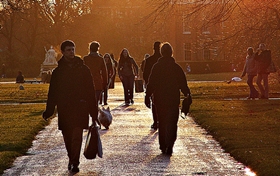
One foot then another
The world passes by
How I enjoy walking
You can walk almost anywhere except on water when it is not frozen. And, the joy of this form of physical activity is that no special equipment is needed.
During the first few decades of my life, I used to walk long distances routinely. I would never wait for a bus, but would walk from stop to stop until the bus and I met in the same place. Then, I might have boarded it unless I was close to my destination. Today, I am lazier, and will wait for the bus.
Walking (without staring at a mobile telephone) is a wonderful way of seeing new things. You might walk the same route repeatedly but if you keep your eyes and mind open, you are bound to spot things that you never noticed before.
In recent years, I have begun writing books, articles, and, now, blogs. I often find that leaving my work desk, switching off the PC, and then taking a walk is perfect for sorting out my ideas. As I walk along, thoughts circulate in my mind and these result in improvements in whatever I am writing.
Apart from any medical benefits, using Shank’s Pony (moving along with one’s own two feet – walking) gives me great pleasure.
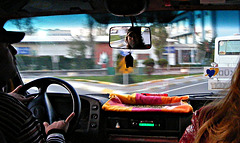
A few years ago, we hired a mini-cab (a type of taxi) to take us from Kensington to Golders Green. When we entered the cab, we heard music being played on the car’s cassette player. It sounded Russian to me. I asked the driver about it and he confirmed that it was Russian. He told us that he was from Afghanistan and had lived in Russia for a couple of years before settling in London. We began chatting as we drove northwards towards Golders Green. He told us that during the day he sold shoes in his own shop and drove his cab in the evening. We engaged in an amicable conversation.
When we arrived at our destination, I asked how much we owed him. He said:
“Nothing at all.”
“But, we must pay you something,” I said.
“No, nothing. You are my friend. I cannot ask you to pay me,” he explained.
For a few moments, I was flummoxed, at a loss as how to proceed. On the one hand, he said he did not want to be paid. On the other, he had done a good job for us, which needed rewarding. Then, I said to him, handing over a £10 note:
“If we can’t pay you, take this as a present for your children.”
He accepted the money without objection. £10 was the normal fare for that journey in those days.
We booked another mini-cab for our return journey. By coincidence, it was driven by someone from Afghanistan. Although he was not as friendly as the outward bound driver, there was nothing to complain about him. When we arrived at our home, we asked him how much we owed. He answered:
“Anything you like.”
I paid him the £10, which we usually pid for that journey, and the driver was happy with that.
Shortly before that day of Afghan mini-cab drivers, I had finished reading a book about travelling in Afghanistan., An Unexpected Light: Travels in Afghanistan by Jason Elliott. In it, he describes shopping in rural Afghanistan. The customer is not quoted a price, but has to make an offer. If the offer is too low, the seller will look insulted and hurt. If it is too high, everyone else in the shop will laugh at the customer. I suspect that it was on this basis that the two mini-cab drivers operated with us. They must have detected our familiarity with eastern ways and customs. Had we been typical Anglo Saxon customers, they might have simply quoted a price.

We entered a popular Thai restaurant, part of a chain, in London’s West Hampstead and waited for our friends to arrive. As they were taking a long time to reach us, we ordered some prawn crackers to quell our pangs of hunger. They arrived quickly with, much to my surprise, a couple of gooey dipping sauces.
The rather unfriendly waitress who delivered our snack, pushed our cheaply produced paper menus aside and said with an abrupt tone of voice:
“Don’t dirty the menus with the sauces.”
I was surprised. Never before in over sixty years of eating regularly in restaurants all over the world have I been asked, nay ordered, to keep the menu clean. I felt that this order to maintain the integrity of the menus to be unwelcome, unfriendly, and impolite.
After eating a revoltingly over sweet meal, I told the waitress about my disgust at her extraordinary instruction when she delivered the prawn crackers. She seemed unfazed by my complaint. I will never ever enter that restaurant again!

The picture depicts the sun setting over Albania as viewed from the Yugoslav shore of Lake Ohrid. When I took the picture, I was standing in Yugoslavia. Now the sun has set forever over Yugoslavia: that country exists no more. What made me interested in Yugoslavia and the Balkans? Here is my reply.
Hergé, the Belgian creator of the cartoon character Tintin, must be held responsible for my fascination with the Balkans. From the age of 7, when my father first presented me with one of his books, I became fascinated by the drawings of Syldavia and Borduria in some of the albums. These were two imaginary countries that the Belgian cartoonist invented to depict what he had seen during his visits to the Balkans. They attracted me than all of the other exotic settings of Tintin’s adventures.
My parents were fundamentally opposed to any totalitarian regime, be it right or left wing. They refused to venture behind the so-called Iron Curtain. Furthermore, they were even reluctant to buy anything made there on the basis that any purchase would give financial support to a regime that opposed the capitalist way of life. Their avoidance of countries, which were under the control of communists, and my fascination by Hergé’s cartoon drawings of south-eastern Europe made me yearn to visit them. As soon as I was old enough to travel alone, I gave in to my yearning.
I chose to visit Yugoslavia first for two reasons. First of all, it seemed more accessible than its neighbours; visas were not required and it appeared to have a less oppressive regime than some of the other Balkan countries. Secondly, I was already becoming fascinated by its mysterious neighbour, the tiny hermetically sealed country of Albania. I believed that by visiting certain areas in Yugoslavia I would manage to catch close-up glimpses of this almost completely impenetrable place.
My early visits to Yugoslavia, which commenced in the late 1960s, were made on my own or with other visitors to the country. These were fascinating enough to make me want to see more, but differed little from simple tourism. Soon, I began meeting Yugoslavs. Many of them, especially in Belgrade and Sarajevo, became good friends. My visits to their country began to assume more of a social nature than simply touristic. I believe that as the years passed and I made ever more visits, I began to experience the country more profoundly, and with far greater affection, than the average tourist. My book “SCRABBLE WITH SLIVOVITZ” contains a trail of memories of the experiences I enjoyed whilst visiting a country that no longer exists.
“SCRABBLE WITH SLIVOVITZ”
is available as a paperback: HERE and on Amazon Kindle
 yamey
yamey 