SOME BUSINESSES HAVE chosen names that amuse me. There are plenty of fish and chip shops called ‘The Codfather’. In the small Essex town of Coggeshall, there is a fish and chips shop named ‘Coddes Hall’. And Royal Tunbridge Wells (in Kent) has one of these outlets, which serves fried fish and chips, with the name ‘Happy Friar’. If they have not already been used, I will suggest the following as appropriate names for seafood outlets: ‘Upon my Sole’, ‘The only Plaice’, ‘The Prawn Broker’, and ‘Get on your Skate’.
There is a hair salon in west London’s Ealing district called ‘Pure Barberism’. And when we are in London, one of our favourite coffee shops in Kensington calls itself ‘Perky Blenders’.
You may be excused for asking where this collection of gimmicky names is this leading to? Well, I was inspired to write this short piece after eating some ice cream in the charming Cornish seaport called Fowey (pronounced ‘foy’). The ice creams were sold at a shop called ‘Game of Cones’. I enjoyed the ice cream much more than the only two episodes of the TV show that inspired the ice cream parlour’s name.
WILTON IN WILTSHIRE was capital of Wessex between the 9th and 11th centuries (AD). Today, it is famous for its carpet manufacturing and the wonderful Wilton House, which has been home to the Earls of Pembroke since 1544, when King Henry VIII gave it to them after the Dissolution of the Monasteries. The House, which contains a fabulous collection of paintings by the great masters, was built on the site of Wilton Abbey (established in 871 AD).
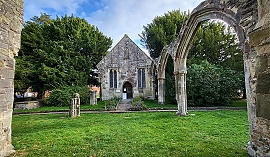
St Mary’s church in the centre of Wilton was originally the first Anglo-Saxon church in the town. It was first built in the 9th century, and then rebuilt in the 12th century. The newer church was further modified in the 15th century. However, by the 18th century it was becoming dilapidated. In 1751, the surving part of the church became used as a mortuary chapel for the Earls of Pembroke. This situation remained unchanged until 1848, when the construction of the large Italianate church of St Mary and St Nicholas was completed in nearby West Street. Then, the old St Mary’s was demolished except for the chancel and the first bay of the nave (than next to the chancel). This survivor is rarely used for services and is now cared for by the Churches Conservation Trust, which looks after historic churches of interest that have become redundant. Outside the preserved part of St Mary’s there are a few gothic arches, remains of the previously much larger church.
We have visited Wilton several times, to see both Wilton House and the Italianate church, as well as to partake of refreshments in the town’s cafés, but it was only today (7th of October 2022) that I first noticed the remains of St Mary’s. This only goes to show that revisiting a place often can be rewarding.
Adam Yamey is the author of several books, including: “Albania on my Mind”; “Scrabble with Slivovitz;” (Once upon a time in Yugoslavia); “From Albania to Sicily”; “Exodus to Africa”; “Rediscovering Albania”; “Aliwal”; “Bangalore Revealed”; “Indian Freedom Fighters in London (1905-1910)”; “Imprisoned in India”; “Beneath a Wide Sky: Hampstead and its Environs”; “Beyond Marylebone and Mayfair: Exploring West London”.
His latest book is:
“Golders Green & Hampstead Garden Suburb: Visions of Arcadia”
Born in 1952 in London, he attended Highgate School, and then University College London. After a doctorate in mammalian physiology, he became an undergraduate once more and qualified as a dental surgeon. After 35 years in general dental practice in Kent and London, he retired in September 2017.
Adam married a lady from India in 1994, and, since then, has been visiting her native land frequently. India has become his second home. He is a keen traveller. The periods between his journeys are usefully and enjoyably employed with: family, cooking, writing, photography, blogging, cinema, theatre, and exploring the many delights that London has to offer.
SANTA MARIA DEL GIGLIO, or ‘Santa Maria Zobenigo’ as it is commonly named in Venice, is a baroque church with a magnificent façade. It was built between 1678 and 1681. The edifice was constructed by Giuseppe Sardi for Admiral Antonio Barbaro, who died in 1679. Amongst his many achievements he was Provveditore Generale (Governor General) of Venetian Dalmatia and Venetian Albania in 1670-71.
During my many visits to Venice, most of which were made annually with my parents during the 1960s, I have passed the church and noted an interesting feature of its façade. The base of this is decorated with six carved stone bas-relief maps. These have always fascinated me, but it was only after our recent trip to Venice in September 2022 that I finally got around to investigating them.
The maps are of Spalato (Split in Croatia); Corfu; Roma (Rome); Padoa (Padua); Candia (Haraklion in Crete); and Zara (Zadar in Croatia). Except for Rome, these are all places that were once governed by Venice. The maps depict places where Antonio Barbaro served in one capacity or another.
Wnen James (later Jan) Morris wrote “Venice” (published 1960), which is I believe the best book written about Venice, he/she noted of the façade of Santa Maria Zobenigo that:
“… it is notorious because not one item of its convoluted design has any religious significance whatsoever.”
Morris also pointed out something I have never noticed on that façade. Namely, that it bears a crest with a double-headed eagle, the crest of the Barbaro family. As this symbol interests me, I checked it out. The Barbaro family might have used it because of their connection to the Vlasto family, who were prominent in Rome by the end of 2nd century AD (see; www.christopherlong.co.uk/per/vlasto.byzantium.html). By the end of the 11th century, the Vlasto family was members of important families including the Barbaro’s. The Vlasto family crest includes the double-headed eagle, which amongst other things, was a Byzantine symbol. Interestingly, the Vlasto’s had already begun using it in the early 1st century AD, while the Byzantines only began using it in the 12th – 13th centuries. Maybe I never noticed the double-headed eagle because whenever I have passed the church, my eyes have been drawn to the maps on its fine façade. They fascinated me so much that I never bothered to look upwards.
During the late 1990s, our then young daughter had a baby-sitter called Bridie. Although Bridie was already well into her eighties when we first met her, she was a remarkably sprightly lady. Born in a rural part of the west of Ireland, she came to England in her late teens. On arrival in England, she and her husband were cared for by the Salvation Army in exchange for taking a pledge never to drink alcohol again. Bridie never reneged on this promise. To earn a living in London, where she settled, she became a domestic servant. Hearing that I had been brought up in northwest London’s Golders Green, she told me the following story.
War memorial clocktower in Golders Green
Sometime before WW2, Bridie was employed as a maid in a Jewish household in Golders Green. She looked after the family’s children and carried out many household duties. Even though it was not a particularly wealthy family, Bridie recalled that she wore uniforms when on duty. There was one outfit that she wore in daytime and in the evening, she changed into another. As she did with our daughter, Bridie became fond of the family’s two young sons.
Many years later, when Bridie had become a grandmother and our daughter’s baby-sitter, she used to spend her spare time travelling around London by bus (making use of her old age free bus pass). One day, she was waiting for a bus at the stop closest to Golders Green’s Sainsbury’s (on the site of the Ionic cinema), when a well-dressed late middle-aged man in the queue said to her:
“Goodness! Is it you, Bridie? We have not seen each other for so many years.”
After a moment, Bridie realised that she was being addressed by one of the two boys, whom she had looked after in the house in Golders Green before the War. Just then, a bus arrived, and as her former charge was about to embark, he shouted:
“This is my bus. Are you taking it, Bridie?”
Bridie misheard what he had said, and by the time she realised, the bus had pulled away, leaving her at the bus stop. She told me that if she had known he was taking that bus, she would have joined him. As far as I know, she has never seen him again.
THE TALL GREY GRANITE drinking fountain that stands on the southeast corner of London’s Lincoln’s Inn Fields is no longer in use. The inscription carved on its base reads:
“In memory of Philip Twells. Barrister at law of Lincolns Inn and sometime Member of Parliament for the City of London. 8 May A.D. 1880”
Born the son of a banker John Twells (1776-1866), Philip (1808-1880) attended Oxford University and then was called to the bar at Lincoln’s Inn in 1834. His father was a partner in the private bank of Spooner Attwood & Co. In 1863, that bank was taken over by Barclay, Bevan & Tritton & Co, a precursor of the modern Barclays Bank. It was then that Philip became a partner in the enlarged banking concern. He was MP for the City of London from 1874 to 1880.
A website (www.layersoflondon.org/map/records/philip-twells-mp-banker-and-slave-owner-of-stoke-newington-church-street) recorded that Philip Twells owned 252 slaves in Jamaica, and added:
“The Slavery Abolition Act of 1833 had made the ownership of slaves illegal within the British Empire although servitude was replaced by ‘apprenticeship’ for at least five years. The 1837 Slave Compensation Act provided compensation to owners for the loss of their business assets.”
“Awarded part of the compensation for the Islington estate in St Mary Jamaica with his brother Rev. John Twells …”
The slave-owner compensation awarded to Philip was £4207, which is worth well in excess of £300,000 in today’s money. On his death, Pholip left a substantial fortune to his wife.
The fountain commemorating Twells in Lincoln’s Inn Fields was a gift of his widow, and was erected in 1882. Sadly, this memorial to a former owner of slaves can no longer refresh the passer-by. However, during weekdays, food and drinks can be obtained at a café in the middle of Lincolns Inn Fields. And while you are in the area, do not miss seeing the magnificent Sir John Soane’s Museum on the north side of the Fields.
THE ITALIAN WORD ‘scuola’ (plural: scuole) does not always mean ‘school’ (i.e., an educational establishment). In Venice, there are several scuole, which were never schools, but confraternities (or guilds). Well-known examples of these include the Scuola Grande di San Rocco, which contains many fine paintings by Tintoretto (1518-1594), and the Scuola Dalmata dei Santi Giorgio e Trifone, which contains a superb set of paintings by Carpaccio (1465-1525). The latter, also known as the Scuola di San Giorgio degli Schiavoni, was founded by Slavs (‘schiavoni’ in Italian) from Dalmatia (now mainly Croatia).
Another group of migrants from the Balkans, Christian (mostly Catholic) Albanians, began arriving in Venice in the early 15th century, both as traders and refugees from the Ottomans. In 1442, the Albanian community in Venice established its own confraternity, the Scuola di Santa Maria degli Albanesi. The building that housed it from the end of the 15th century still stands on a narrow passageway, the Calle dello Spezier, connecting Campo San Stefano and Campo San Maurizio. During our annual family holidays in Venice in the late 1950s and throughout the 1960s, we often passed along the passageway whilst walking from the Academia Bridge to Saint Mark’s Square. After my interest in Albania was first kindled in about 1967, I learnt about the Albanian scuola and always felt excited when we walked past its façade decorated with bas-relief stone carvings.
Three of the sculptures, which are affixed above the ground floor windows, depict two saints (Gallo and Mauritius) with the Mother and Child between them. Above them and located between the two second floor windows there is a larger bas-relief. It portrays a scene with two men in turbans standing on a rock facing a high hill on top of which there is a building with two heraldic crests. One of the men is brandishing a curved sword. This scene is a representation of the great Siege of Shkodër (1478-79). The city was then a Venetian possession. One of the men with a turban is a depiction of Mehmed II. The shields on the building and on the top corners of the sculpture were those of the Loredan and Da Lezze families, who were heroes of the siege.
The Albanian community in Venice was quite important during the period of the Venetian Republic, which ended in 1797. Several years ago, I met the Kosovan scholar and diplomat Bejtullah Destani, who told me that the city’s archives contain many documents charting the activities of the Albanians in Venice, and they have yet to be examined in detail.
Like the Scuola Dalmata, the Scuola degli Albanesi was decorated with a series of paintings by Carpaccio. In 1780, the Albanian scuola was closed. Its building became home to a bakers’ confraternity. 28 years later, when Venice was under Napoleonic rule, the other scuole were all suppressed. The Carpaccio paintings have long since been removed from the Albanian scuola, and can be found in museums in Venice, Milan, and Bergamo.
To get some idea of how splendid the Scuola degli Albanesi must have been in its heyday, a visit to the wonderful Scuola Dalmata should do the trick. Even if you have minimal interest in either Albania or Dalmatia, the paintings by Carpaccio make a good reason to visit Venice.
EARLY IN SEPTEMBER (2022), I was eating spaghetti alle vongole (spaghetti with clams) in a restaurant in Venice (Italy). The place where I was eating this delicious dish has many memories for me.
Lantern hanging outside the entrance to the Antica Locanda Montin
During the late 1950s and throughout the 1960s, my parents took my sister and me for annual holidays in Venice. My parents were discerning eaters. Unfortunately, back in those now far-off times, there were very few restaurants in Venice which served food that met my parents’ approval. Eventually, they homed in on one place that they liked enough to return there for every evening meal (our accommodation provided lunch as part of our demi-pension deal). That restaurant is called the Antica Locanda Montin (‘the Montin’). According to its website, it has hosted celebrities including Modigliani, Ezra Pound, Robert de Niro, Luigi Nono, and David Bowie. Well, I did not know that when I used to dine there with my family.
During our recent trip to Venice, we found out that the Montin is still in business, and we booked a table for lunch. To my delight and amazement, the restaurant looks exactly as it did when I last visited it over 50 years ago. It does not seem to have changed one little bit. The front of the Montin faces a small canal. The dining room is long and rectangular. At the far end opposite the front door, a rear door gives access to a pleasant garden, where people can eat in good weather. The walls of the dining room are covered with framed paintings, many of them of great artistic quality. Apparently, they have been donated over the years by artists, who have dined in the restaurant.
I cannot remember what I used to eat at the Montin over 50 years ago. However, my spaghetti alle vongole was tasty and enjoyable. My wife and our daughter were also happy with what they ate. Our lunch was one of the better meals we ate during our four days in Venice. What I enjoyed even more than the food was discovering that the Montin looks as it did when I was much younger. I am glad that the place has survived the trying times we have been through recently and Italy’s various economic crises.




 yamey
yamey 