THE COURTS GARDEN is in Holt in Wiltshire. The gardens surround a house that was built for a clothier in about 1720, although some parts of the structure were built 200 years earlier.
In 1900, the house was purchased by the architect Sir George Hastings. It was he who laid out the magnificent gardens surrounding the house. The property changed owners in 1910 and then again in 1920, when it was purchased by Major TCE Goff and his wife Lady Cecile. She was influenced by the garden designer Gertrude Jekyll, and created various new features in the garden. The Goffs donated the house and gardens to the National Trust in 1943.
Well-maintained, this beautiful garden is well worth a visit.
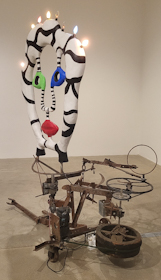
DURSLADE FARM NEAR Bruton in Somerset is home to a branch of the international commercial art gallery, Hauser and Wirth. Until 1 February 2026, there is a wonderful exhibition of artworks by Jean Tinguely (1925-1991) and his partner, wife (for a while), and long-term collaborator Nikki de St Phalle (1930-2002). Both artists produced highly original and very imaginative creations.
A collaboration by Tinguely and de St Phalle
The sculptures created by Tinguely are frequently examples of kinetic art in which elements of the sculptures are made to move by motors, which are parts of the artworks. His sculptures often resemble unusual machines. Some of his works were collaborations with Nikki de St Phalle.
Nikki’s works are often colourful, playful, and figurative. In one room of the exhibition, the viewer is introduced to an interesting method of creating artworks used by de St Phalle. She used a rifle to fire bullets filled with paint at various targets. When the bullets hit the targets, they splattered the paint contained within them. A few examples of this procedure are on display in the show.
The exhibition is held both inside and outside the buildings at Durslade Farm. The works outside were by de St Phalle. Those by Tinguely are all inside. Every 10 minutes, the sculptures with motors are activated for a few minutes. They are now too fragile to be run continuously or left in the open air.
Hauser and Wirth Somerset (at Durslade Farm) is now a popular destination not only for its art shows but also for its restaurants, garden, and pricey farm shop. However, its art exhibitions are always superb, and the current one is no exception.
COMPTON CASTLE IN DEVON is deep in the countryside near to Torquay. It is a fortified manor house that dates back to 1520, and before the fortifications were added in that year, it was already a manor house by the mid fourteenth century.
For many centuries, Compton Castle was home to the Gilbert family. In 1785, the estate was sold. However, in 1931, and American descendant of the family purchased the estate and restored the castle. In 1951, the estate became part of the National Trust on condition that the family could continue to live in a part of it. Today, one wing of the castle is the private home of some members of the Gilbert family.
The most famous member of the family is Sir Humphrey Gilbert (c1539-1583). He is best known for establishing a British colony in Newfoundland – the first British colony in America. And it was the first ever British colony in the world. It can be said that by founding this colony, he was the founder of the British Empire.
Sir Humphrey died at sea while travelling on an English ship, the Squirrel. In many places within Compton Castle there are images and sculptures of squirrels in memory of this ship.
Compton Castle is well worth visiting. Not only is the castle magnificent, but also the rose garden next to it.
IT WAS UNUSUAL for my parents to take us on holidays at the seaside during my childhood. Mostly we went to cities, such as Bruges, Florence, and Delft, where there were plenty of artistic treasures to be viewed. Yet, one year when I was less than 10 years old, we spent a holiday at a hotel in a small place, Maidencombe, which is a few miles east of Torquay in Devon. All I can recall of this trip was staying in a country house hotel that had a beautiful flower-filled garden.
Yesterday (4 June 2025), my wife and I stopped at Maidencombe. I could not recognise anything, and I believe that the hotel where we stayed over 60 years ago has disappeared.
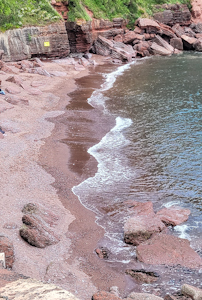
We followed signs to the Café Rio, which is reached down a winding staircase that clings to the slopes of a hillside overlooking a secluded cove surrounded by striated red rocks. The hillside is covered with luxuriant vegetation. The café is on a terrace above a small beach, where intrepid swimmers were enjoying the sea. We ate a light lunch on this terrace, and enjoyed the view.
I am pleased we visited Maidencombe but I can not stop wondering why my parents chose to go there instead of one of our usual culturally rich destinations. What or who influenced them to select Maidencombe? I will most probably never know.
THE DOUBLE-HEADED EAGLE symbol, which dates back to ancient Babylon, and is used as the national symbol of Russia, Serbia, Albania, and other places, can be found in England. This example is on the drain pipe of The Museum of Archaeology and Anthropology in Cambridge. The building stands on the corner of Pembroke Street and Tennis Court Road. The double-headed eagles on the drain pipe can be viewed from Tennis Court Road. I have not yet found out why this symbol was chosen to decorate the drainage pipe.
I HAVE BEEN PAST the Old Bull and Bush pub near Hampstead inummerable times during the past 70 years, but until today (1 June 2025), I had never entered it. Here is a little about the pub from my book “Beneath a Wide Sky: Hampstead and its Environs”:
“Made famous in an old music hall song Down at the Old Bull and Bush (by Andrew B Sterling and Henry von Tilzer), the Old Bull and Bush began life as a farmhouse that was built around 1645. The pub began in the early 18th century. The artist William Hogarth (1697-1754) visited it regularly. The artists Gainsborough and Reynolds frequented the pub with the actor/director Garrick. The present pub was built in the 1920s and is uninteresting architecturally. When I was a child, there was another pub next door to the Old Bull and Bush. This was the ‘Hare and Hounds’. I used to pass it and the two pubs on my way to school in Highgate (between 1965 and 1970). It was already present in the early 19th century. In 1940, during WW2 it was twice destroyed by aerial bombardment. And, according to Christopher Wade, it: “… existed for a time in five linked caravans…” before being rebuilt in 1968. The pub ceased operating in 2000 and has since been demolished. A modern brick apartment block now stands where people used to enjoy a casual pint.”
Well, today, we ate lunch at the pub. The dining room was comfortable, the service was good, but the food was unexceptional. Would I visit that establishment again? Maybe, but I still prefer other pubs in Hampstead.
THIS IS A SUNDIAL at Oxburgh Hall in Norfolk . Only useful when the sun shines, which is not always the case in England. According to Wikipedia, that wonderful source of knowledge whose reliability is often good, the earliest known sundials date from 1500 BC. These were discovered by archaeologists working in Egypt. Oxburgh Hall was built largely in the late 15th century.
SHYAMA GOLDEN WAS born in Texas (USA) in 1983. She is an artist of Sri Lankan heritage, who works in Los Angeles (USA). After qualifying to become a designer and illustrator, she took up full-time painting in 2020. Until 1 July 2025, there is an exhibition of her work at the PM/AM Gallery in London’s Eastcastle Street.
The exhibition includes a short film that Shyama created (with Paul Trillo), which is related to two of the paintings on show. It is a successful attempt to bring ‘to life’ or animate the scenes shown in the paintings. The artist is planning to make other films based on the other paintings in the show. The paintings have a dreamlike quality and most of them include details (for example parrots, exotic plants and jackfruits) that allude to the artist’s Sri Lankan heritage. With one exception, the paintings include blue masks such as are used in traditional Sri Lankan theatrical productions. In most of these paintings, the human figures are shown wearing these masks. The exhibition also includes four blue masks that Shyam has created.
Of the kind of work being shown in the gallery, the artist wrote in her website:
“… my current works populate a parallel dimension with a cast of characters which include vine-covered trees suggestive of human archetypes, Sri Lankan devil dancers dressed as Yakkas who take part in exorcist rituals, and self portraiture. The work is intended to appear theatrical, reflecting on an awareness of the social performance necessitated by our relationships with each other and the drama of everyday life.”
I enjoyed the exhibition because of the paintings’ eerily exotic, surrealist subject matter, depicted in interesting settings. It is remarkable to consider that these intriguing, competent works have been created by someone who has not had formal training in oil painting.
WITH ABOUT SIX hundred and forty pages of text, this book published in 2024 covers a lot of ground. Much of what Tripathi writes about Gujarat and the Gujaratis is fascinating. However, the author’s definition of who is a Gujarati may differ from that of many others. His definition of a Gujarati is anyone whose mother tongue is Gujarati. Thus, he includes groups such as the Parsis, the Bohras, and the Khojas. None of those groups, all of whom have Gujarati as their mother tongue, would usually describe themselves as Gujaratis, even if they reside in Gujarat. Although Kachchhis generally speak Kachchhi amongst themselves, most speak Gujarati as well, but most of them would disagree with Tripathi’s calling them ‘Gujaratis’. By using his definition of a Gujarati, the author was able to include many people, who would not have described themselves as Gujarati, in his book.
The book is a mine of information about people that the author describes as being Gujaratis. Much of this information is fascinating, but there were occasional passages that I felt should have been shortened or omitted. Although Tripathi deals a lot with some of the sadder aspects of life in Gujarat, he also injects humour into his text. However, he notes that Gujaratis are proud of Mahatma Gandhi, a Gujarati, but in recent years, they seem to be forgetting what he stood for.
I am glad that I read this book, but would advise those planning to read it that it is more of an encyclopaedia than a portrait of the Gujaratis. Tripathi covers a great deal, but I felt that at the end of it, my understanding of the soul of Gujarat and its people had only increased by a small amount.







 yamey
yamey 