Inspired by a wax sculpture, “Dasha”, by Urs Fischer

Like a candle, an idea
burns through her brain
burrowing still deeper



Inspired by a wax sculpture, “Dasha”, by Urs Fischer
Like a candle, an idea
burns through her brain
burrowing still deeper

I spent three years working on the experimental aspects of my PhD topic at University College London (‘UCL’) in a laboratory in the Physiology Department. Throughout that time there were always one or two other PhD students working in the same room. ‘Wink’, our supervisor’s wife, was a chemist. She often worked alongside us. Generally, the atmosphere in the laboratory was very congenial.
We were joined by a new PhD student sometime during my second year in the lab. Fortunately, I cannot recall her name, but let’s call her ‘June’.
One morning, June asked me whether she could borrow a pencil from me. As pencils were few and far between in our lab, I said to her: “Make sure you give it back, please.” To which she answered in an unfriendly tone: “Don’t be so Jewish.”
Now, it so happens that I am born Jewish. Although I am the least observant (in religious terms) Jewish person you are ever likely to meet, I am not happy when the word ‘Jewish’ or ‘Jew’ is used pejoratively. Wink must have seen my face flush, because she said to June: “That was unnecessary.”
Although it was almost innocuous, the pencil incident made me wary of June.
Some month’s later, Wink and her husband invited all their PhD students to be their guests at the annual Physiological Society Dinner, which was being held at UCL. I was seated beside Wink and opposite June. When the main course arrived, there were green peas on our plates. I do not like these small round spheres at all.
June noticed me pushing them aside on my plate, and said: “Is your religion also against peas? I must remember that when I invite you around to my place for dinner.” Feeling my face warming, I said to June: “Even if you were to beg me to come to eat at your place, I would have no hesitation in refusing.” Hearing that, June’s face turned bright red. She stood up and without saying anything, left the dining hall. Wink turned to me, and whispered: “Well said, Adam.”
June abandoned her PhD and our lab not long after this dinner.

Now, many years later, I am still sensitive about anti-Semitic remarks, but also deeply curious as to why European people make them, often when they have had little or no contact with Jewish people. In India, which I visit often, although there have never been many Jewish people there, there is barely, if any, prejudice against them. Often Indian people extol the virtues of Jewish people.


Horse power, no diesel
glimpsing the past:
on today’s Piccadilly
In the 1980s, I visited my friends in the former Yugoslavia frequently. Also, I visited Albania and what is now independent Kosovo. During my trips, I picked up a large vocabulary of Serbo-Croat, including quite a selection of outrageous swear words. Grammar has always been beyond me in foreign languages, and often in my own. My interest in Albania and my brief visits to Albanian-speaking parts of the Balkans resulted in me acquiring some vocabulary in Albanian, but far less than in Serbo-Croat. Until the 1990s, I believed that my fragmentary knowledge of these languages would be useless outside the Balkans.
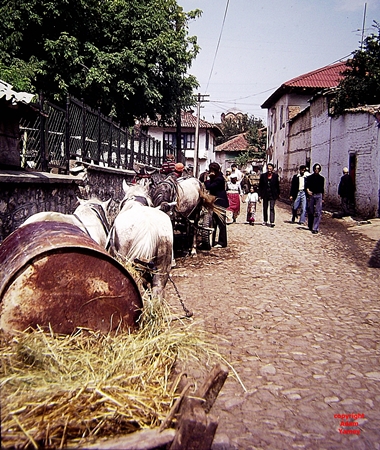
Prizren in Kosovo, pre-1990
During one trip to Belgrade, a friend arranged for me to be an observer in a clinic of a leading oral surgeon. I turned up at a large hospital and spent a couple of hours watching the surgeon reviewing a series of his patients. Although I was grateful to be allowed to watch the great man, I learned little that was relevant to practising dentistry. However, one aspect of this clinic interested me greatly. As each patient entered the consulting room, he or she presented the surgeon with a gift: a bottle, a large piece of cheese, a ham, etc.
The last patient to enter, a man in a somewhat shabby suit, entered and sat in the dental chair without having presented a gift. After his mouth had been examined, the surgeon took the patient and me out into a corridor. We walked through the hospital to a room with locked doors. My host unlocked it, we entered, and he locked the doors behind us. After a brief conversation, the patient handed the surgeon a small brown envelope, which he thrust into his jacket pocket. Then, after the doors were unlocked, the patient went one way, and we went another way. As we walked along the corridor, my host patted the pocket containing the envelope, and before bidding me farewell, said: “Pornographic photographs.”

Poster of Marshal Tito in Sarajevo, Bosnia in the 1980s
My last visit to Yugoslavia was in May 1990. Soon after that, wars broke out in the Balkans, and the former Yugoslavia disintegrated painfully to form smaller independent states. In the early to mid-1990s, there was terrible strife in Bosnia. Many people fled as refugees to places including the UK. In the late 1990s, Kosovo suffered badly from warfare between the Serbs and the ethnic Albanians. Many of the latter fled to the UK.
I moved from one dental practice outside London to another in London, an inner-city practice, in 2001. A significant number of my patients there had come from the former Yugoslavia as refugees. I was the only person in the practice who could greet them in Serbo-Croat or Albanian. Maybe, I was only one of a few dentists in London at that time who had this ability.
To the Albanian speakers my vocabulary was restricted to words such as ‘hello’ and ‘good-bye’, which brought smiles to their faces. Following a trip to Communist Albania in 1984, I recalled the Albanian words of political slogans such as “Long live Enver Hoxha”, “Enver’s party”, and “Long live the Peoples’ Party of Albania.” As many of my Albanian patients had come from Kosovo rather than Albania, these slogans meant little to most of them.
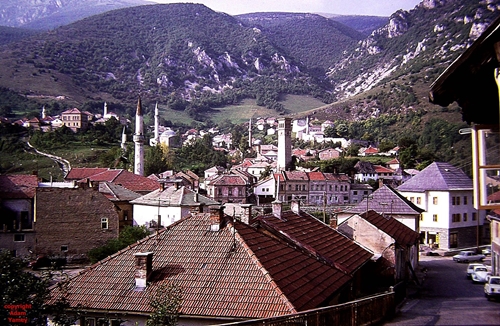
Travnik, Bosnia, 1975
My limited Serbo-Croat was more extensive than my Albanian. I could entertain some of my Bosnian and Serbian patients with polite small-talk. Many of the ex-Yugoslav patients, like those I had seen long before in Belgrade, brought me gifts. Even those, with whom I felt I was not getting along with well, brought me, usually, bottles of home-made alcohol (e.g. rakia, slivovitz, and loza) that had been distilled by relatives who had stayed behind in the former Yugoslavia. These strong alcoholic drinks were delicious, smooth, and delicately flavoured. One fellow plied me with DVDs of the latest Hollywood and other films that he had ‘pirated’. One lovely lady from Bosnia presented me with a pair of earrings, which her uncle had made, to give to my wife. She wears these often, and she is very grateful.

Many Middle-Eastern patients also felt that it was appropriate to bring me gifts. Thus, a lot of delicious baklava and other similar confections came my way. Delicious as these were, they were neither good for my teeth nor for my general health. A Hungarian family kept me supplied with large gifts of paprika powder, and there was a Romanian gentleman who brought me nice bottles of wine. Incidentally, the only words of Romanian I know are “thank you” and “railway timetable”. Once, we employed a Romanian dental nurse and I told her my Romanian party-piece “Mersul trenurilor.” She pondered for a moment and then replied “Ah, the programme of the trains.”
Once, my dental nurse, a friendly West Indian lady, and I were standing near a window facing the main road when a delivery van stopped nearby. A man was delivering trays of baklava to a nearby shop. I said to my nurse: “Why don’t you see if he’ll give us some to try?” She returned with a tray of baklava. Carelessly, because I was in a hurry to see my next patient, I put a large lump of baklava into my mouth, and then bit hard on it. As I was doing this, I heard a deafening bang in my head. The baklava was not too fresh. I had split a molar tooth into two parts, the smaller of which was loose in my gum.
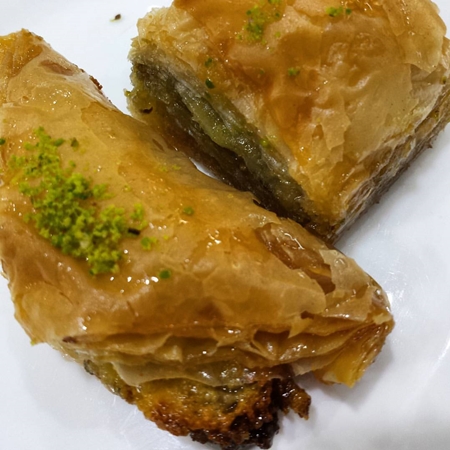
Baklava
Unlike this disastrous piece of confectionary, the gifts kindly given to me by my patients did no harm. Furthermore, what I believed to be a useless tiny vocabulary of Balkan languages proved to be quite useful.
Finally, you might still be wondering whether anybody ever took me aside to present me with an envelope containing pornographic photographs. To satisfy your curiosity, I can tell you that nobody did.
Greetings and thanks to all my followers and other readers!
Your continued interest is much appreciated
Enjoy your weekend!

Two wheels two pedals
Fine frame and brakes
Propell’d by one rider alone
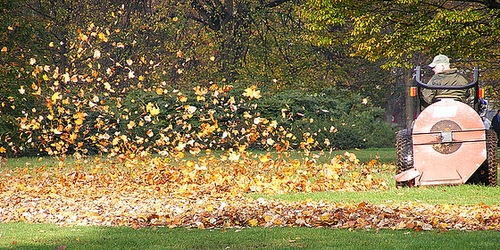
Leaves are falling
sun rises late, air cooling
I’m thinking autumnal
Artwork by Man Ray (1890-1976)
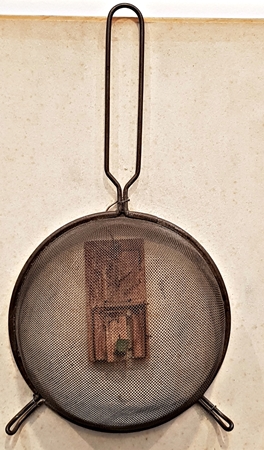
It’s so simple yet so alluring
a sieve, a mouse trap:
it’s pure Dada
At Hackney Downs station

Linear parallels
converging finally
on a high walkway
On Saturday the 29th September 2018, we had a wonderful evening at London’s recently opened Bridge Theatre. It is located on the south bank of the River Thames, a stone’s throw from the world famous ‘icon’ of London, Tower Bridge. From the glass front of the theatre’s foyer, there are superb views of: the new high-rise buildings in the City (including the ‘Gherkin’); the White Tower and the walls of the Tower of London; and Tower Bridge, which is beautifully illuminated at night.

The Bridge Theatre opened for its first show in October 2017. The theatre is the brainchild of Nick Starr, of the former National Theatre, and the renowned theatre director Nicholas Hytner. Both of these two Nicks have been long involved with London’s National Theatre. Their creation, the Bridge, is an improved version of the facilities offered by the now ageing National Theatre on the Southbank. Excellent as the National Theatre is, the Bridge seems to have been designed to avoid some of the defects of the former. The newer theatre, which can seat 900 audience members, was designed by S Tompkins and R Watts of Haworth Tompkins Architects.
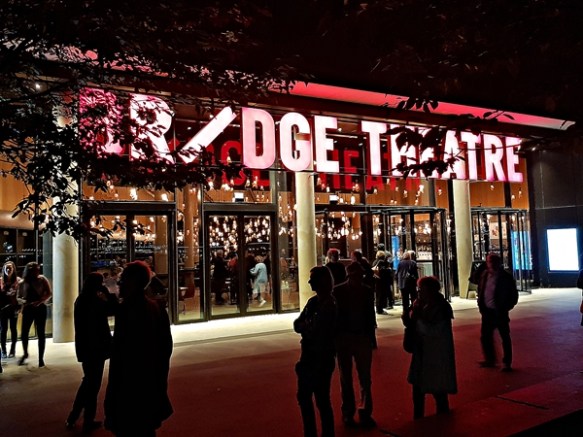
Doorways in the wide glass façade give access to a vast foyer, well-illuminated by a myriad of lamps with curious shades that look like large translucent handkerchiefs. Ample tables and chairs are available for people to sit in the foyer, enjoying excellent food and drinks from the counters lining one side of the space.

When you order food, you are handed a small flat, square receiver that looks like a drinks mat. When your food is ready, lights on the receiver flash alarmingly. The flashing object must be taken to a counter where your freshly prepared food is waiting for you. Despite the size of the foyer and its large capacity, it never felt crowded or noisy. It is a well-designed space.

The cloakroom and toilet facilities are easily accessible, not hidden in odd places as they are in the National Theatre.
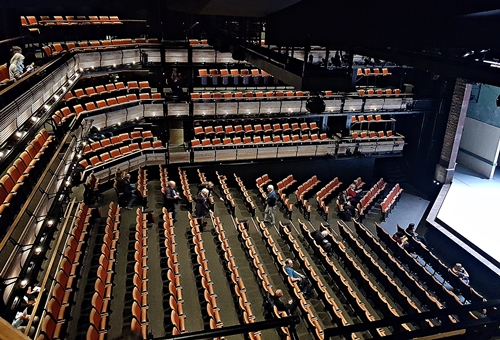
The auditorium is large, but not too large to be without intimacy. No seat is excessively far from the very wide stage. Sightlines are either excellent or more than satisfactory. We had ‘restricted view’ seats, which we bought at the last moment. They were as good as many ‘full view’ seats in older theatres. The acoustics are excellent. We were seated quite far from the stage, but had no difficulty hearing every word. The play we saw, “Allelujah” by Alan Bennett, was well-staged, well-acted, and well-written. In short, it was highly enjoyable. Set in an ageing National Health Service (‘NHS’) hospital facing imminent closure, most of the actors play either the roles of geriatric patients or those of hospital staff and management. The plot is about the plight of the aged and the plight of the ageing NHS system in today’s profit-oriented, economically declining Britain.

Our visit to the Bridge Theatre was enjoyable and uplifting. I cannot wait to see another performance there.

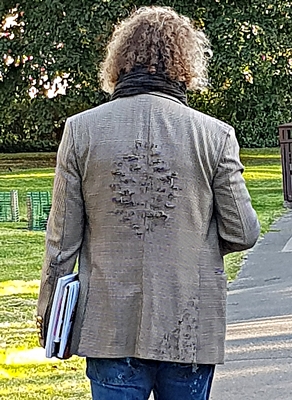
Is it à la mode?
A tailor’s design?
Or is it a torn jacket?
 yamey
yamey 