IN 1604 THE COURT of the KIng’s Bench made a judgement in the case of Peter Semayne v Richard Gresham. It was a trial during which Peter Semayne was suing his tenant Richard Gresham for an outstanding debt. The Court found against Semayne on several counts, one of which was: “It is not a felony for a man to defend his house to the death.” In 1605, the lawyer and politician Edward Coke (1552-1634) summarised the case in the fifth volume of his “Reports”. Amongst his conclusions about this case, he wrote:
“… the house of every one is to him as his castle and fortress, as well for his defence against injury and violence, as for his repose …”
And by the eighteenth century, the words “An Englishman’s home is his castle” had come to encapsulate what had been decided in law during the trial mentioned above.
Visitors to the British seaside cannot miss seeing rows of single storey beach huts close to the beach. Holidaymakers and local inhabitants hire or purchase these tiny huts to store their deckchairs; bathing equipment; simple cooking equipment; and other items to make spending a day at the beach enjoyable. Each hut is its owner’s or tenant’s small dwelling by the beach. However, as we learned during a visit to Minnis Bay in Kent, nobody can spend the night in a beach hut. They have to be vacated and locked up at the end of the day. Seeing people using these small structures, I felt that they regarded their huts as extensions of their homes, but unlike their actual dwellings, these temporary homes cannot be regarded as their castles.
I HAD NEVER HEARD of the artist Anna Boghiguian (born 1946) until we visited her exhibition at the Turner Contemporary Gallery in Margate (Kent). Anna was born in Cairo (Egypt), where she studied political and social sciences at The American University. She also studied fine arts and music at Concordia University in Montreal (Canada). The works on display at Margate until 26 October 2025 are a superb synthesis of both her interests in world affairs and artistic talents.
Anna’s show at the Turner is called “The Sunken Boat: A glimpse into past histories”. It consists of three installations, one in each of three spacious galleries. One gallery contains an installation comprising a set of sandy beaches littered with the remains of wrecked boats and sails along with other flotsam and jetsam. The walls of the room have frames containing images relating to historical and ecological events. Regarding this fascinating and beautifully composed exhibit, the gallery’s website noted that the installation:
“… the centrality of the sea in shaping histories of labour, trade, ecological collapse, and political conflict. It combines sculpture, painting, cut-out figures and sound, inviting reflection on rising sea levels and geopolitical tensions around undersea communication cables.”
Another room has a cluster of cut-outs depicting famous people of the past including Einstein, Gandhi, Queen Victoria, Napoleon, Pythagoras, and many others. Each of the cut-outs are colourfully painted and are suspended from the ceiling by fine threads, and hang above a large black and white chess board. They rotate gently in reaction to movements of the air caused by motions of the viewers.
The third gallery contained an installation that evoked being under the sea. Figures either swimming or drowning are suspended from the high ceiling. The room is lit with a blueish glow that gives the viewer the feeling of being below the sea’s surface. The floor of the gallery is a representation of the seabed, with undersea cables, marine creatures and plants, assorted debris, and other objects one might expect to find there. The lighting was chosen to evoke the reduced illumination that one can imagine exists deep below the sea’s surface. It reminded me a little of the church at Tudely (Kent) whose stained-glass windows by Chagall create the same impression. In this church, Chagall designed the windows to create the impression of being below the sea because the edifice is dedicated to the memory of someone who died by drowning. Unlike the church at Tudely, the installation at the Turner expresses a less specific, more global concern: that of the sea’s ecology at present and in the future.
Words can hardly do justice to the amazing show at Margate. Without doubt, it must be seen to be fully appreciated. The exhibition illustrates that Anna Boghiguian is a competent and imaginative artist with a great grasp of past and contemporary political and present ecological challenges facing the waters in our seas and oceans. And she knows how to express these matters in imaginative and compelling ways,
THERE IS A PUB in London’s West End called “The Cock and Lion”. It is located in Wigmore Street and was established in 1786. Its sign is a large golden lion with a tiny golden cock standing on its back. I wonder what this signifies.
Is the lion Great Britain and the cock France? If this is the case, why is the emblem of the once traditional enemy and rival of England perched on the back of an emblem of Britain? Does anyone know the meaning of this combination of bird and beast?
UNTIL I ATTENDED the superb display of the paintings of Edward Burra (1905-1976) at a special exhibition at London’s Tate Britain, I associated him only with depictions of the USA. Despite his Italian sounding surname, Burra’s father came from a long-established British family. Edward trained as an artist at Chelsea School of Art, then at the Royal College of Art. In 1925, he contracted rheumatic fever, and for the rest of his life he suffered ill-health. However, this does not seem to have affected his ability to produce an impressive number of beautiful paintings.
The exhibition at Tate Britain displays Burra’s paintings and drawings chronologically. Throughout his life, he produced works of art that are not only attractive and intriguing but also sensitive portrayals of his views of the times in which he lived. Some paintings exhibit his interest in surrealism, but although many of his paintings have a dreamlike quality, they are in the main not what could be described as Surrealist. His images of France, although highly original and imaginative, capture the ‘atmosphere’ of French life between the two World Wars. Burra was keen on jazz. Many of his paintings include jazz musicians, particularly those he made while visiting the USA, and New York City in particular. The exhibition includes a collection of some of the artist’s collection of jazz music records.
Burra lived through two World Wars and the Spanish Civil War. The Tate’s exhibition includes many of his paintings depicting the horrors of these conflicts. The final room of the show displays Burra’s portrayals of Britain. The artist’s depictions of landscapes is stylistically original, slightly abstracted, but evokes their nature perfectly.
Whether Burra is painting people or objects or machinery or landscapes, the impact of his painting is in each case powerful. This wonderful exhibition will continue until 19 October 2025, and is well worth seeing. I am glad I went because now I realise that although his paintings of New York and jazz are wonderful, they are only a fraction of Burra’s amazingly artistic output.
ON THE FIRST of July 1916, 19 thousand two hundred and forty British soldiers were killed during the first day of the Battle of the Somme. A memorial on the Leas Cliff promenade in Folkestone, Kent, remembers them, not by name but by number.
In 2008, the artist Mark Wallinger created an artwork called “Folk Stones”, which can be viewed at Leas Cliff. It consists of a square area containing 19,240 pebbles. Each one represents one of the victims killed on that first day of battle in 1916. Just as each of the soldiers had his own service number, the artist has numbered each of the stones in his artwork.
It is a simple creation, but one that is very moving.
IN THE LATE 1960s, my mother used to buy taramasalata from the two Greek Cypriot shops that used to be in London’s Goodge Street area: one was in Charlotte Street, the other in Goodge Street. Taramasalata is a pink* paste made with fish roe (‘taramas’ in Greek; ‘tarama’ in Turkish). I still enjoy eating the stuff. Typically, good taramasalata contains about 8 to 10 % cod’s roe by weight and other ingredients. When my mother discovered that most of the bulk of the taramasalata was bread, she felt swindled. She felt that it was unfair to describe taramasalata as a fish paste when most of what was in the container was bread. It was, she felt, an expensive way to purchase soggy bread.
So, one day she decided that she would make her own taramasalata, and hers, unlike that which she had purchased from the Greek Cypriot shops, would be unadulterated with bread. Her version omitted the bread. The result was so incredibly salty that it was inedible. What she had demonstrated was that the traditional way to prepare this fishy dip using bread was not a load of ‘codswallop’.
DURING OUR RECENT visit to east Kent, we spent two nights in a bed and breakfast (‘B&B’) on Spencer Road at Birchington. Despite visibility being restricted by torrential rain when we arrived at the accommodation, I was able to see that there was an attractive sgraffito frieze around the house at the level of the first floor. Even in the poor light, I could make out that frieze was created in the Arts and Crafts Style, which was popular in the last quarter of the nineteenth and first quarter of the twentieth centuries. Our B&B was called The Old Coach House, and I will explain why soon.
Visitors to English coastal towns will have seen the huge numbers of bungalows (single-storey dwellings) that they contain. What many people might not know is that “… England’s first bungalow was built in Westgate in 1867” (www.birchingtonheritage.org.uk/articles/bungalows.htm). Birchington, which is a few miles from Westgate was home to the country’s first bungalow estate. This comprises five bungalows, each with its own watch tower. They are next to Coleman Stairs, which is a steep path leading down from the clifftop to the seashore. The bungalows, close to the cliff edge, were ready for use in 1880 and are accessed via a private lane from Spenser Road.
Each of the bungalows was provided with its own coach house, which accommodated the householder’s servants, carriages, and horses. Our B&B was one of the coach houses. It has been converted into a residence. Our first-floor bedroom would have once been one of the servant’s rooms. A small staircase leads from the ground to the first floor. This was added long after the building ceased to be a coach house. Before this was added, the servants accessed the first floor by an outside staircase, which no longer exists,
The sgraffito friezes on each of the three former stable blocks that we saw are in good condition. The coach houses were built in about 1882 and designed by John Pollard Seddon (1827-1906), who was closely associated with the Pre-Raphaelite group of artists. The sgraffito work on the coach housed is said to have been created by the sculptor George Frampton (1860-1928), whose other works include the Peter Pan statue in Kensington Gardens and a statue of Queen Victoria in the grounds of the Victoria Memorial in Kolkata. An article published in the Thanet Times in the 1970s revealed:
“Frampton as a youth was a friend of the artist Solomon J. Solomon, a well known artist of his day, who had bought the annex, “The Porch,” in Spencer Road, Birchington, which was the coach house to his main house called “Whitecliff” – one of the famous Tower Bungalows. George Frampton came to live with the Solomon’s when he was a penniless sculptor, fresh from years of apprenticeship to his profession. Solomon wanted to help Frampton and suggested that he might create frescoes round the upper part of his new house. Frampton made this a labour of love. He was 22 years old at the time – 1882 ,,, But the name of his benefactor is almost forgotten – but not Frampton’s frescoes.” (www.birchingtonheritage.org.uk/)
When we booked the B&B, we had no inkling of its historical interest. We had a comfortable stay there, and were well looked after by Tim, our friendly host. His affectionate dog Louie added to our enjoyment of the place.
IN RECENT YEARS, the seaside town of Margate in Kent has become much more of a “trendy” destination than it used to be. From being yet another coastal resort, it has become a magnet for those interested in contemporary art. This is because of the presence of the Turner Contemporary Gallery, Tracey Emins’s gallery, and the Carl Freedman gallery … to mention but a few places. With the influx of tourists with sophisticated tastes, the town has become home to a range of restaurants, which is more varied than in many other seaside towns in north and east Kent.
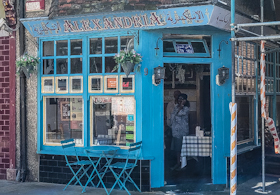
About 6 years ago, a husband and wife from Cairo (Egypt) set up a tiny restaurant on a corner plot in the old centre of Margate. It is called Alexandria Café. The owners chose the name not because they come from Alexandria, but because like the Egyptian city, Margate is by the sea.
Only open on Fridays, Saturdays, and Sundays at present, this restaurant serves beautifully prepared, tasty Egyptian dishes at very reasonable prices. We tried koshari, falafel, baba ganush, pickled tomato salad, and mint tea. Although these are all without meat, non-veg dishes are also available.
The tiny, comfortable eatery is decorated with photographs of Egyptian film stars. A small television screen was showing old Egyptian films.
A few doors away from the lovely Egyptian cafe, there is an ice cream parlour. What makes it special is that in 1866, Karl Marx stayed in the building.
We did not try the ice cream, but I can safely say that of all the places I have eaten in Margate, having visited the place many times, Alexandria is the best.
THE TRAINS THAT used to run into Folkestone Harbour station have not done so for many years. The station has been restored and repurposed as a pleasant, tasteful leisure amenity.
The signal box that used to regulate rail traffic in and out of the station still stands. It is now used as a café. With fine views of the harbour and Folkestone town, the signal box now contains equipment for making coffees and seats for customers. Apart from being an interesting old building, the old signal box contains the levers that used to operate the points within the station and on the bridge across the small harbour that connects it to the main land.
The café is not only housed in an original building, but also the coffee made there is above average in quality.




 yamey
yamey 