WE VISITED TWO churches in Suffolk, and inside them we spotted three things that particularly interested us. The first church is in Cavendish, The Parish Church of St Mary the Virgin. Standing on a hill above the village, its construction dates from 1300 and was largely completed by 1485. Some restoration work was carried out in the 19th century. One of the two things that fascinated us in this church is affixed to the inside of the north wall. It is a bas-relief depicting the Crucifixion. It is a reredos of Flemmish make, created in the 16th century. It is framed in a Victorian surround designed by Ninian Comper (1864-1960) in 1895. The sculpted reredos was brought to the church from the private chapel of the hymn writer Athelstan Riley (1858-1945) in London, following his death.
Cavendish church
The other curiosity in this church, which has memorials to the philanthropists and local parishioners Baroness Sue Ryder and Baron Leonard Cheshire, is on a wall just behind the 19th century wooden pulpit within arm’s reach of the preacher. It is an hourglass, looking like a large egg-timer, which the priest could use to time his sermon. I had never seen such a thing in a church. Less curious but also fairly unusual are the 13 wooden crucifixes on the interior walls of the bell tower. These were made from wood salvaged from the Western Front during WW1 and each one commemorates one of the men from Cavendish who were killed in the conflict.
The other church we visited on our recent trip to Suffolk was St Mary in Stoke by Nayland, which was sometimes painted by John Constable (1776-1837), who was born nearby in East Bergholt. Built in Perpendicular Gothic style between 1300 and 1481 it is very majestic, like a small cathedral. The church is full of interesting monuments including many fine brasses. It was one of the funerary monuments that particularly intrigued us: the Lady Anne Windsor monument. Anne lived from about 1568 until 1615. A stone carving depicts her lying with her head on a pillow. At her feet, there is a carving of a kneeling man, Anne’s son. By her head, two carvings depict a pair of kneeling women, Anne’s daughters. Look closely at this pair and you will notice that their hands have been broken off. Their arms are merely amputated stumps. What is going on here?
Stoke by Nayland church
The answer is that in 1643, Parliamentary Commissioners visited the church in Stoke by Nayland and destroyed 100 religious images and 7 funerary items. Part of this over-zealous iconoclastic behaviour was the removal of the four hands of the two women on Lady Anne’s monument, as well as those of the recumbent figure of the deceased. All the hands of females on the monument were removed but those of the kneeling male figure were left untouched. Apparently, the female hands were removed because the Commissioners considered them to have been in “a superstitious attitude of prayer”, whatever that meant during the Reformation.
The three items I have described are but a few of the things worth seeing in the two churches. I have chosen to describe them because I have not seen such things in the many other parish churches I have visited in England.
THE CHINESE MEDICAL College in Hong Kong was founded in 1887 by the physician Sir James Cantlie (1851-1926), who was the inventor of what we now call ‘first aid’ and one of the founders of The London School of Tropical Medicine. One of his first students in Hong Kong was Sun Deming, better known as Sun Yat Sen (1866-1925). In 1878, Sun went to Honolulu to live with his elder brother. There, he was educated well in English at school. Aged 17, he returned to China. After desecrating a temple, he fled to Hong Kong, then under British rule, where he continued his education, joining the Chinese Medical College in 1887, having already studied a bit of western medicine elsewhere. In 1892, he graduated as a medical doctor. He became a friend of Sir James Cantlie.
In 1896, poor health forced Cantlie to return to London. That year, Sun came to England to visit Cantlie. Already out of favour with the Imperial Chinese government because of his revolutionary activities, private agents employed by the Chinese were sent to Liverpool where he landed to follow his movements. The reason for his conversion to political activism are summarised in an on-line article (www.newstatesman.com/international-content/2021/10/the-london-kidnapping-that-changed-china) as follows:
“The contrast between the colonial advancement he encountered abroad and the endemic poverty he knew from home convinced Sun that China needed revolutionary change. Rather than becoming a doctor, he helped engineer a rebellion in Canton (Guangzhou) in 1895. The failure of the uprising forced Sun to go on the run, which is why he ended up in Britain the following year.”
The first person that Sun visited after arriving in London was his old teacher Cantlie, who lived close to the Chinese embassy, which was, and still is, in Portland Place. On his way there, Sun was kidnapped and held captive in the embassy. He would have faced death had not he persuaded the embassy’s English housekeeper, a Mrs Howe, to smuggle a note to Dr Cantlie. An influential man, Cantlie managed to get Sun released, as was described in the above-mentioned article:
“In the end, it was an article about the kidnapping in the Globe that did the trick. On the following day, 23 October 1896, a large crowd formed outside the legation, noisily demanding Sun’s release. While diplomatic and legal wheels moved in the background, the ambassador and his staff realised they had to let their prisoner go. Sun emerged on to the street a national hero. While recovering at Cantlie’s house, he gave a long interview to the liberal-left Daily News, giving British readers their first insights into China’s embryonic revolutionary movement.”
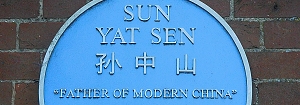
Late last year, we were driving to Buntingford in Hertfordshire when we passed through the nearby village of Cottered. As the traffic was slow-moving, we managed to spot a memorial plaque attached to a house. We did not stop, but we saw enough of it to realise it had something to do with Sun Yat Sen. Very recently, we returned to Cottered to look at the plaque more carefully because we were intrigued that the Sun Yat Sen had a connection with a tiny Hertfordshire village. The plaque attached to a house called The Kennels reads as follows: “Sun Yat Sen “Father of Modern China” was a frequent visitor to this house while in exile from his home country.” Beneath Sun’s name there are three Chinese characters: “孫中山” which Google translates as ‘Sun Yat-sen’.
Curious to know more, we rang the doorbell of the house in Cottered and were greeted by a kindly gentleman, who explained that The Kennels was formerly owned by Sir James Cantlie. An article in an issue of the “The Comet”, a Hertfordshire newspaper, dated March 2017 (https://www.thecomet.net/news/sun-yat-sen-in-cottered-the-father-of-modern-china-5358282) revealed:
“His connection to the property, called The Kennels, comes from his life-long friendship with physician Sir James Cantlie, who owned the house, earlier taught him medicine in Hong Kong – and in 1896 saved him from imprisonment by agents of the Qing monarchy at the Chinese Legation in London.
Dr Sun visited the Cantlies in London and Cottered whenever he was in Britain … Sir James’ son Kenneth recalled one of the statesman’s visits to the village:
‘I must have been about five years old. It was sunset on a summer evening, and Dr Sun was walking up and down in the orchard. He was wearing a grey frock-coat and his homburg hat was tilted forward to keep the level sun out of his eyes. He had his hands behind his back and was pondering deeply. I was about to rush up to him in my usual impetuous way, when I stopped. ‘He is probably thinking great thoughts,’ I said to myself, and I went quietly away. I was not in the least afraid of Dr Sun, who was kindness itself – but my parents and my nurse may have put the idea into my head that here was a great man who must not be interrupted when he was thinking.”
Lieutenant Colonel Kenneth Cantlie (1899-1986) was about five years old in 1904, which was when Sun was living outside China.
The article continued:
“In 1912, after the success of the Xinhai Revolution – which established a Chinese republic, with Sun Yat-sen as its first provisional president – the doctor wrote with clear affection to the Cantlies. On paper headed ‘The President’s Office’, he wrote: “It makes me feel more grateful to you when from the present position I look back on my past of hardships and strenuous toil, and think of your kindnesses shown me all the while that I can never nor will forget.”
Both Sir James and his son Lt Col Kenneth are buried in the cemetery of Cottered’s parish church close to its southern door. According to “The Comet”:
“After Dr Cantlie died and was buried at St John’s Church in Cottered in 1926, the Chinese minister to Britain, Sao-Ke Alfred Sze, laid a memorial tablet at the church. Dr Cantlie’s grave in the churchyard is engraved with a Chinese translation of the gospel verse Matthew 5:7.
China Central Television visited the house in 2001, and again in 2011 as part of filming for a documentary series on the Xinhai Revolution.”
Sadly, I could find neither the tablet amongst the Cantlie family gravestones nor the engraving in Chinese, which is a translation of “Blessed are the merciful, for they will be shown mercy”. Despite this, revisiting Cottered was well worthwhile, and it has for me sparked an increased interest in the birth of modern China. We hope to return to Cottered to see inside its church, which, judging by pictures posted online, looks fascinating.
FROM THE LATE 19th century until a few years ago, High Street Kensington was a healthily flourishing retail centre. In its heyday, it boasted of three large department stores, Pontings, Barkers, and Derry & Toms. The impressive buildings that housed the latter two still stand and are fine examples of art deco architecture located close to the Underground station, which has been in service since the late 1860s. In recent years, the advent of on-line shopping, high rents, and the proximity of the Westfield Mall at Shepherds Bush (opened 2008), which has good parking, have conspired together to make High Street Kensington less appealing to shoppers. Consequently, at any one time a large proportion of shops remain empty awaiting new tenants. Sadly, what was once (especially in the 1960s and ‘70s) a bustling high street with trendy shops like Biba and the ‘funky’ Kensington Market, both gone, has become slightly dreary.
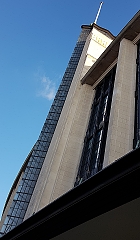
Barkers building
Barker’s former shop, a lovely art deco edifice, which opened in 1933, was designed by Bernard George (1894-1964). Between 1928 and 1962, he was the chief architect for Barker’s of Kensington in-house design group. It is worth examining this building closely to enjoy is many attractive details.
THE ARTIST JOHN Constable (1776-1837) loved Hampstead and eventually lived there. It was in that part of London, then a large village, that he became fascinated by the depiction of clouds. Here is an extract relating to this from a book about Hampstead, which I am in the process of writing:
In the last of a series lectures he gave to the Royal Institution in Albermarle Street in 1836, Constable emphasised his systematic approach to depicting nature, by saying:
“Painting is a science and should be pursued as an inquiry into the laws of nature. Why, may not landscape painting be considered a branch of natural philosophy, of which pictures are but the experiments?”
Clouds over Hampstead Heath by John Constable
One of Hampstead’s attractions for Constable was its wide expanse of sky, which, as the historian Thomas Barratt wrote, the artist:
“… regarded as the keynote of landscape art, and so assiduously did he study cloud, sky, and atmosphere in the Hampstead days that Leslie, his biographer, was able to become possessed of twenty of these special studies, each dated and described. Constable was a man of Wordsworthian simplicity of character, fond of all things rural, and devotedly attached to birds and animals.”
The website of Cambridge’s Fitzwilliam Museum reinforces what Barratt wrote:
“While living at Hampstead, Constable made a series of oil sketches of the sky alone, each one marked with the date, time and a short description of the conditions. His interest in clouds was influenced partly by the work of the scientist Luke Howard, who had in 1803 written a pioneering study, classifying different types of cloud …”
In “The Invention of Clouds” by Richard Hamblyn, a biography of the chemist and amateur meteorologist, who devised the modern classification of clouds (cumulus, nimbus, etc.), Luke Howard (1772-1864), it is noted that Constable, who was familiar with Howard’s work, focussed his concentration:
“… on the extension of his observational range and clouds were the means that he had chosen for the task. After years of searching for an isolated image, seeking a motif upon which to weigh his technical advancement as a painter, he had found it at last in the unending sequences of clouds that emerged and dissolved before his eyes like images on a photographic plate.”
During the summers of 1821 and 1822, Constable made over one hundred cloud studies on the higher ground of Hampstead and its heath. Writing in 1964 in his “The Philosophy of Modern Art”, the art critic/historian Herbert Read (1893-1968), who lived in Hampstead, commented that Constable was:
“… rather a modest craftsman, interested in the efficiency of his tools, the chemistry of his materials, the technique of his craft. His preparatory ‘sketches’ are no more romantic than a weather report. But they are accurate, they are vividly expressed, they are truthful.”
Read next contrasted Constable with Turner, pointing out that the former was far more attentive to depicting nature accurately than the latter, who became increasingly extravagant in his portrayal of it, always moving towards what is now called ‘expressionist’. Barratt wrote that although Constable admired Turner, he had no desire to imitate him and:
“He knew his limits, and recognised that within those limits were to be found subjects worthy of the highest aspirations. “I was born to paint a happier land,” he wrote, “ my own dear England ; and when I cease to love her may I, as Wordsworth says, — ‘never more hear her green leaves rustle or her torrents roar..’”
AT FIRST GLANCE, the lower floor exhibition space at the Barbican art gallery in London resembles the lighting department of a furniture store such as Habitat. It is full of lighting units with Japanese-style paper and bamboo shades. After a moment, you will notice that these lighting units are not run-of-the-mill illuminations; they are interestingly shaped works of art lit up from within. These lamps are part of an exhibition of the artistic creations of Isamu Noguchi (1904-1988). Born in Los Angeles, he was the son of a Japanese father and an Irish American mother. The first 13 years of his life were spent in Japan, where he began learning carpentry whilst helping his mother building their family house. From these early skills, it was not long before he embarked on what was to become a highly productive creative career, making works from a wide variety of materials from wood and stone to metals and plastics and … you name it.
Noguchi studied sculpture at the Leonardo da Vinci Art School in New York City. In 1927, he was given a grant to travel to Paris. It was there that he was apprenticed to the Romanian-born sculptor Constantin Brâncuși (1856-1957), who introduced him to abstraction. After learning much from the great sculptor in Paris, Noguchi abandoned pure abstraction and moved towards depicting the living world. However, his experiences working with Brâncuși influenced his artistic output for the rest of his life. After Paris, Noguchi travelled extensively, learning about techniques and philosophies, especially Chinese and Japanese. In 1929, he first met the architect and inventor Richard Buckminster Fuller (1895-1983), whose ideas about science and technology chimed with his. In the exhibition, there is a shiny chrome-plated bronze bust he made of Buckminster Fuller in 1929. There are also a couple of models he created in collaboration with Buckminster Fuller. Noguchi’s interest in science was not only expressed in sculptures but also in stage settings for ballet performances choreographed by Ruth Page and for performances by Martha Graham.
During WW2, although it was not required for him to enter one of the camps where the Americans ‘cooped up’ potential Japanese enemy aliens – Japanese who lived in the USA – Noguchi volunteered to be confined in a camp in Arizona. By doing so, his aim was to create an arts programme that would ease the lives of those confined in the camp. The barren landscape surrounding his camp proved to be yet another influence on his creative output.
Amongst the many exhibits in the Barbican’s show, there are, in addition to the lighting units, several pieces of furniture designed by Noguchi. One of these is a triangular plate glass tabletop supported by two interlocking timber supports. I have seen this elegant item for sale in upmarket furniture shops, but until I saw the exhibition, I had no idea it had been designed by Noguchi as long ago as 1944. It is still being made today. The wonderful variety of lighting sculptures, which at first reminded me of lampshades that were trendy in students’ rooms in the 1970s, are examples of ‘Akari’. Noguchi began creating them in the early 1950s, and despite their fragile nature, they are still in good condition now. One of the gallery invigilators told us that the translucent paper used to construct these lamps is made from mulberry tree bark. Known as ‘Washi’, this handmade paper can also be made from the bark of some other tree species.
As with other exhibitions at the Barbican gallery, the artworks are well-displayed and beautifully lit. If you go to this exhibition, you should not miss the video film in which Noguchi talks about his life and art very eloquently. And while you are watching it, you can sit on stools and a bench Noguchi designed. Prior to visiting this show, I had heard of Noguchi and seen a few of his works. The exhibition, which continues to the 23rd of January 2022, has truly opened my eyes to what a magnificent artist he was.
WEATHERVANES ATTRACT BOTH wind and my attention. The variety of forms that these wind direction indicators assume is why I enjoy looking at them. A few days ago, whilst crossing London Bridge I spotted a building with two weathervanes on its roof. They are shaped like fish. But they are not alone because the roof is decorated with more metal fish. Their presence is appropriate because between 1875 and 1982, this arcaded edifice next to the river was home to the Billingsgate fish market. Today, the place is used as a venue for gatherings of various sorts.
Writing in 1598, John Stow (c1524-1605) noted that the ward of Billingsgate was named after ‘Belinsgate’. It was then, he wrote:
“… a large water-gate, port, or harborough, for ships and boats, commonly arriving there with fish, both fresh and salt, shell-fishes, salt, oranges, onions, and other fruits and roots, wheat, rye, and grain of divers sorts, for service of the city and parts of this realm adjoining.”
He also mentions that in the reign of Edward III (reigned 1327-1377), Belinsgate was then a much-used place for mooring ships and that these all attracted harbour fees, which depended on their size.
John Timbs (1801-1875), writing in his “Curiosities of London”, published in 1867 provided more of the history of Billingsgate. He wrote that it had been a landing place, if not also a marketplace, since the reign of King Ethelred II (reigned 978-1013). In 1699, an Act of King William III declared that Billingsgate was a market for all kinds of fish, and that it should be close to London Bridge. Timbs recorded:
“The Market, for many years, consisted of a collection of wooden pent-houses, rude sheds, and benches: it commenced at three o’clock AM in summer and five in the winter: in the latter season it was a strange scene, its large flaring oil lamps showing a crowd struggling amidst a Babel din of vulgar tongues, such as rendered “Billingsgate” a byword for low abuse … In Baileys “Dictionary” we have; a Billingsgate, a scolding, impudent slut’”
In 1849, the market was enlarged, making it more spacious and less of a scrum that it had been previously. In 1850, the first Billingsgate market building was ready for use but by 1873, when it was demolished, it was already too small for its purpose. The former market building, which we see today with its rooftop fish ornaments, was designed by the City Architect Horace Jones (1819-1887) and opened for use in 1876. Jones’s most famous building, Tower Bridge, was completed after his death.
After it ceased being used as a fish market, instead of being demolished, the old Billingsgate market was:
“Given an industrial twist by architect Lord Richard Rogers, the building has undergone an amazing transformation, from the 19th century’s largest fish market to London’s premier event space.”
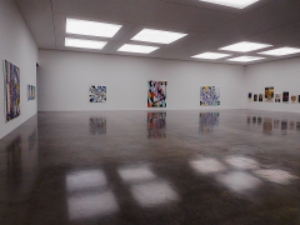
Overlooked by The Shard,the White Cube Gallery in Bermondsey Street, near to London Bridge Station, provides wonderful expanses of well-lit exhibition space. One can explore works of contemporary art in an uncluttered, airy environment. This is so much better than many traditional exhibition spaces such as in 19th century galleries, or even in the relatively recently constructed Tate Modern. Visiting the White Cube in Bermondsey is a worthwhile experience not only because of its wonderful spaciousness but also because it often displays exciting works of art. And when you have had your fill of art, there are plenty of places in Bermondsey Street where you can find a wide variety of food and drink.
“144–152 Bermondsey Street is an existing warehouse and office building, set back from Bermondsey Street via an entrance yard. The building dates from the 1970s and has a modernist industrial appearance, with long horizontal window bands and a simple cubic shape. The outer walls of the building are constructed from dark brown engineering brick, with a concrete and steel framed internal structure…
…The new gallery spaces were inserted as self-supporting freestanding volumes, barely touching the envelope of the existing building.The powerfloated concrete floors can take loadings up to 100 KN/m2. Walls and ceilings are constructed as steel cages allowing art to be installed at almost any point within the space. Structural exclusion zones allow the punching through of walls at selected locations to allow entry points into the exhibition spaces to be coordinated with the ever-changing displays.”
UNTIL RECENTLY, LONDON Bridge railway station, overshadowed by the glass-clad Shard skyscraper, was not visually appealing. It was a place that you lingered no longer than necessary either whilst waiting for a train or having just disembarked.
Today, the station has been transformed into a place where you might want to linger and explore. It has been cleaned up and tastefully remodelled. The station and the tracks leading from it have always been above ground, supported by innumerable brickwork arches. A few years ago before the improvement works were carried out, many of these archways led to passages beneath the station, most of them dark and unwelcoming.
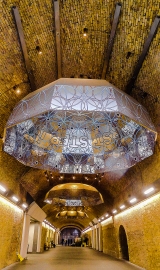
One of these was the Stainer Street Walkway that links St Thomas Street and Tooley Street and passes through the station’s foyer from which stairways lead up to platforms. This wide passageway lined with ochre coloured brickwork is now well-lit and apart from being a bit chilly, quite pleasant. But look up, and you will see three enormous, reflective, decorative umbrellas suspended from the ceiling. Each umbrella is decorated with geometric symbols and lettering. The lettering forms sets of words that are supposed to be meaningful for those who bother to read them.
Together, these umbrellas comprise an artwork, “.Me. Here. Now” by Mark Titchner , which were put in place in mid-2019. With the decrease in passenger numbers since the start of the covid19 pandemic, this lovely set of artefacts have been seen by far fewer people than were anticipated by the commissioners of this creation, Network Rail.







 yamey
yamey 