FALMOUTH IS A small port on the south coast Cornwall, It was founded near their ‘palace’, Arwenack, by the Killigrew family in 1613.
In 1385, the Killigrew family acquired a property, a manor house called Arwenack, now in Falmouth. Although fragments of the 14th century house remain, the shape of Arwenack that can be seen today was established in the mid-16th century by John Killigrew. After that, the family continued to modify this grand residence. During the Civil War (1642-1651), Arwenack was badly damaged. Nothing much was done to the building until the 18th century when extra wings were constructed. Thereafter, the building fell into decline until 1978 when a firm from Redruth repaired and modernised it before converting it into several dwellings, which are still in use today. Arwenack faces a 44-foot-high granite obelisk/pyramid that was erected in 1738 by Martin Lister Killigrew to celebrate his illustrious family.
Now, Arwenack faces a large car park, and behind that a complex of modern buildings that contains shope, restaurants, and the National Maritime Museum (Cornwall)
ZENNOR IS VERY close to Lands End. Its granite church is part Norman and part 13 to 15th century, and dedicated to a Cornish saint, Senara. Legend has it that the church was established by her when she arrived from Ireland in the 12th century. What makes the church special is a carving on the end of an old timber pew, which is about 400 years old. The carving depicts a mermaid holding a comb in one hand and a round mirror in the other one. One version of this mermaid’s story goes as follows:
“Many years ago a richly dressed and beautiful lady occasionally attended the church at Zennor. Nobody knew who she was or where she came from, but her unusual beauty and lovely voice made her the subject of much discussion. With such beauty, the lady had no shortage of want-to-be suitors in the village. One of these local men was Mathew Trewella, a handsome young fellow with the best singing voice in the village. He took it upon himself to discover who this beautiful stranger was. After a service one Sunday, the lady had smiled at Matthew Trewella so he had decided to follow her as she made her way off and towards the cliffs. Years passed and Matthew Trewella’s unexplained disappearance faded into the past. Then one Sunday morning a ship cast anchor off Pendower Cove near Zennor. The vessel’s captain was sitting on deck when he heard a beautiful voice hailing him from the sea. Looking over the side of the ship he saw a beautiful mermaid, with her long, blonde hair flowing all around her. She asked him if he would be so kind as to raise his anchor as it was resting upon the doorway of her house. She explained was anxious to get back to her husband, Mathew, and her children. For it turns out that the beautiful stranger from the church was in fact one of the daughters of Llyr, king of the ocean, a mermaid by the name of Morveren. Warey of stories of Mermaids the captain weighed anchor and headed for deeper water fearing the mermaid would bring the ship bad luck. He did, however, return later to tell the townsfolk of the fate of Matthew.” (www.cornwalls.co.uk/myths-legends/mermaids.htm)
The carving commemorates the mermaid and Matthew, her admirer.
MOST PEOPLE ASSOCIATE the name Cheddar with a cheese and a geological formation, the Cheddar Gorge. While these are both noteworthy things, there is more to Cheddar than them.
The gorge, a rock lined chasm along which a road winds, is a deservedly popular tourist attraction. It was formed 225 million years ago. The lower half of the gorge is lined with formidable cliffs. The upper half of it has tree covered slopes. The gorge is popular with walkers and rock climbers. At the lower end of the gorge, there are plenty of shops and eateries catering for tourists, who flock to the area in large numbers.
The caves in the gorge and around the village of Cheddar provide steady conditions of humidity and temperature that are ideal for making cheese. It was here that the type of cheese known as Cheddar. It was here that Cheddar cheese originated. However, nowadays Cheddar cheese is manufactured in other places in the British Isles.
The village of Cheddar, which is close to the bottom of the gorge, deserves a visit. There is a market cross, which was put up in the fifteenth century. It protrudes from a hexagonal structure that was rebuilt in 1844.
The Church of St Andrew Cheddar is near the market Cross. It was mostly built between 1350 and 1450 on the site of a Roman settlement. The tower includes Roman bricks in its structure. On the north side of the chancel, there is an elaborate canopy above the tomb of the Bristol merchant Sir Thomas de Cheddar, who died in 1443. His wife is buried in front of his tomb. Other features in the church include a fine patterned timber ceiling.
The origin of the name Cheddar is according to Wikipedia:
“Richard Coates, Professor Emeritus of Linguistics at the University of the West of England, has suggested that the name is Ciw-dor, ‘the door to Chew’, referencing an idea that the gorge marked an important routeway through at least part of the Mendip watershed, and giving access between two large and important estates which had probably been a part of the Wessex royal demesne from the 7th century.”
Whatever the origin of the name, Cheddar, its gorge, and its cheese are all worthy of note.
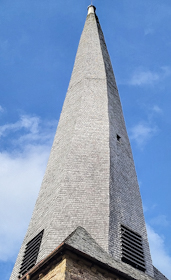
CLEOBURY MORTIMER IS a small town in Shropshire, near to Clee Hill. I could not help noticing that a peculiar church steeple dominates its skyline.
The spire is that of the church of St Mary the Virgin. What makes it distinctive is that it is twisted.
The shingle covered steeple has a timber skeleton that was constructed in the 13th century. Over the centuries, the timbers became damaged by damp, and the spire began to tilt towards the southwest. Furthermore, warping of the woodwork caused it to become twisted. So, the spire not only leans away from being perpendicular but also twists. Fortunately, restorations carried out in 1993 will probably prevent this ancient spire from further deformation.
THE RUINS OF the Valle Crucis Abbey, formerly a Cistercian establishment, stand a few miles away from the Welsh town of Llangollen. Not far away from these picturesque remains, there is a grassy mound on the top of which there is a stone column. This is the Pillar of Eliseg.
The Pillar was erected in the ninth century by Cyngen ap Cadell (died 855), king of Powys, to commemorate his great-grandfather Elisedd ap Gwylog (died c. 755), also a king of Powys.
The pillar has a lengthy Latin inscription that is now impossible to read, but it was deciphered by the antiquarian Edward Lluyd in 1696. According to the website of CADW, a Welsh governmental organisation that looks after ancient sites, the gist of the inscription is as follows:
“One phrase includes the names of successive rulers of the kingdom of Powys during the 8th and 9th centuries. Another reveals that the cross was erected by Cyngen in memory of his great-grandfather Eliseg, who was said to have expelled the Anglo-Saxon English from this part of Wales.”
As to its purpose, this source stated:
“It’s thought that the carefully composed inscription, which includes legal terminology, was intended to be read aloud, to be proclaimed to an audience. Could this be where the ancient rulers of Powys were appointed? Is it a victory monument, declaring political ownership of land won back from the English, or vital propaganda at a time when the kingdom was under threat? Or all of these things?”
During the English Civil War, the Parliamentarian soldiers pulled down the pillar, damaging part of it. The remaining upper part of it was re-erected in 1779. And it can be seen easily from the road that runs between the remains of the abbey and the Horseshoe Pass. Eliseg and his descendants would most probably be disappointed to find that to a large extent Wales is now within the control of England.
WHEN WE VISITED Wigan in Lancashire in 2022, we saw hoardings that advertised the forthcoming opening of an “artisan deli”, and wondered what George Orwell would have made of it.
We returned to Wigan Pier in September 2025, and headed for the site of the proposed artisan deli. However, it has not been built and the signs advertising the plans to build it are no longer to be seen. The area around the Pier looks similar to what it did in 2022. The warehouses that were to have been redeveloped stand empty. Peering through their windows all that could be seen were huge, dusty empty spaces.
During our second visit to Wigan, we took a stroll in the town’s Mesnes Park. This beautifully maintained park was laid out in 1878 on glebe land (terrain set aside to provide income and support for a parish priest). Apart from a lovely pond, lawns, and carefully tended flower beds, the park contains several interesting features. One of these is the octagonal pavilion built in 1880. Now containing a café, it stants on a raised mound, and can be approached by elegant stone staircases. In fron of its main entrance, there is a statue of a soldier, which is part of a memorial to those men of Wigan who fought in the 2nd Anglo-Boer war (1899-1902). And a few steps down from this, there is the elegant cast-iron Coalbrookdale Fountain. This is a replica of one which stood in the park until 1921. Near the pavilion, there is a 10-sided Victorian bandstand.
Between the Pavilion and the main entrance to the park, there is a statue of a seated man. It depicts the Conservative politician Sir Francis Sharp Powell (1827-1911). He held a seat in the House of Commons from 1863 until 1910. He was born in Wigan, but represented several different constituencies during his long parliamentary career. The bronze statue in the park was created by Ernest George Gillick (1874-1951), and erected in Wigan in 1910.
Just over two miles northeast of central Wigan, lies Haigh Hall (built between 1827 and 1840), which was undergoing restoration in 2025. It is surrounded by Haigh Woodland Park, which is a vast parkland area containing a variety of leisure facilities including eateries, adventure playgrounds, a golf course, a mini-golf course, and a fine walled garden. It is hoped that when the restoration of the Hall is completed in 2028, it will provide opportunities for a whole range of activities for visitors.
Our second visit to Wigan has shown us that there is much more to the place than Orwell’s famous Wigan Pier.
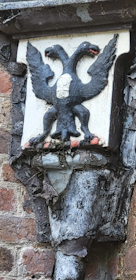
I HAVE LONG been fascinated by the double-headed eagle (‘DHE’). The earliest evidence of its use as a symbol is on Mesopotamian seal rings made as long ago as c3000 BC. Since then, it has been used by the Seljuk Turks, the Byzantine Empire, the kingdom of Mysore, Russia, Austro-Hungary, Serbia, Montenegro, Albania, and many other peoples.
In England, aristocratic families such as the Killigrews and the Godolphins in Cornwall have incorporated it in their coats-of-arms. Today, we visited Rufford Old Hall in Lancashire. It was once the seat of the Hesketh family. And their original coat-of-arms included the DHE. This two headed bird can be seen in many places on the building.
For those less interested in the DHE than me, the main attraction of the place is the 16th century Hall with its hammer beam ceiling and its amazing timber screen.
When we decided to visit Rufford Old Hall today, I had no idea that I would be seeing yet another British family’s use of the DHE. I have no idea what if anything caused these families to incorporate this creature in their crests. It is far less used in Englush heraldry than other creatures such as, for example, the lion, the eagle, the unicorn, and the griffin.
PARBOLD IS A village about 16 miles northeast of the centre of Liverpool. In 1742, the Douglas Navigation, a canal that links Wigan and Liverpool, became operational. It carried stone, coal, and other goods to Liverpool from where they could be shipped to Dublin. The canal passes through the centre of Parbold, and led to the mining of coal in the area. In turn, this led to an increase in the village’s population. With the arrival of the railway in 1855, Parbold became more easily accessible to Manchester and Wigan. This resulted in wealthy inhabitants of these towns coming to live in Parbold. And in the 1960s and 1970s, new housing estates were built in the area. Despite this, Parbold remains a charming place to visit.
Parbold mill
Parbold Hall, which was built in the 1750s, housed a Benedictine School. This institution was the forerunner of the leading Roman Catholic Ampleforth School, which opened in North Yorkshire in 1802. Soon after that, the boys studying at Parbold Hall were moved to Ampleforth, and the Parbold school was closed. Currently, the hall is privately owned, and let out for weddings and holiday accommodation.
One of Parbold’s main attractions is the tall, conical tower that was once a windmill. It stands next to the canal, and replaced a water mill that no longer exists. A website published by West Lancashire Borough Council related that the tall mill:
“… replaced the water cornmill which once stood near the Douglas bridge in Alder Lane. The windmill in its turn was superseded in the middle on the 18th century by the present mill which was originally worked by a steam engine and produced compound cattle foods until its closure in 1985.”
Part of the former mill is now an art gallery. Next to it, there is a pub appropriately named The Windmill. It opened in 1794 to serve both the growing traffic along the newly opened sections of the Leeds to Liverpool Canal and the farmers delivering grain to the neighbouring windmill. It soon became a meeting place for locals. Today, it incorporates a restaurant in addition to the usual bars.
The most interesting sight in Parbold is on a hill overlooking the village and the fields around it. Looking like the top third of a wine bottle, it is a stone monument known as both the Reform Pillar and the Parbold Bottle. It was erected by local worthies to replace another structure, which commemorated the passing of The Reform Act in 1832. The Act made great changes in the electoral system by changing constituency boundaries; creating new constituencies in areas that had been hitherto unrepresented in Parliament; and extending the franchise, giving the vote to all men owning houses over £10 in rateable value. It was the beginning of the path that led eventually to universal suffrage in Great Britain. As a result of the Act, Lancashire gained 11 new Members of Parliament. The bottle-shaped monument was badly damaged by a gale in 1942, but was restored in 1958. A short path leads from a busy main road to the Bottle from which lovely views can be obtained. The monument itself, although interesting, is not a thing of beauty.
Today, Parbold is mainly residential and a popular place for those wishing to walk along the canal or to go fishing. And apart from The Windmill pub, there are several other places where refreshment can be obtained.







 yamey
yamey 