IN THE EARLY 1960s, the first proper self-service supermarket opened on the corner of Golders Green Road and a small service road called Broadwalk Lane. I cannot recall the name of this store, but it was soon taken over by the Macfisheries company. Later, it became a supermarket where many imported foods, especially products from Israel, were sold. Now, it has become a Tesco Express.
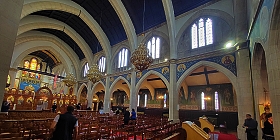
Facing the supermarket (across Golders Green Road) is a gothic revival style church. It has been used by a Greek Orthodox (Christian) congregation since 1968. Now, the The Greek Orthodox Cathedral of the Holy Cross & St. Michael, it was constructed as the Church of England’s ‘St Michael’s Church’ in 1914 to the design of JT Lee. A clock tower, surmounted by a delicate cupola supported by thin columns, was added to the church in 1960. On one of its walls, there is a bas-relief of St Michael with one foot on a serpent. On the northeast corner of the church, there is a plaque listing people who died in WW1. Near this, there is a crucifix standing in the garden next to the church. Its design, typical of C of E crucifixes, predates the arrival of the Greek congregation.
Although the interior of the church maintains some of its original Cof E fittings, such as stained-glass windows, the font designed in a mock mediaeval style, and some wall mounted memorials in English, a great deal of effort has been made to create the atmosphere of a Greek Orthodox place of worship. The walls of the side aisles have been painted with religious scenes. There is a decorated iconostasis and several framed icons. Elaborate chandeliers hang above the nave. Despite the additions to convert the church for Greek Orthodox worship, the original gothic revival features of the building’s interior are evident, but harmonise well with the later additions.
I HAVE PASSED IT OFTEN while travelling along London’s busy Marylebone Road and admired its elegant neoclassical portico supported by six columns with Corinthian capitals, but never entered it until today (the 7th of September 2022). I am referring to the Church of St Marylebone, consecrated in 1817. One of its predecessors, dedicated to the Blessed Virgin Mary was erected nearby in about 1400. It stood near the River Tyburn. The name Marylebone seems to be derived from a conjunction of the words Mary and ‘burn’ (from Tyburn, which began to have a bad reputation because of the much-used gallows close to its banks). This early church was replaced by another, constructed in 1740. It survived until it was demolished in 1949. Nearby, the present larger church, which we see today, was constructed in 1817 on what was then the New Road, a by-pass on the northern edge London, and is now Marylebone Road. Its grand portico faces north, and the high altar and the colourfully decorated apse are in the south end of the building. The church, a typical example of a Regency interior with first-floor galleries, is tall and spacious.
Charles Dicken’s son was baptised in the church. The poet Robert Browning (1812-1889) married a fellow poet Elizabeth Barrett (1806-1861) in the church in 1846. And the composer John Stainer (1840-1901) composed his oratorio “The Crucifixion” specially for this church in 1887 when he was already a fellow of the Royal Academy of Music, which is across the main road facing the church.
The Methodist Charles Wesley (1707-1788), who lived nearby, asked to be buried in what was the churchyard of the older (1740) church. Where this edifice stood is now a peaceful open space, the Garden of Rest, next to Marylebone Lane (a few feet south of Marylebone Gardens). In this small space, there is a stone obelisk mounted on a pedestal. This commemorates the life of Charles Wesley and several members of his family.
Close to Madame Tussauds and the Royal Academy of Music and neighbouring one of London’s more enjoyable shopping areas – Marylebone High Street, stands the lovely church of St Marylebone, which as I discovered today, merits a visit.
VINCENZO MARIA CORONELLI (1650-1718) who was most likely born in Venice (Italy) was not only a Franciscan friar but also a cartographer. Recently, I spotted one of his maps hanging in a frame in a friend’s home. It is a beautiful work of art, bearing the title (translated from French): “Maritime route from Brest to Siam and from Siam to Brest”. It was made between 1685 and 1686, based on information provided to Coronelli by six Jesuit priests sent out to the Indies by the King of France. Coronelli, based in The Republic of Venice, drew the map.
I was particularly interested to see what of modern India is represented on the map. On the coast of “Guzararatte ou Cambaje” (i.e. Gujarat or Cambay), the Island of Diu, then a Portuguese settlement, is marked, as are “Surate” (Surat) and “Bombaim” and “Chaul” (also Portuguese settlements). Further south, Goa is marked, and yet further south along the west coast, we can see Calicut and Cochin. On the east coast of India, we can see “Fort S. Thomé” and “Mahapur”, being old names for a place immediately south of Chennai and Mahabalipuram respectively.
The map becomes more interesting when you look at the “Bouches du Gange” (the mouths of the Ganges). Coronelli draws a complex collection of island’s that depict the Ganges delta, but where one would expect to find Calcutta (Kolkata) on modern maps, there is only a small inset town plan of a place called “Louvo”. This is not a place in India but in modern Thailand (once known as ‘Siam’): its modern name is Lopburi.
The reason that Calcutta is not marked on Coronelli’s map is simple: the place with that name did not exist when the Jesuit priests reported back to Coronelli. Had they made their survey only a little later, they would have been able to report its existence because in August 1686 Job Charnock (c1630-c1692/3) established a trading post (‘factory’) on the River Hooghly, and that became known as Calcutta. I have visited his grave and mausoleum in central Kolkata.
A COLOURFUL FABRIC artwork, a tapestry, by the artist Sonia Delaunay (1885-1979) hangs on a wall overlooking the grand staircase at the Institut français (‘IF’) in London’s South Kensington. Born in Odessa (Russian Empire) as Sarah Elievna Shtern, she spent most of her working life in Paris (France) after having studied art in both Russia and Germany.
Sonia Delaunay at Institut Francais in London
The stairs lead from the ground floor to the first. It is at this level that the IF’s main and biggest cinema, the Ciné Lumière 1, is located. This airy cinema has rows of comfortable seats each with enough legroom to satisfy even the tallest person. We had come (on the 3rd of September 2022) to watch a Spanish film called “Official Competition”, starring amongst others Penelope Cruz. Frankly, I found this much-hyped film dull, disappointing, and somewhat puerile. The plot revolves around filmmaking and competing egos. The audience is treated to too much philosophising (actually, navel contemplating) about acting and moviemaking, the content of which would be considered almost infantile by high school children. However, the cinema’s comfortable seating made watching the film almost bearable. In the past, we have seen far better films at the Lumière, to which we will return to see other films in the future.
Apart from the poor film, the visit to the IF was fun. It was great seeing the Delaunay and we enjoyed cool drinks in the pleasant Café Tangerine on the ground floor.
LONDON’S KENSINGTON GARDENS is bounded to the north by Bayswater Road and to the south by Kensington Gore (overlooked by the Royal Albert Hall and the Albert Memorial), which becomes Kensington Road. Within the park and running almost parallel with its southern boundary is the South Flower Walk (also known as The Flower Walk). The Northern Flower Walk, which runs near and parallel to Bayswater Road was once used by royalty. According to a document published on the Royal Parks website, this was:
“… a delicious and appealing place to stroll for the monarch on the way to … the site of the Bayswater ‘Breakfasting House’…”
The breakfasting house no longer exists. I am not sure whether the South Flower Walk can boast of such an illustrious past. However, when it is in full bloom, it outdoes its northern counterpart in colourfulness and variety of its flora.
Although the whole of Kensington Gardens makes for a pleasant place to stroll, a walk along the South Flower Walk provides and exceedingly pretty perambulation.
RAAVI KEBAB BEGAN serving Pakistani and Punjabi food in the mid-1970s. It is located on Drummond Street, close to London’s Euston Station. This unpretentious eatery with barely any internal decoration except some mirrors with Koranic verses engraved on them in Urdu script, is next door to the Diwana Bhel Poori House. It was at the latter that we used to enjoy Indian vegetarian dishes when we were undergraduate students at nearby University College London during the first years of the 1970s. In those days, Raavi, named after the river that flows through the now Pakistani city of Lahore, did not yet exist. It was only in the early 1990s that a friend visiting from Bombay suggested that we ate with him at Raavi’s. When the grilled kebabs arrived at our table, it was love at first bite. We have been returning to Raavi’s ever since.
Raavi’s with Diwana in the backround
Yesterday (1st of September 2022), we made yet another visit to Raavi’s. As we sat down, I noticed a thick wad of photocopies held together with a bulldog clip. They were resting on top of a neatly folded shawl. Out of curiosity, I looked at the top sheet, which was a page copied from a book with annotations added in red ink. I looked more carefully and noticed that the printed text was in Italian. The page was headed “<De ingratitudine> Joanni Folci Niccolaus Maclavellus”. It is a chapter (‘The ingratitude of Joanni Folci’) from a book by Niccolò Machiavelli (aka Maclavellus), who lived from 1469 to 1527. The rest of the text on the photocopied page appeared to be a learned commentary on Macchiavelli’s chapter.
I do not know why, but I felt that Raavi’s was the last place I would expect to find scholarly papers lying about so casually. I associate the place, as do most of its many customers, with grilled meat and spicy masalas. I asked the waiter about the papers. He shrugged his shoulders and said that someone must have left them behind after eating, and that he had no idea whether anyone would return to retrieve them.
HAMPSTEAD GARDEN SUBURB (‘HGS’) in north London, where I spent my childhood and early adulthood, is a conservation area containing residential buildings designed in a wide variety of architectural styles. It first buildings were finished in about 1904/5. Despite this, many of the suburb’s houses and blocks of flats were designed to evoke traditional village architecture. Much of HGS contains buildings that do not reflect the modern trends being developed during the early 20th century, However, there are a few exceptions. These include some houses built in the ‘moderne’ form of the Art Deco style, which had its heyday between the two World Wars.
In Lytton Close
A few Art Deco houses can be found in Kingsley Close near the Market Place (see https://adam-yamey-writes.com/2022/02/07/art-deco-in-a-north-london-suburb/), and there is a larger number of them in the area through which the following roads run: Neville Drive, Spencer Drive, Carlyle Close, Holne Chase, Rowan Walk, and Lytton Close. The part of HGS in which these roads run was developed from about 1927 onwards, mainly between 1935 and 1938. So, it is unsurprising that examples of what was then fashionable in architecture can be found in this part of the suburb. According to an informative document (www.hgstrust.org/documents/area-13-holne-chase-norrice-lea.pdf) about this part of HGS:
“… A relatively restricted group of established architects undertook much development such as M. De Metz, G. B. Drury and F. Reekie, Welch, Cachemaille-Day and Lander, and J. Oliphant. H. Meckhonik was a developer/builder and architects in his office may have designed houses attributed to him.”
Most of the Art Deco houses on Spencer Drive and Carlyle Close leading off from it are unexceptional buildings, whose principal Art Deco features are the metal framed windows (made by the Crittall company) with some curved panes of glass. Fitted with any other design of windows, these houses would lose their Art Deco appearances. Number 1, Neville Drive displays more features of the style than the houses in Spencer Drive and Carlyle Close. There is, however, one house on Spencer Drive that is unmistakably ‘moderne’: it is number 28 built in 1934 without reference to tradition. It is an adventurous design compared with the other buildings in the street.
Numbers 13 and 24 Rowan Walk, a pair of almost identical buildings which stand on either side of the northern end of the street, where it meets Linden Lea, stand out from the crowd. They have flat roofs and ‘moderne’ style Crittall Windows. Built in the 1930s, they are cubic in form: unusual rather than elegant.
I have saved the best for last: Lytton Close. This short cul-de-sac is a wonderful ensemble of Art Deco houses with balconies that resemble the deck railings of oceanic liners, flat roofs that serve as sun decks, curved Crittall windows, and glazed towers housing staircases. Built in 1935, they were designed by CG Winburne. I have to admit that although I lived for almost three decades in HGS, and used to walk around it a great deal, somehow I missed seeing Lytton Close (until August 2022) and what is surely one of London’s finer examples of modern domestic architecture constructed between the two world wars. Although most of the Art Deco buildings in HGS are not as spectacular as edifices made in this style in Lytton Close and further afield in, say, Bombay, the employment of this distinctive style injects a little modernity in an area populated with 20th century buildings that attempt to create a village atmosphere typical of earlier times. The architects, who adopted backward-looking styles, did this to create the illusion that dwellers in the HGS would not be living on the doorstep of a big city but instead far away in a rural arcadia.
AT THE TATE Britain, I visited the exhibition of paintings and drawings by the artist Walter Sickert (1860-1942). Amongst these, I was interested to see one which depicts a stretch of the platform at what is now Bayswater Underground station. In Sickert’s time, this station was called ‘Queens Road (Bayswater)’. Painted in 1914-15, this station was the closest one to his then home in Kildare Gardens (off Westbourne Grove). In the painting there is a man seated on a bench beneath an advertisement for Whiteleys. This was a department store, whose history I have described in my book “Beyond Marylebone and Mayfair: Exploring West London”*. Here is a shortened extract:
“Queensway was the home of a large department store called Whiteleys. Created in nearby Westbourne Grove by William Whiteley (1831-1907) in 1863, it moved into its large home on Queensway in 1911. After going through various transformations over the years, eventually becoming a shopping mall with restaurants and a cinema, it closed in 2018 … Since 2018, developers have removed the building’s innards whilst preserving its outer walls. The aim is to create a new shopping area along with a hotel and residential units. The final product might be interesting as its architects are from the team led by Norman Foster.”
Between 1968 and 1970, I was at north London’s Highgate School studying in preparation for my A-Levels (examinations to gain admission to university). One of my subjects was biology. I decided to enter the school’s Bodkin Prize biology essay competition. For some long-forgotten reason, I chose as my essay topic the life of woodlice. Seeing the above-mentioned painting by Sickert, reminded me of this essay. Being a keen researcher, even in my late teens, I discovered that there was a detailed book on my chosen subject, and this was available for perusal in a science library (the National Reference Library for Science and Invention), which was part of what has now become known as The British Library. In the late 1960s, when I required the book, the library’s collection was housed in a part of what had been the former Whiteleys department store on Queensway. It was a peculiar place: the bookshelves and readers’ desks were arranged on several layers of curved galleries surrounding a circular open space on the ground floor. Above the circular space, there was a spectacular, circular, large diameter, glazed skylight. The book I consulted was in French, and I spent a whole day laboriously translating it and making notes for use later. ‘cloporte’ is the French for ‘woodlouse’, just in case you are wondering. I believe that one visit was sufficient for me to collect what information I needed.
In December 1967, there was a debate about the state of the British Museum Library (now British Library) in the House of Lords. During a long speech, Viscount Eccles (1904-1999) mentioned the library where I had read about woodlice:
“Learned societies and famous men in the arts and the sciences have been shocked by the substance and the manner of the Government’s decision concerning the Library … An example of how the Act works can be seen in what has happened to the National Reference Library for Science and Invention. For years the former Trustees were frustrated by the delays and niggardliness of previous Governments in finding accommodation for this growing section of scientific material, not to mention the disgraceful shilly-shallying over the Patent Office Library. The position grew so desperate that the Trustees decided to gather together part of the material in temporary premises in Bayswater—admittedly very unsatisfactory…” (https://api.parliament.uk/historic-hansard/lords/1967/dec/13/british-museum-library)
I visited the library a year or so after that speech. As for my essay, I won 2nd prize: 15 shillings (75pence) to spend on books, which was reasonably generous at that time. 2nd prize might impress you for a moment until I reveal that I was one of only two entrants. The 1st prize was won by my classmate Timothy Clarke. His older brother, Charles Clarke, not only became Head of School but later served as British Home Secretary between 2004 and 2006.
Returning to Whiteleys, I began visiting it regularly after 1993, when I began living nearby. Then, as described already, it had become a shopping mall. The galleries, which had once served as a library, were lined with shops and eateries, as well as a cinema. But that is all in the past, and what was once Whiteleys is now a building site. I doubt that Sickert would have been pleased if he were able to see it today.




 yamey
yamey 