THE FORD CONSUL was made in the UK between 1951 and 1962, when I was 10 years old. As a young child, I used to be extremely impressed by this vehicle and was happy when I was occasionally driven in one. Recently, I was in a car park near the Art Deco swimming pool by the sea in Penzance (Cornwall) when I spotted a well preserved example of a Consul, which was still in use. Seeing it, brought back memories of many years ago.
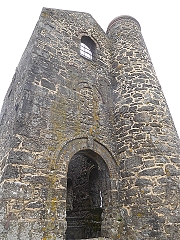
THE CORNISH COUNTRYSIDE often seems wild and almost at the end of the earth. It is richly dotted with reminders of its industrial past, much of which was concerned with mining minerals, notably tin bearing ores. The tiny hamlet of Cripplesease lies on a road that links St Ives with Penzance (the B3311). On a hill north of the place and high above it stands a ruined tower (with arched windows and large doorways) built with granite blocks. Standing on a square plot, this edifice has a gently tapering conical chimney attached to its southeast corner.
This tower is almost all that remains to be seen of the Giew Mine, first worked in the 18th century. It was one of many sites where tin was extracted from the depths of the earth. The tower was used from between when it was built in 1874 and when the mine was closed in 1922. The tower housed a pump engine and the winding gear for Frank’s Shaft, which was sunk to a depth of 1302 feet. Initially steam powered (hence the chimney), an electrically operated system was later installed close to the tower. The electricity for this was provided by a generator also located near the tower.
Ore that was brought to the surface was taken from the tower and moved to an ore crushing facility across the B3311. It was transported across the road by an overhead tramway, which has long since been removed. The tower, whose arches reminded me of Romanesque buildings can be entered. When I visited it, there was a spooky sound echoing within it. Looking upwards towards the open sky that can be seen because the tower has lost its roof I saw that it was being created by a solitary crow perched high up on one of the walls.
The old engine house is easily accessed by a gravel track that leads off the B3311. The unmarked track leads to a small car park, and the remains of the tower are a few feet away.
EGLOSHAYLE IS ACROSS the Camel river, facing the Cornish town of Wadebridge. The Earl of St Vincent pub is hidden away up a hill behind Egloshayle’s St Petroc church. It is housed in a building built in the 17th century as a boarding house for masons. Later, it became a pub. One of its many guests was Admiral Sir John Jervis (1735-1823).
The interior of the pub has timber roof beams and a delightful feeling of times long gone by. It is a great example of many people’s idealised vision of a typical ‘olde worlde English’ country pub. Soon after entering the dimly lit establishment, and your eyes adjust to the low light levels, it becomes evident that the pub is full of clocks, mostly differing in design. Most of them appear to be in working order, but not many of them show the same time. A great number of the clocks chime at least once an hour, but not all at the same time. This being the case, there is usually at least one clock chiming at any given moment. This produces a lovely background symphony of chimes.
I asked one of the pub’s staff why there were so many clocks in the pub. She replied:
“Some people like children. We like clocks”
Later, I asked the landlady about the clocks. She told me that when they took over the pub some years ago, there was no clock in it. She and her husband bought one clock for the pub, and this became the start of their collection. They could not stop buying timepieces. She told me that there are over 200 clocks in the pub and winding them up every day is quite a huge task.
Apart from the fascinating clocks, the pub can be recommended for the delicious, excellently prepared, unpretentious food that can be eaten there.
GENESIS CHAPTER 28 describes a dream experienced by the biblical Jacob. In it, he dreamt that there was a ladder set on the earth that reached up to heaven. In his dream, he watched angels of God ascending and descending what is now called ‘Jacob’s Ladder’.
The small town of Sidmouth on the coast of Devon has its own Jacob’s Ladder. Unlike the one seen in the dream, it neither reaches heaven nor is it being used by angels. Often rebuilt, Sidmouth’s Jacob’s Ladder is made of wood and consists of three flights of stairs which connect Connaught Gardens with the magnificent stretch of sandy beach (at the western end of Sidmouth). This lovely, gently curving strand, known as Jacob’s Ladder Beach, is flanked by red stone cliffs and is about a mile in length. The views from the top of the Ladder and the café in the Connaught Gardens are spectacularly beautiful.
The Ladder was first constructed in 1853 on the instruction of Mr Lousada of nearby Peak House. It was rebuilt in the late 19th century, and then again following WW2. The Connaught Gardens on the clifftop overlooking the beach were first laid out in 1934 by the Gardens Department of Dartington Hall Ltd.
It is unusual features such as Sidmouth’s Jacob Ladder that give many British seaside towns great character and individuality, and makes them fun to visit.
KENSINGTON COURT IS between the Whole Foods department store and Curry’s electrical store, both on High Street Kensington. The doorway to a brick building with white stone masonry trimmings is beneath a carved stone notice that reads “Electric Lighting Station”.
This was an outhouse converted in 1888 to an electricity generating station by a local resident, an electrical engineer Rookes Evelyn Bell Crompton (1845-1940). According to the RBKC website (rbkc.gov.uk):
“A dynamo transmitted direct current on bare copper mains through subways to the houses to charge batteries or accumulators. This quickly expanded to become the Kensington and Knightsbridge Lighting Company, housed in a basement below street level and continuing as a substation until 1985. It has since been converted into private premises and the exterior restored. This quickly expanded to become the Kensington and Knightsbridge Lighting Company, housed in a basement below street level and continuing as a substation until 1985. It has since been converted into private premises and the exterior restored. ”
The original generating equipment was designed and installed by Crompton. Now no longer in use to produce electricity, it is an example of one of the earliest surviving generating stations in the UK.
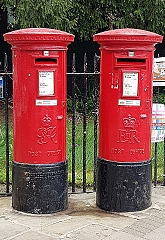
WHILE WALKING IN CAMBRIDGE, I spotted a pair of pillar boxes. At first sight they looked identical but soon I realised that they were not. One had a wider orifice for inserting letters than the other. The wider one bears the ‘logo’ of Queen Elizabeth II and its neighbour with the narrower slit bears the logo of the Queen’s father, King George VI. Apart from these differences, there were much the same.
The two pillar boxes I saw in Cambridge are not particularly old. The first post box on the British mainland was placed in Carlisle in 1853. The idea of using such receptacles for collecting mail is connected with the author Anthony Trollope (1815-1882). An informative website (https://www.postalmuseum.org/collections/highlights/letter-boxes/#) related:
“Anthony Trollope, now more famed as a novelist, was, in the 1850s working as a Surveyor’s Clerk for the Post Office. Part of his duties involved him travelling to Europe where it is probable that he saw road-side letter boxes in use in France and Belgium.He proposed the introduction of such boxes to Britain and a trial on the Channel Islands was approved. Four cast-iron pillar boxes were installed on the island of Jersey and came into use on 23 November 1852. In 1853 the trial was extended to neighbouring Guernsey. None of the first boxes used on Jersey survive. It is possible that one still in use on Guernsey together with another in our collection, originally sited in Guernsey, date from the 1853 extension to the trial.”
Before the introduction of pillar boxes:
“… there was [sic] principally two ways of posting a letter. Senders would either have to take the letter in person to a Receiving House (effectively an early Post Office) or would have to await the Bellman. The Bellman wore a uniform and walked the streets collecting letters from the public, ringing a bell to attract attention.”
Well, all that history is news to me and I might not have bothered to find out about it had I not seen the father and daughter pillar boxes standing side=by-side in Cambridge’s Market Square.
HERE IS SOME PRAISE FOR MY PUBLISHING ACTIVITIES in a book review by Stephen Turner (of the University of South Florida College of Arts and Sciences (USA)) in the Journal of Classical Sociology 2022, Vol. 22(2) 247–253:
“Adam Yamey, a retired dentist and son of an LSE Professor, has published, through Lulu, a self-publishing company discussed in the book, several books about London, the history of places in Britain,the social movements of the Indian diaspora, travel in the Balkans, his great-grandfather, who was a Jewish South African politician, and other historical topics with a strong“social” content. His blog and webpage (https://adam-yamey-writes.com) are nicely professional and indistinguishable from the pages digitally competent academics produce.”
WALKING BY THE THAMES along Chiswick Mall is always enjoyable whatever the weather. The landward side of the street is lined by houses, many of them well over 100 years old. One of them is called Said House. At first, I imagined that the ‘Said’ referred to someone or something in the Arab world, but it seems that this is not the case.
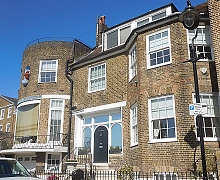
Said House on Chiswick Mall
The façade of Said House is dominated by an overly large bay window with a vast single pane of curved glass. The building’s earliest structures date back to the 18th century, but much has been done since to distort its appearance. Pevsner said that the building was Victorian, but “georgianised” in about 1935 by Darcy Braddell (or by Albert Randall Wells [1877–1942]). One of its early inhabitants was an artist, Katherine Parsons. The actor and theatre manager Sir Nigel Playfair (1874-1935) was also one of its inhabitants. It was for him that the modifications, including the western wing with its bay window, were made.
The origin of the house’s name is uncertain, but one source suggests that it is so-called because its title deeds refer to “the said house”. This is the only explanation of the name that I can find having searched the Internet thoroughly.
There is a terracotta urn in an alcove high above the bow window. A passer-by with a strong Irish accent despite having lived in Chiswick for 65 years told me that this was something to do with Josiah Wedgwood (1730-1795). This might possibly be the case, but I cannot be certain about it. Wedgwood’s associate Thomas Bentley (1731-1780) did live in Chiswick. According to Lloyd Sanders in his “Old Kew, Chiswick and Kensington” (published 1910):
“Bentley was in failing health when, in 1777, he took up his residence at Chiswick, possibly to be near his friend, and three years afterwards he died. He was buried in Chiswick church, where Wedgwood raised a monument to his memory with a medallion portrait by Scheemakers.”
I have not yet discovered precise location of Bentley’s house. But that should not stop you from taking a stroll along Chiswick’s lovely Mall and enjoying the glorious display of flowers in bloom especially during spring and early summer.
The tradition of covering roofs with thatch continues all over the English countryside. Although most buildings are now roofed with tiles, there are still quite a few that have a covering of thatch. The thatch has to be renewed regularly, This is a lengthy and costly business that can only be carried out by the small number skilled thatchers, who operate around the country. Because of the costliness of maintaining it, having a thatched roof is now a conspicuous sign of wealth, whereas once it was not.






 yamey
yamey 