Down the slope to an uncertain fate in France and Flanders

A PARABOLIC ARCHWAY made of stainless-steel straddles a pedestrianised roadway on the clifftop near to the harbour in Folkestone (Kent). A few yards east of the archway, the road descends steeply towards the harbour and a pier from which ships used to sail to and from Fance. The impressive metal hoop was inaugurated in 2014 by Prince ‘Harry’, son of King Charles III. It commemorates the one hundredth anniversary of the start of WW1. The roadway that runs along the clifftop and then down to the harbour is now known as Road of Remembrance. On a fence close to the archway, there are thousands of crocheted poppies, lovingly made by women mourning the tragedy of the so-called Great war.

It was along this road and down the slope, formerly known as Slope Road, that during the Great War (1914-1918) millions of soldiers and auxiliary staff marched from nearby Shorncliffe Camp to the harbour, where they embarked on ships that carried them across the English Channel to war-torn France. As a BBC website page (www.bbc.co.uk/news/uk-england-22892729) related in connection with the roadway:

“For many of the millions of servicemen making their way to the trenches of World War I it was the last part of Britain they stepped foot on.”

The archway, which is close to the steep slope is called the Step Short Memorial Arch because as the website explained, “Step Short” was:

“… the order given to the marching men to shorten their stride as they went downhill.”

When we visited Folkestone in July 2025, we were able to walk beneath the arch, see the poppies, and read the various emotional commemorative information panels near it. However, the sloping part of the road leading down to the harbour was closed off for repairs. The banks lining the slope had begun to subside making it hazardous to be on this historic stretch of road.

I was very much moved by the Road of Remembrance, the archway, and the various memorials. For many of those who marched down that steep slope, it would be the last time they would ever see England. For, as is recounted in a British Parliamentary website (www.parliament.uk/business/publications/research/olympic-britain/crime-and-defence/the-fallen/), during WW1:

“… 880,000 British forces died, 6% of the adult male population and 12.5% of those serving.”

That means that about one out of every eight men walking along where the arch now stands and then down the slope would die across the Channel in France or Flanders.

The pointlessness of war.

Numbered pebbles to remember the dead in Folkestone

ON THE FIRST of July 1916, 19 thousand two hundred and forty British soldiers were killed during the first day of the Battle of the Somme. A memorial on the Leas Cliff promenade in Folkestone, Kent, remembers them, not by name but by number.

In 2008, the artist Mark Wallinger created an artwork called “Folk Stones”, which can be viewed at Leas Cliff. It consists of a square area containing 19,240 pebbles. Each one represents one of the victims killed on that first day of battle in 1916. Just as each of the soldiers had his own service number, the artist has numbered each of the stones in his artwork.

It is a simple creation, but one that is very moving.

Walking along the path of peace along the Western Front

WHEN I SPOTTED THE book in the shelves of a charity shop in the small town of Bruton (in Somerset), I knew I had to buy it. It is written by Anthony Seldon, the youngest son of my parents’ dearest friends, Marjorie and Arthur Seldon. I have known them and Anthony since I was a very young child. The book I purchased is called “The Path of Peace. Walking the Western Front Way”.

In 2021, when Europe was in the midst of the covid19 pandemic, Anthony decided to walk from the Swiss Border to the North Sea, following the path of the Western Front such as it was during WW1. His aim was to help establish a ‘Path of Peace’, to realise the idea formulated during the war by one of the millions who died during it (in 1915), Douglas Gillespie. His idea was, so he wrote to his parents, to establish:

“… a path along No Mans Land from Switzerland to the English Channel after the war was over.”

Douglas wrote to his old headmaster at Winchester College that when the path was established:

“… I would like to send every man [woman] and child in Western Europe along that Via Sacra, so that they might think and learn what war means from the silent witnesses on either side.”

And Anthony explained that the walk he undertook was to help fulfil this noble ambition of poor Gillespie who perished in the conflict.

The book describes Anthony’s arduous walk along the Western Front. It was arduous physically, as the author explained in graphic detail. His feet suffered greatly, almost as much as those of the soldiers who had to spend long periods in the unhygienic trenches. It was also arduous for Anthony because he had recently lost his first wife, Joanna, who had succumbed to an illness (not covid19). The various governmental restrictions imposed to control the pandemic added to his difficulties. Yet, despite many businesses having shut down in France because of the virus, he managed (occasionally with difficulty) to find food and accommodation along the way.

Anthony describes many interesting aspects of the history of WW1 as he made his way north from Switzerland to the North Sea. He mentions what has become of the many places that were heavily destroyed by the artilleries of the armies fighting each other. Intertwined with these historical facts of an impersonal nature, he relates the poignant histories of his parents’ families during the war. For example, he describes how his father was orphaned when his parents died during the Spanish Flu, the spread of which was facilitated by wartime conditions. He also describes how his mother’s father was badly wounded in France and how his wife, Anthony’s grandmother, defied British officialdom and rescued her wounded husband from war torn France. These aspects of Anthony’s family history were known to me before I found the book, but what her wrote adds greatly to what I already knew.

Throughout the book, Anthony muses on the horrors of warfare and its tragic consequences. Yet, the book is not as gloomy as its subject matter might suggest. As the reader follows his progress along a frequently ill-signposted trail, he or she gets to know Anthony better: his strengths and his self-confessed weaknesses. Anthony’s book is both fascinating and moving. I am glad I bought my copy when I saw it in Bruton.

Do you have middle name(s) and do they embarrass you?

FREQUENTLY PEOPLE HAVE more than one name other than their family name (surname). For example, I am Adam Robert Yamey. My father, an economist, had suggested that I should be called Adam Smith Yamey to commemorate the famous early economist Adam Smith. I would not have minded that, but my mother was not happy with the idea, so I learned much later. More famous examples include the painter John Mallord William Turner and the politicians Winston Leonard Spencer Churchill and Mohandas Karamchand Gandhi. My PhD supervisor at University College London had even more ‘middle’ names. He was Robert Douglas Mignon Innes Kerr Harkness. Often, the middle names are those in memory of ancestors. Such must have the case for Robert Harkness, as well as for Churchill and Gandhi.

Photo source: wikipedia

My mother hated her middle name. It was Bertha. I often wondered why she had been given that name. When I began researching the history of my mother’s family, I discovered why she might have had that name on her birth certificate. Her mother had a cousin called Bertha. The reason my mother disliked this name was that during WW1, the Imperial German Army had a large canon, the 42 centimetre kurze Marinekanone 14 L/12, which was manufactured by the Krupp company in Essen (Germany). What upset my mother was that the artillery piece was commonly known by its nickname ‘Big Bertha’. My mother was born only two years after WW1 ended, and the Big Bertha must have been reasonably well-known when she started going to school. You can imagine how much teasing she got when the other pupils discovered her middle name.

Do you have a middle name (or several middle names) and does it (or they) embarrass you?

A young Parsi travelled the world and then fought in WW1

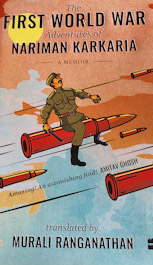
I HAVE JUST FINISHED reading a fascinating book gifted to me by my wife’s cousin. Most of the text is a Parsi’s experiences of fighting for the British during the First World War. Unlike other books about Indian soldiers who fought during that conflict, which deal with statistics and a general overview, this one contains the personal reminiscences of an individual who experienced the battlefronts first-hand.

The book is a translation from Gujarati of the memories of a Parsi (a Zoroastrian) from the town of Navsari in Gujarat – Nariman Karkaria (1895-1949). At the age of only 15, Nariman, wishing to see the world, ran away from home, and with hardly any money in his pocket, reached Hong Kong. From there, he slowly travelled through China to Siberia. His impressions of the places he visited are recorded in his often entertaining book.

When WW 1 broke out, Nariman travelled across Russia and through Scandinavia before embarking on a ship to Newcastle in the UK. From there, he reached London, where he enlisted in an English regiment. After detailing the training he received, he describes his journey to the Western Front in France.

In addition to describing the conditions on the battlefields of France, Egypt, Palestine, and Greece, vividly and often in great detail, Nariman portrays his fascination for seeing new places and people in a delightful way. Reading his memoir, I was infected with his enthusiasm for seeing the world.

Near the end of WW, Nariman spent time in Jerusalem, which he describes most interestingly. His accounts of Tbilisi, Istanbul, Baku, and post-WW1 London are fascinating. I was intrigued reading about daily life in Tbilisi and Baku as they were only a short time before the Russian Revolution.

Nariman’s writings portrayed him as a a genial person, whom it would have been fun to have met. His prose is easy to read and never dull. As the translator, Murali Ranganathan, explained in his introduction to the book, what Nariman wrote is a rare account of the travels and wartime experiences of an adventurous young Indian man from Gujarat.

This is a book well worth reading not only because of its unique perspective of WW1 but also its highly agreeable narrative style.

A war memorial in the heart of Bangalore: they died for the British Empire

ON ARMISTICE DAY (11th of November 2023), we stopped to look at the war memorial that stands in a busy part of Bangalore, where Brigade Road crosses Residency Road. Erected in about 1928, its design was somewhat influenced by Lutyens’s famous Cenotaph in London’s Whitehall. Actually, it has a greater resemblance to the memorial clock tower in London’s Golders Green, where I was brought up.

Bangalore

The four-sided memorial in Bangalore is to commemorate the members of the Pioneers, who died in WW1. However, it also records other earlier campaigns that claimed the lives of Pioneers The Pioneers, more correctly the regiments of the ‘Madras Pioneers’, were established by the British in the 18th century, and later became known as the Madras Sappers. More details are to be found in an article in the hindu.com :
“A glance at some historical documents shows that the 61st Pioneers originated in 1758 and were raised as the 1st Battalion Coast Sepoys which became the 61st Pioneers in 1901 and later became the 1st Battalion of the 1st Madras Pioneers in 1922. The 64th Pioneers also originated in 1758 as the 5th Battalion Coast Sepoys and became the 2nd Battalion of the 1st Madras Pioneers in 1922. The 81st Pioneers stood apart and originated in 1786 as the 28th Madras Battalion and later became the 10th (Training) Battalion of the 1st Madras Pioneers in 1922.”

Apart from WW1, the monument records other campaigns that were fought so that the British could consolidate their Empire. These include (to mention but a few named on the memorial): Mysore, Seringapatam, Nagpur, Afghanistan (1878-80), Burma (1885-87), and China (1900). For some of these conflicts the numbers of men lost are recorded. Numbers of English and Indian fatalities are listed separately.

When we visited the monument on Armistice Day, we saw two fresh wreaths at its base. One had a label attached, which said it had been placed by the French Consulate in Bangalore. The other had no words but it bore ribbon with the colours on the flag of Germany. There was neither an Indian nor a British wreath to be seen.

Diwali and a film from Germany about the futility of warfare

GEORG WILHELM PABST (1885-1967) was a film director born in Austria. His film “Westfront 1918” was produced in 1930. This harrowing film vividly portrays the horrors of trench warfare and its effects on both the active German soldiers and their families back home in Germany. It is really an anti-war film. It was banned by the Nazis because it did not portray German soldiers as victorious heroes. Today, the 11th of November 2023 (Armistice Day), we watched a screening of this horrifying film about the last months of WW1 at Bangalore’s Max Mueller Bhavan (a branch of the Goethe Institute).

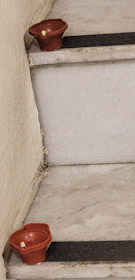
After the screening and interesting discussion about the film were over, we walked down the staircase instead of using the lift in which we had ascended. On each of the steps, there were small terracotta oil lamps (diyas), such as are typically lit during the Hindu festival of light – Diwali. Seeing this charming set of lamps placed to celebrate the imminent festival raised my spirits after having watched such a depressing film about the futility of warfare.

Travelling by air in 1919

AT THE END OF WW1, in 1919, there were two ways of travelling by air. Either by aeroplane or by airship (powered balloons, such as the famous Zeppelins). Airships could travel without stopping for longer distances than ‘planes, but they moved less quickly. You might be wondering how I discovered this, and why am I suddenly telling you about it. Well, yesterday, my wife bought me a copy of “The New Illustrated” in a charity shop. It was a slightly used copy of Volume 1, number 1, published on the 15th of February 1919. Edited by John Alexander Hammerton (1871-1949), it was a successor to his journal “War Illustrated”, which was disbanded in February 1919, a few days before “The New Illustrated” was launched.  The first issue of the new magazine came with a “Map of the World’s Airways”, given away as a gift. It is from this map that the information in this essay is derived.

The map of the world shows routes taken both by airships and aeroplanes, and the flying times between stops. For example, from Cairo to Aden was 25 hours by airship non-stop, and about 13 ½ hours by ‘plane, not including a stop in Suakin (in northeast Sudan). By air across the Atlantic, there were two choices: airship from London to St Johns (Canada), 36 ¾ hours, then ‘plane St Johns to New York with one stop, about 12 hours flying time; or airship from London to Halifax (Canada), 46 ¾ hours, then ‘plane to New York 6 hours non-stop. The timings given on the map assumed that an airship travelled at 60 mph, and a ‘plane at 100 mph. The map only displayed what it called “All British” routes.

These days, we travel between Bangalore (not far from Madras) in India and vice vera taking about 11 hours non-stop, or about 12 hours (flying time) with a stop in the Arabian Gulf States. In 1919, the traveller from London to British India had two choices. From London to Karachi (now in Pakistan) by ‘plane took two days and 10 hours, and stopped in Gibraltar, Malta, Cyprus, Baghdad, Basra, and Bahrein Island. Alternatively, you could fly by ‘plane from London to Bombay in two days and 17 hours, stopping on the way in Gibraltar, Malta, Cairo, Suakin, Aden, and Socotra Island. From Bombay to Madras was another seven hours by ‘plane. Long as these journeys might seem to us today, we must remember that travelling by sea was far slower. For example, when my wife travelled on a P&O liner – a regular passenger service, not a cruise – from Bombay to Tilbury in 1963, the trip took at least a fortnight.

If, by chance, you had wished to circumnavigate the world, you could do it by airship in 16 days and 18 hours via India, or 18 days and 10 hours via South Africa.

While I was writing this, I remembered the father of some close friends. He worked for the Shell oil company. I remember him telling us that when he used to fly to Africa and the Far East during the 1950s, the ‘planes did not fly at night. So, each flight was made in stages. Every evening during the journey, the passengers would disembark and were put up in a hotel until the flight was resumed the following morning. Seeing the 1919 map reminded me of what he told us many years ago.

A Hungarian pensioner at Kings College Cambridge

DURING A RECENT VISIT to Cambridge, we spent some time in the magnificent chapel of King’s College. It is difficult to avert one’s eyes from the masterpiece of gothic fan-vaulting that forms the ceiling of this edifice, but it is worth doing so because the chapel is filled with other wonderful things. These include a painting by Rubens, another by Gert van der Lon, and yet another by Girolamo Siciolante de Sermoneta. The brass lectern that stands in the choir was made in the early 16th century and is surmounted by a small statue of King Henry VI. There are many other items of great historical interest to be seen including the stained-glass windows, which have survived since the 16th century. Interesting as all of these are, what caught my attention was something in a small side chapel – The Chapel of All Souls.

This chapel was converted in the 1920s to house a memorial to those members of King’s College (academics, students, choristers, and servants) who died during WW1. The names of those who perished are listed on engraved stone panels on one wall of the small chapel. Amongst these names is that of the famous poet Rupert Brooke (1887-1915). 

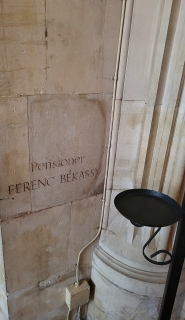
On another wall of the chapel, separate from the list of names, I spotted an inscription carved into the stone. It reads:

“Pensioner Ferenc Békassy”

Ferenc Istvan Dénes Gyula Békássy (1893-1915) was a Hungarian poet born in Hungary. In 1905, he was enrolled at Bedale’s School in Hampshire. In 1911, he began studying history at King’s College Cambridge. He was what is known as a ‘pensioner’. In Cambridge University usage, this word was used for a student, who has no scholarship and pays for his tuition as well as his board and lodging. During his time at the college, he was elected a member of The Apostles and courted the same woman as Rupert Brooke. He composed poetry both in Hungarian and English.

Just before the outbreak of WW1, Ferenc returned to Hungary, where he enlisted as a hussar in the Austro-Hungarian Army. On the 22nd of October 1915 he was killed in action whilst fighting the Russians in Bukovina. He was buried on his family’s estate in Hungary.

After the war, the memorial in King’s College Chapel was established. Because it was considered objectionable for the name of an enemy soldier to be listed amongst those who fought and died for Britain, his name was not included on the memorial. Instead, it was placed on another wall nearby.

Though separated from Rupert Brooke’s name by a few feet, this small chapel serves as a memorial to two great poets, who were killed in their prime.

Remembering victims of war in Sandwich, Kent

Some of the WW1 names and the Falklands victim below

IN THE HEART of Sandwich in Kent, near to the deconsecrated Church of St Peter, there is a war memorial that was erected to commemorate those from the town who died in the ‘War to End All Wars’ – the First World War (1914 – 1918). Roughly 100 names are recorded on the lists of people who died during WW1. However, they are not the only people listed on this monument because ‘The War to End All Wars’ did not live up to its name.’

The memorial lists about 15 people who were killed in WW2 (1939-1945). In addition, three of Sandwich’s population perished in the Korean War (1951), and more recently, one of the townsfolk was killed in the Falklands Conflict (1982).

I sincerely hope that no more names need to be added to this war memorial as a result of the conflict in Ukraine, or any future wars.