
It was long ago
Before water flowed in pipes
That pumps were useful

It was long ago
Before water flowed in pipes
That pumps were useful
Just as many associate Spain with sunshine, plenty of folk think of rain when they consider England. Yet, ironically, there is currently a shortage of water in the country. This is partly because there has been insufficient rainfall and also because for years, governments have neglected maintaining reservoirs and other water sources and water companies have been prioritising profit over provision of water to their customers.

So when it rained today after many weeks of dry weather, we breathed a sigh of relief. But this will be short-lived, because what fell today was literally a drop in the ocean.
THE MOST DISAPPOINTING tourist ‘attraction’ in Jaipur, is the City Palace. After more than 3 weeks travelling in Rajasthan, I can safely say that this royal palace is the least interesting place we have visited. Architecturally, it lacks the finesse seen in other royal palaces. In addition it is far less interesting historically.

Not wishing to seem too negative about the place, I will mention one item that did catch my attention. It is a huge silver vessel, a jar: possibly the largest silver jar that has ever been made. It and several others were made to carry water from the Ganges to England. The water was for the use of Maharaja Sawai Madho Singh II during his visit to England to attend the coronation of King Edward VII in 1902. Each of the jars could carry about 400 gallons of water.
While this is a fascinating exhibit, I do not believe that the palace is worth visiting. Its admission fees are exorbitant by local standards: minimum of £10 for non-Indians and minimum of £3 for Indians. Additional charges are levied to see certain exhibits within the palace compound. These prices must be compared with the admission fees for the palace’s far more beautiful and much more fascinating neighbour, the Jantar Mantar (non-Indians pay £2, and Indians pay 50 pence).
WATER STORAGE TANKS and wells are subject to changes in the water level. In small wells such as are commonly found in England, a bucket and winch system allows the water gatherer to reach the water in the well. In India where water tanks and wells can be quite large, occupying a substantial area of ground, another system is used to allow users to get to whatever level the water has reached. The walls of the sides of the tank/reservoir/well are lined with a series of staircases, which are used to reach the water. Often the sets of steps lining the walls of the so-called stepwells are arranged in attractive geometric patterns.

Since first seeing a (disused) beautiful stepwell in the ruins of the medieval city of Vijayanagara at Hampi in Karnataka thirty years ago, I have been fascinated by stepwells. I have seen many while travelling around Gujarat, and was pleased to find one near our guest house in Jodhpur (Rajasthan). It’s name is Toorji ka Jhalra Bavdi.
The Toorji stepwell was built in about 1740. Its construction was ordered by the Queen Consort of Maharaja Abhay Singh. Back in those days, ladies of the royal family often commissioned the building of water tanks and wells. The Toorji stepwell was used mostly by women, who traditionally did household chores including the fetching and carrying of water.
Toorji stepwell is constructed with the rose red sandstone of Jodhpur. It is decorated with carvings of various sizes. Nowadays, as with so many interesting places all over the world, it is a popular location for taking ‘selfies’ and for posing for photographs. Despite this, it is a stepwell worth seeing and is a remarkably tranquil spot surrounded by a maze of narrow, busy streets and lanes.
THE AVAILABILITY OF water is essential for human life. Since 8400 BC, or even earlier, mankind has been digging wells to access sources of groundwater. In England today, usable wells are few and far between because water is supplied by various other means. Occasionally, one comes across wellheads of now disused wells. One of these has become a minor visitors’ attraction on the lovely small island of Mersea, which is south of Colchester on the north side of the mouth of the Blackwater River.

The well head, which in in West Mersea and has been recently restored looks like a square wooden crate. It has a commemorative bronze plate on its square covering. Known as St Peter’s Well, it was an important source of water from ancient times until the early 20th century. It may have been associated for a while with a West Mersea Priory (founded 1046, dissolved 1542) that once stood nearby.
In April 1884, Mersea Island was struck by an earthquake. A crack in the ground opened near St Peters Well, and for a short time the water in it:
“… turned white, as if mixed with lime, and was quite warm, but the day after had resumed its pellucid qualities.” (www.merseamuseum.org.uk/mmphoto.php?pid=SS050030&hit=631&tot=642&typ=cat&syn=all)
Today, there is little to see but the restored wooden wellhead that stands on a slope overlooking the wide sandy beach, which appears when the tide is out, The metal plate contains quotations from the Bible and the information that the well, which had served the people for over 1000 years, was one of the main sources of fresh water for the islanders, and had never run dry.
Judging from the contents of rubbish bins awaiting collection from the street entrances of houses in West Mersea, an important source of fluid intake is nowadays bottles and cans obtained from the booze shelves of off-licenses and supermarkets.
A STEPWELL OR ‘VAV’ (pronounced ‘vaav’) is a well in which users have to descend to the water within it by steps (staircases). The first one I ever saw is a disused vav in the ruins of Vijaynagar in Karnataka. During several trips to Gujarat, we have looked at many other vavs. Some have just one staircase leading to the water in the well, and others have more than one. Because many stepwells are at least partially, if not wholly, subterranean, the structures maintaining their iintegrity are sometimes quite complex – often a series of arches or layers of galleries. Therefore, the architecture of stepwells is varied and often fascinating.
On our second visit to Surat (in early December 2023), we spent a morning looking at two vavs: the Khammavati, and the larger Chatushmukhi. The former is near the railway station, and the latter is a couple of miles away, next to the Gopi Talav (lake).
The Khammavati is about 300 years old. It was established by Kansara a devotee of a goddess of stepwells. It is still used regularly, and is a little difficult to find. To reach it, you have to enter a small, rather rundown looking house. After removing your footwear, you walk through the ground floor room towards a door that leads to a staircase. Its steps lead down to the well. It descends below some brick arches that span the gap between the walls on either side of the steps. Before reaching the water, the steps pass through a chamber containing sculptures of Hindu deities.
The water in the well looked quite clear. A gentleman arrived whilst we were looking at it. After removing a few leaves from the surface of the water, he filled a couple of buckets. He told us that it was “good water”.

Unlike the Khammavati, the Chatushmukhi vav is no longer used. It was constructed in 1510 AD. Apart from being disused, the structure is in very good condition, which is fortunate because it has an interesting design. The centrally located circular well (now dried up) is approached by four short staircases, each of them is at ninety degrees to its neighbours.
The Chausmukhi vav is beside a circular reservoir, the Gopi Talav. This was first built in about 1610 by Malik Gopi, a wealthy merchant of Surat. By 1673, it had become silted up and of no use as a water source. In 1716, some of its stones were removed to be used in the construction of Surat’s city wall. The Talav lost its former glory. However, in 2015, the city’s corporation restored it, and filled it with water. Today it and the vav form part of a well maintained park – a haven to which one can retreat to escape the noise and bustle of this busy city.
Surat, like Milan in Italy, is a throbbing hub of business and commerce. At first sight, it is, like Milan, not obviously attractive. But on closer examination both cities are studded with historical gems (and in the case of Surat, I am not referring to its famous diamond industry).
ACROSS THE MAIN ROAD from the 16th century Hazira Maqbara – a mausoleum – there is a small stepwell – the Hazira Vav. We have visited it before but never saw it in use.
A flight of tiled steps leads down to the water in the stepwell. To put it mildly, the water looks filthy and completely uninviting.
At the top of the stairs, there is a small Hindu shrine. The small courtyard surrounding the top of the staircase is decorated with coloured images depicting various Hindu deities. A few coconuts hang between them. These nuts are considered auspicious by Hindus. At our Hindu wedding in 1994, coconuts were included on the complex ceremony, which lasted several hours.
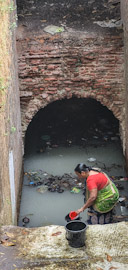
While we were looking at the well, a lady in a sari and her husband arrived. The woman descended the steps to the waters edge. Her husband explained to us that she was suffering from itchiness and that the curative waters of the well might help cure her condition.
The lady picked up one of the bucket on the step beside the water, and filled it from the well. Then, she began dowsing herself with the water. Fully dressed, she poured several buckets of the unwholesome looking water over her whole body.
Having watched this, we felt that it was unlikely that the water itself would heal her, but more likely, it was her faith in its curative properties that might have helped. Having seen the water, my thought was that if one bathed in the well, it is likely that you would end up less healthy than before you entered it.
WE TAKE IT FOR GRANTED that when you turn on a tap in your bathroom or kitchen, fresh water will flow. And when, usually for maintenance purposes, the mains water supply is turned off temporarily, we can be truly inconvenienced. There are still many parts of the world where piped water is not available to domestic users, but the UK is no longer one of these.

During a recent (May 2023) trip to Lavenham in Suffolk, my wife noticed something next to a pavement. It was a now obsolete bit of plumbing, which has been preserved to demonstrate that even as late as 1936, the small town did not have a public piped water supply for its dwellers. I suppose that before that date, the people had to rely on springs and wells.
The object that can be found on the east side of Church Street, south of Water Street, is a public standpipe. A notice near it explained that piped water came to Lavenham in 1936 to 1937. Several standpipes were erected to give the public access to the water. At that time, people had to collect water from the standpipes and take it to where they required it. However, they did not yet have the luxury of having taps that supplied water in their own homes. The standpipe, which we saw, is now non-functional, but is one of nine such items still to be found in Lavenham.
Lavenham is full of small reminders of how different life was many centuries ago. The standpipe is a small souvenir that makes us realise how different life was less than 100 years ago.
WHEN THE PORTUGUESE first landed in Madeira in the 15th century, the area that they settled – the southeast corner of the island – it was not well watered. Using slave labour, they constructed a series of irrigation channels to bring water from the mountains to the drier area, where they later planted valuable crops such as sugar cane. These channels that snake their way gradually downhill along the mountainsides are called ‘levadas’. The construction of these channels continued into the early 20th century, when they were built by Salazar’s political prisoners.
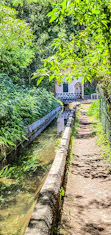
Today, the levadas continue to carry water and are well maintained. Paths run alongside each levada. Walking along them is a popular pursuit for tourist. Some of the paths are quite hazardous, and there are guided tours to shepherd groups of walkers safely along these waterside pathways.
We do not enjoy group tours. So, we had to find a levada that is not too hazardous and was easily accessible from Funchal. I homed in on the Levada dos Tornos, which passes under the hilltop village of Curral dos Romeiros – the terminal of bus number 29.
When we reached Curral, we asked the bus driver about the levada. He suggested where we proposed to walk was not good for us. We returned downhill in his bus, and he dropped us off at a staircase that led up toa section of the Levada dos Tornos, which he told us was not too narrow and led to a tea house.
We had a pleasant 3 mile walk along the levada, which wound its way gently downhill. All along the rout, lizards darted across the footpath as we approached them. Our way was lined with flowers and trees, many of them eucalyptus. Short stretches of the levada were shaded by bushes and trees. Other stretches provided views down wooded valleys. Sometimes, the port of Funchal could be seen far away and far below us. Most of the pathway was without hazards, but short lengths of it ran alongside sheer drops. Eventually, we reached the compound of the Jasmine Tea House, which caters for British tastes (cakes, scones, etc.) We did not have time to sample its wares because we did not want to miss the next bus (route 47) back to central Funchal.
Although we walked along a tame stretch of levada, we were able to gain an impression of Madeira’s remarkable network of irrigation channels.
LONG BEFORE LONDONERS began the current fashion of carrying bottle of water wherever they go, the city’s inhabitants had to rely on water sources such as hand-operated street pumps. Although there are still a few functioning public drinking fountains in London, there are no usable pumps to be found. However, a few of them have been kept as historic monuments. One of these is located on the north pavement of Cornhill, a few yards east of the Royal Exchange building.
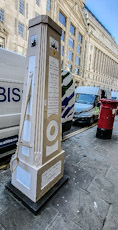
The pump, which is now kept looking like new – except that it no longer works – was set-up in 1799. On one of its four sides, the manufacturers, Phillips & Hopwood (“Engine Makers”), have included the information that the pump was paid for by the Bank of England, the East India Company, Fire Offices (i.e., insurance companies), and the “bankers and traders of the Ward of Cornhill”. The inscription on this side of the pump also mentions that the it was erected above a well that had been discovered and enlarged.
On another side of the pump, that facing south, there is a brief history of the well. It was first dug before 1282 when Henry Wallis (aka Henry le Walleis; died 1302), thrice Mayor of London, built a “House of Correction” on the spot. This was a prison for “night walkers” and was known as “The Tun”. Stow writing his “Survey of London” in 1598, noted that the prison was built of stone and (preserving Stow’s spelling) we learn:
“In the yeare 1298. certaine principall Citizens of London, brake vp this prison called the Tunne, and tooke out certain prisoners for the which they were sharply punished by long imprisonment, & great fines, as in another place I haue shewed.
In the yeare 1401. this prison house called the Tunne was made a Cesterne for sweete water conueyed by pipes of Leade frõ the towne of Tyborne, and was from thence forth called the conduite vpon Cornhill: Conduite vpõ Cornhill.Then was the wall planked ouer, and a strong prison made of Timber, called a Cage, with a payre of stockes set vpon it, on the top of which Cage was placed a Pillory for the punishment of Bakers offending in the Assise of Breade: for Millers stealeing of Corne at the Mill: and for baudes Cage, stockes and pillorie vpon Cornhill.and scolds &c.”
By the time the pump was set-up, the prison had long since gone (? demolished). How and why the well was rediscovered, I cannot say, but it was, and its water became accessible by using the pump. The top of the pump serves as an advertisement. At the top of each of the four sides of the pump, there are symbols, which people would have recognised as being the trademarks of four insurance companies in existence at the time that it was established. Back in the 18th and early 19th centuries, firefighting services were provided by the insurance companies. The trademarks of insurance companies were placed on buildings so that firefighters of each insurance company could recognise which houses had paid for policies that made them eligible to be saved by the firemen.
Today, firefighting is no longer provided by insurance companies, and water is no longer available from public pumps. So, it is not surprising to see many people wandering around London with their own supplies of drinking water – in plastic bottles and other containers. What does surprise me is that when I was younger, in the 1960s and 1970s, one hardly ever saw people carrying their own drinking water. Now, it is quite common to see people sipping from their personal water carriers. Have people become thirstier recently, or what is it that makes them feel that they should never be without a portable supply of potable water?
 yamey
yamey 