THE RUINS OF the Valle Crucis Abbey, formerly a Cistercian establishment, stand a few miles away from the Welsh town of Llangollen. Not far away from these picturesque remains, there is a grassy mound on the top of which there is a stone column. This is the Pillar of Eliseg.
The Pillar was erected in the ninth century by Cyngen ap Cadell (died 855), king of Powys, to commemorate his great-grandfather Elisedd ap Gwylog (died c. 755), also a king of Powys.
The pillar has a lengthy Latin inscription that is now impossible to read, but it was deciphered by the antiquarian Edward Lluyd in 1696. According to the website of CADW, a Welsh governmental organisation that looks after ancient sites, the gist of the inscription is as follows:
“One phrase includes the names of successive rulers of the kingdom of Powys during the 8th and 9th centuries. Another reveals that the cross was erected by Cyngen in memory of his great-grandfather Eliseg, who was said to have expelled the Anglo-Saxon English from this part of Wales.”
As to its purpose, this source stated:
“It’s thought that the carefully composed inscription, which includes legal terminology, was intended to be read aloud, to be proclaimed to an audience. Could this be where the ancient rulers of Powys were appointed? Is it a victory monument, declaring political ownership of land won back from the English, or vital propaganda at a time when the kingdom was under threat? Or all of these things?”
During the English Civil War, the Parliamentarian soldiers pulled down the pillar, damaging part of it. The remaining upper part of it was re-erected in 1779. And it can be seen easily from the road that runs between the remains of the abbey and the Horseshoe Pass. Eliseg and his descendants would most probably be disappointed to find that to a large extent Wales is now within the control of England.
IT IS NOT UNCOMMON to find that transport vehicles such as trains, boats, and aeroplanes, are given names. They are often named to honour noteworthy people. While strolling along platform 1 at London’s Paddington station today (21st July 2024), I noticed a train bearing the name ‘Megan Lloyd George CH’. You will, I hope, excuse my ignorance when I tell you that although I have heard of David Lloyd George (1863-1945), a former Prime Minister, Megan Lloyd George was not a name with which I am familiar. I wondered why the Great Western Railway (‘GWR’) had chosen to put her name on one of its trains. When I got home, I found out why.
Megan Lloyd George (1902-1966) was the youngest child of the Prime Minister David Lloyd George. She was born in Criccieth, Wales. Until she was four years old, she could only speak in Welsh. Between the ages of 8 and 20, she spent much of her life in the Prime Minister’s residence, 10 Downing Street. It is not surprising that the young lady became interested in politics. With some help from her father, Megan became the Liberal party candidate for the Welsh constituency of Anglesey, and in May 1929, she was elected as its Member of Parliament (‘MP’). She became the first woman MP from Wales. She was re-elected in the general elections of 1931 and 1935.
“… on his visit to Hitler in 1936, and opposed the policy of appeasement, urging him to press for Chamberlain’s resignation in May 1940.”
She served in Parliament throughout WW2, and was re-elected in 1945 and 1950, but with greatly reduced majorities. In 1952, she lost her seat.
For various political reasons, Megan and several other members of her party left the Liberal Party and joined the Labour Party in April 1955. In 1957, she became the Labour MP for Carmarthenshire, with a majority of 3000 votes. Always a popular figure, she took Carmarthenshire again in 1966, with a majority of 9000. By then, she was suffering from cancer, and died soon after the election and a few days after having been awarded the Companion of Honour (‘CH’) by Prime Minister Harold Wilson. In 2016, she was nominated as one of the ‘50 Greatest Welsh Men and Women of All Time’ (www.walesonline.co.uk/news/wales-news/50-greatest-welsh-men-women-11431779).
GWR trains run from Paddington to the west of England and parts of Wales including its capital, Cardiff. So, we should not be surprised to find Megan’s name on one of them. Having said that, I am not sure where the train with her name on it was heading as it left platform 1.
This painting on display at Sotheby’s in New Bond Street was created by Sir John Kyffin Williams (1918-2006). He was born in Wales on the island of Anglesey.
When I was a pupil at London’s Highgate School (between 1965 and 1970), Kyffin Williams taught art at the school. He was the senior art master between 1944 and 1973. I was fortunate to have attended a few of the painting sessions He supervised.
In 1968, Kyffin visited the Welsh settlement in Patagonia. After his return to England, he gave a fascinating talk about his trip to us at the school. I attended this, and still remember some if what he related.
A few years ago, we drive to Anglesey to see his work at the Oriel Mon gallery near his birthplace, Llangefni.
Seeing this painting at Sotheby’s brought back happy memories.
WE USED TO make long trips by car in France. Amongst the many sights we visited were various Cistercian abbeys, such as those at Citeaux and Clairvaux. Later, during trips to Wales, we often visited the ruins of the Cistercian Abbeys at Strata Florida and at Tintern on the River Wye. I do not know what drew us to these Cistercian places, but we went out of our way to see them. So, when we were staying near Warrington in Lancashire and I noticed that we were not far from yet another Cistercian site, we made a bee line for it. Overlooking the River Dee, the ruins of Basingwerk Abbey are located near the town of Flint in the county of Flint.
Though not as extensive as the ruins at Tintern, there is plenty to see at Basingwerk. Dedicated to the Virgin Mary, the abbey was founded in 1132 by Ranulf de Gernon, 4th Earl of Chester. Being on the border between England and Wales:
“Basingwerk was patronised by both the Welsh and Anglo-Norman nobility. Royal benefactors included Henry II, Prince Llywelyn ab Iorwerth (d. 1240), Prince Dafydd ap Llywelyn (d. 1246) and Edward I.” (https://www.monasticwales.org/browsedb.php?func=showsite&siteID=24).
Originally founded as part of the Order of Savigny, it joined the Cistercian Order in 1147. In about 1355, it was reported that the abbey was in a devastated condition. During the early 15th century, Basingwerk tried to encourage pilgrims to visit its shrine, hoping that this would raise funds to repair the place. Between 1481 and 1522, Abbot Thomas Pennant restored the abbey and improved its fortunes. Sadly, by 1537, the institution had been suppressed by order of King Henry VIII. In 1540, the site of the former monastery was sold. After changing hands a couple of times, it became the property of the Mostyns of Talacre.
In 1923, the ruins of the abbey were taken over by the government, and now they are well-maintained by CADW – the historic environment service of the Welsh Government. Despite the appallingly bad weather prevailing when we visited the remains of the Cistercian abbey, we were able to enjoy wandering around the ruins. To recover from the inclement conditions, we took refreshments in the nearby café/restaurant in Basingwerk House.
THESE DAYS WE ARE so preoccupied with the Russian invasion of Ukraine that the English invasion of Wales is not in the forefront of our minds. In the 13th century, King Edward I of England (reigned 1272-1307) decided to conquer Wales. To do this, he built a series of castles from which his armies could enter Wales. One of these was built at Flint on the left bank of the River Dee not far from Chester, from which supplies could be easily carried either by land or by water (sea and river).
The castle at Flint was designed by Richard L’engenour and built between 1277 and 1278. Its form was based on Savoyard models. One of its circular towers was built larger than the others and separated from the rest of the castle – it served as the ‘donjon’ or keep.
Many of those who constructed the castle – English people – stayed on in the area to become the inhabitants of the new fortified, walled town of Flint. They felt safe within the town’s walls, but this sense of security was soon to be disturbed. For in 1294, the Welshman Madog ap Llywelyn led a revolt of the Welsh against their English rulers, and attacked Flint. Rather than letting the town fall into the hands of the Welsh, the Constable of Flint Castle ordered that the town be burned to the ground so that the Welsh rebels would be denied shelter and food.
The castle remained functional until the Civil War, when it, along with other strongholds, was destroyed following orders issued by Oliver Cromwell, soon after 1647.
Today, the impressive ruins are open to the public and well maintained by CADW, a Welsh Government body that looks after sites of historic interest. In 1838, JMW Turner created a watercolour painting showing the castle with a beautiful sunset behind it. We visited it on a rainy day in May 2024. Despite the inclement weather, seeing the castle gave us great pleasure.
WHEN I WAS A child, I had a jigsaw puzzle, whose pieces were shaped like the counties of England and Wales, as they were in the 1960s. When you put the pieces together correctly, you ended up with a map of England and Wales. The county of Flintshire always fascinated me because it was then divided into two separated parts. Today, the 27th of May 2024, we made our first ever visit to Flintshire. Amongst the places we looked at was Connahs Quay, which is on the Welsh bank of the River Dee.
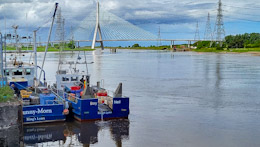
In the early 18th century, the Dee silted up. This put an end to Chester being used as a port. Instead, Connahs Quay, which is close to the mouth of the Dee became an important port and a place where ships were built. The place was also an important fishing port. You can still see fishing vessels at Connahs Quay. We watched two of them setting out to catch shellfish as the tide came rushing furiously up the river.
The advent of the railway in the 19th century, brought industry and prosperity to the area, and the town grew. In recent years, industry has declined in the district, and Connahs Quay has lost its former prosperity. However, there is still a large power station nearby and the Shotton steelworks, now owned by the Tata company, provide some employment.
With a fine view of the recently constructed (1998), elegant suspension bridge over the mouth of the Dee and a promenade along the river Bank, Connahs Quay is a pleasant place to linger.
Primrose Hill is south of Hampstead village and southeast of Swiss Cottage. It is a delightful place to take exercise and has been home to several notable figures. From its summit at 210 feet above sea-level, it is possible to enjoy a superb panorama of London when weather permits. At its summit, a low concrete construction is inscribed with some words by the poet William Blake (1757-1827).
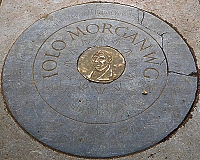
In the centre of the circular concrete platform at the summit of the hill, there is a round commemorative metal plaque surrounded with words in the Welsh language. It was placed to remember Iolo Morganwg (1747-1826), who was born in Wales as ‘Edward Williams’. He was a poet and antiquarian, who both wrote and collected poetry in the Welsh language. He had a great interest in preserving the literary and cultural heritage of his native land. His integrity as a scholar was somewhat undermined by the fact that he had forged several manuscripts that he claimed were of mediaeval origin. Nevertheless, he was involved in the early revival of Druidism. In 1792, he founded the ‘Gorsedd Beirdd Ynys Prydain’ (Gorsedd of Bards of the Island of Britain). The Gorsedd, which still meets today, is a society of poets, writers, musicians, artists, and other individuals, who have made notable contributions to the Welsh nation, language and culture. Every year, the Gorsedd assembles at a festival of Welsh culture, now known as the Eisteddfod. According to the website of the Royal Parks, Primrose Hill was the site of the first ever Gorsedd, which was held on midsummer’s day, 21 June, 1792, a long way from Wales.
WE ARRIVED IN ENGLAND from India on the 27th of February 2020. Because of the covid outbreak, we had not left England until today, the 13th of September 2021. Some, especially those who live there, regard Cornwall as being another country, rather than part of England. We have visited that southwest county of what most people regard as England, since we arrived back from England. So, it would be pushing things if we said that we went abroad to Cornwall,
Today, we travelled abroad, leaving England for a few hours. To reach our destination we did not have to take covid tests or show evidence of double doses of vaccine or, even, show our passports. However, leave England we did. We crossed the River Severn to leave England and enter Wales. Crossing the Severn Bridge on the M48 did not require us to pay a toll as used to be the case, as the crossing is now free of charge. A few years ago, a toll was charged for crossing into Wales, but no longer; it has been abolished.
Tintern Abbey
Well, I hear you say, Wales is not exactly ‘abroad’, but when one has not left England for over 18 months, it will do as ‘abroad’. Wales has its own parliament and most signs, be they on the road or elsewhere, are bilingual (English and Welsh) and, if you are lucky, you will meet a speaker of the Welsh language. To us, crossing over into Wales, after so many moths without foreign travel, felt like going abroad.
We drove along the beautiful Wye Valley and stopped at the attractive ruins of the former Cistercian Tintern Abbey (Abaty Tyndyrn in Welsh), the first ever Cistercian foundation in Wales. At the ticket office, I expressed my joy at being abroad after so many months, and the cashier said to me in a gently Welsh accent:
“I like your style.”
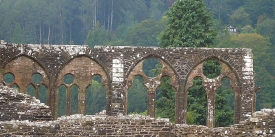
We have visited Tintern Abbey (founded 1131) many times in the past and each time it has been a wonderful experience. Today was no exception. Set in a wooded valley, the ruins of the gothic buildings look great against the background of trees with dark green foliage. After spending about an hour in Tintern, we drove along roads which were mainly in Wales but occasionally crossed the border into England. When we reached Wrexham (Wrecsam in Welsh), we headed off north and east into England, our trip abroad having been completed.
THE PAINTER GEORGE ROMNEY (1734-1802) moved to Hampstead in north London for health reasons near the end of the 18th century. His home on Holly Hill, originally named ‘Prospect House’ because of the views over London that could be seen from it, still stands today, even thouh it has been altered since Romney occupied it. During 1792, he made frequent visits to Hampstead and the following year he decided to move to the suburbs north of London. In June of that year, he took lodgings at a place he called ‘Pineapple Place’ near Kilburn. Dissatisfied with his Kilburn abode, and having been persuaded that it would be better to buy an existing building rather than to build from scratch, he bought the house on Holly Hill, an old house and its stables, in 1796. It is this building that bears a plaque commemorating his residence there. The Holly Hill house contained his studio, which was completed after the artist had spent £500 on alterations to his new home. While the alterations were being carried out, Romney lived in a building called The Mount on Heath Street, so the informative historian Barratt reveals in Volume 2 of his encyclopaedic history of Hampstead.
Romney’s house in Hampstead, London
The works that Romney had paid for resulted in the creation of:
“…strange new studio and dwelling-house … an odd and whimsical structure in which there was nothing like domestic arrangements. It had a very extensive picture and statue gallery …”
Barratt continues:
“At last Romney got rid of the builders and decorators, and all his town treasures —paintings, casts, statues, canvases, and what not—scores of cart-loads of them—were deposited in the new house and gallery, and the painter began to think that his higher aims were about to be attained.”
But this was not to be. His health failed and in January 1799, he shut up his Hampstead abode and travelled to Kendal. He returned to Holly Hill briefly but returned to Kendal after the 28th of April. He died in Kendal. His house in Hampstead was sold and by 1808, it contained ‘Assembly Rooms’ and three years later it became home to ‘The Constitutional Club’. Barratt revealed that the rooms in Romney’s house were:
“…For sixty years these rooms were practically the Town Hall of Hampstead and the centre of the town’s municipal life. The Hampstead Literary and Scientific Society, formed about 1833, met here, and many learned men at its invitation gave lectures in the rooms …”
Lord Ronald Sutherland Gower, author of “George Romney” published in 1904, wrote of FRomney’s Hampstead dwelling:
“…externally the building, which is covered over with a kind of wooden boarding, has the appearance of a large stable; but within are some remains of the great gallery in which the artist placed his collection of casts, and handsome columns decorate this room; it is now a Conservative Club, and appears to be well attended by the residents of that portion of Hampstead. As a living house it must have been supremely uncomfortable; and one no longer has the advantage of the view over London from the upper windows from which Romney loved to look out and watch the distant dome of St. Paul’s lying in the Thames Valley below; the great city has crept up and around Holly Bush Hill, and crowded out the prospect which gave the great painter almost the last solace in his melancholy decline of life.”
Recently, I wrote an essay (see https://adam-yamey-writes.com/2021/04/29/artists-in-hampstead-londons-montmartre/) about some artists who lived in Hampstead and mentioned George Romney. Someone who read it wrote to me and reminded me that Romney’s former home was also the abode of another artist, the Welsh born architect Sir Bertram Clough Williams-Ellis (1883-1978), most famous for his creation of Portmeiron in western Wales. At about the same time as my correspondent mentioned Williams-Ellis, I found a copy of the architect’s autobiography, “The Architect Errant”, in a disused telephone box, now being used as a book exchange, in Madingley, Cambridgeshire. Although I have not yet read the whole book, I have found what he wrote about his time living in Romney’s former home in Holly Hill. He bought this building in 1929 and redesigned it considerably.
Clough left Chelsea for Hampstead. He wrote of Hampstead and its proximity to the Heath:“It was this love of spaciousness that had propelled me first from South Eaton Place … to Hampstead where the desire for bracing air, a garden, and good schools for the children, were factors determining our choice.
From the edge of a plateau high above the dome of St Pauls we looked southwards from George Romney’s old house across the maze of London …”
The autobiography provided a description of Romney’s house as it was when Clough lived there:
“The fine old house, much altered and adapted to our curious habits, being far too large either for our needs or means, was proportionately delightful to inhabit, and with two ex-billiard rooms (it was once a club) at the disposal of the children, its size had compensations.”
Referring to Romney’s picture gallery, Clough added:
“For myself I had taken the immense old picture gallery as my studio, and I did not hesitate to play up to the magnanimity of its proportions in my embellishments … my wife was surprised and a little shocked at my choosing to work in what she not unjustly called my ‘ballroom’…”
He noted that Romney’s former home was “… splendid for large parties…”, and he held many of them. For example, Clough hosted:
“… dances every so often, a show by Ballet Rambert, David Low drawing large cartoons and selling them for charity. We also gave a party to meet the Russian Ambassador, M Maisky, who made a speech from the gallery balcony …”
The balcony can be seen clearly in a photograph on the RIBA website (www.architecture.com/image-library/RIBApix/image-information/poster/romneys-house-hollybush-hill-hampstead-london-romneys-studio/posterid/RIBA71050.html).
Ivan Mikhailovich Maisky (1884-1975) was the Soviet Ambassador to the Court of St James from 1932 until 1943. Unfortunately, the party referred to above does not get a mention in Maisky’s diary (as edited by Gabriel Gorodetsky), which is perhaps not surprising in view of the huge number of events an ambassador is obliged to attend. A year before Maisky became the ambassador:
Rather oddly, Clough does not mention this trip in his autobiography.
Clough wrote that the South African-born scientist Sir Solly Zuckerman (1904-1993), who was studying primate behaviour:
“… wished one of his research baboons on us, as he wanted to study its reactions to ‘bright, intelligent young society’. He was then writing his rather ambiguously entitled book “The Sexual Life of Primates” – so Betsy had quarters on the flat roof at the top of the house for several months.”
The book referred to above was probably “The Social Life of Monkeys and Apes”, published in 1932. Betsy’s stay in Romney’s old house was not entirely successful. It was not:
“… the social success that we had hoped, unresponsive and dirty, we bade our little lodger farewell without regrets. The experience may have been good for Betsy, but I don’t think our children benefitted markedly from the association.”
Clough and his family left Hampstead for Wales at the outset of WW2, keeping a London ‘pied-a-terre’ in Carlton Mews, now demolished. His and Romney’s house in Holly Hill, an edifice altered for Romney by Samuel Bunce (died 1802), has since been used as the studio for an architect’s firm, Hancock Associates, in the 1970s (information from Beth Portwood) and other purposes. In 2012, the architect’s firm ‘6a’ worked on the building to modernise its interior and restore it to a single family dwelling as it had been when Romney acquired it (www.6a.co.uk/projects/more/romneys-house).
The house stands amongst a small cluster of buildings near Fenton House and this charming ensemble makes me think that externally little has changed since these houses were built in the 18th century.
WHEN I WAS SIXTEEN, that was in 1968, I made two memorable trips. The first was a youth hostelling trip in Wales and the other, which followed soon after that, was my first visit to Paris.
Three good friends of my age and I travelled by train to Chepstow in South Wales. Our plan was to walk from one youth hostel to the next, carrying our baggage in rucksacks.
From Newport, we struggled along footpaths by the east bank of the River Wye until we reached the village of St Briavels. The youth hostel was housed in parts of the place’s mediaeval castle, whose construction began in the early 12th century.
We were assigned beds in a dormitory. At night I struggled to make myself comfortable in the shroud-like sheet sleeping bag that was required by guests staying in British youth hostels. In those days, I used to find it difficult falling asleep in places away from home. St Briavels was no exception. In the middle of the night I felt the urge to go to the loo, but because I was anxious about walking across the dark castle courtyard to the hostel’s only toilets, I remained becoming increasingly uncomfortable until day broke.
The eight mile hike from Newport to St Briavels had been a hard, tiring ‘slog’. We were not looking forward to doing something similar the next day. We walked a few miles until we reached a main road, and then boarded a local bus. At this point, dear readers, you need to know that in 1968 youth hostels were only supposed to be used only by travellers making their way under ‘their own steam’ (i.e by walking, cycling, canoeing, horse-riding etc.), but not by motorised transport.
We reached the small town of Crickhowell and walked from there towards an isolated youth hostel on the edge of the Brecon Beacons mountain range. The Nantllanerch youth hostel, which only functioned between 1966 and 1969, was about a mile from the house where its warden lived. We were the only people staying in this un-manned hostel miles away from anywhere. It had no electricity and the chemical toilets were attached to septic tanks. Lighting was via gas lamps fuelled from a cylinder. This delightful place was also supplied with an out-of-tune upright piano. We stayed there for two nights, using the day between them to climb one of the nearby peaks. I had never climbed a mountain or a significant hill before. Every time I saw what I hoped was the summit, it proved to be a ridge behind which there was another gruelling climb. After that experience, I decided that Everest was not for me. However, a few years later, I did climb, or rather scramble up, Mount Ventoux in the south of France.
We left Nantllanerch and used public transport to reach Brecon, where we spent another night in a youth hostel. Then, again disobeying the rules, we travelled a long way using public transport to Great Malvern, where we spent another two nights. On the day between them, we completed a lovely walk along the ridges connecting the peaks of the Malvern Hills. I fell in love with Great Malvern and have revisited this mainly Victorian resort often.
Every time one left a youth hostel, the warden was required to stamp our Youth Hostel Association booklets with the hostel’s official stamp. On leaving Great Malvern, we notice that the warden had placed the hostel’s stamp upside down in each of our booklets. We wondered why. Long after we had returned to London from Great Malvern, we discovered the reason. An upside-down stamp was to warn the wardens of other youth hostels that the bearer of this stamp had caused trouble or breached a rule. The warden at Great Malvern must have realised that our itinerary as recorded by the hostels in which we had stayed could not have been undertaken without making use of motorised transport along the way.
I loved my first youth-hostelling trip and felt sure that my first trip to Paris, which followed it, would be an anti-climax. But I was wrong. I travelled with my family to Paris on the Night Ferry train, which was boarded in the evening at Victoria station in London. There were two platforms at the station dedicated to the Night Ferry trains. To enter them, one needed not only tickets but also passports. Our family occupied two neighbouring compartments. My sister and I shared one of these. It was equipped with two berths, one above the other, and a basin with water taps.
The Night Ferry travelled to Dover, where the sleeping cars, such as we occupied, ran along rails into those in the hold of a cross-channel ferry. We all remained in our compartments. After a while, our carriages were pulled out of the ferry and onto the rails at the French port of Dunkirk. I could not sleep a wink. I stared through the glass of the window of our compartment throughout the night. There was not much to see during the sea crossing, but things improved at Dunkirk, where our carriage was shunted around a huge floodlit marshalling yard for what seemed like several hours. As dawn broke, we set off through France towards Paris.
Paris was a wonder, an ‘eye-opener’ for me. I loved everything about it, especially the metro with its curious pervasive characteristic smell and some of its trains that whooshed along on rubber tyres instead of metal wheels. In those far off days, the entrances to station platforms were provided with doors, ‘portillons’, which closed automatically just before a train left the station. These were supposed to prevent passengers from rushing to board the train just before its doors closed. Once, I got caught behind a closed portillon just after my parents and sister had passed through on to the platform. For a moment, I felt panicked, but the family waited for me to be liberated. Above ground, some of the metro stations were decorated with art-nouveau metal work. I loved this because I was already very keen on this artistic style.
We stayed in a small hotel on the Ile St Louis, a peaceful oasis separated from the rest of Paris by the River Seine. It was the nicest place I have stayed in the city. On my first visit, I loved the bookshops on Place St Michel and the well-stocked record shops nearby. We did a great deal of sight-seeing including a visit to the Louvre. What I remember most about this world-famous collection was rather mundane. We had left our coats at a garde-robe near one of the entrances. By the time we had paid our respects to the Mona Lisa and many other great works of art, we had forgotten where we had left our belongings. We spent longer looking for our coats than we had done admiring artworks.
My parents, who were not keen on visiting places that were neither churches nor museums, did take us up the Eiffel Tower, but only to its lowest viewing platform. What impressed me there were the lifts that climbed at an angle rather than vertically. My first visit to Paris was followed by many more, always enjoyable and always eliciting in me the same sense of wonder as my first.
We returned to London on the Night Ferry, arriving at Victoria in the morning. After we had stepped down onto the platform, my mother pointed to a lady disembarking from the next carriage to ours and said to us excitedly:
“Look, there’s Lady Churchill.”
It was Winston’s widow. I had been at the Hall School in Belsize Park when in early 1965, my class gathered around a small black and white TV to watch Winston’s funeral, ‘live’, as it happened.
The next year, following the success of our first hostelling trip in Wales and nearby, my three friends and I decided to go back to Wales on another hostelling trip. The first hostel on our itinerary was at Capel-y-Ffyn in the Brecon Beacons National Park, just north of the ruins of Llanthony Abbey. We booked in and woke up the next morning to discover that the ground was covered with a thin layer of snow. Then, fate struck.
I had promised to telephone my over-anxious mother every day. So, I went to the village telephone box and rang her. She told me that she had heard that there was snow falling in Wales. I told her how little we had seen. She replied that we were to return to London immediately. I do not know what she was imagining. She might have thought that snow in Wales was likely to be as dangerous as blizzards in the Arctic.
My friends and I knew that my mother’s orders were never to be questioned. It was with great sadness that we packed up (while the snow was melting) and returned to London. My mother’s over-anxiety had wrecked our adventure.
Years later, my wife and I were entertaining the mother of one of my friends on the sabotaged trip. Then in her late eighties, she could still remember being amazed at the time when she heard how my mother had reacted to the news of snow falling in Wales.
To my great relief, my three disappointed friends remained friendly with me despite my vicarious role in greatly abbreviating what promised to be a great trip. Sadly, of the three one died a few years ago. A spot of snow never put him off risking his life more excitingly during his colourful career. Nor, did it deter the rest of us from doing many things that would have given my late mother cause for great anxiety.
Photo showing clouds over the Brecon Beacons in south Wales





 yamey
yamey 