Churchill in Cornwall (England) and Maharashtra (India)

WE OFTEN VISIT Wadebridge in Cornwall. It contains an establishment called Churchill Bars. Actually, it is also the headquarters of the local Conservative Club. Until 2025, this place had a restaurant that served well-prepared meals, which included very tasty roast pork belly. Sadly, since early 2025, the Churchill Bars have ceased serving meals.


Fortunately, far away from Cornwall in South Bombay, Churchill Cafe is still in business. Located in Colaba and owned by Parsis, this tiny restaurant serves superb European-style dishes, as well as a few Parsi gastronomic offerings. Decorated with photographs of London landmarks and a portrait of Winston Churchill, this bustling restaurant is well worth visiting.

End of an era at a pub in Cornwall

EGLOSHAYLE FACES WADEBRIDGE across the River Camel. The Earl of St Vincent pub is hidden away up a hill behind Egloshayle’s St Petroc church. It is housed in a building built in the 17th century as a boarding house for masons. Later, it became a pub. One of its many guests was Admiral Sir John Jervis (1735-1823). When we visited the pub in May 2022, I wrote the following about it:

The interior of the pub has timber roof beams and a delightful feeling of times long gone by. It is a great example of many people’s idealised vision of a typical ‘olde worlde English’ country pub. Soon after entering the dimly lit establishment, and your eyes adjust to the low light levels, it becomes evident that the pub is full of clocks, mostly differing in design. Most of them appear to be in working order, but not many of them show the same time. A great number of them chime at least once an hour, but not all at the same time. This being the case, there is usually at least one clock chiming at any given moment. This produces a lovely background symphony of chimes. I asked one of the pub’s staff why there were so many clocks in the pub. She replied:

“Some people like children. We like clocks”

Later, I asked the landlady about the clocks. She told me that when they took over the pub some years ago, there was no clock in it. She and her husband bought one clock for the pub, and this became the start of their collection. From then onwards, they could not stop buying timepieces. She told me that there are over 200 clocks in the pub and winding them up every day is quite a huge task.Apart from the fascinating clocks, the pub can be recommended for the delicious, excellently prepared, unpretentious food that can be eaten there.

In 2023, when we returned to Cornwall, we were looking forward to eating at the eccentrically decorated Earl pub. However, it had closed by then. In September 2025, we noted that the pub had re-opened, and we booked a Sunday lunch there. Apart from a few clocks outside the pub, there were no clocks within it. The pub had been tastefully renovated. I asked what had happened to the clock collection, and the new publican told me that he had got rid of them. That was a shame, but the food we ate was far better than what I remember eating when the pub was filled with clocks and owned by two ageing sisters, who have, sadly, died since our last visit. The Sunday roast lunch was excellently cooked by the publican, who does the cooking.

A much used word in Cornwall

FEW, IF ANY people in Cornwall are fluent speakers of the Cornish language. However, one word of this language is still in common usage. That word is ‘dreckly’. When I first noticed it outside a shop we drove past, I imagine the word meant ‘directly’.

Today, we were sitting in Dollies on Molesworth Street in Wadebridge – one of our favourite cafés in Cornwall – when I spotted a notice which read:

“All meals prepared fresh to order – dinner comes dreckly…”

I asked the owner’s son, who works in the place, about the meaning of ‘dreckly’. He told me that it is a very useful word, which means roughly ‘in the future’. If something or somebody is coming dreckly, that can mean its arrival might be in a few minutes, or a few hours, or a few days, or maybe never at all. 

As I am always keen on checking information I have gathered, I looked up ‘dreckly’ on the Internet, and discovered that my informant had been quite accurate. According to urbandictionary.com:

“Dreckly is something that you will get around to at some point in the future, possibly never.”

And another source (Wikipedia) confirms this:

 “Dreckley / Dreckly – at some point in the future; soon, but not immediately; like ‘mañana’, but less urgent.”

So, now I am satisfied about the meaning and usage of the word.

I will endeavour to learn some more words of Cornish … dreckly!

Up and down Molesworth Street

YOU CAN BYPASS the small town of Wadebridge in Cornwall by speeding along the A39 road, which extends from Bath in Somerset to Falmouth in Cornwall, but that would be a pity because it is a charming town. Wadebridge thrives because of its fine bridge across the River Camel. The great writer Daniel Defoe (c1660-1731) wrote about the town and nearby Padstow in his “A Tour Through the Whole Island of Great Britain”, published 1724-26, as follows:

“Padstow is a large town, and stands on a very good harbour for such shipping as use that coast, that is to say, for the Irish trade. The harbour is the mouth of the river Camel or Camal, which rising at Camelford, runs down by Bodmyn to Wodbridge or Wardbridge [sic], a large stone bridge of eight arches, or thereabouts, built by the general goodwill of the country gentlemen; the passage of the river there, before, being very dangerous, and having been the loss of some lives, as well as goods…”

Defoe noted that the passage from Wadebridge to Ireland via Padstow could be achieved in 24 hours. Thus, Wadebridge and its river crossing, now much widened since Defoe’s time, was an important stage for vehicles carrying passengers and goods between England and Ireland. The route for this transport would have been to first cross over the Camel on the bridge and then to proceed north westwards up the slope of Wadebridge’s then main thoroughfare, Molesworth Street. During daylight hours, most of this road is closed to motorised vehicles and provides a pleasant pedestrian precinct.

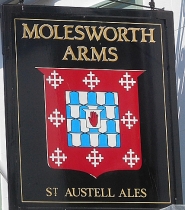
Molesworth Street is lined with shops, eateries, and some pubs. The Molesworth Arms, a former coaching inn, has existed since the 16th century. It was previously known by other names including The Fox, The King’s Arms and The Fountain. It got its present name in 1817. Nearer the bridge, there is The Swan Hotel near the old bridge, originally named ‘The Commercial’, is much newer than the Molesworth Arms. It was constructed the late 19th century.

I cannot explain why, but spending time on Molesworth Street always satisfies me. The recently opened (late 2021) Dollies café provides good coffee and exceptionally wonderful English breakfast items; everything is prepared freshly after ordering. Up the hill, stands Churchill Bars. Housed in the premises of the still functioning Wadebridge Conservative Club, it comprises a bar and a small restaurant named Winston’s. Popular with locals, this eatery serves generous helpings of lovingly prepared, tasty food. Its speciality, which is well worth trying, is roast belly pork served with roast potatoes, gravy, and vegetables (not overcooked). Unlike so many other places serving food in Cornwall, this place is good value and not pretentious.

Apart from several charity shops, a good newsagent, two butcher’s shops, a hardware store, banks, and so on, there is a small bookshop on Molesworth Street. This independent bookstore stocks a superb range of Cornwall-related books, both fiction and non-fiction. In a backroom, there is a large selection of second-hand books. Small booksellers such as this one on Molesworth Street make a welcome change from the countrywide bookshops such as Daunt’s, Waterstone’s, and WH Smiith’s.

Not as ‘trendy. as places such as Fowey, Falmouth, St Ives, and Padstow, Wadebridge seems a more ‘normal’ or ‘real’ kind of place, not wholly dependent on tourism. It is well placed to make excursions to places all over the county of Cornwall.

What’s in a name?

THE NAME MOLESWORTH immediately recalls a naughty schoolboy who cannot spell properly.  Nigel Molesworth, a pupil in St Custards, a preparatory school, appears as a character in books by Geoffrey Willans (1911-1958) such as “Down with Skool”, “How to be Topp”, and “Whizz for Atomms”. However, for the Cornish town of Wadebridge, the name Molesworth has other significance.

One of the main shopping thoroughfares in Wadebridge is called Molesworth Street. The Town Hall was opened in 1888 by Sir Paul Molesworth (1821-1889). A pub called The Molesworth Hotel, a former coaching inn housed in a building that dates back to the 16th century, is located on the street named after Molesworth. The pub was only named as it is today in 1817. Previously, it had various names including The Fox, The King’s Arms, and The Fountain.

Wikipedia informs us that:

“The Molesworth, later Molesworth-St Aubyn Baronetcy, of Pencarrow near St Mabyn in Cornwall, is a title in the Baronetage of England. It was created on 19 July 1689 for Hender Molesworth.”

Hender Molesworth (c1638-1689) was a Governor of Jamaica from 1684 to 1687 and from 1688 to 1689. Pencarrow House is just under 4 miles southeast of Wadebridge. Each of the 2nd, 4th,6th, and 8th Baronets represented Cornwall or parts of the county in Parliament. The Molesworths were (are?) major landlords in the area around Wadebridge.

Sir William Molesworth, 8th Baronet (1810–1855), was the grandfather of Sir Paul, who opened the Town Hall in 1888. This edifice bears a weathervane in the form of a steam railway locomotive. After undertaking a ‘Grand Tour’ of Europe, which lasted from 1828 to 1831, William made his way to Pencarrow, where he:

“…devoted time to establishing the Wadebridge-Bodmin Railway company. He engaged Hopkins the civil engineer to survey the land for the route with the prospectus for the formation of the Railway Company drawn up by Mr Woollcombe, from the family’s firm of solicitors.” (www.pencarrow.co.uk/story/sir-william-molesworth/)

This railway opened in 1834, was the first steam railway in Cornwall.  It continued in service until 1979. The tracks have been removed but some of Wadebridge’s station buildings have been preserved,

William became interested in radical politics. In 1832, he was elected Member for East Cornwall, and re-elected in 1835. As an MP, he:

“…had joined a group named the ‘Philosophical Radicals’ who advocated various reforms such as universal education, disestablishment of the church and universal suffrage.”

Between 1837 and 1841, William, having alienated his Cornish electorate, sat in the House of Commons, representing Leeds. After falling out with his Leeds constituents on account of his views on foreign policy, he retired to Pencarrow, where he dedicated his time to improving the gardens.

In 1844, William married a widow, an opera singer Andalusia (née Carstairs), who died in 1888. The year after his marriage, William was elected MP for London’s Southwark constituency, a seat he held until his death. Amongst his positions whilst representing Southwark, he was Secretary for The Colonies during the last few months of his life. He had wished to be buried in his grounds in Pencarrow, but instead he was buried in London’s Kensal Green Cemetery.

Sir William and his family are deeply involved in the history of Wadebridge and it is right that the Molesworth name is so prominent in the town. From now onwards when I hear or read the name Molesworth, a naughty schoolboy with spelling problems will not be the only thing that springs to mind.

Crossing the Camel

THE CONSERVATIVE CLUB in Cornwall’s Wadebridge has opened its doors to the general public. Visitors to the club of any political persuasion can enjoy superbly cooked food in its bar and dining room, which bears the name ‘Winstons’. The club, which is located at the higher end of Molesworth Street, is housed in a building that is far more than 100 years old. The street runs gently downhill towards a multi-arched stone bridge that crosses the River Camel.

Before there was a bridge across the river, the town now known as Wadebridge was called ‘Wade’ and stood beside a ford across the Camel, whose name probably means ‘crooked one’. Crossing the river by means of the ford was perilous. Before the bridge was built, a ferry became available as an additional means of traversing the wide stream. Becoming distressed by the number of people and animals that died whilst attempting to cross the river, the Reverend Thomas Lovibond, Vicar of Egloshayle, had the idea of building a bridge. This bridge was constructed between 1468 and 1485. It is said that its supporting piers rested on packs of wool. With the arrival of the bridge, the town of Wade became renamed ‘Wadebridge’. The chronicler and topographer William of Worcester (1415-c1482) mentioned the bridge as ‘Wade-brygge’ in 1478’.

 The bridge was widened in 1853 and again in 1963. It was refurbished in 1994. Although the stonework of the arches looks old, I am not sure how much of it is part of what was constructed in the late 15th century.

During the Civil War (1642-1651), Cornwall was a Royalist stronghold. Much of the rest of the southwest of England supported the Royalist’s opponents, the Parliamentarians. Wadebridge’s bridge was an important strategic location. In 1646, the Parliamentarian Oliver Cromwell (1599-1658) led 500 dragoons and 1000 horsemen successfully to take control of the bridge. The story goes as follows (www.cornwalllive.com/news/history/oliver-cromwell-came-person-take-511634):

“After losing the decisive Battle of Torrington in Devon on February 16, 1646, the Royalists escaped into Cornwall … [the] Parliamentarians, led by Thomas Fairfax, hunted them down and reached Launceston on February 25 and Bodmin on March 2 … On March 5 the Cornish Royalist leaders realised they were fighting a losing battle and surrendered the east of Cornwall to the Parliamentarians at Millbrook … A day later, as the battle moved westwards, Parliamentarian commander Oliver Cromwell and 1,500 of his soldiers descended onto Wadebridge to take control of the bridge and prevent its use by the Royalist army. The route across the bridge was considered to be of such strategic importance that Cromwell, who had been spending months mopping up resistance in Devon and Cornwall, personally led his troops there to capture it.”

The huge forces brought by Cromwell were either unnecessary or an effective deterrent because the Royalists withdrew without putting up a fight (www.wadebridgemuseum.co.uk/bridge.html).

The first motor car to cross the bridge did so in 1901. The crossing continues to play an important role in the transport network of Cornwall. The town is a charming small centre, well supplied with pubs, independent shops, and branches of supermarket chains. It is a part of the Parliamentary constituency of North Cornwall. Diners at, and members of, Wadebridge Conservative Club might (or might not) be pleased to know that the local MP since 2015 is Scott Mann, a Conservative. He was born in Wadebridge and attended its local state secondary school. I suppose that he must have dined or drunk at the Conservative Club where we enjoyed first class food. So, next time you are in Wadebridge, sweep aside any political prejudices you might harbour and head for Winstons at the Conservative Club and enjoy a great meal.