Faith healing in a well in Baroda

ACROSS THE MAIN ROAD from the 16th century Hazira Maqbara – a mausoleum – there is a small stepwell – the Hazira Vav. We have visited it before but never saw it in use.

A flight of tiled steps leads down to the water in the stepwell. To put it mildly, the water looks filthy and completely uninviting.

At the top of the stairs, there is a small Hindu shrine. The small courtyard surrounding the top of the staircase is decorated with coloured images depicting various Hindu deities. A few coconuts hang between them. These nuts are considered auspicious by Hindus. At our Hindu wedding in 1994, coconuts were included on the complex ceremony, which lasted several hours.

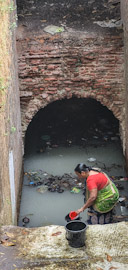
While we were looking at the well, a lady in a sari and her husband arrived. The woman descended the steps to the waters edge. Her husband explained to us that she was suffering from itchiness and that the curative waters of the well might help cure her condition.

The lady picked up one of the bucket on the step beside the water, and filled it from the well. Then, she began dowsing herself with the water. Fully dressed, she poured several buckets of the unwholesome looking water over her whole body.

Having watched this, we felt that it was unlikely that the water itself would heal her, but more likely, it was her faith in its curative properties that might have helped. Having seen the water, my thought was that if one bathed in the well, it is likely that you would end up less healthy than before you entered it.

From revolution to religion and meditation

SRI AUROBINDO (1872-1950) lived in Baroda between 1893 and 1906. During this period, he was an official in the Gaekwad’s government, a professor of English, and the Vice Principal of Baroda College, now the Maharaja Sayajirao University of Baroda.

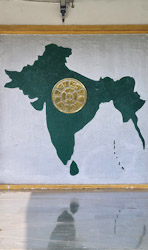
Map at Aurobindo Ashram in Baroda

Today, Aurobindo is best known as a spiritual leader, who spent much of his life in Pondicherry. However, before this he was a keen supporter of ridding India of its domination by the British. During his term as Vice Principal, he began taking an active interest in the growing independence movement.

In 1906, he shifted to Calcutta to become the first principal of National College (now Jadavpur University), which was founded to provide national education to Indian youth. He resigned in 1907 because of his increased involvement in anti-British activities.

In May 1908, Aurobindo was imprisoned for a year because he was suspected of having been involved in the fatal Alipore Bomb case. He was acquitted. During his imprisonment, his interests began to move from revolution to religion. He began practising yoga, and thinking about spiritual matters.

After his release, the British security services kept him under observation despite the fact that his active involvement in nationalist activities was waning. By 1910, he had fled to Pondicherry, which was then a French colony and out of reach of the British authorities. From then on, his activities as a spiritual leader, for which he is best known, took off.

The house where he lived in Baroda between 1900 and 1906 stands surrounded by well tended gardens. It is now known as an Aurobindo ashram. People who believe in him visit the place to meditate and enjoy its peaceful atmosphere.

At the end of one of the gardens, there is a stage. Behind the stage, there is a large map on a wall. It shows the outlines of British India before it became divided into Bangladesh, Burma, India, Pakistan, and Sri Lanka. I do not know when this map was drawn, but it is interesting that it does not depict modern India alone.

As we wandered around the place, I wondered how many of its visitors seeking spiritual solace consider Aurobindo’s earlier less peaceful approach to life.

Smoke and flames in a Muslim mausoleum in Baroda (Gujarat)

THE HAZIRA MAQBARA is an impressive octagonal structure in Baroda (Gujarat). It was built in about 1586 in the Mughal style of architecture, such as can be found in Delhi. This beautiful mausoleum houses the graves of Qutb-ud-din Muhammad Khan who was the tutor of Salim, son and successor of Akbar, and also that of his son Naurang Khan who held important posts in Gujarat under Akbar. There are other graves within the building and also nearby on land near it.

The various graves are covered with colourful cloths upon which red rose heads are placed. The roses are replaced daily, and the cloths every Thursday. This we were told by an elderly man who had been praying loudly within the main central chamber of the mausoleum.

Apart from the beauty of the building and its wonderful jaalis (latticework window screens), I was impressed by some things that I have noticed in many other Muslim mausoleums in India.

Incense stick near some gravestones

Within the mausoleum and close to the graves outside it, there were incense sticks (agarbatti) burning, releasing small clouds of fragrant smelling smoke. Within the mausoleum, I spotted at least two oil lamps (diyas), each with small flickering flames.

Agarbatti and diyas are commonly found in Hindu temples, and often at the beginning of the day in shops, restaurants, etc. I first noticed them being used in Islamic settings in India in Sufi dargahs (shrines containing graves) in Bangalore when going on excellent guided walks led by my friend Mansour Ali. Later I begun noticing these things, which I had initially assumed were only associated with Hinduism, in places associated with Islam. I have discussed this commonality of Hindu and Muslim practices in one chapter of my new book about travels in India, which is available from Amazon (eg https://www.amazon.co.uk/HITLER-LOCK-OTHER-TALES-INDIA/dp/B0CFM5JNX5/ ) AND if you live in India, from https://store.pothi.com/book/adam-yamey-hitler-lock-and-other-tales-india/ .

Other chapters in my book about my experiences of visiting India cover a wide variety of subjects. The book, which is aimed both at those who ‘know’ India and those who do not, is both informative and entertaining.

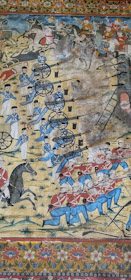
British soldiers on the wall in a house in Baroda

BY THE VERY EARLY 19th century, the armies of the Marathas had been beaten by the armed forces of the British East India Company. After this, from 1805 onwards until 1947, the State of Baroda was ruled by a Hindu Maratha dynasty – the Gaekwads of Baroda. Put simply, the Gaekwads controlled the internal affairs of the state in such a way that British interests were not damaged, and the British controlled the external affairs of the state.

Between 1849 and 1854, Bhau Tambekar (Vithal Khanderao) was the Diwan (prime minister) of Baroda. He lived in a large building, which was probably constructed in the early to mid 19th century. Known as Tambekar Wada, this typical Maratha-style mansion has three storeys and surrounds a courtyard. Currently, the first floor of the front (eastern part) of the building is the only part open to the public.

The part of the building that can be visited is a long rectangular hall with a wooden jaali (perforated screen) near one end of it. The walls of this room are covered with beautiful detailed paintings from floor to ceiling. Many of them depict scenes from the Mahabharata, Ramayana, and Hindu religious images. However, the north wall of the hall is even more fascinating.

Most of the north wall is covered with a mural depicting a battle between the British East India Company and the Marathas. Most of the picture shows features of the British forces in great detail. There are even several flags that resemble Union Jacks. Some British soldiers, dressed in red uniforms, can be seen riding elephants. Whoever painted this wall had a good eye for both detail and representation of battles.

On the same wall as the battle scene, there are several smaller paintings depicting European men and women. On one of these, a woman in European garb seems to be consoling another woman. In another, a man wearing a red jacket is looking at a European lady affectionately.

The purpose of the painted hall is not known for sure. It has been suggested that it was for entertaining guests. The small part enclosed by the screen might have been reserved for ladies. In its heyday, purdah would have been observed in the house. The hall has a set of windows through which one can access a narrow balcony that extends along the entire length of the eastern side of the house. This terrace has a perforated screen through which people on the balcony could look out onto the street without fear of being seen by passers-by.

Although this December (2023), we are enjoying our fourth visit to Baroda, we would not have known about the Tambekar Wada had our friend Nandita A not told us about it. I am very pleased that she introduced us to this gem hidden within the narrow backstreets of Baroda’s Dandia Bazaar district.

Art, Alembic, and brewing in Baroda

THE SINGER LATA MANGESHKAR (1929-2022) has only ever appeared in one advertising film. It was for a medical product, a cough syrup, called Glycolin. This stuff was manufactured by the Alembic pharmaceutical company of Baroda, founded in 1907. In 1960, it was the first company to manufacture penicillin in India. Under the leadership of the Amin family, Alembic produces a wide variety of pharmaceutical products.

The company owns a huge ‘campus’ in north Baroda. This has been named Alembic City. Part of it, which contains repurposed former factory buildings, has been developed to create an art hub, which has been named Alembic Art District.

Alembic Art District

The Art District contains a museum that illustrates the history of the Alembic company. Other buildings house artists’ studios. These are given free of charge to selected artists who have applied for them. There is also gallery space.

A food court has been created. Nearby, there is a good Japanese restaurant (called Bento B). Next door to this is The Brewery.

Those who are familiar with Gujarat will know it is a teetotal state – sale and consumption of alcohol is forbidden. So, what is with The brewery? Well, it is a brewery, but alcohol is not brewed here. It is a kombucha Brewery. We sat in the stylish restaurant within The Brewery, and enjoyed the best kombucha I have ever tasted.

Like the Tate Modern and the Battersea Power Station, both repurposed former industrial sites, Alembic Art District contains remnants of its former existence. However, the resulting environment that has been created is much more delightful than the two places in London mentioned above.

A wonderful little bookshop in Baroda

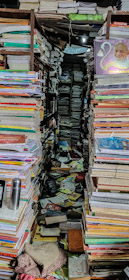
A FEW MINUTES WALK from our hotel in BARODA (Gujarat) brings you to Patel Bookstore. The owner of this small bookshop stocks ‘pre-loved’ (not ‘secondhand’) books. Some of them are arranged on surfaces under the verandah in front of his shop and on its counter. The rest of them are on shelves and on the floor of the part of his store behind the counter. The shop has a chaotic appearance, but I am sure Mr Patel knows what he has in stock.

Mr Patel, a friendly gentleman, has a huge stock of books in English – much fiction and slightly less nonfiction. He also sells books printed in Gujarati.

The owner of the shop is happy to buy back books you have bought from him. When you make a purchase, he writes the price you paid in the book, and how much he would be prepared to buy it back when you have read it. He is also happy to buy other volumes that you wish to dispose of.

Even though I could not see many books that appealed to me, I love visiting idiosyncratic bookstores like that run by Mr Patel.

Drawn to remember: an exhibition by an Indian painter

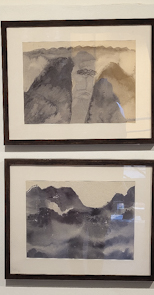
THE PAINTER MAHESH BALIGA was born in the south Indian state of Karnataka in 1982. He studied painting at The Chamarajendra Academy of Visual Arts (CAVA) in Mysore, and then received a postgraduate qualification at the prestigious Faculty of Fine Arts, MSU, in Baroda (Vadodara in Gujarat). He has taught at various art schools in India and exhibited in several countries including India. Currently, he lives and works in Baroda. Between the 12th of April 2022 and the 28th of May 2022, some of his works are being exhibited in a solo exhibition, “Drawn to Remember”, at the David Zwirner Gallery in Grafton Street (in London’s West End).

The paintings on display were created using casein tempera. This kind of paint has a glue-like consistency, but it can be thinned with water. According to Wikipedia, artists like this kind of paint because:

“… unlike gouache, it dries to an even consistency, making it ideal for murals. Also, it can visually resemble oil painting more than most other water-based paints …”

At first glance, it is difficult to discern whether the Baliga’s paintings on display at Zwirner’s resemble water colours or oil paintings; some of them seem to look halfway between the two mediums. All of them, except one, are quite small canvases and without exception they are all attractive. The subject matter depicted in the works is varied, from studies of plants and animals to everyday scenes (often with depictions of Indian life) to the slightly unusual. An example of the latter is in the only large canvas of the show in which there is an image of a man with sticky plasters over his left eye. Another odd subject shows a man with flowers growing out of his shirt. This is appropriately named “Flowering Self”.

The small size of most of the paintings, which the artist described as ‘lap-sized’, has a reason. Many of them were executed on the journeys the artist made when commuting to and from Surat (in the south of Gujarat), where he held a teaching position for a while. Though they are not large paintings, each one of them provides a window on the artist’s experiences and and his take on them. Although the paintings are far from mundane, they are not over-dramatic or excessively visually challenging. The exhibition is well worth seeing.  I would be happy to hang any one of the works I saw at his exhibition on my walls at home.

Letting off gas

THIS IS AN UNSAVOURY subject. So, you have been warned.

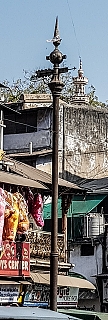
On our first visit to Baroda (Vadodara) in the western Indian state of Gujarat a few years ago, I noticed several tall cast-iron structures resembling lamp posts, except that they were topped with curious objects. Each of these tall streetside poles is topped with spheres, each with four cylindrical projections. Beneath each sphere, there is an arrow. I was puzzled by these objects. So, I posted pictures on Facebook and asked if any of my friends knew what purpose these things serve or used to serve. I received several ingenious suggestions, none of which turned out to be correct.

Baroda (Vadodara)

Having seen these items in Baroda (and also in Bombay and Ahmedabad), I began noticing similar structures in London. None of the examples in London are topped with the sphere and arrow, but in other respects they are not particularly different from those I saw in India. Eventually, I learned that they are all examples of ‘stink pipes’. There are many fine specimens, disused I believe, dotted around London. Recently, I was reminded of those I saw in India when I saw a couple near Chiswick Mall in west London.

It was not until after about 1858 that sewage began being channelled through enclosed sewers in London, an improvement instigated by London Metropolitan Board of Work’s Chief Engineer Joseph Bazalgette (1819-1891). Sewage is waste matter, which tends to decompose. The products of decomposition include noxious gases such as for example hydrogen sulphide, carbon monoxide, ammonia, and methane. Some of them are highly inflammable and all of them increase in pressure as the sewage flows through the sewers. The stink pipes serve(d) as vents through which the gasses building up could escape from the sewers. They tend to be tall so that the gases blow off high above ground level where there are more likely to be breezes that can disperse the gases. Without adequate venting, the gaseous vapours can become dangerously explosive. Returning to Baroda, where the stink pipes are topped with spheres. The gases escape through the conical projections and, I have learned, the arrows indicate the direction of the sewer running beneath them and which way the sewage is flowing.

From revolutionary to saint

On Sunday morning it was Republic Day, the 26th January 2020. The streets in Baroda were quite. Several of the few vehicles we saw carried Indian national flags that fluttered proudly as they sped past us.

It was also quieter than usual at the Sri Aurobindo Nivas, the home where Sri Aurobindo lived while he was an official in the government of the princely state of Baroda and both professor and vice chancellor of what is now Baroda University. Aurobindo lived with his wife, Mrinalini in this house donated by the Gaekwad. After Baroda, Aurobindo and his wife moved to Calcutta. Later, he moved to the French colony of Pondicherry. After he arrived there, his wife followed him but during the journey to join him, she died suddenly of an infection (https://www.boloji.com/articles/13683/mrinalini-sri-aurobindos-forgotten-wife). I have written a bit about Aurobindo in Baroda in my book “Travels through Gujarat, Daman, and Diu” (published in India by pothi.com as “Gujarat Unwrapped). Here is what I wrote:

“Today, Sri Aurobindo is associated with ‘peace and love’ by many people, especially the crowds of Europeans who seek spiritual solace at his ashram in Pondicherry. While Aurobindo was working as a teacher in Baroda in the early 20th century, he was involved in Indian independence movements. Although he espoused peaceful methods, he was not averse to the use of violence. Jyotirmaya Sharma wrote in his book, Hindutva: Exploring the Idea of Hindu Nationalism, wrote: “It was at Baroda that Aurobindo took the first decisive steps into political life … Aurobindo clearly believed in the efficacy of violent revolution and worked towards organizing secret revolutionary activity as a preparatory stage for open revolt and insurrection…” In a biography, Sri Aurobindo for All Ages, its author Nirodbaran, who worked in close contact with the great man for twelve years, wrote: “When we asked him once how he could even conceive of an armed insurrection against the well-equipped British garrisons, he answered: ‘At that time, warfare and weapons had not become so lethal in their effect. Rifles were the main weapons, machine guns were not so effective. India was disarmed, but with foreign help and proper organisation, the difficulty could be overcome; and in view of the vastness of the country and the smallness of the regular British armies, even guerrilla warfare might be effective…”

After a year’s spell in Alipore prison in connection with his alleged involvement with some politically motivated murders in Bengal, Aurobindo settled in Pondicherry, and from then began espousing a spiritual approach to life. While living in that French colony, he continued to contemplate contemporary Indian issues, including that of the relationship between Hindus and Muslims. In late 1909, Aurobindo wrote: “Our ideal therefore is an Indian Nationalism, largely Hindu in its spirit and traditions, because the Hindu made the land and the people and persists, by the greatness of his past, his civilisation and his culture and his invincible virility, in holding it, but wide enough also to include the Moslem and his culture and traditions and absorb them into itself.” Jyotirmaya Sharma wrote: “Savarkar legitimately claimed paternity for the idea of Hindutva; but Hindutva could lay to an equally formidable patrimony in the thought of Dayananda, Vivekananda, and Aurobindo. What binds these four thinkers together is the systematic marshalling of a Hindu identity in the service of Indian nationalism.” Sharma quotes the following passage, written in 1923, from Aurobindo’s India’s Rebirth (a collection of writings): “It is no use ignoring facts; some day the Hindus may have to fight the Muslims and they must prepare for it. Hindu-Muslim unity should not mean the subjection of the Hindus. Every time the mildness of the Hindus has given way. The best solution would be to allow the Hindus to organize themselves and the Hindu-Muslim unity would take care of itself, it would automatically solve the problem.” And, in 1934, Aurobindo wrote: “As for the Hindu-Muslim affair, I saw no reason why the greatness of India’s past or her spirituality should be thrown into the waste paper basket in order to conciliate the Muslims who would not at all be conciliated by such a stupidity.”

The Sri Aurobindo Nivas, where Aurobindo lived until 1906 while he was an esteemed teacher and state official in Baroda, is a two-storey grand, mainly brick bungalow with European-style wooden window shutters. In 1971, the Government of Gujarat handed it over to Baroda’s Sri Aurobindo Society, which promotes the peaceful aspects of Aurobindo’s teachings and philosophy. The house is surrounded by a well-maintained garden. This contains an outdoor stone shrine, a flat marble table with a bas-relief of a lotus flower in its centre. The lotus was surrounded by a flower arrangement consisting of a circle surrounding a six-pointed star. The star with centrally enclosed lotus is a symbol of Sri Aurobindo, whereas the circle is the symbol of his spiritual partner, the Mother, who settled in Pondicherry in 1920. She was born Mira Alfassa (1878-1973) in Paris, of Turkish and Egyptian Jewish parentage. She became the founder of Aurobindo’s ashram in Pondicherry.

The ground floor of this typical colonial-style bungalow contains offices and a library, which was full of people reading at tables. The upper floor has carpeted rooms decorated with relics and portraits of Sri Aurobindo and the Mother. These two people are often depicted in their old age, but here at Aurobindo Nivas we saw a couple of portraits, hung side-by-side, showing both as young people. The rooms on the upper floor are used for silent meditation. People sit cross-legged on the floor and occasionally prostrate themselves, their foreheads touching the floor. Also, they stand up and touch the paintings and photographs of Aurobindo and the Mother in the same way as Hindu worshippers touch idols in temples.

There is a large well-tended lawn behind the bungalow. About twenty-five people were sitting on the grass on rugs, meditating and doing yoga. They were facing a boundary wall on which there is a large outline map of India as it was before Partition in 1947 (including what is now Pakistan and Bangladesh). In the centre of what is now India, there is the circular symbol of the Mother.”

(end of extract).

After spending a pleasant hour in Aurobindo’s former residence, we took refreshments including south Indian filter coffee and dahi vada in the nearby three storey Canara Coffee House (founded 1950). Then we continued our exploration of the Sursagar Lake and looked for picturesque old buildings in the city. Many of the older structures, mostly residential usage, are rich in finely carved wooden decorative features.

By the time we had seen sufficient, the temperature was approaching 30 degrees Celsius – a contrast to the near zero conditions we had encountered earlier on our trip in places like Darjeeling and Mount Abu.

TRAVELS THROUGH GUJARAT DAMAN AND DIU is available from Amazon, lulu.com, and Bookdepository.com

GUJARAT UNWRAPPED , an Indian edition of the above is available from pothi.com (only in India)

Mashed potatoes

Some restaurants in India serve both veg (vegetarian) and non-veg (meat, fish, eggs) food. Recently, my wife and I were sitting near to a young lady in a very good Italian restaurant in Vadodara in Gujarat.

Our young neighbour is a vegetarian. She ordered a veg pasta and asked the waiter if she could have a portion of mashed potatoes. I know that pasta and mashed potatoes are an unusual combination, but that is what she wanted.

The waiter told her that she could not order mashed potatoes with a veg pasta. Puréed potatoes, which are pure veg, could only be served with a non-veg dish.

We overheard the waiter telling this to our neighbour. My wife, who always tries to be helpful, interrupted the waiter and told him to bring a small dish of mashed potatoes with the pasta. Eventually, and somewhat reluctantly, the waiter did as asked. Our neighbour was so happy to receive the mash with her pasta that she got up and gave my wife an affectionate hug.

I am not a vegetarian.

Although I have met numerous pure vegetarians during the 25 years I have been visiting India, I still find it hard to believe that there are so many people, who have never tasted meat, eggs, or fish.