They fled from Trieste to Rome

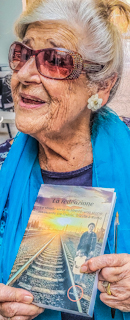
We met this lady quite by chance at a bookshop in Trieste, Italy.

At the end of WW2, there was conflict over who was to own Trieste – Yugoslavia or Italy or an independent state. During thus troubled period, many Italians fled from Trieste because life there was dangerous. Many Italians were killed by Yugoslav partisans.

This lady, then a small child, fled with her mother to Rome, and was one of the first refugees to arrive there.

The book she is holding is about that era, and she is the small child on the front cover.

Trieste and the fragrant odour of sauerkraut

The first time I visited Trieste was by car in the 1980s. As I wanted to avoid having to drive within the city and because I was worried about parking there, I stopped on a village near Trieste. My idea was to leave the car there, and enter the city by local bus.

I parked close to a restaurant. As soon as I opened the car door, the odour of sauerkraut, a foodstuff that I adore, assailed my nose. Immediately, I entered the trattoria, and ordered a dish with sauerkraut – a food preparation I had not expected to find in Italy.

Well, I should not have been surprised. The part of Italy containing Trieste is not only close to sauerkraut eating areas such as Austria and the former Yugoslavia, but was also once part of the Austro-Hungarian Empire.

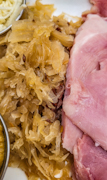
Today, 21 September 2026, I was back in Trieste. At lunch, I ordered a “Triestino”. It was a plate with cooked ham, potatoes fried with onions, raw horseradish, mustard, and … SAUERKRAUT! Needless to say, it was delicious.

A small town in Italy near Slovenia

For less than the price of a single journey ticket on one of the water buses in Venice, you can buy a return ticket for the 30 minute ferry ride between Trieste and its southern neighbour Muggia – a little port on the northern fringe of the Istrian peninsula. This narrow strip of Italian territory is very near the Slovenian border.

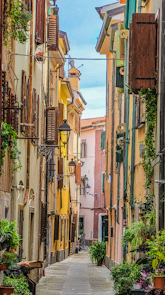
Approaching Muggia by sea, the place’s  modern surroundings, which is all that the arriving traveller can see from the boat, look barely inviting. However, a short walk brings one into the maze of attractive streets and piazzas of the old town.

The cathedral – ‘duomo’ – is in the heart of the old town. It was constructed while Muggia was part of the Patriarchy of Aquilea. Consecrated in 1263, it is a spacious church decorated with freckles, some of which look as if they have been mutilated by a sharp object. We visited this church and two other charming smaller ones – Chiesa del Crocifisso and the Chiesa di S Francisco, which was restored in 1411.

Near the edge of the old town, there is a short cul-de-sac called Calle del Ghetto. It is believed by some that some that Jewish people once lived there, but the evidence is slender. The town’s records do not record any inhabitants processing this religion.

Muggia has a long history, stretching back to prehistoric times. After the decline of the Western Roman Empire, Muggia was under Ostrogoth, Lombard, Byzantine, Avar and Frank dominations, until 931, when king Hugh of Italy donated it to the Patriarch of Aquileia. In 1420, Muggia became part of the Venetian empire,  and remained so until 1797, when Venice fell. The town then became part of the Austro-Hungarian Empire. After WW1,  Muggia became part of Italy, and has remained so ever since. Although between 1945 and 1954 it was part of the short-lived, nominally independent  Free Territory of Trieste – in the sector controlled by the Americans and British. The other sector was under Yugoslav control.

Today, Muggia is a thriving tourist destination. Despite this, it is not overwhelmed: it  is a lovely place to wander about, and there are plenty of places to eat and drink. Much to my surprise,  Muggia seems not to be dominated by tourism. There are plenty of ‘locals’ around. We had coffee in a small bar which had far more locals than visitors. Although the lady who made it was friendly,  the cappuccino she served me was one of the worst I have drunk anywhere.  Maybe, I  was simply unlucky, or, perhaps Muggia  being on the very edge of Italy, the magic of cappuccino has become diluted by being so close to Slovenia.
Exodus from Yugoslavia … for the lucky ones.

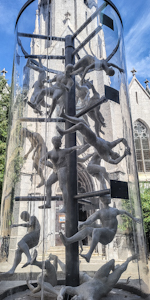
The Lutheran church in central Trieste was built in an austere late gothic style between 1871 and 1874. Outside its west end, in Largo Odorico Panfili, there is a tall cylinder surrounded by transparent glass or plastic. Within the cylinder there are models of people. This artwork is a monument to a tragic era.

The monument called “Momentum”, designed by Jasmine Iannì and Giuseppe Sabatino, is dedicated to the memory of those Italians who fled from areas that had been Italian but had been incorporated into Tito’s Yugoslavia at the e d of WW2. These territories included Istria, Fiume, Dalmatia, and Zadar .

Well, I knew about these refugees, but not about something else commemorated by the monument. What I had not known about were the ‘foibe’ killings – massacres of Italians living in the formerly Italian territories that became part of Yugoslavia. These were, it is said, carrued out by Tito’s communist partisans. According to Wikipedia (https://en.wikipedia.org/wiki/Foibe_massacres):

“The estimated number of foibe victims is disputed, varying from hundreds to thousands,according to some sources 11,000or 20,000…”

I was horrified to learn about this. I had read that many anti-communist Yugoslavs and other opponents of Tito had been killed or imprisoned at the end of WW2. In the 1980s, I knew the wife of a man who had been imprisoned by Tito in 1945 because he was “the wrong kind of communist”, and was still behind bars in the mid-1980s.

However, until I saw the monument in Trieste today in September 2026, I did not know about the Italians who had been massacred simply because overnight in 1945, they were suddenly living in the wrong place.