
The Lutheran church in central Trieste was built in an austere late gothic style between 1871 and 1874. Outside its west end, in Largo Odorico Panfili, there is a tall cylinder surrounded by transparent glass or plastic. Within the cylinder there are models of people. This artwork is a monument to a tragic era.
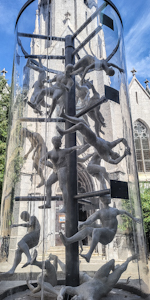
The monument called “Momentum”, designed by Jasmine Iannì and Giuseppe Sabatino, is dedicated to the memory of those Italians who fled from areas that had been Italian but had been incorporated into Tito’s Yugoslavia at the e d of WW2. These territories included Istria, Fiume, Dalmatia, and Zadar .
Well, I knew about these refugees, but not about something else commemorated by the monument. What I had not known about were the ‘foibe’ killings – massacres of Italians living in the formerly Italian territories that became part of Yugoslavia. These were, it is said, carrued out by Tito’s communist partisans. According to Wikipedia (https://en.wikipedia.org/wiki/Foibe_massacres):
“The estimated number of foibe victims is disputed, varying from hundreds to thousands,according to some sources 11,000or 20,000…”
I was horrified to learn about this. I had read that many anti-communist Yugoslavs and other opponents of Tito had been killed or imprisoned at the end of WW2. In the 1980s, I knew the wife of a man who had been imprisoned by Tito in 1945 because he was “the wrong kind of communist”, and was still behind bars in the mid-1980s.
However, until I saw the monument in Trieste today in September 2026, I did not know about the Italians who had been massacred simply because overnight in 1945, they were suddenly living in the wrong place.

