
For less than the price of a single journey ticket on one of the water buses in Venice, you can buy a return ticket for the 30 minute ferry ride between Trieste and its southern neighbour Muggia – a little port on the northern fringe of the Istrian peninsula. This narrow strip of Italian territory is very near the Slovenian border.
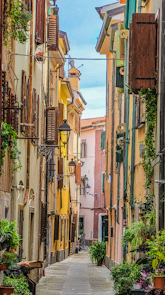
Approaching Muggia by sea, the place’s modern surroundings, which is all that the arriving traveller can see from the boat, look barely inviting. However, a short walk brings one into the maze of attractive streets and piazzas of the old town.
The cathedral – ‘duomo’ – is in the heart of the old town. It was constructed while Muggia was part of the Patriarchy of Aquilea. Consecrated in 1263, it is a spacious church decorated with freckles, some of which look as if they have been mutilated by a sharp object. We visited this church and two other charming smaller ones – Chiesa del Crocifisso and the Chiesa di S Francisco, which was restored in 1411.
Near the edge of the old town, there is a short cul-de-sac called Calle del Ghetto. It is believed by some that some that Jewish people once lived there, but the evidence is slender. The town’s records do not record any inhabitants processing this religion.
Muggia has a long history, stretching back to prehistoric times. After the decline of the Western Roman Empire, Muggia was under Ostrogoth, Lombard, Byzantine, Avar and Frank dominations, until 931, when king Hugh of Italy donated it to the Patriarch of Aquileia. In 1420, Muggia became part of the Venetian empire, and remained so until 1797, when Venice fell. The town then became part of the Austro-Hungarian Empire. After WW1, Muggia became part of Italy, and has remained so ever since. Although between 1945 and 1954 it was part of the short-lived, nominally independent Free Territory of Trieste – in the sector controlled by the Americans and British. The other sector was under Yugoslav control.
Today, Muggia is a thriving tourist destination. Despite this, it is not overwhelmed: it is a lovely place to wander about, and there are plenty of places to eat and drink. Much to my surprise, Muggia seems not to be dominated by tourism. There are plenty of ‘locals’ around. We had coffee in a small bar which had far more locals than visitors. Although the lady who made it was friendly, the cappuccino she served me was one of the worst I have drunk anywhere. Maybe, I was simply unlucky, or, perhaps Muggia being on the very edge of Italy, the magic of cappuccino has become diluted by being so close to Slovenia.

