Never come to Holland again with this passport

DURING THE 1980s, I used to drive from my home in Kent through Europe to Hungary and Yugoslavia. I used to take the car across the sea on the Olau Line that ran between Sheerness in Kent and Vlissingen in Holland. In those days, I held an old-style UK passport. With hard covers, it was dark blueish black. On the front cover, there was a coat of arms embossed in gold and words in gold lettering mentioning it was a British passport. There were two horizontal slots in the front cover. These were lined with white paper. On one of them, the passport holder’s name was written by hand, and on the other, the passport number.

I used to carry my passport in my trouser pocket. So with time, it gradually got a bit bent as it pressed against my leg. Another thing that happened was that the gold coat of arms and the gold lettering wore so thin that they were barely visible. Likewise, my name on the cover also began to become less distinct.

At various demanding frontiers, such as the borders to Communist countries such as Albania, Bulgaria, and Hungary, the tatty appearance of my passport was of no concern to the often-over-zealous border officials. However, it did cause trouble in a place where I least expected it.

On one occasion, after disembarking at Vlissingen, I handed my passport to the Dutch immigration official. He looked at it, and then wandered away with it. About 10 minutes later, he returned with it, holding it gingerly by one of its corners. As he handed it to me, he said:

“Next time you are coming in Holland, you must have a new passport.”

Clearly my passport’s appearance was not in harmony with the Dutch sense of tidiness and orderliness.

A friendly encounter in a cathedral in Pondicherry (India)

Between late 2024 and early 2025, we spent 88 days travelling 4000 miles through India. I have published an account of this fascinating odyssey in my book, “88 DAYS IN INDIA: A JOURNEY OF MEMORY AND DISCOVERY”, which is available from Amazon (https://www.amazon.co.uk/dp/B0FKTFBFM2). Here is a very brief excerpt from the book. It describes what happened when we were sitting in a cathedral in the formerly French colony of Pondicherry.

HERE IS THE EXCERPT:

We sat inside the spacious cathedral’s cool interior within reach of the draught
coming from a fan attached to one of the pillars supporting the long nave’s high,
barrel-vaulted ceiling. As we were relaxing in the cooling breeze, a small group
of Indians entered, and went to the front pews, where they knelt and prayed in
front of the high altar. Amongst them was a young couple dressed in their finest.
Each of them had lavish flower garlands (malas) around their necks. As they
walked away from the front of the church towards where we were seated, we
asked them if they had just married. They told us that that was the case. They
had been married in another church and wanted to pray in the cathedral. These
friendly people invited us to join them in the church’s sunlit entrance while
photographs were being taken of them, of us, and of us with them. They asked
us for our blessing.

Opposite the cathedral on a corner plot, we entered a large bookstore. Tables
covered the floor. They were laden with books, mostly new, but not arranged in
any obvious order. Along one side of this vast hall, there were ..
.

END OF EXCERPT

A busy market in a street in west London

CROWDS OF TOURISTS swarm to west London’s Portobello Road Market, especially on weekends. But how many of these visitors from all over the world know anything about the history of the place?

Here is an excerpt from my book “BEYOND MARYLEBONE AND MAYFAIR: EXPLORING WEST LONDON”. Beginning with Kensington and Paddington, it describes London from west of Park Lane and the Edgware Road to (and including) Heathrow Airport, and from Wembley south to Chelsea.

Here is an extract from the chapter dealing with Portobello Road:

“Before the mid-19thcentury Portobello Lane, as it was then called, was to quote the historians Florence Gladstone and Ashley Barker (writing in1924):“‘… one of the most rural and pleasant walks in the summer in the vicinity of London’, and within living memory it led ‘through fields to Kensal Green… cornfields and meadow land on each side… ‘”

Well, Portobello Road is no longer bucolic. It is lined with buildings along its length. Currently, it begins with a short section that leads off Pembridge Villas. It is here that you can stop for a drink at the Sun in Splendour pub, which was built in the early 1850s.Afterrunning a few yards westwards, Portobello Road heads off in a north-westerly direction, which it maintains with barely any deviation for the rest of its length. Number 22 was the first London home of the writer George Orwell. He lived there as a lodger in the winter of 1927. After crossing Chepstow Villas, the road slopes downwards and soon after this the market area commences. On most weekdays, much of the market is dedicated to daily needs, mostly food. On Fridays and Saturdays, the number of stalls and the variety of goods on offer increases dramatically. In normal times (i.e., when there is no pandemic),Portobello Road is choked with crowds of people from all over the world on Saturdays. In the 1860s, the Metropolitan Line (now the ‘Hammersmith and City Line,) was built. It crosses Portobello Road …”

To discover more about London, from west of Park Lane and the Edgware Road to Heathrow Airport, buy a copy of my book/kindle from Amazon website, e.g..:

As experiences of India gradually become memories

THE BOEING JET began moving away from the oddly designed new terminal at Bangalore’s International Airport. I watched the landscape slipping past ever more quickly as we accelerated along the runway before eventually becoming detached from the soil of India. As the aeroplane rose higher and higher, random things flashed through my mind such as: eating laal maas on a rooftop in Jaisalmer; a Dutch cemetery on the coromandel Coast; hawkers wandering up and down a railway carriage in West Bengal; riding through Bangalore in a Jesus autorickshaw; being asked to bless strangers, a newly married couple, in a church in Pondicherry; tasting nolen gur in Murshidabad; attending an aarti on the Ganges; and much more. After flying over the west coast of India, all of these experiences and a whole host of others that we had enjoyed during our 88 day stay in India became, like the coastline we crossed, distant memories, which I hope will remaine etched permanently in my mind.

Portraying travels around the world in colourful Japanese woodblock prints

THE DULWICH PICTURE Gallery is the oldest building in Britain designed specifically to display art works. It was designed by the architect Sir John Soane (1753-1837) and opened to the public in 1817. Completed long before the advent of electric lighting, the rooms of the gallery were illuminated by daylight that entered them from windows on the roof. Nowadays, it is illuminated by modern lighting. It would be interesting to see how it looks when it is lit solely by daylight. The institution houses a magnificent collection of works by famous ‘old masters’ and puts on temporary exhibitions, one of which is on until November 2024. The current show is dedicated to colourful woodblock prints created by three generations of a Japanese family: the Yoshida dynasty.

Yoshida Hiroshi (1876-1950) was married to Yoshida Fujio (1887–1987). They were both printmakers. Their sons, Yoshida Tōshi (1911–1995) and Yoshida Hodaka (1926–1995), also made prints, as did Hodaka’s wife Yoshida Chizuko (1924–2017). Chizuko and Hodaka’s daughter, Yoshida Ayomi (b. 1958), continues the family’s tradition of printmaking. She has created a site-specific installation (based on cherry blossom trees) for the exhibition. Examples of all these artists’ fine works, which range from figurative to abstraction, are displayed in the exhibition. Each exhibit is a feast for the eyes.

For me, the highlight of the show are the prints by Yoshida Hiroshi. Each one is exquisitely executed and brilliantly composed. Several of his prints on display depict scenes in Japan, ranging from a view of Mount Fuji to the interior of a shop. Hiroshi and his wife also travelled extensively: through Africa, America, Asia, and Europe. When in London in 1901, Hiroshi paid a visit to the Dulwich Picture Gallery. His signature is on a page of the Gallery’s visitors book, which is shown in the exhibition. I was particularly fascinated by the prints he made after seeing sights in the USA, Canada, Switzerland, Italy, Greece, and Egypt. The exhibition includes two beautiful depictions of the Taj Mahal in Agra (India).

Although the rest of the exhibition was fascinating, I was intrigued to see famous tourist sights so beautifully depicted by a traveller from the Far East – a man with great powers of observation and immense artistic talent.

The woodblock prints on the display are without doubt masterly creations. A short video described how they were created. The artist draws the scene to be depicted. A wood carver carefully transfers this image by carving it in reverse on a wooden block. Then a coloured ink is applied to selected parts of the block. Paper is placed on top, pressed down, and a print is created. The process is then repeated using another colour on different or the same parts of the block. This adds the second colour to the print. This process can be repeated carefully well over 30 times (up to 100 in some cases) until the desired coloured image is completed. At each stage the paper must be accurately positioned on the inked block to ensure it is placed in exactly the same place as on all the previous ink applications. The artist supervises the carver and the printer throughout the production. The process must require supreme concentration and dedication, but the end justifies the means.

One might wonder why bother with such a complex and labour-intensive process, when a scene could more easily be depicted using a brush and paints or pen and inks. I cannot answer this, but will say that the results in the hands of the Yoshida family are remarkably and delightfully distinct from pictures created by other means. If you can visit the Dulwich Picture Gallery to see the Yoshida show, then do not miss it.

Tea makers and politicians in India

MY LATEST BOOK, “The Hitler Lock & Other Tales of India”, is mainly aboutmy very varied and fascinating experiences of travelling in India and only a little bit about Adolf Hitler. Here is a brief excerpt from the book:

Some say that when he was a young boy at school, India’s Prime Minister Narendra Modi helped in his family’s tea stall. Although he never became a chaiwallah, I have met one tea maker who became actively involved in politics. He was the owner of Chai Day Teahouse in Bangalore’s Johnson Market. I visited his establishment a couple of times in 2016, but when I looked for it four years later, it had disappeared.

Chai Day was more of a café than a tea stall. It had tables and chairs within its premises. What struck me immediately was that the walls of the seating area were covered with slogans, such as “Don’t promise when you are happy. Don’t reply when you are angry. Don’t decide when you are sad.”, and “We are not use less. We are used less”, and “Thanking you your faith for Syed Arif Bukhari.” The latter refers to the name of the owner, and the fact that he used to, and may still, put himself forward for election to positions, including MLA, in the Government of Karnataka. He told us that he is an independent and that his symbol is an electronic calculator. Just in case that is meaningless to you, I should explain that all political parties in India identify themselves with symbols as well as their names. For example, the Congress Party symbol is a raised right hand, and that of the BJP is a flowering lotus. This is done so that voters who have difficulty reading can find the party for which they want to vote. After chatting amiably with the charming Mr Bukhari, he said:

“If one chaiwallah can become a Prime Minister, maybe I can do the same.”

He might have been joking, but who can tell what the future will bring.

We are fond of drinking tiny cups of sweet, milky, often spiced, tea at the numerous tea stalls that can be found all over India.  During a visit to the Gujarati city of Baroda (Vadodara), we spoke to two tea makers one morning. One of them was a charming lady, who told us about the working life she led. She operates her stall from 630 am until 730 pm daily. She boils her tea with milk and spices on a gas ring, as do most other chaiwallahs. Each of her gas cylinders contain enough fuel (domestic LPG, which contains butane or propane or a mixture of them) to keep her stall going for 15 days.

The other chaiwallah we spoke with was Gopal. He has a tea stall near the entrance to one of the former pols (see below) of Vadodara. He works from 10 am to 6 pm. His stall was very busy when we visited it that morning. It faces a peepal tree with numerous Hindu offerings around the base of its trunk. One of the daily offerings to the gods is the first cup of tea that Gopal makes each morning. Like many other chaiwallahs we have visited in Gujarat, Gopal adds fresh herbs and spices to his tea. That morning, he had large sprigs of mint leaves and bunches of lemon grass and ginger. He pounds the latter in a pestle and mortar. He told us that pounding the ginger releases more flavour than grating it, which is what many other tea makers do. I asked Gopal whether I could take photographs of him and his stall. He allowed me to do so. As we were leaving him, he told his customers proudly (in Gujarati):

“Our Prime Minister must go to the UK and USA to have his picture taken. See, people from the UK have come all the way from London to Vadodara to photograph me.”

[Note: A pol is an ancient form of gated community, built for protection, found in the historic centres of Varodara and (more prevalently) in Ahmedabad].

You can buy a copy of the book either as a paperback or as a Kindle e-book from Amazon:

By road and by rail through rural Gujarat

WE HAD DECIDED TO travel to Mandvi (in Kutch, a part of Gujarat) by taking a train to Gandidham, then going by road the 98 kilometres between there and Mandvi.

The Indore to Gandidham Express arrived 30 minutes late on Ahmedabad Junction’s platform 4. Getting on to our carriage was a veritable scrum. The problem was that people, including us, wanted to board before those alighting at Ahmedabad had reached the carriage entrance. Someone behind us shouted “Hurry up and get inside.” When a passenger who was trying to leave the train replied “We want to get off”, the irritating lout behind us shouted “You should have started getting out quicker.” We struggled along the carriage and found our window seats eventually.

We had reserved seats numbers 73 and 76. A man was sitting in seat 76. When we said it was one of ours, he said that he was occupying his alloted seat, namely seat 77. It took some considerable persuasion before he understood that seat 77 did not have the number ‘76’ above it. This incident reminded me when I used to travel by train in Italy during the 1960s.

Whenever we travelled by intercity trains in Italy long ago, my parents always reserved seats – always in the first class carriages – in advance. Invariably, our reserved seats would be occupied by passengers who should not have been in them. It was o lying after the train conductor had been summoned that the people yielded our seats to us. Moments later, these obstinate people would engage in friendly conversation with us.

Returning to the Indore to Gandidham Express, before it started, vendors selling fruit and bottled water roamed along the platform looking for customers. Meanwhile, a hot tea seller moved along the interior of the train. He and others remained on board during the journey, as did a couple of snack vendors.

Once we got going, the train sped along. There was only one intermediate station where we stopped briefly during the 4 and a 1/2 hour journey. As we traversed the flat plains of Gujarat, we saw many neatly cultivated fields and numerous industrial units of varying sizes. In the area where eastern Kutch begins, we passed vast expanses of land being used as salt pans. Every now and then, we saw conical mounds of grayish white harvested salt.

Many trains passed us, travelling in the opposite direction. Almost all of them were freight trains. The line along which were moving leads to and from the busy port of Kandla on the south coast of Kutch. What little we saw of Gandidham and its outskirts was unattractive.

The air temperature at Gandidham station was well over 30 degrees Celsius and there was little shade. To exit the station, we had to use an escalator. Once again it was a scrum trying board it. Some passengers were too frightened to step on it which made using it even more difficult.

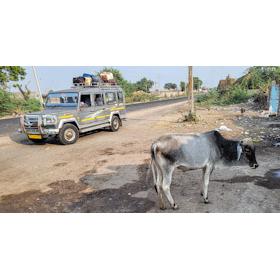
Our host in Mandvi had kindly booked us seats in a shared taxi to travel from Gandidham to Mandvi. This vehicle was like a jeep. It had a front row of seats – sofa like – and behind that there was another similar seating arrangement. Behind that, there was a far less comfortable seating space that accommodated any number of people that could be squeezed in. We were booked into the seating behind the front seats and in front of the rear ‘compartment’.

Although the middle seating had been booked for my wife and me, Lopa invited one of the three passengers who had squeezed in the front seat next to the driver to join us. He turned out to be a friendly chap. He and his friends were returning home from several days of a religious pilgrimage. Our new companion was a trader in rice, sugar, etc. He bought commodities and sold them for export. During our journey, he received a telephone call. He told us that soon after getting home, he had to go to Bombay for some urgent work. He and his business partner would have to drive for 11 hours through the night to reach Bombay from near Mandvi.

Our driver decided not use the 4 lane highway between Gandidham and Mandvi because of heavy traffic. Instead – and it made the journey far more interesting – he took us along a “short cut”, using country roads, some of them minor. This added fascination because we passed through rustic villages. At one of these, we were stopped by an elderly lady standing beside the road. She wanted to go to Mandvi, and was invited on board.

At another place, we stopped and the driver picked up a bundle tied in cloth, which he delivered to someone in another village we passed through later. After about an hour, to my great relief because my mouth was parched, we stopped for about 20 minutes at a stall where snacks and cold drinks were available.

At one point early during our journey, someone in the rear compartment asked our new companion to dial a certain number on his phone. Some conversation in Gujarati ensued. It turned out that there were some labourers travelling in the rear compartment. As they had not yet been paid by their employer, they claimed that they did not have the 300 Rupees needed to pay for the ride. Our friendly sugar trader allowed the employer to electronically transfer the required amount to his account. Our neighbour then suggested that he could electronically transfer that fare money to the driver’s account. However, the driver wanted to be paid in cash, which the trader kindly agreed to do.

Most of the way, the driver used one hand to steer, and the other to hold his mobile phone to his ear. Despite this hazardous practice, there were no scary moments along the way. We arrived at our destination safely, but somewhat cramped.

When we sat inside our host’s air-conditioned large saloon car to drive to his house, it felt as if we had moved from a stone seat into a feather bed. Never before has a modern saloon car felt so comfortable.

Despite moments of discomfort, our rail and road trip was enjoyably interesting. By the end of the journey we felt as if we had been truly travelling – a feeling that air travel often fails to provide.

Get a taste of my latest book about travelling in India

Recently, I published a book, “THE HITLER LOCK & OTHER TALES OF INDIA”, which is about some of my experiences of frequent visits to India over a period of thirty years. It consists of an introductory prologue and 101 short pieces of prose. To get some idea about what the book contains, here is one of them.

“IMPROPERLY DRESSED

In August 2008, we spent a few days at a beachside hotel just north of the city of Calicut (Kozhikode) in Kerala. Our accommodation was in the village of Kappad, where it is said that the Portuguese Vasco da Gama might have first set foot on Indian soil in 1498. Whether he did or did not, we had a good holiday in the area despite the occasional monsoon downpours.

One afternoon, while we were being driven through the countryside near Calicut, we spotted an isolated Hindu temple in the middle of a wooded area. It was surrounded by a fence and looked interesting from the car. We stopped, and found an open gate through which we entered the temple compound. The place was deserted – there was not a soul to be seen. Out of respect for Hindu traditions, we removed our footwear before wandering around. I took photographs of what was clearly quite an old temple.

We were on the point of leaving this holy place when we spotted a pandit entering. He walked towards us, not looking too pleased to see us. Speaking in Hindi or English – I cannot remember which – he said that I was not properly dressed to be in his temple. We apologised, and then he asked me to remove my shirt. I did as he requested, hoping that this would improve his mood. After I had taken off my shirt, he asked me to remove my trousers. To be charitable to him, I guess he would rather have had me wearing a lunghi or a dhoti instead of trousers. When he asked me to take off my trousers, we decided to leave the temple compound speedily.

Had I done as he had asked and put on traditional clothing of Kerala, the priest might have felt obliged to make us feel welcome in his temple. But it is likely that he knew full well that a westerner like me was unlikely to do what he wanted, and instead would leave his compound. His actions were a subtle way of getting us to leave without needing to sound impolite or unwelcoming.”

And here is another excerpt:

“DIPLOMATIC AMNESIA

Almost immediately after I first arrived in India (in late December 1993), and a few days before our Hindu wedding ceremony, my father-in-law recommended that I visit his tailor – Mr Krishnan – to get measured up for some new suits. One of these was to be a white ‘Prince Suit’, and the other two were western style formal suits in greyish materials. The Prince Suit, a traditional Indian design with a high neck collar, was to be worn at our wedding reception after the marriage ceremony. The other garments would be useful for the many formal occasions, which my father-in-law anticipated both in India and England. He loved such occasions.

When he worked in an upmarket tailoring shop in Bangalore’s Brigade Road, Mr Krishnan had made suits for my father-in-law. When I met him, he was semi-retired and worked from his home in a small, old-fashioned house on a short lane in a hollow several feet beneath the nearby busy Queen’s Road. He was a short, elderly gentleman – always very dignified and polite. He measured me up for the suits in his front room, which served as part of his workshop. After a couple of visits to try the suits whilst they were still being worked on, I picked up the finished garments. Each of the suits fitted perfectly – ‘precision-fit’ you could say quite truthfully. Despite being so accurately made, they were not in the least bit uncomfortable. Everybody admired them. I could understand why I had been sent to Mr Krishnan.

Our next trip to India was made 20 months later when our recently born daughter had had sufficient vaccinations to allow her to travel safely. During the interval between these two holidays, my dimensions had changed significantly because of my good appetite and happy marriage. Notably, my girth had increased greatly. Sadly, the suits that Mr Krishnan had so carefully crafted no longer fitted me. We returned to see Mr Krishnan, who told us that in anticipation of my dimensions changing, he had left extra cloth within the garments for adjusting them. Without comment, he took my new measurements, and noted them down in a book. My wife, who had accompanied me, said to the tailor, mischievously:

“Just out of curiosity, Mr Krishnan, would you be able to look up Adam’s previous measurements to see how much he has changed.”

He put down his pencil, sighed, and said:

“I am very sorry, Madame, but I have unfortunately lost them.”

Mr Krishnan was not only a wonderful tailor, but also a perfect diplomat.”

If you enjoyed these, and want to read more, then please obtain a copy of my book, which is available in paperback and Kindle from Amazon sites such as

[For those who live in India, the paperback can be ordered here:

https://store.pothi.com/book/adam-yamey-hitler-lock-and-other-tales-india/]

Seeing India through the eyes of a Londoner

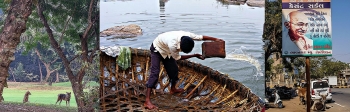
AMONGST THE 101 diverse topics in my book about travelling in India, you will find the following four: observing a padlock made by a company called Hitler; encountering jackals on a golf course; travelling in coracles on crocodile-infested waters; and having spectacles made by Gandhi’s optician. Since getting married in India in early 1994, I have made over fifty visits to the country during which I have spoken to many people and explored a multitude of places – both well-known and hardly known except to locals. My book, “The Hitler Lock & Other Tales of India”, contains a selection of my experiences in the country. The book aims to fulfil the idea of great Jean Molière (1622-1693), namely, “If you want to edify, you have to entertain.” I hope that you will find that I have achieved that.

You can purchase my book from Amazon (either as a paperback or a Kindle e-book) by clicking on the picture below:

DISCOVER THE EXCITING RANGE OF TOPICS IN MY NEW BOOK ABOUT MY TRAVELS IN INDIA DURING THE LAST 30 YEARS

Here is a list of the chapters in Adam Yamey’s anthology of his often entertaining travel experiences in India. The book is both for those who know India and for those who do not.

The book and/or Kindle can be bought by clicking on the picture below.

LIST OF CHAPTERS

Introduction … page 9

Prologue: A book from India … 12

Saved by a nosebleed … 14

You married him? … 16

It began with a bang … 18

Shantiniketan … 20

. Maria and Job … 23

Please use the meter … 27

Mixed couples … 29

Coracles … 31

West End Hotel … 35

Less than one degree … 39

Puncher …42

Dining with the dead … 48

A generous gratuity … 50

Miner’s sauce … 52

From Kutch to Norway … 54

Looking so lovable … 56

Beneath the banyan trees … 58

Meeting Khushwant Singh … 61

A palace by the sea … 64

Monkey business … 67

Chicken 65 … 70

Diplomatic amnesia … 72

Meeting the Mahatma … 74

Feeding the cows … 79

Montecatini Terme … 83

Hummus in Hampi … 86

Clothing can be critical … 89

Traditional but trendy … 94

Facial prejudice … 96

Paradise for bookworms … 99

Wrapped up … 105

The personal touch … 108

He worked with Le Corbusier … 111

My Ferrari … 115

From Gandhi to Hitler … 117

An unusual invitation … 121

Looking for literature … 123

Of dargahs and dyeing … 127

Before my time … 130

Improperly dressed … 132

Dining at Limra … 135

Hitler on the shelf … 139

Beefsteak not biryani … 144

Independence Day … 146

Large snakes … 148

One wife four husbands … 150

One day it might be you … 153

Waterfalls and water closets … 155

Cunning old fox … 158

Kutchi beer … 161

Albanians in India … 163

Bodies in the dark … 167

Don’t let it go viral … 169

Clubbing …171

Lopchu … 175

Threads of faith … 179

Nizam’s … 184

Teapots and politics … 187

A refreshing breeze … 190

Buried not burned … 193

Gandhi’s spectacles … 197

Tea at Lothal … 201

They came from Persia … 207

Don’t take the train … 211

Defying inflation … 215

In your face … 217

Cops and crocs … 219

A curious hotel … 222

Denmark by the sea … 225

No bill food is free … 231

Espresso in Diu … 234

Maurice and Bob … 237

An Indian welcome … 242

The pandit’s wife … 244

Royal encounter … 247

Unlocking a secret … 253

Curious coffee … 255

Do they speak Hindi in Russia? … 257

Dashiki … 260

Field of cars … 263

I love Stalin … 267

Jeremy Bentham and Calcutta …269

India’s first mosque … 273

Eggs excepted … 278

Saving their necks … 280

Reclining on a rug … 283

Bollywood in Bangalore … 285

A coffee house … 289

Bargaining in Mount Abu … 291

Not long in Nepal … 295

An unexpected sight … 299

Four bangles … 303

On the safe side … 306

PHD … 308

In touch with history … 311

James and Adeline … 316

Ladies only … 318

Lost property … 320

Plants from paper … 323

A soaking in Calcutta … 325

Mapusa market … 331