Leopoldstadt by Tom Stoppard

Wyndhams Theatre, London

I HAVE WATCHED AND GREATLY enjoyed many plays by Tom Stoppard. So, it was with high expectations and great excitement that I booked good tickets for his latest play, “Leopoldstadt”, which is about a tragic period during Austria’s history, a time that interests me greatly. The play follows the history of a Jewish family living in Vienna between the late 19th century and about 1955. Like many Jewish families living in Germany and Austria, they were determined to appear increaslingly less Jewish and ever more like their gentile neighbours, a process known as ‘assimilation’. As Amos Elon demonstrates in his wonderful book, “The Pity of it All”, the more assimilated the Jewish people became, the less they were tolerated by their mostly anti-Semitic neighbours. Stoppard’s play attempts to portray this sad state of affairs in “Leopoldstadt”. His play was more like a history lesson than a compelling work of drama.

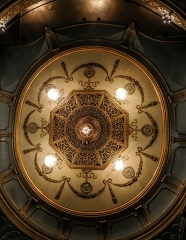
“Leopoldstadt” was being performed in London’s magnificent Wyndhams Theatre. Frankly, although there were a few wonderful scenes in the play, I was mostly disappointed. Although it was clearly a heartfelt and moving exploration of part of his family’s history, Stoppard has written far better and subtler plays in the past.

Unveiled at last

THE CORONET CINEMA in London’s Notting Hill Gate was renamed The Print Room a few years ago. Once a cinema, it is now a theatre. Like other theatres, it was closed for a long time during 2020 and early 2021 because of the covid19 lockdowns. During this prolonged period of closures, a statue was placed upon the dome that stands above the theatre’s main entrance. In my book “Walking West London” (freely available as a pdf file from https://adamyamey.co.uk/walking-west-london/), I wrote about the Coronet/Print Room as follows:

“… the former ‘Coronet Cinema’. This was designed as a theatre by WGR Sprague (1863-1933) who designed many of London’s theatres. It opened in 1908. By 1923, the Coronet had become a cinema, and remained so for many years. Apart from the screen, the fittings inside the auditorium were those of an unmodernised Edwardian theatre. Until smoking was banned in all public places, the Coronet was one of the last cinemas in London which permitted smoking (but only in the balcony seating). Between 2004 and 2014, the Coronet doubled up as both a branch of the Kensington Temple Church and, also, as a cinema. And, in 2015 the Coronet reverted to being used as a theatre, now called ‘The Print Room’. This sensitively restored theatre puts on interesting plays, which are well-produced. The bar, which is located beneath the stage in what was once the stalls area of the cinema, is worth visiting to see its ever changing, tastefully quirky décor. In 2020, the theatre was redecorated and a statue by the British sculptor Gavin Turk (born 1967) has been placed upon the dome above the building’s main entrance. The new artwork replaces one that was removed many decades ago.”

When I wrote this, the sculpture was enshrouded in a tarpaulin. Only recently, the covering has been removed and the sculpture can be seen in all its glory. The artwork depicts the artist Gavin Turk posing as the famous artist Sir Joshua Reynolds (1723-1792) just as he appears his sculptural in the Annenberg Courtyard of Burlington House in the grounds of the Royal Academy. When seen from the east, the new sculpture looks like a painter holding a palette and his brush. However, when seen from the west, the viewer might be led to believe that the statue is of a man holding a gun. I feel that the sculpture is a great addition to the landscape of Notting Hill Gate, but a bit too high above ground level to be able to see it easily with the unaided eye.

Back to the theatre

BACK TO THE NATIONAL THEATRE

THE DORFMAN IS one of the three auditoria that make up the National Theatre complex on London’s South Bank. The Dorfman, which opened in 2014, is a completely redesigned version of The Cottesloe that used to stand in the same place. On our first ever visit to The Dorfman, today, the 6th of October 2021, we noted that it was a great improvement over its predecessor: better seating and sight lines than at the former Cottesloe.

Stage at the Dorfman

The play that we watched, “Rockets and Blue Lights” by Winsome Pinnock (born 1961), was inspired by a painting by JMW Turner. Originally named “Slavers Throwing overboard the Dead and Dying—Typhon coming on”, it is now named “The Slave Ship”. Painted in 1840, it now hangs in the Museum of Fine Arts in Boston, USA. Close examination of this wonderful painting reveals the wild sea near a sailing ship is full of hands reaching out from the waves, the hands of Africans sinking after being tossed overboard. Turner, a sympathiser of slave trade abolitionists, might have painted this in response to the tragic story of British slave ship “Zong” on which about 130 enslaved Africans were killed in 1781 when drinking water supplies on-board ran low.

The play explores the possible back stories of those tossed overboard from the ship depicted in Turner’s painting. The drama alternates between the present and the dark past when slavery was still flourishing in the Americas. At first a little confusing, it does not take long before the constant changes in period begin to make sense. The scenes set in the present relate to the making of a film about Turner and those set in the past try to recreate the story that led to the disaster painted by Turner. The ideas behind this play are not without great interest but at times I felt that a bit of editing (i.e., abbreviating) would have made the drama punchier. Understandably, the playwright wanted to make the horrors and inhumanities of slavery abundantly clear to the audience, which she did very well. I am glad to have seen this play, but do not rate it amongst the best I have seen during many decades of watching drama on the stages of the National Theatre.

Our visit to the Dorfman was the first to the National Theatre since the day before the first covid 19 ‘lockdown’ commenced in March 2020. On that day before everything closed down for months, we sat for seven hours in the National Theatre’s Littleton auditorium to watch a truly excellent play, “The Seven Streams of the River Ota” by Robert Lepage, the National Theatre at its very best. Even though the play we have just seen at The Dorfman was not nearly as good as the play by Lepage, it was lovely to return to the National Theatre. That said, the South Bank felt eerily underpopulated compared to before the pandemic, probably because of the paucity of tourists from abroad. Walking in the sunshine along what used to be a crowded, joyful recreation area, I wondered whether we will ever experience the ‘normal’ we enjoyed before covid19 changed the world.

Drama in the Peak District

WE DROVE TO BUXTON from Macclesfield, crossing part of the Peak District, which was shrouded in dense morning mist despite it being mid-September. The town, once an important spa, is delightful. Its centre is rich in Victorian buildings, as well as some 18th century edifices, such as The Crescent, now a hotel. In appearance, the Crescent, which was built for the 5th Duke of Devonshire between 1780 and 1789, rivals the fine crescents found in Bath. Another notable structure in Buxton is The Dome, now a part of the University of Derby. This huge dome was built to cover a stable block for the horses of the 5th Duke, which was constructed between 1780 and 1789 to the design of John Carr (1723-1807). The dome itself, which is 145 feet in diameter and larger than those covering Rome’s Pantheon and St Peters, was added between 1880 and 1881, by which time the building it covered was being used as a hospital. It is the second largest unsupported dome in the world.

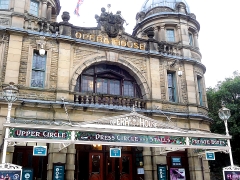
In common with great cities such as Vienna, Milan, Paris, Manaus, London, New York, and Sydney, tiny Buxton also can boast of having an opera house. Located next to a complex of Victorian glass and iron structures including a plant conservatory and the Pavilion with its attached octagonal hall, the Opera House was designed by the prolific theatre architect Frank Matcham (1854-1920) and first opened its doors to an audience in 1903. Live theatrical performances, not confined to opera, were held there regularly until 1927, when it became a cinema. Between 1936 and 1942, the Opera House, although then primarily a cinema, hosted annual summer theatre festivals, two of which were in collaboration with Lillian Baylis (1874-1937) and London’s Old Vic Theatre company (https://en.wikipedia.org/wiki/Buxton_Opera_House). In 1979, the theatre was restored, and an orchestra pit added. Since then, the Opera House puts on a programme of live performances, which include a little bit of opera.  Unfortunately, during our visit to Buxton, the auditorium was closed, but we did manage to enter the lovely foyer with its mosaic-bordered floor and its ceiling painted with a scene evoking the style of 17th and 18th century painters.

The Opera House, the Crescent and the Pump Room opposite it, and The Dome, all add to the charm of Buxton. They are all close to a lovely park, through which the River Wye (not to be confused with the river with the same name in Wales) runs through. Buxton’s Wye flows into the North Sea via the River Humber. High above the park, runs the High Street, where we stumbled across a fabulous bookshop, Scrivener’s, which boasts five floors packed with books, many of them second-hand or antiquarian. So, if it is literature (fiction and non-fiction) rather than drama that appeals to you, this shop is a place that must be visited. 

It was well worth winding our way across the hills to Buxton through the low clouds, which made visibility very poor. The town is filled with interesting things to see, some of which I have described above. However, it was the Opera House that intrigued me most. Had it been given a name other than Opera House it might not have fascinated me quite as much. That a town or city can boast an opera house, gives the place a certain ‘caché’ that places, which do not possess one, lack.

Take me to the Tivoli

WIMBORNE IS A CHARMING small town in Dorset, a little north of Poole and Bournemouth. Famed for its Minster church with its mediaeval chained library, the place is rich in old buildings. One of these, looking less old than many of its neighbours, houses the Tivoli Theatre. It attracted my attention because of its (heavily restored) art deco features.

Housed in what was originally the 18th century Borough House, the theatre-cum-cinema was created in 1936 to the designs of Edward de Wilde-Holding, a prolific architect. The cinema was closed in 1980 and was threatened with demolition for a road scheme, which fortunately was abandoned. It was restored by a group called ‘Voluntary Friends of the Tivoli’ and reopened in 1993. In addition to showing films, the theatre is used for live events on its stage.

The Tivoli was not the only art deco cinema we spotted on our recent trip to the area around Winchester. 28 miles northeast of Wimborne, there is another one, The Plaza in Romsey, which was built in 1931 as a cinema but is now used as a theatre. Unlike the Tivoli in Wimborne, which occupies an old building, the Plaza in Romsey was purpose-built as a cinema.

An actress on the village green

SHE SITS THERE MOTIONLESS, day after day and year after year, watching the traffic on Westway either rushing past or crawling along in a traffic jam. In her heyday, before being captured in stone, instead of the noise of motor vehicles, she would have enjoyed the sound of the applause given by audiences in dimly lit theatres. She was the actress Mrs Sarah Siddons (1755-1831), and her carved stone statue stands facing the elevated Westway in Paddington Green, just west of the Edgware Road.

Mrs Siddons

Paddington Green used to be part of an expanse of ancient wasteland located in an area now bounded by the Regents Canal, the Paddington Arm of the Grand Union Canal, and Edgware Road, but now much of this wasteland has been built upon. Writing in 1867, John Timbs noted:

“Paddington Green, now inclosed and iron-bound, was the green of the villagers, shown in all its rural beauty in prints of 1750 and 1783. Upon a portion of it were built the Almshouses, in 1714; their neat little flower-gardens have disappeared. South of the green is the new Vestry -hall. At Dudley Grove was modelled and cast, by Matthew Cotes Wyatt, the colossal bronze statue of the Duke of Wellington … it is thirty feet high, and was conveyed from the foundry, upon a car, drawn by 29 horses, Sept. 29, 1846, to Hyde Park Corner.”

Dudley Grove was in Paddington. What is now left of the wasteland consists of St Mary’s churchyard and next to it a small grassy area, still known as ‘Paddington Green’, and marked as such on a map drawn in 1815. It contains the statue of Mrs Siddons. The first written record of the Green is dated 1549. The Green contained a mediaeval chapel, now long-since gone. It has been replaced by St Mary’s Church, which was built in the Georgian style, in 1788. It was designed by John Plaw (1745-1820), who emigrated from London to the North American Colony of Prince Edward Island in 1807. His church in Paddington was later modified in the 19th century but restored to its original shape (a Greek Cross in plan) in 1970 under the guidance of the architect Raymond Erith (1904-1973), amongst whose other creations was the current form of the Jack Straws Castle pub in Hampstead.

The present church is the third in the area, which was halfway between the ancient villages of Paddington and Lilestone. The old Manor of Lilestone (or ‘Lilystone’) included the present Lisson Grove and extended as far as Hampstead. The earliest church was taken down in about 1678. The second church, which replaced it, can be seen in old drawings. It was a simple edifice with a single aisle and a small bell tower at one end. Edward Walford, writing in the 1880s, described it as:

“… not unlike the type of country churches in Sussex…”

The poet and preacher John Donne (1572-1631) preached his first sermon in the first church in 1615 and the painter William Hogarth (1697-1764) was married to Jane Thornhill (c1709-1789) in the second in 1729 without her parents’ knowledge.

Next to the western end of the church there is a single-storied rectangular, brick building decorated with trompe-l’oeil grisailles, one of which depicts Mrs Siddons. Today, this houses the Phileas Fox Nursery School. Built on the site of the old, now demolished, vestry hall (parish council meeting place), this building, the  church hall,  in a late Georgian style was designed by John Quinlan Terry (born 1937), an architect of the ‘New Classical’ style favoured by Prince Charles, and built in 1978-81.

Apart from the statue of Mrs Siddons on Paddington Green, most of it is surrounded by buildings or roads built either at the end of the 19th century or long after. At the eastern side of the Green there is what looks like a pair of either early 19th or possibly 18th century houses. The reason Mrs Siddons is commemorated on the Green is that she is buried in the adjoining St Mary’s Churchyard. Her gravestone is contained within a cast-iron enclosure that looks like a small cage. For some time, the actress lived in Paddington in a house which used to stand in the area around Westbourne Green, which is near the current Westbourne Park Underground station.  

Mrs Siddons was highly acclaimed as an actress by many. The critic James Henry Leigh Hunt (1784-1859) had reservations as he remarked in his autobiography:

“Want of genius could not be imputed to his sister, Mrs Siddons. I did not see her, I believe, in her best days; but she must always have been a somewhat masculine beauty; and she had no love in her, apart from other passions. She was a mistress, however, of lofty, of queenly, and of appalling tragic effect. Nevertheless, I could not but think that something of too much art was apparent even in Mrs Siddons; and she failed in the highest points of refinement.”

Although the poet and playwright Joanna Baillie (1762-1851), shared Hunt’s opinion about her, others held her in higher regard.

The statue of Mrs Siddon in Paddington Green was sculpted by the French sculptor Léon-Joseph Chavalliaud (1858-1919). In the 1880s, he moved to London from France and lived south of the Thames in Brixton. His Mrs Siddons, based on a portrait by Sir Joshua Reynolds, was unveiled by the actor Sir Henry Irving (1838-1905) in 1897. It was the first statue of a woman, who was not royal, to be put up in London.

Paddington Green, like its close neighbour Paddington Station, figures in the history of London’s transportation. For, it was from here that the coachbuilder George Shillibeer (1797-1866) ran London’s first omnibus service to The Bank of England in 1829. He had got the idea from Paris, where he had been asked to design carriages that could carry up to 24 passengers at any one time.

The Paddington Green police station building stands a few yards east of Paddington Green. Constructed in 1971, this used to provide local policing services as well as an interrogation centre for terrorist suspects. Suspects accused of terrorist activities were brought here for questioning from all over the UK. Although it was refurbished in 2009, the station was closed in 2018. The building’s future is in the hands of property developers, who plan to build new housing on its site.  

Until the beginning of the 19th century, Paddington Green was a bucolic environment on the edge of what was then London. Now, surrounded by buildings and highways, it is a green but noisy oasis in a highly urbanised area.

A new arrival above the theatre

I HAVE NEVER SMOKED. Therefore, when smoking was banned in cinemas, I was not upset by this ruling. The Coronet cinema in Notting Hill Gate was one of the last cinemas in London to enforce the ban. Smokers sat upstairs in the circle and non-smokers sat downstairs in the stalls. Despite the smoking, it was a delight seeing films at the Coronet because the cinema was housed in what was once a theatre that first opened in 1898. The original interior décor, though in need of some restoration had been preserved.

The theatre was designed by the theatre architect William George Robert Sprague (1863 – 1933), who also designed the Novello and Aldwych theatres in London. Audiences at the Coronet were able to see famous actors such as Ellen Terry and Sarah Bernhardt on its stage. From 1923, the Coronet became used as a cinema, the screen being positioned in the theatre’s proscenium arch. In 2004, the Coronet was bought by Kensington Temple, who used it for prayer meetings. When not being used for religious purposes, films were screened there for public audiences as before.

In 2014, a fringe theatre group, The Print Room, which left its original premises in nearby Hereford Road, acquired the Coronet and began using it as a theatre once more. A new stage was constructed. It covers the area of the theatre where the stalls seats used to be. The audience sits in the steeply raked seats of the former circle seating area. Where the stalls used to be, has been converted to a quirkily decorated bar area. Because the bar is just beneath the stage, the bar is closed during performances to prevent noise from it being heard in the auditorium during a show. All of this has been done without changing what has been left of the place’s old internal décor.

The Coronet occupies a corner plot. Its exterior has neo-classical decorative features with pilasters, pediments etc. There is a dome high above the main entrance, which is located at the corner of Notting Hill Gate and Hillgate Street. For as long as I can remember (about 30 years), the lead-covered dome was unadorned.

The covid19 pandemic began closing London in about March 2020. The Print Room, like all other theatres in the country, closed. As it is close to shops that we use, we passed it regularly. During the summer, the theatre was covered with scaffolding whilst builders redecorated its exterior. By the end of summer, the scaffolding was removed.

Several weeks later, I could not believe my eyes. A statue had been placed on the top of the dome. The figure on the dome appears to be bound by ropes or cables and his or her face is covered by the sort of mask one might wear if one was a beekeeper. The figure is holding what looks like a large open book or an artist’s palette in its left hand, whilst pointing a pen or artist’s paintbrush into the distance with the right hand. Close examination of the sculpture reveals that at present the ropes are holding down a protective covering. I look forward to seeing what is being concealed.

I was curious about the sudden appearance of a statue on the dome. It turns out that when the Coronet was built, the dome did bear a statue (www.arthurlloyd.co.uk/CoronetTheatreNottingHillGate.htm). When it was taken down, I cannot discover, but it was more than 30 years ago. Planning to replace it began in September 2018 (www.rbkc.gov.uk/idoxWAM/doc/Revision%20Content-2133806.pdf?extension=.pdf&id=2133806&location=VOLUME2&contentType=application/pdf&pageCount=1). The planning document submitted by the Studio Indigo architectural practice reveals:

“Historical images and photos of the Coronet show that there was at some point a statue on top of the dome roof. The statue appeared to be of a life size human figure, the details of which were difficult to precise.

The proposals include for a life size bronze sculpture of the artist Gavin Turk as the famous English portrait artist [posing as] Sir Joshua Reynolds. The statue is based on the Alfred Drury sculpture which stands in the Anneberg Courtyard of Burlington House in the grounds of the Royal Academy, and is a design by contemporary artist Gavin Turk. The new statue celebrates the notional idea of a theatrical/cultural building which had a figure calling the people into the venue.”

Looking at old pictures of the Coronet, it seems that the new sculpture will not resemble the original. If the sculpture that now perches on the dome is by Gavin Turk, a leading British sculptor, it will be in good company. Not far away, there is an abstract sculpture by Antony Gormley on the roof of Holland Park school.  

Noticing that a statue had arrived on the dome of the Coronet hit me dramatically. I was very pleased to see it as it will enhance a theatre which is already remarkable for the high quality of its productions. Furthermore, it is heartening that the only remaining elegant edifice on Notting Hill Gate’s main thoroughfare, mostly ruined architecturally in the 1960s and 1970s, is being well-maintained and tastefully improved.

Where seven streets meet

SEVEN ROADS MEET at a point in London called Seven Dials. A column with seven sundials attached to it stands in the middle of the circle where they meet. Long ago, on the 5th of October 1694, the writer and diarist John Evelyn (1620-1706) noted that he went:

“…to see the building beginning near St. Giles’s, where seven streets make a star from a Doric pillar placed in the middle of a circular area; said to be built by Mr. Neale, introducer of the late lotteries, in imitation of those at Venice, now set up here, for himself twice, and now one for the State.”

The pillar with sundials facing in seven directions was erected in 1694 by Edward Pierce (1630-1695) and Thomas Neale (1641-1699). Pierce was a sculptor, architect, and stonemason. Neale was a Member of Parliament for 30 years; Master of the Mint; gambler; and entrepreneur. His achievements included:

“…development of Seven Dials, Shadwell (including brewing and Navy victualling), East Smithfield and Tunbridge Wells, to land drainage, steel and papermaking, mining in Maryland and Virginia, raising shipwrecks, to developing a dice to check cheating at gaming. He was also the author of numerous tracts on coinage and fund-raising and was involved in the idea of a National Land Bank, the precursor of the Bank of England. The extent of his interests – as a prominent Hampshire figure, as a member of the Royal Household, as a long-standing MP serving on dozens of Committees and as the promoter of an extraordinary plethora of projects” (www.sevendials.com/history/thomas-neale-1641-1699).

In July 1773, the column bearing the seven dials was removed because it was believed that there was a substantial amount of money hidden beneath it, so wrote Peter Cunningham in his Handbook of London (1850). None was found. Another theory suggests that the pillar was removed:

“… to rid the area of the undesirables who congregated around it. The remains of the column were later moved to the garden of the architect James Paine (Junior) at Sayes Court, Addlestone, but not re-erected.” (www.sevendials.com/resources/Seven_Dials_History_of_the_Area_by_Dr_John_Martin_Robinson.pdf)

It was not until 1989 that the demolished column was replaced. It was reconstructed according to Pierce’s original design that is lodged in the British Library. The new column was unveiled by Queen Beatrix of the Netherlands on the 29th of June 1989.

The entrepreneur Thomas Neale would have approved of a venture that commenced in his Seven Dials district in 1976. That year, Nicholas Saunders (1938-1998) opened his Whole Food Warehouse in a disused warehouse in Neal’s Yard (formerly ‘Kings Head Court’), named in memory of Thomas Neale. In Saunder’s words:

“I decided to start a wholefood shop which I would like myself – one that was cheap, efficient and would not make customers feel bad because they could not recognise a mung bean. At that time wholefood shops were mostly of the hippy style – folksy looking with open sacks and used paper bags; nice meeting places for the in-groups but hopelessly inefficient, expensive and tending to make ordinary people feel like intruders.” (https://nealsyardlondon.co.uk/history/).

His venture proved successful. Various other businesses including Neal’s Yard Remedies, Neal’s Yard Dairy, Casanova & daughters, and Wild Food Café, opened nearby. Saunders wrote:

“The Yard has developed into a social scene. Even though the businesses are each independent, everyone who works in them, and many of the regular customers, identify with the place. In fact most of the workers are customers who had asked for a job. My old idea of a village community has manifested in the form of a community of small businesses, each one individual and free to go its own way. It is rather like a family, with me as a father and the businesses as my grown-up children.”

Although we made our last visit to Neal’s Yard in the middle of the covid19 pandemic, when the place was empty and closed, it is safe to say that the Yard continues to be a vibrant ‘social scene’ and its shops are still thriving despite the fact that shops supplying ‘whole foods’ have multiplied considerably since Neal’s Yard was established. Saunders is commemorated in the Yard by a wall mounted plaque.

Apart from selling food and remedies, Neal’s Yard was home to the film studio run by Michael Palin and Terry Gilliam between 1976 and 1987. It was here that they edited the Monty Python series of films.

One of the entrances to Neals Yard is an alleyway leading from Monmouth Street (formerly ‘Great St Andrew Street’), one of the seven streets leading to the Seven Dials. The street is home to one of London’s older still existing French restaurants, Mon Plaisir, which is close to Neals Yard and was founded long before Saunders established his venture. The brothers David and Jean Viala started the eatery in the 1940s.

My parents moved from South Africa and settled in London in the late 1940s, by which time Mon Plaisir was serving customers. I do not know when my parents first ate there, but during my childhood I remember it as being one of their favourite places at which to to eat out. Until 1972, when new management took over the restaurant, Mon Plaisir occupied one shopfront. Its characteristic quirky décor rich in everyday French posters and other ephemera remains substantially unchanged since the 1940s. As a child during the 1960s, I was taken there infrequently. I remember liking it. One thing that I recall was that the toilets were approached through a doorway at the end of the restaurant furthest away from the street. An artist’s palette was nailed above the doorway. It bore the words “Le Pipi Room”. On a visit made this century to the enlarged restaurant, I noted that the sign had disappeared. When life returns to ‘normal’ again, another meal at Mon Plaisir is on our ‘to do’ menu.

During my childhood, the Seven Dials did not make any impression on me. I knew about Mon Plaisir, but never ventured south the few yards to the Dials. With the opening of the Donmar Theatre on Earlham Street, another of the roads leading to the Dials, in 1977, which we have visited often, the Seven Dials entered my London radar.

Before ending this somewhat rambling piece, here is a true story about the theatre. Soon after it opened, an American friend, a keen theatregoer who was midway in age between my parents and me, invited me to join her at a performance at the Donmar. It was a play with a Chinese theme. We were seated in the front row, literally on the stage. My friend who had long legs, stretched them out onto the stage and the actors had to take care not to trip over them. Halfway through one of the acts, my friend began fumbling in her large bag and withdrew a thermos flask. She removed the lid, which served as a cup, and gave it to me to hold. Then, she filled the cup with hot soup, which she proceeded to drink whilst the drama unfolded in front of us. I often wonder what the actors, who were so near us, thought when they saw a member of the audience enjoying her picnic in front of them.

The Seven Dials and the streets radiating from the column are full of fascinating buildings, some old and others new and there are plenty of shops to explore apart from those pioneering wholefood shops in Neals Yard. If you can manage to get a ticket to the Donmar, and this is quite hard if you are not on their advance booking scheme, then it is often worth watching a performance there.

How well do you know Leicester Square

IT WAS EERIE walking in Leicester Square today in early February 2021 at midday because we were almost alone. Normally, the square is full of people milling about and joining circles of folk watching street entertainers perform, sometimes with great skill. Apart from us, I saw no more than ten other people in this usually crowded popular focal point for Londoners and tourists alike. There was a sense of peace and calm that one customarily associates with spots deep in the countryside. I doubt that this square has been like this for many years, maybe since it was first laid out between 1630 and 1671, when it was then known as ‘Leicester Fields’.  

At the north-east corner of the Square was Leicester House, which was named after Robert Sydney, 2nd Earl of Leicester (1595-1677), and was built in about 1635. It was home to members of some royal personages including, briefly, Elizabeth Stuart, Queen of Bohemia (1596-1662) whose life ended in the house, and later the huge natural history collection of Sir Ashton Lever (1729-1788), the last lessee of the house before it was demolished in 1791.

During the 18th century, the houses surrounding Leicester Square were occupied by several people, whom we still remember today. The artist William Hogarth (1697-1764) lived on the east side of the square on a site that was later occupied by the Sablonière Hotel, now demolished. The hotel’s plot is now the site of a twentieth century building housing the offices of several radio stations including LBC and Classic FM and a branch of TGI Friday. The famous surgeon and scientist John Hunter (1728-1793) lived in the house next to Hogarth’s from 1785 until his death. He kept his collection of specimens there as well as giving lessons in anatomy and dissection in rooms he added to the rear of his home. Hunter was buried in the nearby church of St Martin in the Fields. Across the square on its west side, the artist Sir Joshua Reynolds (1723-1792) lived and worked from 1761 until his death. His studio was an octagonal room. According to John Timbs, writing in 1867:

“… the sticks of his brushes were 18 inches long; he held his palettes by handle …”

In addition to his residence and studio, Reynolds built a gallery for his works. The row of houses that included that of Reynolds has long since been demolished. When I first knew Leicester Square, the east side of the square was occupied by a large office building, Fanum House, that housed the Automobile Association. Its appearance has been modified and is known as ‘Communications House’.

Other artists, who lived in the square, include Hans Huyssing (1678-1753/53), a Swedish painter; Jacques Christophe Le Blon (1667-1741); Michael Dahl (1659-1743), a fashionable Swedish portrait painter; and William Martin (1753-c1836), an English painter. Apart from artists, other notable people, several military and medical celebrities, lived around the square.

The square has a garden, in the centre of which there is a statue of William Shakespeare. This is a copy of an original made in 1741 by the Flemish sculptor Peter Scheemakers the Younger (1691-1781) who spent most of his working life in London. It was placed in the square in 1874 when the financier and member of Parliament Albert Grant (1831-1899), who was born ‘Abraham Gottheimer’, bought the garden and opened it to the public. During the 18th century, there was another statue in the square: a metal equestrian sculpture of King George I, sculpted by C Buchard.

The large Odeon Cinema on the west side of the square has a black tiled façade. It was built in the art-deco style in 1937, designed by Harry Weedon (1887-1970), who designed many other cinemas in the 1930s. It was built on the site of the big Alhambra Theatre, which opened as a music hall in 1858 and survived until its demolition in 1936. Today, there is a bar next to the Odeon. It bears the name ‘Lost Alhambra’.  

The Empire Theatre, now a casino and a cinema, is on the north side of the square. With its neo-classical façade, it was built in 1884 as a variety theatre. Its architects were Thomas Verity (1837-1891 and Thomas Lamb (1871-1942). This stands roughly on the western side of the land occupied by the former Leicester House. To the east of this plot, there stands another cinema, a fine example of the art-deco style, the Vue Cinema, which was built in 1938 and opened as the ‘Warner Theatre’. Its architects were Thomas Somerford (1881-1948) and EA Stone. The façade includes two bas-relief sculptures, one representing the spirit of sight and the other of sound, which were created by Edward Bainbridge Copnall (1903-1973), who was born in Cape Town in South Africa.

The Swiss Centre that used to stand at the northwest corner of the square was demolished a few years ago and was replaced by a newer building. The Centre contained a couple of expensive but good restaurants where Swiss specialities were served. The steak tartare and cheese fondue, which were served at the Centre, were particularly good. A clock with a carillon adorned with the crests of the Swiss Cantons is all that remains of that fine Swiss establishment.

At the south side of the square, facing the cheap theatre tickets booth, stands the Hampshire Hotel, currently devoid of guests. Before it became a hotel, this building housed the former Royal Dental Hospital. Opened in 1858 in Soho Square (number 22), it moved to the premises in Leicester Square in 1874 (https://ezitis.myzen.co.uk/royaldental.html). In those days, the once fashionable Square had become a run-down part of London. In 1983, The Royal Dental Hospital was merged with Guys Hospital Dental School. When this happened, a dental friend of mine, who worked at Guys, suggested to me that the merged hospital should be renamed as ‘Roys’. In 1985, the Leicester Square hospital was closed. Soon after this, the former hospital was reconditioned to become a hotel.

Being the centre of London’s theatre and entertainment district, it is appropriate that recently the square has been adorned with life-size sculptures of famous entertainers such as Charlie Chaplin, Rowan Atkinson (with whom you can share a bench), Laurel & Hardy, Mary Poppins, and other familiar actors.   I cannot decide whether these frozen figures enhance the square, but as they are fairly discreetly positioned, they do add something to a place that has been home to well-known people since the beginning of the 18th century.

Had Leicester Square not been as empty as it was today, I would not have spent so long there to take photographs. I realised that this square, through which I have always preferred to hurry, has some interesting architecture and such a lovely statue. Although I enjoyed Leicester Square without the crowds, I look forward to healthier times when people can mix there, freely and happily.