Shops and shrines on a busy road in old Bangalore

I KNOW OF TWO Avenue Roads. One is in London. Lined with the homes of the wealthy, it runs between Swiss Cottage and Regents Park. The other one is in Bangalore. It runs between KR Market (aka City Market) and a large Hindu temple (mandir) where Kempe Gowda Road becomes District Office Road. Both the road in London and its namesake in Bangalore carry much traffic, but there the similarity ends.

Avenue Road in Bangalore (‘AR’) is mainly lined with all kinds of shops, especially those dealing in paper goods (stationery as well as printed books). It runs through one of the oldest parts of the city: Chickpet. The lines of shops are punctuated by small lanes and alleys that lead away from AR.

Old pillars in a mandir on Avenue Road in Bangalore

As you stroll along the thoroughfare, you will pass mandirs and one church. And near the KR Market end of the road, a short lane leads to a Muslim shrine, the Dargah-e-Hazrath Manik Mastan Sha Saherwadi. It is well worth removing your footwear to enter this peaceful place. The grave it contains is in a small room with a mirrored, domed ceiling.

Some of the mandirs on or near AR are also worth looking into. Although some of their facades look fairly recent, the carved stone columns within the buildings look quite old. Near the street entrance of one of the mandirs on AR, I saw two intricate stone carvings of Hindu subjects. Both looked as if they might have been carved several centuries ago.

The Rice Memorial Church stands in its own small grounds, separated more from its neighbours than the mandirs on AR. Named after the British missionary, the Rev Benjamin Holt Rice, this Church of South India place of worship was built between 1913 and 1916 on the site of an earlier chapel first constructed in 1834, and then later rebuilt before being demolished. Although I have passed it often, I have not yet been able to enter it.

Not far from the church and a couple of picturesque mandirs, there is a branch of the Kamat chain of eateries. You can stop there for snacks and a variety of beverages. This place is in the midst of the numerous bookshops on AR. Proclaiming discounted books, these stores mainly stock textbooks and computer programming instruction manuals. Incidentally, AR is a good place to find a wide variety of diaries and calendars.

Bustling Avenue Road in Bangalore is a far more colourful and interesting thoroughfare than its rather elegant but staid namesake more than 5000 miles away in London. The street in Bangalore and the lanes leading off it give one a good idea of the ‘flavour’ of the parts of the city which existed before the arrival of the British imperialists. It makes a fascinating contrast to the newer Cantonment areas that became established after the British began settling in Bangalore.

A stroll along Gujarati Road

SOME YEARS AGO, I bought a book in the antique shop on Princess Street in Fort Kochi. It is a modern reproduction of a book published in about 1910. Its subject matter, mostly in English, is a detailed description of the benefits of living in Cochin. Its intended audience was Gujarati speaking people thinking of settling in the area. It was aimed at Hindus, Moslems, Jains, and Parsis.

A few days ago (in February 2023), I purchased a recently published book by Bony Thomas called “Kochiites”. It describes the many different communities that have settled in Kochi. One brief chapter is about the small group of Dawoodi Bohri, Shia Moslems, who live south of the historic centre of Kochi. Another is about the Hindu and Jain Gujaratis (and Kutchis), whose communal activities are centred along the 1 mile long Gujarati Road. As my wife has roots in Kutch and the rest of Gujarat and we enjoy visiting those parts, we decided to take a stroll along Gujarati Road, which is in the Mattancherry District of Fort Kochi. It was Sunday morning.

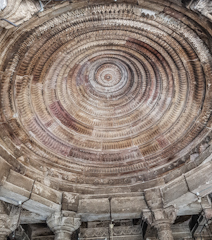
Gujarati Road runs in a north south direction. We began our exploration at the Jain temple and moved southwards. At the Jain temple, we were not the only tourists. My wife was the only visitor who could speak in Gujarati with the lady who showed us around the spotlessly clean Mandir. Its interior has a beautiful inlaid multicoloured floor and the inside of the main dome was a replica of the kind of domes with concentric ridges that one sees in mediaeval Hindu and Jain temples, as well as in mosques constructed during that period. Photography was not permitted within the temple.

Our next port of call was the shop of Chamanlal H Mithalwala. For many generations, this shop, owned by Gujaratis, has been selling Gujarati sweets and farsan (savoury snacks). We were able to buy some freshly made dhokla. However, we were told that khandvi always runs out in the early morning on a Sunday, soon after it has been made. The owner is Kutchi, as are many of the folk who live near Gujarati Road.

The Sri Jalaram Dham, a Hindu temple frequented by Gujaratis and financed by them, is almost opposite the sweet shop. Built quite recently (2012), it is not particularly noteworthy architecturally. It contains several brightly coloured idols and a small tulsi tree grows outside. The priest (pandit) told us he came from Rajkot, and almost all of the worshippers are Kutchis.

Just to the south of the Jalaram Dham, we reached the Sri Cochin Gujarati Vidyalaya, a Gujarati school in which most of the teaching is done in English. Founded in 1920, it has about 3000 pupils and covers education from lower kindergarten to college entry.

Within the school’s compound, there is a Hindu temple – about 140 years old. Its ceiling is decorated with larger than life bas-relief lotus flowers. We spoke with a trustee of the temple, who showed us some of the original idols and explained that in the area there are about 200 Gujarati families. Of these, 48 are Kutchi Bhatias, about 100 are other Hindu Gujaratis, and the rest are Jain. The temple is Shaivite. Our informant told us about another temple, which is Vaishnav and is frequented by the local Kutchi Bhatias. This interested us because my wife’s mother was a Kutchi Bhatia.

As can be seen all over Gujarat, there is a chabutra (dovecote) next to the temple. There is another one at the Jain temple, mentioned above

We continued south along Gujarati Road, passing the Gujarati Bhavan (which we did not enter) and several wonderful fruit and vegetable stalls.

Near the fruit and veg shops, which are located near the southern end of Gujarati Road, there is yet another temple – the Shri Navneeta Krishna Mandir. This is the Vaishnav temple used by many of the Kutchi Bhatias. The main temple was locked up, but behind it there was a lot of activity. This was centred around the mandir’s gaushala (cow shelter), where cows are provided with a pleasant home.

Worshippers were feeding the cows and calves. They were also placing cloths on the cows before handing them to the priest who was standing amongst the congregation. We were asked to touch one of these cloths before it was handed to the priest. The congregants took it in turns to touch the priest’s feet, and receive a blessing.

Near to the temple, there is a large housing compound, all of whose residents are Kutchi Bhatias. One sweet couple invited us into their ground floor flat, saying to us: “Welcome to our home. As guests, you are gods.”
We chatted with them both in English and Gujarati. They gave us lovely cups of chhaas (buttermilk, a typical Kutchi drink). They offered to cook us lunch, but we declined because we had to get somewhere else. This charming couple, Deepika and Harish, did not want us to leave. When we did eventually go, I felt that we had been in the company of genuinely warm-hearted loving people.

Before setting off for Gujarati Road, I was worried that it might offer little of interest. How wrong I was! Although I have only briefly summarised our experiences, we saw many interesting places and met many friendly people. Over the years I have been falling in love with Gujarat and Kutch. This small outpost of people from that part of India in Kerala has only increased my affection for Kutch and Gujarat.

[NB Kutch, which is now a large district in the State of Gujarat, was an independent kingdom until 1947. Even today, no self-respecting Kutchi likes to be called a Gujarati!]

Seduced by style

DURING VARIOUS VISITS TO AHMEDABAD, we have often driven past the Ahmed Shah Masjid, but never visited this venerable mosque. Close to the great Bhadra Fort and built in about 1414 AD by Ahmed Shah, the founder of Ahmedabad, this is the oldest extant mosque in the city. Today, we entered this exquisite mosque and its garden and discovered a perfect example of Indo-Islamic architecture.

When this mosque, and many others built in western India up to at least a century later, was constructed its creators incorporated many design features that can be seen in Hindu and Jain temples that were constructed centuries before believers of Islam entered/invaded India.

The grounds of the Ahmed Shah Masjid are entered through a small stone pavilion. The step inside it is just like the entrance steps to Hindu and Jain temples in that it includes a centrally located semicircular projection.

The patterning on the exterior stonework of the mosque and the many pillars within it would not look out of place on pre Islamic places of worship in India. However, the presence of figurative carving found in Hindu and Jain temples is completely absent in mosques. One small exception, which I saw at the Ahmed Shah Masjid and others in Ahmedabad, are carvings of trees, the Tree of Life.

The Ahmed Shah mosque and many other medieval mosques in Gujarat are topped with numerous domes. Seen from the outside of the mosques, they do not look exceptional, but viewed from within, the influence of Hindu/Jain temple architecture is obvious.

The domes are usually supported by 8 pillars arranged as a regular octagon. Neighbouring pillars support horizontal lintels, which together form an octagon. The dome rests on these lintels. The internal surfaces of the domes, when seen from below, consist of a series of concentric rings that decrease in circumference as they approach the top of the dome. The stonework of the rings can be either plain or elaborately ornamented. The design of these domes and their supporting supporting pillar systems are identical to what can be seen in Indian temples built long before Islam arrived in India.

Unlike the non-Muslim temples that inspired their design, medieval mosques contain features that are unique to mosques, such as elaborately decorated mihrabs, niches in the wall of the that worshippers face when they pray.

The Ahmed Shah mosque has an elevated internal chamber, where the king could pray separated from the rest of the congregation.

Having at last visited this fascinating mosque, I would reccomend all visitors to Ahmedabad to visit it first before exploring the other wonderful 15th and 16th century mosques that enrich the city.

The Ahmed Shah Masjid is a fine example of how conquerors can be conquered by the culture of those whom they have invaded. Just as the Muslims were bewitched by the wonders of Indian culture, so were the British many years later, as well exemplified by the Brighton Pavilion.

Around the mountain

LAST NIGHT WE MET DR ARUN SHARMA. He was introduced to us by Mr Kashyap Jani, the owner of Hotel Saraswati, where we stayed in Mount Abu. Not only is Sharma a medical doctor in Mount Abu but he is also an accomplished writer, a prolific poet, a composer of music, a keen and well informed local historian, and also a skilful painter. In addition to singing an excerpt from one of his many operas, he told us a bit about the history and mythology of Mount Abu, which he believes is the oldest place on earth. Partly at his suggestion and partly because we had seen some information displayed at our hotel, we decided to take a driver to visit historic places around the base of Mount Abu and its associated peaks.

Our driver, Zakir, picked us up early in the morning and drove us to a food stall next to the Madina Masjid, the only mosque in Mount Abu. We joined some men who were keeping warm around a bonfire and had tea and omelettes. Throughout Mount Abu, locals make bonfires to keep warm, especially after sunset.

We drive downhill from Mount Abu along the winding mountain road, Abu’s only road link to the ‘outside world ‘. The picturesqueness of the landscape was enhanced by patches of morning mist.

Our first stop was at the Badrakali Hindu temple, which is extremely old. We were told it is 8000 years old, but this seems unlikely. We entered the inner sanctum to see the idol depicting the principal deity.

We were followed by a man, who walked over to an enormous speaker and turned it on. We were blasted with incredibly loud music: mostly rhythmic drumming with frequent blasts on conch shells. The volume was as high as, or even greater than most discotheques.

The priest within the chamber with the main idol waved around a smoking censer before lighting several lamps on a metal holder, creating what looked like a fiery comb. While ring a bell with his left hand, he waved the flaming comb around the inner sanctum, up and down the principal idol and other lesser ones. All the time, the loud music thudded deafeningly. Suddenly, he put down the comb of flames, picked up a conch shell and used it to throw water at all of us facing him. As suddenly as it had begun, the music ended. The priest continued chanting while all those attending this ‘aarti’ left the temple. We were lucky to have witnessed this dramatic yet very moving ceremony because it is only performed twice a day.

A short drive, during which we saw wild peacocks and plenty of greyish monkeys with black faces, brought us to another ancient temple, the Hrishikesh, a very peaceful spot. After walking past cattle and a large number of monkeys, we entered thetemple compound. A young boy was cleaning an idol of the ‘guru’ which faced the main idol of the temple located in the innermost sanctum. This chamber was covered by a cloth curtain. The priest llowed us to peer inside, where he was carefully cleaning the idol. He told us that only when the goddess had been cleaned and dressed, could she be revealed to worshippers. The temple and its compound contains numerous finely carved religious stone artworks.

After a lovely drive through very rustic landscape, Zakir drove us along a rough track to the isoated Toda Paladi, a very small Hindu temple. We chatted to the priest, who, after inviting us to sit with him, asked us if we were at peace and content. Then, we looked at the old stepwell (‘vav’) near the temple. It was almost overflowing with water covered with a thin layer of green algae. The priest had told us that the well always received a good supply of water that flowed down from nearby Mount Abu. We left the customary donation to the temple. The priest explained that when enough money had been collected, he hoped that it would be spent on improving the road leading to his temple.

The Sun Temple at Varman was built in the 10th century AD. Somewhat ruined, but maintained by the Archaeological Survey of India, it contains carved stone features such as some of those that we saw at the great Jain temples at Mount Abu. The Sun Temple is, even though now incomplete, a gem.

Not far from the Sun Temple, we drove along a very sandy road until Zakir said the car could go no further safely. I disembarked and walked with some difficulty through vey soft fine sand towards a pair of huge banyan trees. Near these are the unguarded remains of Krishna Vat. A passing local with flamboyant facial hair typical of that seen on many Rajasthani men made me understand that the temple had been destroyed long ago by invaders. Despite the temple being a disorganised pile of exquisitely carved stones, people still worship there. For that reason my ‘guide’ asked me to remove my sandals while I prowled around the ruins, taking photos. My companion explained to me in Hindi what I was looking at, but I barely understood what he was saying. However, he did make it clear that a small rectangular patch of earth surrounded on three sides by stones was all that remains of the innermost sanctum of the temple.

After a relatively long drive, we reached the Behra Tarak Jain temple, which was built about 20 years ago. Although recently constructed, this temple, like most other contemporary Jain temples, is designed in the same way as those which were built over 1000 years ago. Thus, this new temple gives the visitor a good idea of how the historic temples must have looked when they were just completed. In all of the modern Jain temples we have visited both in Gujarat and Rajasthan no expense has been spared to create or recreate the perfection seen in the earliest temples.

Another drive along country lanes brought us close to the Karodi Dhwaj Hindu temple. I had to climb about 150 metres up a track too rough for our taxi to reach this small old temple compound clinging to the rocky slopes of Mount Abu. A staircase cut into a huge rock led down to a pool of water deep in a rocky cleft. The temple buildings overlooked this. Although of great beauty, they had been heavily painted with silver and other coloured paints. Some of the finer details of the carved stone idols were also hidden under deep layers of garish coloured paint. This temple almost hidden away in the rocks reminded me of some monasteries I have visited in Serbia. They were located next to the sources of streams at the heads of valleys to make them less accessible to foreign invaders, in their case the Ottoman soldiers.

The Mirpur Jain temple is definitely not concealed. It overlooks the plain surrounding Mount Abu. The mountainside makes an impressive backdrop to this beautiful temple constructed in a rare stone with light blue streaks. Constructed before the better known Dilwara temples, this could well have been the model which inspired the builders at Dilwara. Many of the finely carved features seen at Dilwara, where photography is firbidden, are in evidence at Mirpur. Almost as breathtaking as Dilwara, seeing Mirpur is a ‘must’.

The last stop on our tour was a Hindu temple within a natural rock cave, the Vastanji Shiva temple. This is located above a slope that was covered with litter. We were welcomed by several friendly temple assistants to the cave temple with its low painted rock ceiling. After we had admired the deity, we were invited into a neighbouring building, where men and women were keeping warm around a wood fire in a hearth on the floor. We were given a warm welcome and cups of tea. Pur new acquaintances invited to stay for a night of prayer at the temple. They told us that we would be offered food and bedding. Many people make the pilgrimage to this place and avail the hospitality offered. The sleeping quarters are flattish surfaces below the temple under colourful cloth shamianas. I guessed that much of the litter lying around was the result of the previous night’s pilgrims. All around we saw monkeys busy eating discarded vegetables and flower garlands.

We drive back up to Mount Abu after sunset, and disembarked at the grandiose former summer palace of the rulers of Bikaner, an erstwhile princely state in Rajasthan. It is now a ‘heritage’ hotel. We ate an indifferent meal in one of the dining rooms. The place was so cold that all of the diners were wearing inelegant padded jackets for outdoor use rather than dinner jackets and other fine garments that would have been worn when the hotel was a royal palace.

Thus, ended a fine day that was inspired by the historical research which Dr Sharma has been doing for years and by the publicity given to it at our hotel by its owner.

Monkey business

MONKEY


I was reminded of what follows, a true story,  after seeing an excellent photograph (reproduced above). The photographer Ajay Ghatage (from Bangalore) has kindly allowed me to use this photo.

Until I first visited India in 1994, I had never seen a monkey except in a zoo. Even in the hearts of big cities in India, these creatures are as successful as other city fauna such as pigeons, wild dogs, and birds of prey. I never cease to be fascinated by the monkeys’ antics, but I do recognise their nuisance value.

Kitchen windows need to be protected to stop monkeys from entering. At least once I walked into the family kitchen and startled a monkey, which was about to leap out of the window clasping a bunch of bananas.

Once my wife’s family decided that it would be fun to go on an outing to the Big Banyan, a few miles outside Bangalore. The Big Banyan is at least 400 years old and lives up to its name – it is a vast rambling tree that spreads its branches and aerial roots over a huge area. It is a popular picnic place, but, having visited it, I fail to see why. We found a clearing within the area covered by the tree, and then laid out a blanket for a picnic. Before we could sit down, many monkeys appeared. One of them began tugging at the blanket, and others looked greedily at our picnic baskets. The situation became so menacing that we abandoned the idea of a picnic and retired to eat in the car.

Many years later, my wife, our daughter, and I visited Badami in northern Karnataka. This place is famed for its fabulous Hindu, Jain, and Buddhist temples, some of which were carved in the living rock by the Chalukya dynasty in the 5th to 8th centuries AD. The area was infested with monkeys on the look-out for almost anything they could get hold of.

Some of the ancient temples are located next to a ‘tank’ or lake. While we were looking at these, our daughter wanted to take a photo. So, my wife held her bag.  Suddenly, I heard my wife making loud growling sounds. She was tugging our daughter’s bag while a monkey was trying to pull it away from her. The monkey was strong, but my wife’s growls scared it into releasing the bag.

A short while later, we sat down to have soft drinks under some trees. Our daughter ordered a virulently coloured orange carbonated drink. It was not one we would have recommended, but it appealed to our daughter. After the bag incident, we had warned her not to let go of anything, but she forgot momentarily. She put the opened bottle of drink beside her on the bench. Before she could say “monkey”, the bottle had disappeared. We looked up into one of the trees, and saw a monkey putting the bottle to its lips.

A few seconds later the monkey turned the bottle upside down, and then poured its contents down through the branches. Clearly, it was a creature with a discerning palate.