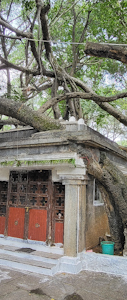
ON THE CAMPUS of Bangalore’s Chitrakala Parishath art college, there is a small Hindu mandir, the Ganapathi Temple. Dedicated in 1984 and built by Mandelia Parmarth Rosh, it contains an effigy of Ganesh and not much else.
What makes this small religious building both fascinating and charming is that its construction incorporates branches of a large, living banyan tree. The tree is growing through part of the temple.
IN DECEMBER 2024, we hired a taxi to take us from Jaisalmer to Bikaner: both are cities in Rajastahan (India). As it was a journey that was going to take over five hours, we decided we needed a break en-route.
When we asked our rather sullen driver to find a place for us to stop for a light lunch, he drove us off the main road into a small town (an overgrown village) called Ramdevra. The modest place where we ate satisfactory vegetarian food was not one frequented by foreign visitors. People hanging around the establishment were clearly curious about us, but in a friendly way. After lunch, our driver encouraged us to walk to the Sree Baba Ramdev Temple, for which the town is famous. It was much further away from the restaurant than the “few minutes” our driver had told us. Near the temple, there were many stalls where lumps of different coloured crystalline dhoop (aromatic products made with herbs and resins, which when heated or burned release fragrant smoke) and incense sticks were for sale. It was very clear that his choosing to stop in Ramdevra was to visit the temple, which turned out to be a crowded place in a huge shed filled with Hindu shrines.
It was mass-production Hinduism. Impatient crowds of people, including us, were hurried along narrow passageways demarcated by metal railings. The maze of railings made the place look like a cattle market filled with animal holding pens. The idea seemed to be to get the devotees to donate money at the several shrines in exchange for blessings that were performed by pandits as quickly as they could manage. Rather than feeling like a spiritual experience, it felt more like being a product on a fast-moving industrial conveyor belt. Our driver seemed pleased that he had visited the temple complex. We did not share his enthusiasm, and were pleased when we returned to the highway.
THE WALLS OF THE fort in Jaisalmer (Rajasthan) contain a living city that has been in existence since the early 18th century, but the fort itself was established in the 12th century. It is enjoyable to wander the narrow lanes that thread their way between houses, many of which are decorated with elaborate, Rajput style carving.
The only thing that can cause the visitor some concern is the regular passage of motorbikes and scooters along the thoroughfares which are severely limited in width. These vehicles, often driven by impatient people who sound the horn loudly and frequently, squeeze past one, narrowly avoiding injuring pedestrians. I suspect that these motorists find the tourists as irritating as the pedestrians regard them. That said, like Venice, whose main thoroughfares are crammed with visitors, Jaisalmer, like Venice, has byways that are almost deserted apart from the few residents who dwell in the houses lining them.
A tulsi tree
Today, we made a second visit to the fort and tried to avoid the busiest lanes as much as possible. In so doing, we stumbled across two lovely old mandirs (Hindu temples). Both were constructed in the 15th century, long before the fort became a residential area for civilians.
Both mandirs are still used for worship. In one of them, the Laxmi Narayan mandir, two pandits (priests) were having a heated argument yelling at each other across the courtyard. At this mandir, there was a tulsi (holy basil) tree, growing in a container, which has small alcoves in which lighted diyas (oil lamps) can be placed. I watched a man walking clockwise around the tulsi tree several times. When he had done this, he plucked one of its leaves and touched it reverently against his forehead.
The tulsi tree is of religious significance to devout Hindus. I read somewhere that when the Portuguese were occupying Goa and trying to encourage people to become Roman Catholic, tulsi trees were outlawed in that former colony.
The courtyard of the Laxmi Narayan was partly shaded by a peepal tree, whose leaves are heart shaped. Like the tulsi tree, the much larger peepal tree is also of religious significance.
The other old temple, which is smaller than it’s neighbour (Laxmi Narayan), is called the Ratneshwar Mahadev. I did not notice any tulsi plants associated with it. However, a peepal was growing next to it.
Although both mandirs had visitors, both locals and tourists, they were less crowded than the much-visited Jain temple with the fort. When we walked past it yesterday, it was literally swarming with tourists.
Apart from the spectacular array of finely decorated buildings that can be seen, what makes the fort of Jaisalmer well worth seeing is that it is still home people who live their everyday domestic lives there. Interspersed amongst the many things designed to appeal to tourists, one catches frequent glimpses of local people living their daily lives.
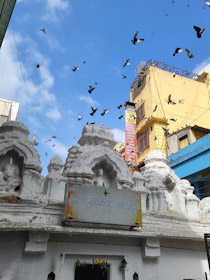
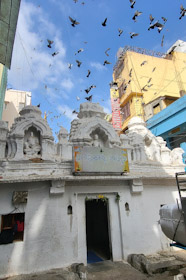
WHILE WALKING ALONG Bangalore’s Avenue Road, which runs from City (KR) Market to Palace Road, I spotted a mandir (Hindu Temple) down a side street. It was painted white, and its facade was surmounted by three tall niches, each containing a sculpture.
So many layers of paint had been applied over the years that the details on the sculptures had disappeared from view. At the rear of the mandir, I saw a tower like structure – part of the mandir’s roof. This was a popular landing place for pigeons. Within the building there were crudely carved stone pillars supporting the ceiling. These looked very old. Two rows of pillars lined a central ‘aisle’ leading to a shrine at the far end of the temple.
Above the entrance, there was a sign written in the script of the Kannada language, which I am unable to read. I showed a photograph of this sign to a bearer (waiter) in the dining room of the Bangalore Club. He deciphered it for me. The mandir is ‘Sri Belli Basavanna Devasthana”. This means ‘The Sri Basavanna Silver Temple’. Located in Basavannagudi Street in the Chickpet district, this is one of the oldest mandirs in Bangalore.
Born in Karnataka, Basavanna lived from 1131-1196 AD. A Shaivite (follower of Shiva) and social reformer, he was a founder of Lingayatism. His reforms included rejection of both social and gender discrimination. According to Wikipedia: “Basava championed devotional worship that rejected temple worship and rituals led by Brahmins and replaced it with personalized direct worship of Shiva through practices such as individually worn icons and symbols like a small linga (sic). This approach brought Shiva’s presence to everyone and at all times, without gender, class or caste discrimination.” Thus, we can see that Basava(nna) was a forward thinking person. He made religious worship personal rather than mediated by caste-conscious Brahmins.
Had my eye not been attracted by the flocks of pigeons flying around the small white mandir, it might have been many years before I became aware of Basavanna and his important ‘democratisation‘ of Hinduism.
THE DHRABUDI TRMPLE complex is near the sea about 5 miles east of the town of Mandvi (Kutch, Gujarat). It is located ated next a small Freshwater lake, where pilgrims can bathe. Our driver told us that baby boys are brought to be blessed at the temple when they reach their first birth anniversary. When we visited, we saw a group of people doing a puja in the open air. They were respecting the first death anniversary of one of their relatives.
While wandering around the temple compound, we saw a group of Rabari women seated in the shade, under a large banyan tree. The Rabari are nomadic cattle and camel herders, as well as shepherds. In India, they aremost frequently found in Gujarat, Punjab, and Rajasthan.
Worshippers come from far and wide to do pujas at the mandir. The temple offers free meals to pilgrims. These are served in a large dining hall. One wall of this is lined with numerous portraits of people who have died. We were told that diners pick up a thali and other eating utensils before lining up to be served food.
Pit containing glowing charcoal for cooking
The kitchen, which is next door to the dining hall is vast. It was spotlessly clean. I saw a few gas rings, but what really fascinated me was the other method by which food is heated up. I saw three or four pits sunk into the floor. Each one is shaped like a large spoon. Glowing charcoal is heaped in the bowl of the ‘spoon’, and can ve spread along the stem. Pots are placed above the charcoal. The arrangement reminded me of the Turkish ocakbaşı. I imagine that the cooking speed can be adjusted by varying the amounts of glowing charcoal beneath each of the enormous cooking pots.
We did not stay to join the pilgrims having lunch. Although the temple cooks kindly invited us, we had lunch awaiting us at my wife’s cousin’s home.
I always enjoy visiting place of worship. What made Dhrabudi special for me was being shown its wonderful kitchen.
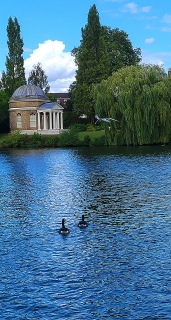
THE GREAT ACTOR David Garrick (1717-1779) was famed for his many performances of plays by Shakespeare and many others. In 1754, he bought Hampton House (now Garrick’s Villa), which overlooks the Thames at Hampton. The following year, he decided to build a garden folly to honour his hero William Shakespeare. This was completed in 1756, and is now known as ‘Garrick’s Temple to Shakespeare.’ Its architect is unknown, but Garrick did employ Robert Adam (1728-1792) to make improvements to Hampton House, and Lancelot ‘Capability’ Brown (1716-1783) to landscape his grounds. Whether either of these two were involved in designing the Temple is not known.
The octagonal Temple is Palladian neo-classical in style and has a portico with columns topped with Ionic capitals. Seen from across the Thames, it looks as if it had been plucked from a romantic painting of a classical Italian landscape by an artist such as Claude Lorrain. The Temple houses a statue of the Bard and a small museum about Garrick. Unfortunately, despite information on the Temple’s website which stated that it would be open, it was locked closed. We were not the only people to have arrived on a Sunday afternoon, expecting it to be open.
I am pleased that I saw the Temple, which I had read about, and plan to attempt to enter it on another occasion.
TEMPLE STATION IS on the Circle and District lines of London’s Underground. It was opened in 1870 and named after the nearby ancient Temple Church, which stars in Dan Brown’s 2003 novel “The Da Vinci Code”. The station’s ticket office is housed in a single storey building with a flat roof surrounded by a balustrade. The flat roof, with a few benches, occupies about half an acre and until recently served simply as a place to sit in the fresh air. Now, this has changed.
The flat roof has become employed as an open-air exhibition space for young artists. Today (December 2021), we climbed the stairs to reach the roof and were amazed to see that it has been covered with multi-coloured painting and plastic floor tiles, a dramatic sight. There is also a colourful hut, “The Artist’s Hut”, a modern take on the traditional cabman’s shelter. With the title “Back in the Air: A Meditation on Higher Ground”, the art installation was created by London-based artist Lakwena Maciver (born 1986). Also on this coloured space, there are a couple of ceramic works by another artist, Camilla Bliss. It is a wonderful surprise to see this field of bright colours, especially beneath a cloudy, grey sky. It would be fun to see the space from the air. But I do not know whether the pigeons would agree with me.
In the future, it is hoped that other artworks will b e displayed above Temple Station.
THE DOMED IONIC temple in the gardens of Chiswick House in west London was built in the early 18th century. It appears in a painting executed in 1729. This circular building is faced by an obelisk that stands in the centre of a circular pool. Today, we walked past these neoclassical garden features when we noticed a lady in a flowing white dress posing on the steps of the temple. Facing her across the circular pond were cameramen and their assistants, some holding large reflector screens. They were either carrying out a photo-shoot or making a film. Every now and then, a man holding a smoke gun ran past the temple creating an illusion that the temple was bathed in mist. Here is a photo I took whilst this activity was in progress.






 yamey
yamey 