Seeing things differently

I DOUBT THAT Auguste Rodin (1840-1917) would have ever imagined that a copy of his sculpture “The Kiss” (created 1901-1904) could have ended up being displayed bound up in one mile of string. Situated in the lower ground floor foyer of London’s Tate Britain gallery, that is what can be seen currently (August 2022). The British artist Cornelia Parker (born 1956) decided to wrap-up/tie-up a replica of “The Kiss” as described. You might wonder why. I cannot tell you, but make the observation that we all perceive things differently. And one of the skills that has united artists over the centuries is that they can express to other people the way they perceive and understand the world they observe. Rodin’s bound sculpture stands close to the entrance of an exhibition dedicated to works by Ms Parker, which runs until the 16th of October 2022.
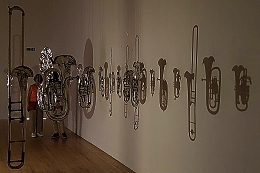
Part of “Perpetual Canon” by Cornelia Parker

The exhibition consists of artworks of varying sizes including visually dramatic installations, each large enough to fill a spacious room in the gallery. All the works are labelled. These labels explain how they were created and the concepts, some of them with political aspects, that the artist intended to express. When I look at works of art, I am primarily stimulated by their appearance and the visceral emotions they evoke in me. I am less interested in the concepts being portrayed and the artist’s explanations. Therefore, amongst the exhibits in the Parker exhibition, it was the installations that both interested me and excited me most.

The installation “Thirty Pieces of Silver” consists of domestic silver plate items that were squashed beneath a steam roller. Each piece is suspended above the ground by fine threads attached to the ceiling. They are arranged in thirty separate groups and lit from above. The shadows of the silver objects are projected on the floor below them. This delicate-looking installation’s name is taken from the 30 pieces of silver, which Judas received for betraying Jesus.

A spectacular installation, “Cold Dark Matter: An Exploded View”, is housed in another room. Parker arranged with the Army School of Ammunition to use Semtex (as used by terrorists) to blow-up her garden shed (filled with tools and other stored objects). Then, all the fragments were recovered, and one by one they were suspended from the ceiling of the gallery in such a way that the ensemble resembles a still from a film made whilst the shed was exploding. In the middle of all the suspended debris, there is a single light bulb shining. This throws the distorted shadows of the blackened fragments onto the gallery’s walls.

In another room, there was an installation, which also made effective use of reflections projected on to its walls. “Perpetual Canon” consists of a collection of silvered brass instruments, which have been flattened. Each of them is suspended from the ceiling by a fine thread, and they are arranged in a circle which surrounds a centrally located light. The light throws shadows of the instruments onto the four walls surrounding them. Like the two previously described works, this provides a very effective and intriguing visual experience.

Another installation, “The War Room”, impressed me least amongst this category of Parker’s works on display. One of the last rooms in the exhibition houses an installation called “Island”. This consists of a common design of garden greenhouse. Its floor consists of worn floor tiles that used to line the corridors of The House of Commons. The glass panes are covered with white dots made from cliff chalk. They are related to Parker’s reaction to Brexit. Contained within the glasshouse, there is a light whose brightness pulses like that of a lighthouse: increasing gradually, and the slowly diminishing. This causes the shadows of the dots and the frame of the greenhouse to be projected on to the walls of the room containing it. Like the light producing them, the intensity of the shadows pulsates gradually.

As already mentioned, the exhibits’ labels explain what Parker is trying to express. Interesting as that is, it was the visual impact of these installations that impressed me most. Parker, like all great artists, has interesting ideas expresses them most imaginatively and effectively.
The black man’s burden

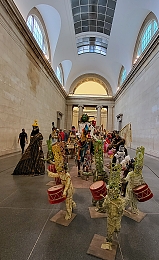
IN 1899, RUDYARD Kipling (1865-1936), who was born in Bombay (when India was under British rule), wrote a poem called “The White Man’s Burden”. The content of this piece was in harmony with the then current idea that the ‘white race’ was morally obliged to ‘civilise’ the non-white races of the earth, and through colonisation to encourage their economic development and ‘progress’. Well, this was an illusion happily believed by most of the colonisers. The reality was that colonisation was not designed to benefit the colonised but to increase the prosperity of the colonisers. The white man’s burden was in truth much more the burden which had to be borne by the non-white races, which were colonised. This is beautifully characterised in an art installation, “The Procession”, on display in London’s Tate Britain until the 22nd of January 2023. Conceived and created by the Guyanese-British artist Hew Locke (born 1959 in Edinburgh), I have seen it twice so far, and loved it each time.

“The Procession” consists of a large number of models of people dressed in colourful and fantastical costumes. They are arranged as if they are taking part in a carnival or parade. Many of the models appear slightly grotesque or even menacing. If these models were real people, they would inspire awe and maybe fear. Some of them carry banners, others carry skulls, and there are some supporting poles from which objects are either suspended, or on which objects are supported.

There are banners in the procession. Some of these depict colonial dwellings and institutions. Others show enlarged photographs of company share certificates and financial bonds. Some of the characters in the parade wear clothes on which these old-fashioned records of financial investment are printed. Thus, the artist has portrayed the fact that success of the investments of the European and American colonists and their backers rested on the shoulders of the hard-working black colonial subjects, who derived few if any benefits from their labour.

“The Procession” is not only a highly original way of conveying the unfortunate history of colonization, but also a feast for the eyes. It is both a reminder of Britain’s not always too glorious colonial past, as well as a celebration of the cultural diversity, which this country enjoys. The installation is housed in the magnificent neo-classical Duveen Galleries (opened in 1937), whose design is derived from architecture characteristic of the ancient imperialist regimes, which dominated the Mediterranean many centuries ago. Was it accidental or deliberate to place an essentially anti-imperialist exhibit in rooms that evoke an imperial past and by their immensity dwarf the exhibits? Whatever the answer, this is an exhibition for which it is well-worth making a detour.

The underground artist

THE BRITISH SCULPTOR Henry Moore (1898-1968) moved to London’s Hampstead district in 1929. Between that year and 1940 he lived in Parkhill Road, close to the Mall Studios, where the great sculptor Barbara Hepworth had her home and workshop. Many of Moore’s other close neighbours were in the forefront of the modern art world of the years between the two world wars. Not far away, the designer Jack Pritchard (1899-1992) and his family lived in Belsize Park Gardens, having moved there from Hampstead’s Platts Lane.

By Henry Moore, 1941

Quoting from my book “Beneath a Wide Sky: Hampstead and its Environs”:

“In 1929, he [Pritchard] and the Canadian architect Wells Coates (1895-1958) formed the company, Isokon, whose aim was to build Modernist style residential accommodation. Pritchard and his wife, a psychiatrist, Molly (1900-1985), commissioned Coates to build a block of flats in Lawn Road on a site that they owned. Its design was to be based on the then revolutionary new communal housing projects that they had visited in Germany, including at the influential Bauhaus in Dessau.”

The modernist building, now known as the Isokon, still stands on Lawn Road, which is close to Parkhill Road. It is still used as a block of flats. Completed in 1934, the building included communal areas including a restaurant and a bar called The Isobar where (to quote from my book again):

“… exhibitions were held in the Isobar and, according to an on-line article in ‘The Modern House Journal’ these were attended by artists including Adrian Stokes, Henry Moore, Barbara Hepworth, Ben Nicholson and Naum Gabo. The article also noted that this refreshment area was frequented by modernist architects such as Erich Mendelsohn, Serge Chermayeff and, Wells Coates, as well as by left-wing politicians.”

The Lawn Road Flats (the Isokon) was an early British example of a ferro-concrete building with a steel frame. This made it far more resistant to being damaged by bombs than its many brick-built neighbours. In fact, the only damage it suffered during WW2 was a few broken windowpanes. Various people, including the author Agatha Christie, moved into the Isokon to seek protection from the Blitz. Another person doing the same was Henry Moore, who moved there in 1941.

Many people, who were not lucky enough to be able to live in a relatively bomb-proof edifice, sought shelter from the bombs by spending nights on the platforms of Underground stations such as Belsize Park and Hampstead, all of which are far beneath the ground. Henry Moore created a series of dramatic drawing of the people taking shelter on Underground station platforms. It is quite possible that while living in Hampstead, he visited the stations mentioned above to find subjects for his drawings, which provide a vivid record of the terrible times when London was under attack from the air.

Recently, whilst visiting the Tate Britain art gallery, which houses a great deal of British art, I saw two of Moore’s Underground drawings, both dated 1941, and several of his sculptures. The drawings are not accurate depictions of what the artist saw, but they illustrate his reactions to what he witnessed, and as such they emphasise the atmosphere of those fearful times.  Although there is no doubt that Moore was a great artist, on the whole I prefer the works of his contemporary and sometime neighbour in Hampstead: Barbara Hepworth.

Art beneath your feet

MOST VISITORS TO London’s Tate Britain and National Gallery tend to look at the paintings hanging on the walls and sculptures on pedestals. Fewer people look down to see what they are walking on. The floors of the main entrance portico of the National Gallery and of Gallery II at the Tate Britain are well worth examining.

National Gallery, London (UK)

The mosaics on these floors were created by the Russian artist Boris Vasilyevich Anrep (1883-1969). Born in St Petersburg, he studied law at the Imperial School of Jurisprudence in that city, graduating in 1905. In 1908, he abandoned law and went to Paris (France) to study art. Between 1910 and 1911, he studied at the Edinburgh School of Art. While in France, Boris met several British artists and intellectuals, many of them members of the Bloomsbury Set. His fascination with mosaics began in about 1904 after seeing the early Christian mosaics in Ravenna (Italy). In 1917, Boris settled in England, where he created many of his mosaics.

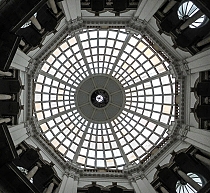
The floor of Gallery II at what is now the Tate Britain, but was formerly ‘The Tate Gallery’, was damaged by bombing during a Zeppelin raid in WW1. In 1921, Anrep was commissioned to make a mosaic floor for this gallery. By 1923, it was ready. The dramatic-looking creation consists of scenes representing William Blakes “Proverbs”. Each of the vignettes in the octagonal gallery, which used to house pictures by Blake, includes one of Blake’s proverbs. They are surrounded by a depiction of the flames of Hell.

The floors of the Portico at the national contain a much greater area of mosaics than that of the gallery in Tate Britain. Anrep created the mosaics between 1926 and 1952. Some of them are becoming worn out after having been walked on for so many years since the were put in place. A website (https://artuk.org/discover/artists/anrep-boris-18831969) explained that the mosaics in the National Gallery consist of:

“… four floors on and around the main staircase, executed between 1926 and 1952. The subjects are ‘The Awakening of the Muses’, ‘The Modern Virtues’, ‘The Labours of Life’, and ‘The Pleasures of Life’; portraits of many well-known contemporaries are incorporated in them, for example the philosopher Bertrand Russell representing Lucidity and the film actress Greta Garbo as Melpomene, the Muse of Tragedy.”

Sir Winston Churchill is also depicted, as are other well-known personalities (for details, see: https://mikepitts.wordpress.com/2016/06/10/lookdown-boris-anrep/).

The attractive, intriguing mosaics at both the National and the Tate Britain are far less famous than many of the works to which most visitors make a beeline. However, Anrep’s mosaics should not be overlooked. In fact, I believe they are worth lingering over at least as long as one might when viewing, say, a Rembrandt in the National, or a Turner in the Tate.

Incidentally, after Anrep died, his body was cremated at Golders Green Crematorium, a place which I have described in my book “Beneath a Wide Sky: Hampstead and its Environs”.

Hampstead and the Tate Britain Gallery

THE TATE BRITAIN pleases me far more that its younger relative, The Tate Modern, and its cousins in Liverpool and St Ives. I do not know why, but I feel far more comfortable in the old institution on London’s Millbank. Today (31st of March 2022), I took a leisurely wander through some of the Tate Britain’s galleries. I was on the lookout for works by artists, who have been associated with Hampstead in north London. My only disappointment was that there were no works by John Constable (1776-1837) on display. Buried next to Hampstead’s parish church, he worked and lived (for several years) in Hampstead. I had better luck with one of his contemporaries, George Romney (1734-1802). His “A Lady in a brown Dress: The Parson’s Daughter” hangs in the Tate. “Roadside Inn” was painted in about 1790 by George Morland (1763-1804), who used to visit Hampstead to teach. The gallery also contains a picture, “Punch or May Day”, by the painter Benjamin Haydon (1786-1846), who is known to have visited Hampstead, where he met the essayist and critic Leigh Hunt and walked with the poet Wordsworth.

By Mark Gertler

It was the painter William Rothenstein (1872-1945), who found accommodation for, and looked after the great Indian literary genius Rabindranath Tagore, when he stayed in Hampstead briefly in 1912. The artist, who also lived in Hampstead for a while, is represented by at least two of his paintings in the Tate Britain: one was painted in 1891 and the other in 1899-1900.

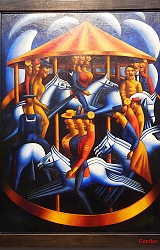
It was during the first five decades of the 20th century that Hampstead became a mecca for artists, who are remembered today and whose works are displayed in Tate Britain. “The Merry-Go-Round”, a colourful painting created by Mark Gertler (1891-1939), who had a studio in Hampstead, depicts a fairground attraction on Hampstead Heath. It was painted in 1916. Gertler studied at the Slade School of Art at the same time as the painter Stanley Spencer (1891-1959), who had a studio in Hampstead’s Vale of Health for a while. It is therefore apt that Gertler’s painting hangs next to one by Spencer: “The Resurrection, Cookham”.

Another juxtaposition is a wooden sculpture by John Skeaping (1901-1980) and a painting by Ben Nicholson (1894-1982). Both worked in Hampstead in the 1930s and both were married to the sculptor Barbara Hepworth (1903-1975). She divorced Skeaping to marry Nicholson. One of her sculptures is on display close to another artwork by her second husband. I spotted one more work by Hepworth. That was a painting, a sketch for a sculpture she was planning in 1957. The three artists all worked at various times in the Mall Studios near Parkhill Road.

David Bomberg (1890-1957), who, like Gertler and Spencer, studied at the Slade, lived in West Hampstead between 1928 and 1934. There are several of his dazzling, colourful paintings hanging in the Tate Britain.

Henry Moore (1898-1986), who lived for a while in Hampstead, is the best represented of all the artists who lived or visited that locality. Tate Britain has many of his sculptures on display and some of the sketches he made during WW2. These images depict people sheltering in deep Underground stations to be safe from the bombs being dropped by the Luftwaffe. Moore lived for a while in the modernist and relatively bomb-resistant Lawn Road Flats (‘The Isokon’) near South End Green (and, incidentally, near the Mall Studios). I have read that it is likely that Moore made some of his dramatic wartime sketches in the nearby Belsize Park and Hampstead Underground stations.

It was fun visiting the Tate and seeing pictures by some of the artists, whom I have written about in my new book about Hampstead: “Beneath a Wide Sky: Hampstead and its Environs”. This work contains two chapters detailing Hampstead’s myriad artistic connections. If you wish to learn more about this and about other aspects of Hampstead and its surroundings, my book (and Kindle edition) can be obtained from Amazon (https://www.amazon.co.uk/dp/B09R2WRK92).

Born in Portugal, hanging in the Tate

THE TATE BRITAIN is currently hosting a wonderful exhibition of the works of Paula Rego, born 1935 in Lisbon, Portugal during the fascist dictatorship of Antonio Salazar (1889-1970), who was in office from 1932 to 1968.  Her father was anti-fascist and anglophile. He sent Paula to a finishing school in Kent (UK) when she was 16. Later, she enrolled to study painting at the Slade School of Fine Art, part of London’s University College. While she was studying there (from 1952 until 1956), she met her future husband, the painter Victor Willing (1928-1988). They married in 1959, following Victor’s divorce from his first wife. Paula and Victor lived between Portugal and the UK, finally settling in the latter in 1972.

Distributed within eleven rooms of the Tate Britain, Rego’s works are well displayed, some of them with informative panels placed beside them. Her paintings express her political (anti-fascist) and social consciousness, some of which is concerned with the ill-treatment of, and the indignities inflicted on, women, especially in the country where she was born.

Rego’s paintings are dramatic, colourful, powerful, and not lacking in a sense of humour. They are sometimes almost abstract, but the element of figurativeness is never completely absent.  Her paintings often lean towards surrealism.  Whether they are expressing subversion, or love, or depression, or pure fantasy, they are visually intriguing and cannot fail to engage the viewer. Throughout her works, which span several decades, the influence of her native land can be discerned, sometimes without difficulty, other times with the assistance of the informative labels by their side.

The exhibition, which opened on the 7th of July 2021, will continue until the 24th of October 2021. So, there is plenty of time for you to enjoy this superb exhibition of the fabulous works of this fascinating artist. It is an exhibition that once again demonstrates that great art is often created as a reaction to an oppressive regime.

A joyous façade on the Tate Gallery

HERE IS SOMETHING WORTH seeing if you can. It is on display at the Tate Britain until the 31st of January 2021 and you need not enter the gallery building to see it. Originally created to celebrate Diwali, the Hindu Festival of Light, in late 2020, this is a wonderfully joyous celebration of both Indian and British culture in light and colour.

The artist Chila Kumari Singh Burman was born in Bootle, near Liverpool, daughter of Punjabi Hindu parents. She graduated at the Slade School of Fine Art in 1982 after having also studied at Southport College of Art and Leeds Polytechnic.

Burman has temporarily transformed the main (Thames facing) entrance of the Tate Britain, its staircase and pillared portico into a pleasing and often humorous riot of colour that makes many references to her upbringing and India’s culture and mythology. To do this, she has made use of coloured lights, neon tubing lights, coloured photographs, and decorative printed coloured paper. The Tate’s website (https://www.tate.org.uk/whats-on/tate-britain/exhibition/chila-kumari-singh-burman) describes Burman’s installation, “Remembering a Brave New World” as follows:

“This magnificent installation, remembering a brave new world, combines Hindu mythology, Bollywood imagery, colonial history and personal memories. Inspired by the artist’s childhood visits to the Blackpool illuminations and her family’s ice-cream van, Burman covers the façade of Tate Britain with vinyl, bling and lights. She changes the figure of Britannia, a symbol of British imperialism, into Kali, the Hindu goddess of liberation and power. The many illuminated deities, shapes and words are joined by Lakshmibai, the Rani (queen) of Jhansi. Lakshmibai was a fierce female warrior in India’s resistance to British colonial rule in the 19th century.”

This description provides a fair summary of what is to be seen. It does not mention the entertainingly decorated autorickshaw (three-wheeler) that was on display in the vestibule of the gallery when we visited. The doorways are also worth examining because they are lined with images taken from the Amar Chitra Katha’s comic books that are published in India to teach Indian children about both Hindu mythology and Indian history. Our daughter, whose background, is both Indian and European, used to enjoy reading these.  Despite what the Tate has written, the artwork does not come across as polemical or anti-British, at least not to me. On the contrary, the artist appears to be enjoying her joint cultural heritage: both British and Indian. My wife said of the installation:

“If this is multi-culturalism, let’s have more and more of it!”

However, words are quite insufficient to describe the visual impact of this wonderful spectacle. It has to be seen to be believed and enjoyed. We saw it during daylight when it can be enjoyed in fine detail, but I imagine that seeing it after dark would also be quite magical.

Burne-Jones in London

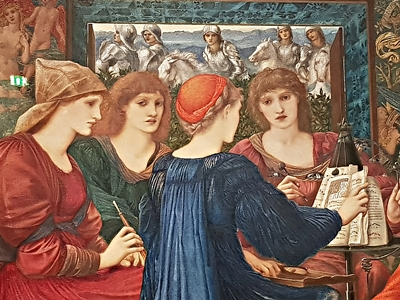
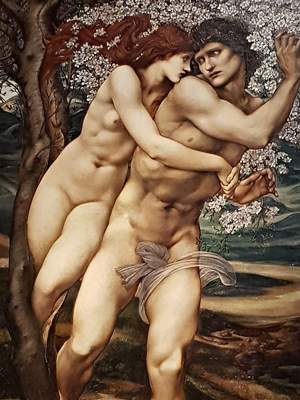
Until 24th February 2019, there is an excellent exhibition of the works of the Pre-Raphaelite artist Edward Burne-Jones (1833-98) at London’s Tate Britain.

BURNE 1


For Victorian art  

looking back to the past

Burne-Jones does excel


BURNE 2