THE FIRST ROOOM of the Tate’s exhibition of photographic images of Britain in the 1980s, “The 80s Photographing Britain”, was disappointing. There were too many small photographs, which would have been far easier to appreciate by seeing them in a catalogue or book. However, the other rooms of this show, which is on until 5 May 2025, contain many photographs that are often interesting as well as artistic. As the Tate’s website explained, during the ‘80s:
“… photography was used as a tool for social change, political activism, and artistic and photographic experiments.”
It continued to say that the visitor to the exhibition will:
“See powerful images that gave voice and visibility to underrepresented groups in society. This includes work depicting the Black arts movement, queer experience, South Asian diaspora and the representation of women in photography.”
After my initial disappointment in the first room of the exhibition, I soon began enjoying the exciting range of pictures on display in the rest of the show. During most of the 1980s, I was working as a dentist in a small, rather conservative provincial district in Kent, and was largely unaware of the social changes that were going on around me. So, now, many years later after having seen the exhibition at the Tate Britain, it has only dawned on me what had passed me by while I was concentrating on looking after the dental health of some of the inhabitants of the Medway Towns.
Would I recommend seeing this show? My answer is ‘yes’, but hurry because it is ending soon.
THE EXHIBITION WE saw today (the 3rd of June 2024) at London’s Tate Britain exceeded our expectations. Called “Now You See Us”, it consists of about 150 artworks created by over 100 women, working between the years 1520 and 1920. Apart from their gender, these artists shared at least one other thing in common: they were professional artists who worked in Britain, rather than talented amateurs. The earliest works on display are by women working in the Tudor Courts during the 16th century. They include Susanna Horenbout (1503–1554) and Levina Teerlinc (c.1510s–1576), some of whose exquisite paintings can be seen in the exhibition.
There were too many artists to be able to describe them all in this short essay. Some of them (for example: Angelica Kauffman, Artemisia Gentileschi, Mary Beale, Mary Moser, Laura Knight, Julia Margaret Cameron, and Elizabeth Forbes) are now well-known, but others whose works are exhibited are somewhat obscure. One notable artist, Élisabeth Vigée Le Brun (1755-1842), who lived (and painted a little) in England for about three years, is not exhibited in the show, which is a pity because from what I have seen of her work (at Ickworth House in Suffolk), she was a highly competent artist. Next, I will highlight several things that particularly interested me in this superb exhibition.
There are several small paintings created on sheets of ivory. They reminded me of the glass paintings I have seen in India. One of these is a beautifully executed self-portrait by Sarah Biffin (1784-1850). She was born without arms or legs, yet learned to sew, write, and paint using her mouth. Early in her career, she worked at country fairs, where people used to pay to watch her draw and paint. Later, she established herself as a professional portraitist.
There were three photographs by the Victorian photographer, Julia Margaret Cameron, about whom I have written a short book. I am glad that her works are included in the exhibition because her skill was creating painterly works of art, rather than accurate images, with photography. Here work was greatly admired by the pre-Raphaelites.
I was interested to see a painting by Frances Reynolds (1729-1807), who was the sister of the famous artist Sir Joshua Reynolds. Although the painting is not a great work of art, its presence in the exhibition exemplifies the situation for women artists before they were first admitted to art schools in the second half of the 18th century. Before that time, several of the artists, whose work is on display, had to learn to paint from male artists in their family – fathers, husbands, and so on.
For a very personal reason, I was interested to see a painting by the poet and painter Anne Killigrew (1660-1685). Her father was the playwright Henry Killigrew (1613-1700). The reason that this Killigrew family is of interest to me is that their coat of arms includes the double-headed eagle, indicating the family’s connection with the mediaeval Earls of Cornwall. Sadly, Anne, whose works are attractive, died young following a smallpox infection.
One room of the exhibition contained works by women artists working in the Victorian era. These, often sentimental, works did not appeal to me. However, the final room, which contains works created in the first two decades of the 20th century, is spectacular. Many of the exhibits in this room demonstrate how artists were abandoning tradition, and exploring new techniques. This period coincided with the gradual improvement in women’s rights in Britain.
The exhibition continues until the 13th of October 2024, and is well worth visiting.
LAST YEAR, THE exhibits at Tate Britain were re arranged – or ‘rehung’ as the gallery likes to put it. In addition to rearranging the paintings and sculptures – very excellently I might add – previously unseen exhibits were added to the galleries. One of these is in a small gallery containing sculptures and some drawings by the British artist Henry Moore (1898-1986).
The additional exhibit in this gallery devoted to Moore is a glass cabinet containing a Ban the Bomb poster – a photomontage – designed by Henri Kay Henrion (1914-1990). I went to school in Belsize Park with one of his sons for a few years. The rest of the contents of the cabinet are documents – mainly press cuttings – about one of the sculptures near to the cabinet. They relate to a sculpture Moore created for the University of Chicago. The bronze sculpture, which at first sight resembles a combination of an atomic ‘mushroom cloud. with a distorted face beneath it, is called “Atom Piece (Working Model for Nuclear Energy)”. The Tate’s website (www.tate.org.uk/art/research-publications/henry-moore/henry-moore-om-ch-atom-piece-working-model-for-nuclear-energy-r1171996) explained:
“As its subtitle suggests, Atom Piece (Working Model for Nuclear Energy) 1964–5 represents the intermediary stage in the development of a much larger sculpture, Nuclear Energy 1964–6, which Moore was commissioned to make for the University of Chicago to mark the twenty-fifth anniversary of the first controlled generation of nuclear power, conducted by the Italian physicist Enrico Fermi in 1942.”
The sculpture next to the cabinet is one of 13 bronze castings that Moore had made from one of his plaster maquettes that were created whilst planning the larger sculpture commissioned by the University of Chicago. Moore donated it to the Tate.
The photomontage by Henrion shows a human skull superimposed by a mushroom cloud. He created it in about 1959. The Tate’s website mentioned that Moore was most probably aware of Henrion’s terrifying image long before he created the sculpture for Chicago:
“Moore is likely to have been familiar with Henrion’s photomontage: in 1950 he had signed a letter published in the Times protesting against the potential use of atomic weapons, and in 1958 had become one of the founding sponsors of the CND.”
Although I have seen the ‘atomic’ sculpture by Moore at Tate Britain many times, I had not taken any special interest in it. However, thanks to the superb ‘rehang’ at the gallery and the addition of the glass case containing Henrion’s image, I began to appreciate the atomic sculpture, and strangely also began to enjoy Moore’s sculptures even more than I had before.
WHAT IS YOUR EARLIEST memory of a news item? In my case, I remember my parents discussing something about Cuba. This was The Cuban Missile Crisis of October 1962. I had little or no idea about it, but later I learned that US President John F Kennedy was involved in its resolution. A year later, when we were staying in the USA, we were there when he was assassinated. I well recall that and my feelings about it at the time. That remains in the forefront of my memory, but far back in the fleshy recesses of my grey matter, the name Grunwick resides. While visiting an exhibition at the Tate Britain recently, I saw several photographs that brought this vague memory back into my consciousness.
Grunwick Film Processing Laboratories (‘Grunwick’), located at Willesden in northwest London, processed photographic films and produced finished prints from them. Photographers (mostly amateurs) put their undeveloped exposed films into an envelope along with payment, and sent them to Grunwick, who later returned the developed film and the prints made from it. In 1973, some workers at Grunwick joined a trade union and were subsequently laid-off by the company. The company employed many workers of Asian heritage – including a substantial number of ladies. As the then Labour politician Shirley Williams pointed out, the Asian ladies were being paid very much less than the average wage, and conditions were bad – hours were long, overtime was compulsory (and often required without the employer giving prior notice).
On the 20th of August 1976, Grunwick sacked Devshi Bhudia for working too slowly. That day, three other workers walked out in support of Devshi. Just before 7 pm that day, Jayaben Desai (1933-2010) began walking out of the factory. As she was doing so, she was called into the office and dismissed for leaving early. When she was in the office, Jayaben said (see guardian.com, 20th of January 2010):
“What you are running here is not a factory, it is a zoo. In a zoo, there are many types of animals. Some are monkeys who dance on your fingertips, others are lions who can bite your head off. We are those lions, Mr Manager.”
Thus began a two-year long strike, which was supported not only by the company’s workers but also by many politicians and trade unions, including, for a short time, the Union of Post Office Workers, who refused to cross the Grunswick picket lines.
Jayaben was born in Dharmaj, now in the Anand district of the Indian state of Gujarat. Soon after marrying, she and her husband migrated to what is now Tanzania. Just before the Commonwealth Immigrants Act (1968) made it difficult for Commonwealth citizens to settle in the UK, the couple moved to England. There, she was obliged to take up poorly paid work, first as a sewing machinist, and then as a worker at Grunwick.
Not only did Jayaben initiate the strike, but she helped keep it going until the dispute was resolved. In November 1976, when the Post Office workers stopped supporting the strike, she told an assembly of Grunwick’s workers:
“We must not give up. Would Gandhi give up? Never!”
Later, like Gandhi, she employed his tactic – the hunger strike – outside the Trade Union Congress in November 1977. During the court of enquiry led by Lord Justice Scarman, she gave powerful evidence against her erstwhile employer. When the strike was over, she went back to sewing, and then later became a teacher of sewing at Harrow College. After passing her driving test at the age of 60, she encouraged other women to do so to increase their freedom. After her death, some of her ashes were deposited in the Thames, and the rest in the Ganges.
The reason that Grunwick came to mind at Tate Britain was that its current exhibition “Women in Revolt! Art and Activism in the UK 1970-1990” (ends 7th of April 2024) includes several photographs taken at Grunwick during the strike. Three of them include portraits of Jayaben in action.
As I wrote earlier, I had heard of Grunwick, but I could not recall why until I saw the exhibition. As for the remarkable Jayaben Desai, I am happy that I have become aware of her and her amazing achievements.
I DO NOT KNOW whether it was deliberate or accidental that currently (until the 7th of April 2024) there are two contrasting (or, maybe, complementary) exhibitions on in the galleries of London’s Tate Britain.
On the first floor, there is an exhibition called “Sargent and Fashion”. It is a collection of paintings by the American-born artist John Singer Sargent (1856-1925), who was born in Florence (Italy) and died in London (UK). The aim of the show is, according to the Tate’s website, to show:
“… how this remarkable painter used fashion to create portraits of the time, which still captivate today.”
The exhibition includes some of Sargent’s portraits alongside a few of the items of clothing that his subjects wore whilst he was creating their portraits. In this well laid out show, the viewer gets to see that Sargent was an excellent painter, whose portraits manage to radiate the natures of the sitters’ personalities. I doubt that most of Sargent’s subjects would have been disappointed with the pictures he produced for them. Many of the paintings are portraits of women. Almost all of them were depicted wearing elegant clothes, and are superbly executed conventional portraits. They celebrate aspects of the ‘respectable’ (i.e., wealthy) society of his times.
Beneath the Sargent exhibition, on the ground floor of Tate Britain, there is an exhibition showing how women in Britain broke out of their conventional male-dominated lifestyle during the 1970s and 1980s. Called “WOMEN IN REVOLT Art, Activism and the Women’s movement in the UK 1970–1990”, it is according to the Tate’s website, it is:
“… a wide-ranging exploration of feminist art by over 100 women artists working in the UK. It shines a spotlight on how networks of women used radical ideas and rebellious methods to make an invaluable contribution to British culture. Their art helped fuel the women’s liberation movement during a period of significant social, economic and political change.”
During a long part of the period covered by the show, Britain had its first female Prime Minister, Margaret Thatcher (in office from 1979-1990). Although she fought her way through hitherto male bastions to emerge as the country’s first lady Prime Minister and showed what women were capable of doing in the world of politics, she was not a feminist icon, as Natasha Walter wrote in The Guardian (online 5th of January 2012):
“Obviously Thatcher was no feminist: she had no interest in social equality, she knew nothing of female solidarity … We should never forget her destructive policies or sanitise her corrosive legacy. But nor should we deny the fact that as the outsider who pushed her way inside, as the woman in a man’s world, she was a towering rebuke to those who believe women are unsuited to the pursuit and enjoyment of power. Girls who grew up when she was running the country were able to imagine leadership as a female quality in a way that girls today struggle to do. And for that reason she is still a figure that feminists would be unwise to dismiss.”
However, as Baroness Burt of Solihull said in the House of Lords on the 5th of February 2018:
“… my next figure is 1979, which, of course, was the date when we got our first female Prime Minister. Personally, I would feel more inclined to celebrate this milestone if she had encouraged other women to come forward, to use some of the talented women that she had at her disposal. But, sadly, she got to the top and pulled the ladder up behind her, which is a great shame, because the whole point of having representation from all parts of society is to make for better government.”
As several exhibits on display at the Tate (until the show ends on the 7th of April 2024), Mrs Thatcher was intensely disliked by artists encouraging ‘female liberation’.
Before entering the exhibition, I was a little worried that all I would see was propaganda and other polemic material. Well, there was plenty of that kind of thing, and much of it was both interesting and often visually intriguing – sometimes quite witty. The exhibition, which is excellently curated, also includes many paintings, sculptures, videos, and other artistic items. These have mostly been created by female artists with whom I am not familiar. And all of them are both visually engaging and satisfying. Several of these were of Indian heritage, and others have ‘black’ African heritage. There are also cases containing printed material that propagated feminist ideas. Included amongst these were a few copies of the magazine Spare Rib, which I remember seeing at friends’ houses many years ago. My future wife was one its readers. Published between 1973 and 1993, its aim was to challenge the traditional roles of females (of all ages) and to explore new ways in which they could engage in society. In fact, this was the aim of many – if not all – of the works in the exhibition.
We visited both exhibitions today (the 28th of February 2024), to experience the contrast between them. Both are excellent in their own ways and achieve what the curators intended. They are both well worth visiting. However, to my taste, the exhibition on the ground floor was far more exhilarating and inspiring, that the more conventional show on the floor above it.
GRENFELL TOWER IN west London went up in flames on the evening of the 14th of June 2017. At least 72 people died in the conflagration. Amongst those unfortunates was the Gambian-British artistic photographer Khadija Mohammadou Saye (born 1992).
About a month before she died, she met the painter Chris Ofili (born 1968) in Venice (Italy), where they were both exhibiting their works.
In 2023, the Tate commissioned Ofili to create an artwork to decorate the grand north staircase of the Tate Britain. According to the Tate’s website, Ofili:
“… considered the significance of painting directly onto the walls of a public building and wanted to choose a subject that affected us as a nation. ‘Requiem’ is a dream-like mural, resulting from his poetic reflections.”
Ofili said:
“I wanted to make a work in tribute to Khadija Saye. Remembering the Grenfell Tower fire, I hope that the mural will continue to speak across time to our collective sadness.”
“Requiem” covers three of the staircase’s large walls. On the middle wall, there is a portrait of the artist Khadija Saye. The website explained:
“Artist Khadija Saye is at the centre of an energy force, high up on the middle wall. She represents one of the souls. She holds an andichurai (a Gambian incense pot) to her ear, in a pose taken from her own artwork. This object was precious to Saye, as it belonged to her mother. It symbolises the possibility of transformation through faith, honouring Saye’s dual faith heritage of Christianity and Islam.”
At the top of the stairs, there are panels explaining the wall paintings. There is also one of Ms Saye’s photographs. Called “Andichrai”, it is from a series of photographs she created in the last year of her life. The photograph, which is a visually intriguing artwork, shows a woman holding an andichirai to her ear, It looks as if Ofili used this photograph to create his image of Khadija in his “Requiem” mural.
When I first looked at Ofili’s “Requiem”, I was reminded of the dramatic images of William Blake (1757-1827). It is a wonderful memorial to an artist, who was cut-off in her prime. I do not know how long “Requiem” will remain on the staircase at the Tate. So, I recommend that you go and see it as soon as possible.
AFTER BEING DISAPPOINTED by the large temporary exhibition of playful but repetitive works by the artist Sarah Lucas (born 1962) at Tate Britain, we had a coffee and then revisited the rooms containing paintings and sketches by John Mallord Turner (1775-1851). It has been many years since we last viewed these paintings, and seeing them revived our spirits after having had them somewhat lowered by the Lucas exhibition.
One of the Turner galleries contains a particularly fine painting by the American artist Mark Rothko (1903-1970). It hangs amongst a series of Turner’s often unfinished late experiments on canvas. They were mostly items found in Turner’s studio after his death. Without outlines, these almost ethereal paintings are examples of the artist’s experimentation in ways of depicting light and colour. If one did not know when these works were created, one might easily guess that they are the works of an artist working during the age of Impressionism. As an aside, many of Turner’s finished works are extremely impressionistic, and I consider him to be the pioneer of what later became Impressionism, and one of the best creators in this style. These experimental works were displayed at an exhibition in New York City at its Museum of Modern Art in 1966. That year, Rothko remarked:
“This man Turner, he learnt a lot from me”.
The Rothko painting hanging amongst the Turner experiments was created in 1950-52. Later, in 1969, Rothko donated a set of his paintings to the Tate, hoping that they would be hung close to those of Turner. They are not; they are hanging at the Tate Modern.
Moving away from the room in which the Rothko painting is hanging, I came across another Turner painting that interested me, “The Deluge”, which was first exhibited in about 1805. In the bottom right corner, Turner has painted a black-skinned man rescuing a naked white woman. On close examination, the man can be seen to have a chain around his waist. The Tate’s caption to this picture includes the following:
“Painted at a time when the cause for Britain to abolish its enslavement of people of African descent was gaining ground, this detail is significant.”
Some years after it was painted, Turner gave a print of this work to a pro-abolition Member of Parliament.
“The Deluge” is not the only painting by Turner relating to his sympathy for the abolition of slavery. His “The Slave Ship”, first exhibited in 1840, is another powerful example. This painting, now in Boston (Massachusetts), is based on the dreadful incident when, in an attempt to cheat the insurers, the captain of a slave ship, the Zong’, caused 132 slaves to be thrown overboard (in 1781). Turner had learned about this crime from the anti-slavery activists with whom he associated. Although Turner, a liberal, was sympathetic to the abolition of slavery, he was not totally divorced from the benefits that transatlantic slavery brought to Britain, as was pointed out by Chris Hastings in the “Mail Online” on the 28th of August 2021:
“One of Britain’s greatest painters has fallen victim to woke culture, as art-lovers are being warned not to ‘idolise’ J. M. W. Turner because he once held a single share in a Jamaican business that used slave labour.”
The website of London’s Royal Academy gives more detail:
“It would be fair to assume that Turner’s views were strongly pro-abolition at the time he painted this work. However, scholars have pointed out that earlier in his career he apparently had no qualms about investing in a company that ran a plantation … In 1805 Turner invested £100 to buy a share in a business called Dry Sugar Work. Despite the name, this enterprise was a cattle farm on a Jamaican plantation run on the labour of enslaved people. The business was owned by Stephen Drew, a barrister who bought the estate from William Beckford in 1802. The firm went bust in 1808.”
Some many months ago, we saw a play at the National Theatre, “Rockets and Blue Lights” (written by Winston Pinnock). It concerns an ageing Turner seeking inspiration from a remembered incident like the awful event that took place on the “Zong”. During the play, it was alleged that because of his disgust with the slave trade, Turner gave up using sugar. Whether or not this was the case, I cannot say.
Fascinating as are abolitionist and the Rothko ‘connections’ with JMW Turner, the well-displayed paintings in the Turner galleries are all superb and well worth visiting.
JOHN LINNELL (1792-1882) painted the Kensington gravel pits in about 1811. The picture hangs in London’s Tate Britain These pits lay alongside Bayswater Road and Notting Hill Gate. They provided gravel for building projects in England and as far away as Imperial Russia.
Today, the pits no longer exist. They have been built over, but street names such as St Petersburg Place and Moscow Road commemorate the fortunes made by selling gravel from these pits to Russia.
You can discover more about this and much more about Paddington and Kensington and points further west in my book “BEYOND MARYLEBONE AND MAYFAIR: EXPLORING WEST LONDON” (see https://www.amazon.co.uk/gp/aw/d/B0B7CR679W/
WE OFTEN VISIT the Tate Britain art gallery on London’s Millbank, usually to see special temporary exhibitions. Rarely, if ever, do we spend time looking at the Tate’s permanent collection. However, today, the 6th of July 2023, we met some friends who wanted to see the recently re-hung paintings in the permanent collection. The paintings are arranged in rooms in chronological order. Each artwork has an interestingly informative label, which describes the social conditions of the era in which it was created and other points about it.
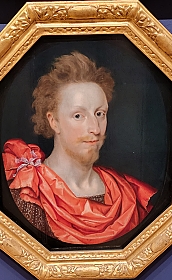
The first room of the series of galleries is dedicated to works created just before, during, and after the (Protestant) Reformation in 16th century England. I found it to be most interesting. The radical rejection of Roman Catholic religious practices involved, amongst many other things, a profound disapproval of the artistic portrayal of religious subjects. A consequence of this was that artists switched from painting religious scenes to portraiture. Just as people love being portrayed in photographs today, those who could afford it in the 16th century were pleased to have themselves immortalised in well-executed paintings. What I had never realised before was that the Reformation unwittingly gave birth to the long tradition of British portrait painting. Maybe, most people know this already, but it was news to me.
The gallery dedicated to the Reformation era has many fine portraits, by artists both known and unknown. However, one of the paintings hanging amongst the portraits is a religious scene, “An Allegory of Man”, by an unknown artist. Painted in about 1596, it would have been a highly controversial subject given the Protestant aesthetics prevailing at that time.
Although the temporary exhibitions at the Tate Britain are usually well worth viewing, the permanent collection deserves many a visit, as we discovered today.
UNTIL I WAS SIXTEEN, my parents took me to Florence (Italy) every year, except in 1967 – the year after the city had been devastated by a flood. My parents were crazy about Italy, the Italians, and Italian art. In Florence, we used to view many frescos in churches and palaces and even those removed from their original locations and placed in museums.
Traditional fresco painting was a laborious process, which produced durable images on walls and ceilings. To create a fresco, first a couple of layers of plaster are applied to a surface (wall or ceiling) and allowed to dry. Then, the artist(s) sketch the image that will eventually be created. Next, a part of the sketch is covered with fresh plaster. The extent of this is the area which the artist can paint during one day. While the plaster is damp, the artist paints that section of the picture with water-based coloured paints. As the plaster dries, the paint becomes incorporated within it, producing a surface more durable than if the paint had been painted onto dry plaster. Day by day, section by section, the process is continued until the whole image has been finished.
I mentioned that some frescoes have been moved into museums. The Italians developed a method for doing this. The fresco to be moved is covered with a cloth sheet coated with adhesive, Then the cloth is pulled away from the wall or ceiling. As it is peeled away, it takes with it that layer of the fresco that contains the paint-absorbed layer of plaster. When this layer has been removed, the artist’s sketch becomes revealed. This is of great interest to historians of art, who can learn how the artist developed his final product from his original sketch. This whole process fascinated me when I was a child, and still amazes me.
Most of the great Italian frescos were created many centuries ago, and the process has fallen out of fashion. Well, at least that is what I believed until I visited a lovely exhibition at Tate Britain. On show until the 7th of May 2023, it is a display of works created by Hannah Quinlan (born 1991) and Rosie Hastings (born 1991). They have created six large, colourful images depicting, to quote the Tate’s website:
“…street scenes showing groups of people portraying various power dynamics, class and social relations and positions of authority.”
Attractive and fascinating as these works are, what really intrigued me is the way that they were made. The paintings, which have been created during the last few years, have been executed using traditional fresco technique such as I described above. In an interview recorded on the Tate website, they were asked why they used this archaic technique, and they replied:
“Fresco painting is often found in places of political, legal and educational importance and is executed at a monumental scale. Traditionally, frescos depict scenes loaded with ideology and symbolism while presenting themselves as neutral or universal. A fresco often represents the moral code of the time within which it is painted, intended as an instructional and educational medium that reinforces dominant perceptions.”
I can understand this, and like their reasoning. I enjoyed the exhibition, and encourage others to take a look. Enjoy the frescos, but do not omit to examine the lovely drawing the artists created using graphite.