AS I WRITE this on 7 April 2026, the President of the USA has already threatened “… to bomb Iran ‘into the Stone Age’.
In 1940,the Germans, under the leadership of Adolf Hitler, had slightly less ambitious evilintentions. They tried to reduce London to no more than rubble, and to some extent they succeeded, as can be seen at an exhibition being held at London’s Imperial War Museum until 1 November 2026. The show, “Beauty and Destruction: Wartime London in Art”, contains a collection of paintings and drawings done by artists who were in London while it was being bombed by the Germans, during the so-called Blitz. There are images by a wide range of war artists, some I had heard of, and others that were new to me. Each image is accompanied by a good explanatory panel.
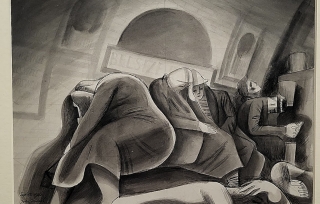
By John Farleigh
I knew thar during the Blitz, peopled sheltered in deep Underground stations, and that the artist Henry Moore is famous for depicting these makeshift shelters and those sheltering within them. What interested me in the War Museum’s exhibition was that there were pictures of these Underground shelters and other subterranean places by other artists, including: John Farliegh, Edward Ardizzone, Olga Lehmann, and Anthony Gross.
The other pictures on display show the damage done to buildings, aspects of attack and defence, life during the Blitz, and portraits of those who suffered during the attacks. Given what has been threatened by a President of the USA, it was somewhat unnerving seeing the pictures in the War Museum’s superb exhibition.
THE BRITISH SCULPTOR Henry Moore (1898-1968) moved to London’s Hampstead district in 1929. Between that year and 1940 he lived in Parkhill Road, close to the Mall Studios, where the great sculptor Barbara Hepworth had her home and workshop. Many of Moore’s other close neighbours were in the forefront of the modern art world of the years between the two world wars. Not far away, the designer Jack Pritchard (1899-1992) and his family lived in Belsize Park Gardens, having moved there from Hampstead’s Platts Lane.
By Henry Moore, 1941
Quoting from my book “Beneath a Wide Sky: Hampstead and its Environs”:
“In 1929, he [Pritchard] and the Canadian architect Wells Coates (1895-1958) formed the company, Isokon, whose aim was to build Modernist style residential accommodation. Pritchard and his wife, a psychiatrist, Molly (1900-1985), commissioned Coates to build a block of flats in Lawn Road on a site that they owned. Its design was to be based on the then revolutionary new communal housing projects that they had visited in Germany, including at the influential Bauhaus in Dessau.”
The modernist building, now known as the Isokon, still stands on Lawn Road, which is close to Parkhill Road. It is still used as a block of flats. Completed in 1934, the building included communal areas including a restaurant and a bar called The Isobar where (to quote from my book again):
“… exhibitions were held in the Isobar and, according to an on-line article in ‘The Modern House Journal’ these were attended by artists including Adrian Stokes, Henry Moore, Barbara Hepworth, Ben Nicholson and Naum Gabo. The article also noted that this refreshment area was frequented by modernist architects such as Erich Mendelsohn, Serge Chermayeff and, Wells Coates, as well as by left-wing politicians.”
The Lawn Road Flats (the Isokon) was an early British example of a ferro-concrete building with a steel frame. This made it far more resistant to being damaged by bombs than its many brick-built neighbours. In fact, the only damage it suffered during WW2 was a few broken windowpanes. Various people, including the author Agatha Christie, moved into the Isokon to seek protection from the Blitz. Another person doing the same was Henry Moore, who moved there in 1941.
Many people, who were not lucky enough to be able to live in a relatively bomb-proof edifice, sought shelter from the bombs by spending nights on the platforms of Underground stations such as Belsize Park and Hampstead, all of which are far beneath the ground. Henry Moore created a series of dramatic drawing of the people taking shelter on Underground station platforms. It is quite possible that while living in Hampstead, he visited the stations mentioned above to find subjects for his drawings, which provide a vivid record of the terrible times when London was under attack from the air.
Recently, whilst visiting the Tate Britain art gallery, which houses a great deal of British art, I saw two of Moore’s Underground drawings, both dated 1941, and several of his sculptures. The drawings are not accurate depictions of what the artist saw, but they illustrate his reactions to what he witnessed, and as such they emphasise the atmosphere of those fearful times. Although there is no doubt that Moore was a great artist, on the whole I prefer the works of his contemporary and sometime neighbour in Hampstead: Barbara Hepworth.