
Sun beating down
Canine lying beyond the shade
Dog day afternoon

Sun beating down
Canine lying beyond the shade
Dog day afternoon
JEWELLERS STREET RUNS in a north/south direction. In the morning, the sun shines on the west side of the street and in the afternoon, on the east side. As its name suggests, the street is lined with many shops selling jewellery.

Jewellery breaks sometimes, but it can often be repaired. K is a jewellery repairer. In the morning he sits working in the shade on the pavement on the east side of the street, outside a particular shop. In the afternoon, you will find him outside a shop close to a silver and hold plating shop on the west side of the street.
K squats bare-footed alongside his trays of tools and materials, and mends a wide variety of jewellery. When re-threading necklaces and bracelets, he uses his toes to hold one end of the thread. We visit this friendly, highly skilled man whenever we are in Bangalore, usually with items if jewellery that have broken since our last visit to the city.
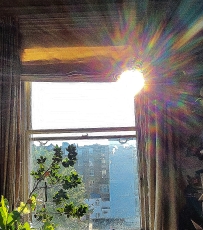
Early morning
Sunlight bursts through the window pane
Another day begins
AFTER DAYS OF GREY skies, the sun shone without pauses today (the 30th of March 2024). This was lucky because come rain or shine, we had decided to walk south from Primrose Hill through Regents Park to Marylebone Road. Much of the way we passed places with fond memories for us. The first of these was Chalk Farm Underground station. It was near here that my wife used to live in a flat on Fellowes Road long before we married.
From the station, we walked across a graffiti-covered iron bridge that crosses the mainline railway tracks from Euston. This brought us to the eastern end of Regents Park Road (‘RPR’). Lined with shops and eateries, this curving road is where we met with our friends frequently. One of our favourite places was Lemonia – a Greek restaurant. When it first opened, it was on the south side of the road. Now, it occupies larger premises on the north side of RPR. After having coffee at Roni’s, an Israeli café that did not exist in the 1980s when we often visited the area, we walked towards the base of Primrose Hill. Today, being the Easter weekend, the road was far less busy than it is on other weekends.

Looking down from Primrose Hill
Fortified with coffee and a croissant, we ascended the steep path leading from opposite the house where Friedrich Engels once lived to the summit of Primrose Hill, which had attracted a crowd of people who had come out to enjoy the sun and the magnificent view of London to the south of the hill. While we were descending the hill towards Regents Park, a young lady, who was ascending the hill with her husband and two children, greeted us. I did not recognise her as I had not seen her for 21 years, and (then only briefly) when she was a young teenager. She is the daughter of one of my cousins, and the great-great granddaughter of my ancestor Franz Ginsberg, who was a Senator in the parliament of South Africa between the two world wars.
After reaching the bottom of Primrose Hill, we crossed Prince Albert Road, and then walked over a bridge that traverses the Regents Canal. At the south end of the bridge, we passed some enclosures (containing what looked like large wild boars or warthogs) of the London Zoo. Then, we walked along a straight path between grassy playing fields – not particularly scenic. In the distance we could see the minaret of the Regents Park Mosque and the domes on the roof of the London Business School, where my wife studied. Eventually we reached a more attractive area close to the eastern edge of the Boating Lake, over which we crossed on a bridge. Soon, we arrived at the circular road, appropriately named the Inner Circle. It seemed to being used as an unofficial racetrack for cyclists on expensive looking bicycles. Having safely crossing the road without being hit by a cyclist, we entered the round heart of Regents Park, which contains the famous Queen Marys Rose Garden.
We took refreshments at the strange-looking Regent’s Bar & Kitchen. In plan, it is a collection of identical adjacent hexagons. The roofs of some of these have sharp conical pinnacles. From there we passed beds of rose plants. All of the roses were without flowers, A small wooden bridge crosses a stretch of water – part of a larger pond – to reach the attractive Japanese Garden Island from which you can see a man-made rocky waterfall designed as it would be in gardens in Japan.
After wandering around the Japanese garden, we headed towards the Inner Circle, which we crossed before walking south along a road called York Bridge because it crosses a body of water by means of of a similarly named Bridge. Before reaching the bridge, we passed the buildings of Regent’s University. These used to house a part of the University of London – Bedford College. Founded in 1849, it was for the higher education of women. From 1878 onwards, women studying there were awarded degrees by the University of London. In 1984, after Bedford College had merged with Royal Holloway College, its premises in Regents Park became the home of Regent’s University, which is not affiliated to the University of London. Interestingly, the wrought iron gates to Regent’s University’s grounds still bear the crests of its predecessor – Bedford College. In the 1920s, my wife’s maternal grandmother, Benabai Bhatia, who had come from India with her husband Haridas, who was studying for an FRCS, studied at Bedford College. On her return to India and after she was widowed at a young age, she became a superintendent of schools in Bombay.
After crossing York Bridge, we soon reached Marylebone Road, having had a thoroughly enjoyable walk.

Rays of sunshine
Burst through a hole in the heavens
High above the sea

IN A COUNTRY SUCH AS ENGLAND, the profusion of sundials seems almost ironic given how often the sky is grey and the sun is hidden. Since the year 2000, the average monthly sunshine ranges from less than 50 hours to a little over 250 hours per month (https://www.statista.com/statistics/584898/monthly-hours-of-sunlight-in-uk/), the variation reflecting the different seasons of the year. The average number of daylight hours varies from 8 in January to 16.5 in July (http://projectbritain.com/weather/sunshine.htm). Using these figures and a bit of basic arithmetic, one can estimate that there is sunshine for about 20% of the daylight hours on an average January day, and about 89% of the daylight hours on an average July day. Roughly speaking, a sundial, which can only be of use when the sun is shining, is likely to be helpful for telling the time in England between 20% and 89% of daylight hours on an average day. Nevertheless, there is a great number of these partially usable timepieces in existence in gardens and on buildings in England. The figures I have calculated make the words of my opening sentence only slightly less drastic than they seem. Yet, relying on sundials as timepieces is, as my wife pointed out, a good interpretation of the words of Samuel Johnson (1709-1784), quoted by his biographer James Boswell (1740-1795):
“The triumph of hope over experience.”
This was not said in relation to sundials, but to:
“…Johnson’s hearing of a man who had remarried soon after the death of a wife to whom he had been unhappily married.” (https://www.phrases.org.uk/meanings/hope-over-experience.html)
In other words, enjoy the sight of sundials in their many shapes and sizes but do not become wedded to them if knowing the time is of importance to you.
MY MOTHER KEPT A SUN LOUNGER in the garden. It was propped up against a wall of our family home in northwest London. It was made of aluminium tubing and ‘upholstered’ with tautly stretched dark blue canvas. I will tell you why it was there and not in Canada.

My late mother, Helen (pictured above), was born in South Africa in 1920. Until 1947, I believe that it was quite possible that she might have spent her whole life there.
While living in Cape Town in 1947, she and her sister were invited to a party held by their stepfather’s relatives in the suburb of Parrow. Their hosts, Mr and Mrs Kupfer, had also invited two bachelors, Basil and his brother Ralph, whom they knew from the time when the Kupfers and the two unattached men and their parents lived in the small town of Tulbagh east of Cape Town.
By the end if the evening, Basil and Helen agreed to meet again. Not long after the party, Basil invited Helen to the cinema (bioscope in South African English). They met and talked so much that they never made it to the picture house. Almost immediately after this, they became engaged.
Soon after this, so my mother once told me, Basil informed her that they would not be able to meet again for a few weeks because he was too busy marking university students’ examination scripts. Also, he told her that was about to set sail for England, where he was taking up a teaching post at the London School of Economics (LSE). They agreed that given the imminence of his departure, Helen should follow Basil to London, and they would get married there. Basil departed for London.
Helen, who could not contain her excitement, sailed to Southampton in early 1948. She sat in the boat train to London dismayed by what she saw of England. It was soon after WW2 had ended. She told me that the sight of rows of small houses all with chimneys emitting filthy smoke and the grey skies made her wonder why she had come to such a dismal place to marry a man she hardly knew. They married in mid-March 1948.
After my parents ‘tied the knot’, Basil chose to leave LSE to take up an academic post at McGill University in Montreal. Helen and Basil ‘upped sticks’ and emigrated to Canada in about 1950. The move was not a great success. The climate in Montreal was harsh. My mother told me that for most of the nine months they remained there, it was bitterly cold. She related that they had a flat that overlooked a cemetery. For a few months, the frozen ground was so hard that graves could not be dug. Coffins had to be stacked up above ground until the ground was soft enough to be dug. Helen bought a fur coat. It was made of soft brown fur that I can still remember. In 1950, stores in Montreal were well heated. Customers left their fur coats near the shops’ entrances whilst they were inside shopping.
It was not only the climate that was difficult in Montreal. My father found the atmosphere in the university was awkward to say the least. There was great antagonism between the francophone and anglophone academics. This created an environment that reminded him of the racially divided one he had happily left behind in his native South Africa.
The adverse conditions in Montreal, both social and meteorological, and the offer of another job at LSE, caused my parents to return to London (UK, not Ontario!). They put down a deposit on a detached house in Hampstead Garden Suburb. It was a part of London where many other LSE academics lived. These included: Sir Lionel Robbins and Sir Arnold Plant, and later Professors J Durbin, I Lakatos, P Cohen, and J Watkins and many others.
My parents’ bedroom in the Suburb contained some very well-made wardrobes, which they had had made for their flat in Montreal and brought to London. That they had gone to the trouble of having bespoke cupboards built in Montreal suggests that they had planned to stay much longer than a few months in Montreal.
My mother could never get used to how little light there was in England compared to what she had been used to in South Africa. Every interior wall in our house was painted white, to reflect as much of the little daylight that there was. In contravention of the strict conservation area planning rules that were, and still are, in place in the Suburb, she made alterations to some of the south facing windows in our house during the 1960s. The original windows consisted of a latticework of small panes. She replaced these with large single panes, which allowed far more daylight to enter the house. Even though our neighbours were always asked to remove unauthorised modifications to their houses, the frowned-upon modified windows were still in place more than three decades later. Now, finally, I see that they have been restored to their original, officially approved design.
My mother died in 1980. Between her arrival in London and her death, there was less sunshine in the city than there is nowadays. Had she lived longer than her six decades, I believe that she would have approved of the warmer, sunnier climate that London enjoys now. When she was at home and the sun happened to shine through a gap in the clouds, she would stop whatever she was doing and rush outside into our garden. She would lie on the sun lounger and enjoy feeling the sun’s rays on her face even if only for a few minutes. As soon as the sun disappeared behind the clouds, she would leave the lounger and prop it up against the wall of the house ready for the next opportunity to enjoy what she so missed after leaving South Africa. Had my parents remained in Canada, I wonder whether she would have kept a sun lounger at the ready outside her home there. Also, if they had not returned to London, I would have been born a Canadian instead of a ‘Brit’.
 yamey
yamey 