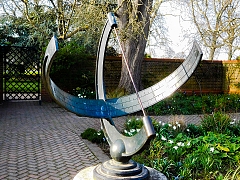
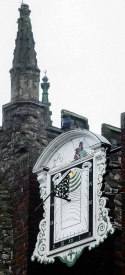
THIS IS A SUNDIAL at Oxburgh Hall in Norfolk . Only useful when the sun shines, which is not always the case in England. According to Wikipedia, that wonderful source of knowledge whose reliability is often good, the earliest known sundials date from 1500 BC. These were discovered by archaeologists working in Egypt. Oxburgh Hall was built largely in the late 15th century.
FOR THOSE WHO DO NOT know, a gnomon is the part of a sundial that casts a shadow.
The gnomon on the Esplanade at Ventnor
In 1851, Sir Thomas Brisbane (1773-1860), who gave his name to a city in Australia, donated a tall gnomon to the town of Ventnor on the Isle of Wight. In sunny conditions, this object casts a shadow on a line marked on the pavement at noon GMT (1 pm BST). Sir Thomas had spent some time in Ventnor during the mid-19th century, and sadly his daughter Eleanor Australia MakDougall Brisbane died in Ventnor in 1852 at the young age of 29.
As we are discovering during our visit to the Isle of Wight, the sun does not always shine in Ventnor (or anywhere else on the island). Recognising this problem that renders the gnomon useless when the sun is not shining, the town erected a short clock tower near to the gnomon in 1870. This clock was rebuilt in 2001. It bears a plaque commemorating Fred Blake (1924-2001), who, along with his father (Adolphus) and grandfather (James), were: “… proud to maintain this barometer for over 120 years”.
We did not see the gnomon working because of cloudy weather conditions, and the two faces of the clocks displayed different times and neither of them appeared to be working. The barometer seemed to be working. It is curious features such as the gnomon that help make towns on the English coast endlessly fascinating.





 yamey
yamey 