
A glass of cider
Chilling by the lazy river
It’s summer time

A glass of cider
Chilling by the lazy river
It’s summer time
EVERY SUMMER SINCE 2000 except for the year 2020, the Serpentine Gallery in London’s Kensington Gardens has hosted a special event. On each of these years between June and October, a temporary pavilion has been erected near to the original Serpentine Gallery (now known as Serpentine South). No two pavilions have looked the same. However, what they have in common is that each one of them is the first ever completed structure erected in England by the pavilion’s designer/architect.
This year (2022), the pavilion, called “Black Chapel”, was designed by the American artist Theaster Gates (born in Chicago in 1973). In the past, we have seen exhibitions of his works hosted in the White Cube Galleries at both Masons Yard and in Bermondsey. Many of his exciting artworks have impressed us greatly. So, it was with high expectations that we went to see his pavilion.

At first sight, we were disappointed by the Black Chapel. It is a huge black cylinder with three apertures. Two of them are entrances and the third is a circular orifice in the centre of the tall structure’s circular, domed ceiling. A segment of the cylinder is walled off and serves as a café servery. Benches line the lower parts of the wall of the rest of the building. Seven large, flat rectangular, metallic paintings (or plates) are attached to a part of the internal wall, and there is a large bell just outside one of the pavilion’s two entrances.
Today, many people like to have art explained to them. For me, it is my visceral reaction to an artwork that is more important than its intended meaning or the artist’s intentions. The ‘meaning’ of a work of art is, for me, secondary to the way I am affected by it. For those, who seek meaning in art, this is what the Serpentine’s website has to say about the pavilion:
“The structure, realised with the support of Adjaye Associates, references the bottle kilns of Stoke-on-Trent, the beehive kilns of the Western United States, San Pietro and the Roman tempiettos, and traditional African structures, such as the Musgum mud huts of Cameroon, and the Kasubi Tombs of Kampala, Uganda. The Pavilion’s circularity and volume echo the sacred forms of Hungarian round churches and the ring shouts, voodoo circles and roda de capoeira witnessed in the sacred practices of the African diaspora.”
Interesting as this might be, it neither increases nor diminishes my appreciation of the Black Chapel. Theaster Gates’s Black Chapel is less exciting visually than some of the past pavilions. Although our initial impressions of this seemingly simple structure were not particularly favourable, after spending a little time in it, the place grew on us and now we hope to visit it again.

Ripe tomatoes
And a shower of basil leaves
Add mozarella
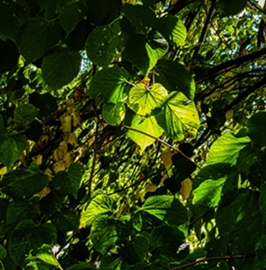
Leaves illuminat-ed
By late summer sunlight:
Autumn is nearing
Photo taken in Kensington Gardens, London, UK

Stuck to the chair,
Hands and fingers sweaty:
A sultry London heatwave
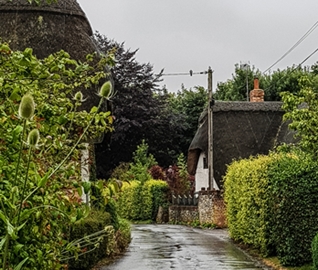
Thatch’d roofs and gentle rain
Puddles under foot
A typical English summer

The first fly of this year flew into my room just after the short warm spell we had in London over the Easter weekend. It was not the first fly that I have seen this year because the first couple of months of this year I spent in India. However, the fly in question, which arrived in late April, was the first fly that has tried to annoy me in London.
Although its buzzing and endless fly-passes can become annoying, there is another sensation that seeing and hearing the insect evokes in me. It reminds me of summer, a season I love. So, despite it annoying me, seeing this first plump fly also makes me joyful and gives me the feeling that warm, long bright days are not far off in London.
 yamey
yamey 