A STATUE OF of Robert North Collie Hamilton (1802–1887) who was British Resident of Indore during the first war of independence in 1857, stands within the garden of the Lalbagh Palace in Indore.
According to a website about the city’s Lalbagh Palace (www.freepressjournal.in/pbd-indore/hamilton-road-only-road-of-indore-named-after-britisher) :
“In the year 1857, a group of freedom fighters gathered at Hamilton Road to protest against the Britishers. On the same day Hamilton was going on leave and his acting officer Sir Henry Marion Durand had taken charge. Sir Durand, angry at the protestors, ordered British army to attack them. When Hamilton came to know this he cancelled his sanctioned leave and ordered the army to not to attack”
The Hamilton stands close to a statue of Queen Victoria.
Because of Hamilton’s actions, he is remembered in Indore not only by the statue but also the city contains a short road named after him. It is the only road in Indore named after a British person.
I FIRST CAME ACROSS the name Indulal Yagnik when I was researching my book (“Indian Freedom Fighters in London:1905-1910”) about the less well-known Indian Freedom Fighter, Shyamji Krishnavarma (1857-1930). Indulal Yagnik (1892-1972), who was a writer and political activist, published a biography of Krishnavarma in 1950. Yagnik wrote many other things, amongst which were the first 30 chapters of Gandhi’s autobiography that were dictated to him by the Mahatma whilst they were both imprisoned in Yeravada jail.
Between 1915 and 1947, Yagnik was active in the Indian struggle for freedom. Amongst his many activities, he carried the first tricolour Indian flag from Germany to India. This flag had been designed by Madam Cama, a leading proponent of Indian independence, and had been displayed to the world (for the first time) at a meeting of socialists in Stuttgart (Germany). Yagnik was imprisoned by the British at least twice on account of his anti-British activities and publications.
After Independence, in 1956, Yagnik led the Mahagujarat Movement for a separate Gujarat state, which led to the separation of Gujarat from Maharahtra that occurred in 1960.
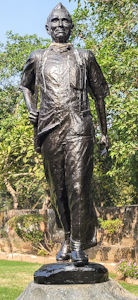
Close to the east end of the Nehru Bridge in Ahmedabad, the city in which Yagnik died, there is a small, well-maintained park in which there is a fine statue of Indulal Yagnik. It was created by the late Kantibai B Patel, who also made many other statues of well-known Gujarati people, including many of Mahatma Gandhi. The statue of Yagnik depicts the man striding forward, his shirt pocket filled with a spectacles case and a pen.
I was keen to view the statue not only because I had read Yagnik’s biography of Krishnavarma but also for another reason. His nephew, who lives in Bangalore, is a good friend, whom we got to know because his wife is related to members of my wife’s wider family.
Even if you do not have the sort of ‘connection’ we have with Indulal Yagnik’s nephew, the statue is worth seeing because it is a good piece of sculpture.
THERE ARE MANY statues depicting Mohandas K Gandhi (the Mahatma; 1869-1948) all over the world. There is one in Manchester close to the city’s cathedral. A small notice next to it notes that it was gifted by the Kamani family to honour their grandfather Bhanji Khanji Kamani (1888-1979). Inaugurated in 2019, it is a project by the Shrimad Rajchandra Mission in Dharampur (Gujarat).
Shrimad Rajchandra (1861-1901) was a Jain philosopher, scholar, and reformer. Gandhi was introduced to him in Bombay in 1891, and the two men wrote to each other when the Mahatma was a lawyer and activist in in South Africa. Gandhi wrote in his autobiography that Shrimad was his “guide and helper” and his “refuge in moments of spiritual crisis”. Well, I did not know that.
As for Bhanji Khanji Kamani, the notice next to the statue in Manchester notes that he was “… a Fellow Scholar of Gandhi.” I am unclear about the meaning of this because Bhanji was about 19 years younger than the Mahatma. I wonder whether he was actually a disciple of Gandhi, rather than a Fellow scholar.
We saw the statue representing a man who advocated peaceful protest on a day when violent protests were predicted all over England.
THE ALBANIAN EMBASSY is on St Georges Drive in London’s Pimlico. On our way there we passed a statue that stands on a triangular plot where St Georges Drive meets Denbigh Street at an acute angle. The statue commemorates Thomas Cubitt (1788-1855), who was born in Norfolk and died in Surrey. It was created in 1995 by William Fawke (1948-2018).
The metal sculpture depicts Cubitt standing on a platform facing a pile of building bricks. In his left hand, he holds a long, notched stick – a brick measure. The platform upon which he stands is supported by balustrade bottles (‘balusters’) that are used to support the railing that rests upon them. The bottles supporting Cubitt are the type found on the houses built by Cubitt.
Cubitt was the son of a carpenter. During his trip to India as a ship’s carpenter, Thomas earned sufficient money to be able to establish a building business in London’s Holborn. In cooperation with his younger brothers, William and Lewis (who designed Kings Cross station), his firm took off. He was an excellent organiser, and created teams of builders that included every branch of the trade. Some of his projects are listed in an interesting web page (https://victorianweb.org/art/architecture/cubitt/bio.html):
“By now he was a close friend of the royal family, having collaborated with Prince Albert on the design for Osborne House, which he then built for him. He also won the contract to extend Buckingham Palace, and it was Cubitt as well who orchestrated the dismantling of Nash’s Marble Arch there, and its reassembly at Hyde Park, ready for the Great Exhibition. The Exhibition itself was a project suggested to Prince Albert by Cubitt, after a conversation with a friend who had recently visited an exhibition in Paris. From 1839 Cubitt was an active member of the Institution of Civil Engineers; he was a leading figure in the campaigns for a main drainage system and a more extensive Thames Embankment, and rooted for limiting smoke emissions and conserving open space: Battersea Park owes its existence largely to him.”
In addition to this and other major projects, he built much of Tavistock Square and great swathes of housing in Pimlico. So, it is fitting that his statue has placed in the midst of the houses which his firm created in Pimlico. It was interesting to ‘discover’ the statue of Cubitt shortly before we entered the embassy which is housed in one of the houses he built in Pimlico.
LANCASHIRE USED TO be the centre of the cotton processing industry in the UK. Cotton grown in the southern USA and in India’s Gujarat was shipped to Lancashire, where the cotton mills used it to manufacture textiles.
In the heart of the city of Manchester, we were surprised to find a huge bronze statue of the former President of the USA, Abraham Lincoln (in office from 1861 to 1865). Lincoln played a significant role in the abolition of slavery in his country. Many of the slaves worked to grow and harvest cotton, much of which was sent to Lancashire. The processing of the cotton grown by the slaves provided employment for the workers of Lancashire. The statue was created by the American artist George Grey Barnard (1863-1938) in 1919, and is one of three castings – the others being in Louisville, Kentucky and in Cincinnati, Ohio.
Beneath the statue in Manchester and carved in the plinth, there is the wording of a letter sent by Lincoln to the working people of Manchester. Written on the 19th of January 1863, Lincoln thanked the workers of Manchester, who were supporting the abolition of slavery and at the same time suffering because of the blockade that prevented cotton reaching Lancashire from the southern states of the USA. According to one website (https://manchesterhistory.net/manchester/statues/lincoln.html), Lincoln’s blockade of the cotton exporting ports was not universally welcomed:
“To what degree the people of Lancashire gave this support willingly is questionable. Lincoln’s Union Army blockaded the southern ports preventing the Confederate supporters from trading their cotton and causing what was known as the Cotton Famine in the UK. By November 1862, three fifths of the labour force, 331,000 men and women, were idle. The British Government was encouraged to take action to overturn the blockade and riots broke out because of the hardship suffered by the workers. The Confederate Flag flew on some Lancashire mills.”
The American Civil War was not the only time that the Lancashire cotton workers had to suffer because of a freedom struggle taking place many thousands of miles away. In addition to the USA, British India was a supplier of cotton to the mills of Lancashire. Indian cotton was sent to Lancashire, and processed to make textiles that were then sold in India. Because of this, a vast number of weavers in India, who could have made the textiles, were made unemployed and impoverished.
As part of Mahatma Gandhi’s attempt to free India from British rule, he initiated a boycott of cloth and clothing made with textiles manufactured in England. This was sufficiently successful to render a great number of Lancashire textile workers unemployed – at a time when the Great Depression was hitting the country. On the 25th of September 1931, Gandhi travelled from London to Darwen, a small town (with textile factories) north of Manchester. He spent the following days speaking to people of all walks of life, explaining the purpose of his Khadi movement – the boycotting of imported textiles and the encouraging of homespun Indian textile production. Both of my wife’s grandmothers chose to wear only khadi cloth because they supportrd the freedom struggle. James Hunt described Gandhi’s visit to Lancashire in his book “Gandhi in London”, and noted that:
“Everywhere Gandhi explained that whatever the effect of his khaddar movement and boycott might have on Lancashire’s unemployment was a result of his prior concern with the greater sufferings in India. While Britain had 3,000,000 unemployed. India had 300,000.000 villagers idle every year. The average Indian income was a tenth of what the British unemployed worker received from the dole …”
Overall, despite the effects that his boycott was having, the workers of Lancashire welcomed him warmly and supported his cause.
Until we visited the Manchester Museum, which is about 1.3 miles south of Lincoln’s statue, I was unaware of Gandhi’s visit to Lancashire. The museum has a gallery dedicated to the South Asian diaspora, despite being called “the South Asia Gallery”. One of its showcases concentrates on the Mahatma’s brief visit to Darwen.
We visited Manchester in May 2024 to see an art installation curated by our daughter. We also wandered around the city, sightseeing. Little did we expect to discover connections between this vibrant city and both Abraham Lincoln and Mahatma Gandhi.
LONDON IS FULL of reminders of the past. Almost wherever you go, you will come across a memorial (be it a plaque on a wall, or a monument, or a statue, or even a street name) to someone or something of historical interest. Today, the 20th of February 2024, after spending a pleasant hour with my friend Royden Clogstoun (related to the Victorian photographer Julia Margaret Cameron) at the British Library, I walked to Twinings tea shop, which is on the Strand (opposite the Royal Courts of Justice). I began heading south along Mabledon Place, which soon becomes named as Cartwright Gardens. This road runs along the straight edge of a green space shaped like a segment of a circle. The green space is bounded by a road that forms part of a circle – this is also called Cartwright Gardens. Until 1908, this crescent-shaped road was called Burton Crescent in honour of its developer James Burton (1761-1837).
Many of the buildings on the crescent are now hotels. The green space contains tennis courts and a bronze statue. This monument was added to the open space – the garden of Cartwright Gardens – in 1831, that is about 20 years after the area was developed. The statue depicts Major John Cartwright (1740-1824), who lived for a time in what was then Burton Crescent. Born in Marnham (Nottinghamshire), he served in the Royal Navy from the age of 18. In 1771, he retired from the navy for a time for health reasons.
When the colonists in the North American colonies began to rebel against their British rulers, Cartwright refused an appointment in the armed forces because he believed that the colonists had just reasons for their cause. In 1774, he wrote “”American Independence the Glory and Interest of Great Britain.”, which was a plea in favour of the colonists. According to the plaque beneath his statue, he was:
“…the first English writer, who openly maintained the Independence of the United States of America …”
And, furthermore, he:
“… he nobly refused to draw his Sword against the Rising Liberties of an oppressed and struggling People …”
Yet, this is not all he did in the face of existing conventions of his time. He was an active campaigner for parliamentary reform. His goal was to introduce secret ballots and universal suffrage (for men) – to give all men the right to vote in parliamentary elections. He did not live long enough to see his goal attained. For, it was only in 1918 that the Representation of the People Act was passed in Parliament. This allowed all men aged over 21 to vote regardless of the value of their property, and women aged over 30 provided their residence had a rateable value of over £5.
I knew nothing about John Cartwright and his remarkable outlook on life until I stopped to look at his statue today. However, I knew about his younger brother Edmund Cartwright (1743-1823). He invented the power loom, one of the machines that paved the way for the industrialisation of textile production and helped the birth of Britain’s so-called Industrial Revolution.
Had I taken a bus from the British Library to the Strand, instead of walking leisurely, I would not have passed through Cartwright Gardens, and it might have been a long time before I became aware of John Cartwright and his revolutionary ideas.
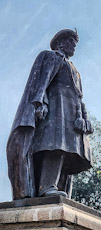
SUBHASH CHANDRA BOSE Park, formerly named Irwin Park, runs parallel to the seashore at Ernakulam in Kerala. At the south end of this pleasant open space, there is a tall statue depicting Sri Sir Rama Varma GCIE, LLD, Maharaja of Cochin (c1861-1941). He reigned between 1932 and 1941. The statue was unveiled in January 1939 by the then Viceroy of India, Lord Linlithgow during a visit to the city. He was Viceroy from 1936 to 1943.
Rama Varma
While visiting Ernakulam that day, the Maharajah arranged for him to watch a display of Bharatnathyam dancing (https://www.cochinroyalhistory.org/). This was held before tea in the grounds of the Maharaja‘s nearby Durbar Hall. The statue was unveiled after tea.
The Durbar Hall was constructed over 100 years ago in extensive grounds owned by the Maharajahs of Cochin. For many years, it has been used as an art gallery. Beautifully restored by the organisation that runs the Kochi Muziris art biennale, it serves as one of the art festival’s venues during the 4 months that the Biennale runs. The current 2022/23 event in the Durbar Hall is a show called “Idam” which contains a variety of visual art exhibits, all of which have been created by 34 Malayali artists. Overall, it is an enjoyable exhibition by artists displaying an exciting variety of interesting imaginative ideas, all expressed in well executed artworks.
The works in the Durbar Hall are in stark contrast to the Maharaja‘s statue that stands in the hot sun not too far away. Unlike the Maharajah, who was probably unwilling to break out of his comfortable colonial mould, the artists are showing that they are willing to attempt to escape from prevailing convention
ONE OF THE FIRST things that a visitor sees when entering Chennai’s Fort St George is a cupola supported by eight fluted pillars topped with Ionic capitals. It looks as if it ought to contain something, but it is empty.
In 1792, after losing a military campaign against the army of the British East India Company, the ruler of Mysore, Tipu Sultan, surrendered two of his sons as hostages to be held by the British. They were handed over to the British commander Lord Cornwallis. Tipu’s sons were taken to be held by the British until he had paid them an enormous sum of money, deemed to be reparations for damages that were supposed to have been inflicted on his British opponents. He managed to pay this ‘ransom’ after a couple of years, and his sons were returned.
Cornwallis was regarded as a great hero by the British. In about 1800, Thomas Banks sculpted an enormous stone statue of Cornwallis standing on a tall stone cylindrical base. The base has figures sculpted in bas-relief. The bas-relief depicts the moment when Tipu’s sons were handed over to Cornwallis.
At first, the statue was housed in the above-mentioned cupola. Later, it was moved indoors, first to the Long Room of the Connemara Library, and then later to the museum in Fort St George. It was moved indoors from its original position beneath the cupola, because, to quote an informative panel near it: “… of ill feeling caused by certain reliefs on its base.” Well, at least it was never toppled to the ground as was the case with, for example, statues of Stalin, Enver Hoxha, and the Bristol slaver Edward Colston.
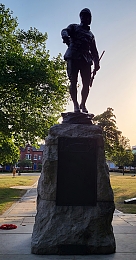
PALMYRA SQUARE IS a delightful rectangular piazza in the heart of Warrington in Cheshire. I use the word ‘piazza’ because the English word ‘square’ includes many squares which are anything but square. The centre of this open space is filled with the pleasant Queen’s Gardens, the Queen in the name being Victoria. It was near the end of her reign that the 2nd Anglo-Boer War (‘Boer War’; 1899-1902), a bloody conflict between the British Empire and the Dutch speaking colonists in what is now South Africa, occurred. In the middle of the eastern half of Palmyra Square there is the statue of a man in a helmet carrying a rifle in his left hand. His right arm points forward, as does his right index finger. The other fingers of his right hand clutch a pair of binoculars. He is wearing knee high boots, standing on a sculpture of a rock, and dressed in an old-fashioned military uniform. As soon as I saw this statue, I guessed (from the style of the uniform) it was connected the Boer War, and when I looked at the plinth upon which the military figure is perched, I discovered that I was right.
The monument was unveiled by General Sir Redvers Henry Buller (1839-1908), in the year before his death. Buller commanded British forces in South Africa during the Boer War. The man depicted on the plinth is Lieutenant Colonel MacCarthy O’Leary (1849-1900). He was killed on the 27th of February 1900 whilst leading men of his regiment (The South Lancashire) during the Battle of Pieters Hill. Richard Danes in his “Cassell’s History of the Boer War” (published 1901) pointed out that the 27th of February was Majuba Day, which was when the British were soundly beaten by the Boers at the Battle of Majuba Hill in 1881. The battle at Pieters Hill, which led to a British victory, facilitated the opening of the road to Ladysmith, which was being besieged by the Boer forces. An informative website (www.alamy.com/stock-photo-statue-of-lt-col-william-mccarthy-oleary-in-queens-gardens-warrington-54385554.html) revealed:
“The Regiment drew many of its recruits from the then-South Lancashire town of Warrington, where Colonel O’Leary was very well known. When the town erected a memorial to the men of the Regiment who died during the war, it chose to feature a sculpture of Colonel O’Leary on campaign in South Africa.”
The statue was sculpted by Edward Alfred Briscoe Drury (1856-1944). Amongst his many other creations is the South Africa Gate on The Mall in London.
The plinth upon which O’Leary stands forever motionless bears a large plaque on which the many members of the 1st and 2nd Battalions of the South Lancashire Regiment, who died during the Boer War, are recorded. These include a few officers and too many men of lower rank. Another plaque records the campaigns in which the regiment was involved. Apart from Pieters Hill, these were: Spion Kop, Vaal Krantz, Colenso Kopjes, Tugela Heights, Relief of Ladysmith, Botha’s Pass, Laings Nek; and the occupations of Wakkerstroom, Utrecht, and Vryheid. In other words, they took part in most of the important struggles during the Boer War.
The monument stands in a peaceful square in a small town, once in Lancashire but now in Cheshire, just about 400 yards from the River Mersey. As I stood looking at it during an unusual heatwave when the air temperature was between 35 and 37 degrees Celsius, I wondered how the brave men recorded on the plinth, who would have been encumbered with military equipment and inappropriate uniforms, managed to keep on going during the hot weather that they would have encountered whilst struggling against the Boers in the south of Africa.





 yamey
yamey 