Does it matter which cricket team you support?

IN 1960, THE CONSERVATIVE politician Norman Tebbit devised what has become known as ‘the cricket test’ to ascertain how well immigrants had become integrated into the life of the United Kingdom and how loyal they had become to their adopted home. It related to which team they supported when the team from their country of origin was playing test cricket against a British team. He suggested that those immigrants who support their native country’s cricket team rather than England’s  are not significantly integrated into the United Kingdom

My father was an immigrant. He was born, brought up, and educated in South Africa. He took a keen interest in professional sport, when it was presented on the radio (we did not have a television at home). I remember seeing him sitting at his desk in his study working with the radio on in the background. He delighted in listening to radio commentaries of cricket and tennis matches. I am not sure whether he was able to visualise the games in his mind, or whether he was only interested in the scores, or both. When, after apartheid was ended in South Africa, and the South African cricketers were once again playing the English team, he was asked which of them he hoped would win. He said:

“It does not matter to me,” he replied, “I support both of them.”

I wonder whether this counted as a pass or fail in Tebbit’s cricket test?

Paintings and the Olympic Games in Paris in Cambridge

MY INTEREST IN the Olympic Games is limited, but that did not stop me from visiting the Fitzwilliam Museum in Cambridge, where an exhibition is being held to celebrate the 1924 Olympic Games, which were held in Paris. The exhibition, “Paris 1924: Sport, Art, and the Body”, is on until the 3rd of November 2024. Paris was, and still is, an appropriate place to hold the Olympic Games, because the man who revived this ancient Greek festival of sport, Pierre de Coubertin (1863–1937), was born in that city. The exhibition is well laid-out. Naturally, it contains many items of interest to enthusiasts of sport and the Olympic Games. Most of these are relevant to the 1924 Paris event, which was held only 10 years after the outbreak of WW1. The exhibits which interested me most were some of the paintings.

The Paris Olympics of 1924 took place during an exciting era of artistic experimentation and development. Most of the paintings in the exhibition provide evidence of that exciting period of twentieth century art. There is a painting of a gymnast by the German artist George Grosz (1893-1959), which was painted in about 1922. Works by the Italian Futurists Gino Severini (1883-1966), Enzo Benedetti (1905-1993), and Umberto Boccioni (1882-1916), figure in the exhibition. There is also a painting by Jack Butler Yeats (1871-1957), who was a brother of the famous poet William Butler Yeats. An interesting almost Cubist painting of a tennis player caught my eye. It was created in 1917 by an artist I had not heard of: André Lhote (1885-1962). A modernistic portrayal of a female runner by Willi Baumeister (1889-1955) fitted in well with the theme of the exhibition.

The paintings and sculptures chosen for the show were what made the exhibition enjoyable for me. One painting amongst them was for me the greatest surprise. It is a huge portrait depicting the face of the tennis player Mrs Helen Wills Moody (1905-1998), created in pastels in 1930. She had won two gold medals in the Olympics of 1924. I do not know why, but it was with great surprise that I saw that the artist was the Mexican Diego Riviera (1886-1957). Although the portrait is large, I had always associated Riviera with huge murals, rather than portraits and smaller paintings, of which, I have recently discovered, he created many.

I am pleased that I have seen the exhibition at the Fitzwilliam not because it has increased my interest in the Olympic Games, but because it included some fine paintings, which I had not seen before.

A polo player in India and Somerset

LYTES CARY is a mediaeval manor in the English county of Somerset. This beautiful building, maintained by the National Trust, was owned by the Lyte family since the 15th century, if not earlier. The Great Hall of the manor house was built in the 1460s. The manor remained in the Lyte family until 1755, when the indebted Thomas Lyte IV surrendered all rights to their family home. Between then and 1907, the property fell into decay.

In 1907, the dilapidated Lytes Cary was purchased by Sir Walter Jenner (1860-1948) and his wife Flora, who died in 1920. They lived with their daughter Esme (1898-1932), a keen horse rider, who died of pneumonia after having been drenched in a rainstorm. Sir Walter was the son of Queen Victoria’s physician, Sir William Jenner (1815-1898), who studied at my alma mater University College in London. At his death, he left a great fortune.

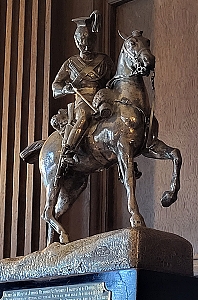
Polo trophy

Sir Walter had the house repaired and filled it with furniture and objets d’art appropriate to the age of the house. The result was a comfortable home with fascinating contents. One of the many objects that caught my eye is a trophy depicting a military man on a horse. This item bears an engraved plate:

“Major Sir Walter Jenner Bt, from Lt Colonel Forrester Colvin 1915 to commemorate joining the Ninth Lancers together December 1880. The many happy years spent therein and the following polo tournaments won by the regiment…”

Below this, there is a long list of tournaments played in India, England, Wales, and Ireland. In India, he was in the winning teams in Umballa (Ambala) in 1883 and 1884, and in Meerut in 1885. The latest tournament listed on the trophy was in Dublin in 1893.

Educated at Charterhouse School, Sir Walter became a magistrate in Somerset after retiring from the Ninth Lancers. He served in his regiment during WW1 and was awarded the DSO for his services in that conflict.

I enjoy visiting old houses like Lytes Cary and always find it interesting when I discover links between them and the history of India. Sir Walter’s polo trophy is not one of the most attractive pieces on display at Lytes Cary, but for me it was most fascinating.

Wrecked, then recovered

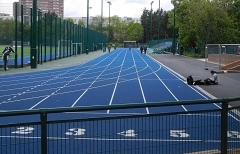
Running track at Paddington Recreation Ground

PADDINGTON RECREATION GROUND, located between West Kilburn and St John’s Wood, was formally established in 1893. It was London’s first public athletic ground. From 1860 to 1893, it was a parish cricket ground. In 1888, a cricket pavilion was constructed. It is now named after Richard Beachcroft who was Secretary of the cricket club in the 1880s. Also in 1888, the grounds were opened to public access and a cycle track was laid out, which remained in existence until 1987 when the position of the cricket pitch was moved. In 1893, the Paddington Recreation Act was passed, authorising:

“…the formal acquisition of lands in the Parish of Paddington to “provide the residents with a public recreational ground.” (https://en.wikipedia.org/wiki/Paddington_Recreation_Ground).

In 2006, the grounds were completely refurbished by Westminster City Council. The centrally located cricket pitch and its Victorian pavilion are now surrounded by a children’s playground; tennis courts; an outdoor gymnasium; a running track; hockey pitches; a bandstand; a bowling green; and various fenced off enclosures containing gardens and an ‘environmental area’. The pleasant park with its café and other facilities covers 27 acres and is well used by locals.

The Paddington Recreation Ground was a place where two world famous sportsmen trained. One was the professional road and track cyclist Sir Bradley Marc Wiggins (born 1980), who won the Tour de France in 2009. He learned to ride a bicycle in the grounds. He attended the St Augustines Church of England School nearby. The other sportsman was a medical student at the nearby St Marys Hospital when he trained on a running track at the Recreation Grounds, and on the 6th of May 1954, he became the first man to run a mile in under 4 minutes. This man was Sir Roger Bannister (1929-2018).

The Recreation Ground has several entrances. One of these is a short path leading from Carlton Vale. It runs past a pub called ‘The Carlton Tavern’, which has a curious recent history. In 1918, a German bomb destroyed a pub that stood on this site. In 1921, this was replaced for the Charrington Brewery by a newer building designed by Frank J Potter (1871-1948), who also designed the observatory in Hampstead. During WW2, the pub was the only building in the street not to have been destroyed during The Blitz. This plucky little pub’s luck ran out in 2015.

In 2015, developers bought the Tavern with a view to demolishing it to create space to build luxury flats. A week before the pub was due to become a protected historical edifice, the developers, no doubt having learned what was in the offing, reduced it to rubble. They hoped that they would get away with being fined an amount, which they could easily recoup when they sold the luxury accommodation they were planning to build. Things did not work out in their favour. Local action groups fought for the pub’s reconstruction and won. The courts ordered the developers to reconstruct the pub brick-by-brick (www.standard.co.uk/news/london/developer-told-to-rebuild-maida-vale-pub-brick-by-brick-after-site-torn-down-without-notice-10211892.html). They did a good job, and today it looks much as it did before it was hurriedly demolished.

Both the pub and the Recreation Ground stand in the shadow of the tall tower of the Anglo-Catholic Church of St Augustin. Known as ‘the cathedral of north London’, the church was designed in the gothic revival style by John Loughborough Pearson (1817-1897), who also designed Truro Cathedral in Cornwall. St Augustin was consecrated in 1880, but the tower and spire were not completed until 1897-98. I have never been inside this building, but I have seen photographs of its interior, which looks superb.

The places described above are almost all that remains of an area which has been subject to much rebuilding since WW2. Visiting these places can make an interesting detour when walking near Little Venice along the Paddington Arm (branch) of The Grand Union Canal. I doubt that I would have visited the Recreation Grounds had I not been alerted to it and encouraged to pay it a visit by two sets of friends, to whom I am grateful.

A road through my childhood

IT IS BECOMING AN ADDICTION: I must write something every day. It is probably a harmless compulsion, but it gives me great pleasure. Today, I will write about a road that did not exist until 1835. It runs northwards from the centre of London. It was built to bypass the hills on which Hampstead perches. The old route to Finchley and Hendon from central London passed across these hills before Finchley Road, originally a toll road, was constructed. Part of Finchley Road connects the suburb of Golders Green with Swiss Cottage. For five long years I travelled along this stretch.

HALL BLOG

Swiss Cottage is named after a pub, Ye Olde Swiss Cottage, which still resembles many people’s idea of what a Swiss chalet should look like. The pub is a descendant of the Swiss Tavern, built like a Swiss chalet. Opened in 1804, it stood on the same spot as its most recent avatar. It stood on the site near one of the toll booths built for collecting money from people using Finchley Road in earlier times.

There was another toll collecting place at Childs Hill, between Golders Green and Swiss Cottage. This toll gate was next to the now demolished Castle pub. For five years, I passed through Childs Hill on my way to the Hall School near Swiss Cottage.

I attended The Hall between 1960 and 1965. The Hall, founded in 1889 (the year the Eiffel Tower was built) was a private school for boys preparing boys for entry into private secondary schools, misleadingly called ‘public schools’.

During my time at the Hall, several bus routes plied between Golders Green and Swiss Cottage: 2, 2a, 2b, and 13. The fare was five pence (less than 2.5p) for children. I used to say to the conductor: “five-penny half, please”.

The bus journey to and from The Hall was tedious and slow. This was because Finchley Road was being widened. The roadworks began before I entered The Hall and continued after I left it five years later. To widen the road, which was lined by houses and shops all the way between Childs Hill and Swiss Cottage, every garden by the roadside had to be cut short. There was a garden centre in a long greenhouse near Finchley Road Underground station opposite the present O2 Centre.  More than three quarters of its length was demolished to permit road widening. All in all, the long section of road being ‘improved’ caused the rush hour traffic to move sluggishly. After 5 years of enduring this, I used to be able to recite from memory and in the correct geographical order the names of all the shops along Finchley Road. Today, hardly any of them exist. Even the large, still extant department store John Barnes has changed its name to John Lewis. Gone is the remains of the garden centre and the Edwardian Swiss Cottage public swimming pool. During my time at The Hall, this place closed when the then new Swiss Cottage Library and swimming pools opened close to the swiss style pub. Another of many disappearances is that of Cosmo, a restaurant that used to be popular with refugees from Central Europe and later with my wife, who loved the Hungarian cherry soup served there.

The Camden Arts Centre stands at the corner of Arkwright Road and Finchley Road.  The arts centre faces across the main road the start of Lymington Road, which soon runs along the side of a large grassy open space. This is where Hall School boys played football and cricket. We used to walk two by two with one of our teachers from the school to and from the field, a distance of at least a mile.

The Hall School was an ‘elite’ establishment. Almost all the pupils had parents who were listed in “Who’s Who”, or royalty, or were extremely wealthy. Several of my fellow pupils were sons of Greek shipping magnates. One of these used to be driven from the school to Lymington Road in his chauffeur driven Bentley, which he pronounced ‘bantly’. Occasionally, he used to offer teachers a lift in his luxurious vehicle.

The sports field in Lymington Road was opposite a small newsagent-cum-sweetshop. We were not supposed to enter this during school hours, which included time at the sports field. And, because we walked back to school after a sporting session, there was little chance to explore it, but somehow, we managed. The shop was amazingly well-stocked with cheap sweets. I discovered that if I walked from Swiss Cottage to Lymington Road, the fare from there to Golders Green was two pennies (there were 240 old pennies in one Pound) cheaper than from Swiss Cottage. This gave me two pennies on top of what I was given daily to buy snacks (in my case, read ‘sweets’) on the way home.

At Swiss Cottage, there was one sweet shop near my bus stop. It was a branch of Maynard’s inside the subterranean foyer of the Underground station. The sweets it sold were poor value: there was nothing for under three (old) pennies. In contrast, the shop on Lymington Road was full of sweets costing less than one (old) penny. For example, one penny bought four ‘blackjacks’ or a large chewy item called a ‘refresher’. And, for three pence, a ‘Sherbet Fountain’ (still available on the internet for 132 [old] pence or 55p). This used to consist of a paper cylinder containing a fizzy lemon flavoured white powder into which there was a black cylindrical straw made of liquorice (used to suck up the powder). The thing looked just like an unexploded firework. In short, It was worth walking about a mile to save on the bus fare and then to spend it in a place where my money had much better buying power.

At the end of the day, I disembarked at Golders Green near the Underground Station. There used to be many children from other schools mingling there on their journeys home. One incident at this place remains in my mind, but before relating it, you need to know what we wore at The Hall. The colour that predominated in the school uniform was pink, which was considered rather strange for a boys’ school. Blazers and peaked school caps also contained black trimmings. One of these, which was prominently sewn on to our caps and the outer breast pocket of our pink blazers trimmed with black, was a black Maltese cross. The way that the school’s emblem was drawn was closer to the shape of the German Iron Cross than to the real Maltese cross. By the time I was attending The Hall, I had already become interested in the Holocaust (the Shoah). Golders Green had many Jewish people living there and several shelves of its public library were filled with books about the deeds of Hitler and his followers. I borrowed and read many of them. Therefore, I was horrified when I stepped off the bus at Golders Green one afternoon, and then some schoolboys from another school shouted at my friend and me:

“Look, the Nazis have arrived.”

Is it not strange what one cannot forget?


Picture from https://www.uniform4kids.com/ 

.

Sergeant B

gymnast near assorted country flags


I have always been hopeless at all physical activities such as sports and gymnastics. I enjoy walking and have in the past played tennis half-heartedly.

At school, we had to attend gymnastics classes (‘gym’ for short). In the school I attended between the ages of 8 and 13, gym classes were held at the gymnasium at the public baths in London’s Swiss Cottage. The gym teachers there took a delight in making a misery of the lives of those, like me, who were no good at gym. 

When I moved to Highgate School, my senior (or high) school, things changed for the better. Gym classes were held in the school’s own rather antiquated gymnasium beside the unheated open-air swimming pool. The classes were conducted by a retired military man, Sergeant B.  He was not in the least bit interested in those, like me, without any skills in gymnastics. All that he wanted was that the useless members of the class kept well out of the way of those who had some aptitude for gym. This suited me fine. I used to spend the gym classes seated at one edge of the room, doing nothing.

In summer, we had to swim in the open-air pool. This was quite comfortable if it was raining, but it felt icy cold on a warm sunny day. As with gym, swimming was not one of my strengths. Once again, Sergeant B was not interested in people like me. The poor or non-swimmers were told to stand in the shallow end of the pool and to keep out of the way of the rest of the class.

No doubt it would have been better if Sergeant B had encouraged the ‘useless’ members of the class to gain some enthusiasm for gym and swimming, but I cannot say that I regretted his neglect.

Sergeant B retired many years ago. Nowadays, pupils at Highgate School cannot expect such a casual approach when it comes to physical exercises.


Photo by Victor Freitas on Pexels.com