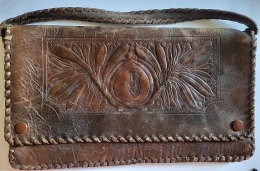
OF MY FOUR GRANDPARENTS, I met only one of them – my father’s mother. The other three died before I was born. My mother’s mother was called Ilse – her parents were born in Prussia and Baden Württemberg before the Unification of Germany in 1870. From what I can recall, my mother told me that her mother was gifted artistically. She painted and made various kinds of objects by hand. One of these came into our possession some years ago. It is a large purse made from leather. With two industrial press-studs, it is held together with stitched leather. The front flap has a leafy design tooled in it. The image has the characteristics of the art-nouveau style that was popular in the late 19th century, and the early part of the following century. In the centre of the design, there is a pair of intertwined initials tooled in the leather. These appear to be “J” and “B”.
When Germans wrote in the late 19th century, they often used what looks to our eyes like the upper-case letter ‘J’ where we would now use the upper-case letter ‘I’. To write the letter ‘J’ (as in jelly), the old German alphabets used a ‘J’ that differed slightly from the ‘J’ used to denote ‘I’. Therefore, the initials on the purse are most likely ‘IB’. Now, IB could either refer to Ilse or to her husband, my grandfather, Iwan B.
Inside the purse, there is some handwriting, which I recognise as my mother’s. It gives her name, Helen B, and the address of the farm her mother bought after having been widowed twice:
Beside this, she had written “Poste restante”. I imagine that she had done this because most of the time she was living not in Stellenbosch, but in Cape Town. This would have been before 1948 when she travelled to England to marry my father.
Apart from a few old photographs, this well-made purse is one of the very few material souvenirs of a grandmother whom I never met.
ALMOST WITHOUT REALISING IT, it seems that I have developed an interest in 19th century photographers. A visit to the Isle of Wight in 2022 led to me becoming interested in the life and work of the pioneer of artistic photography – Julia Margaret Cameron (1815-1879). She lived at Dimbola Lodge in Freshwater on the Isle of Wight between 1860 and 1875. It was here that she produced most of her highly creative photographs. I have written a book about her: “Between Two Islands: Julia Margaret Cameron and Her Circle”.
Five years after Julia left the Isle of Wight, my great-grandfather Franz Ginsberg travelled from the German Empire to King Williams Town (‘KWT’) in the eastern part of what was then the southern African Cape Colony. Aged 18, he arrived there with his future brother-in-law Jakob Rindl. The two men set up what became a successful commercial photographic studio in the town, which they might have chosen because many of its European inhabitants were German speakers. Although Jakob continued the studio after 1885, Franz diversified his activities by founding soap, match, and candle factories in the town.
I believe that despite becoming a successful industrialist and politician, Franz continued taking photographs as a hobby. Because of his success in KWT, other members of his family came out from Germany to work in the town. Amongst these were Franz’s nieces, Anna and Else Ginsberg. These two intrepid ladies founded a photographic studio in KWT. They were the first ladies to have opened a commercial photography studio in what was to become South Africa. Of interest, amongst each of the generations of Franz and Jakob’s descendants, there have been keen photographers including myself,
In May 2023, when we visited the city of Funchal on the Portuguese island of Madeira, we came across a museum that helped to bring 19th century photography back to life for me. It is the Museu de Fotografia da Madeira in Rua de Carriera. The museum is housed in what had been the premises of the commercial studio founded by Vicente Gomes da Silva (1827-1906) in 1863. The studio remained in business until 1978. In 1982, the Regional Government of Madeira purchased the building – Atelier Vicente – and used it for a museum of photography.
Vicente Gomes da Silva became interested in photography in 1856, and by 1859 he was recorded as an amateur photographer in a local newspaper published in the June of that year. By 1863, he had made photography his business venture, and moved into the Atelier on Rua Carriera in 1865. A year later, he was appointed photographer to the Empress of Austria. His son, also called Vicente, continued the business, and was appointed photographer to the Portuguese royal family in 1903.
The museum is interesting not only because it exhibits the sorts of cameras that must have been used by my ancestors in South Africa and by Julia Margaret Cameron, but also because features that were characteristic of early photographic studios have been maintained and explained. The Atelier was opened before there was electricity on Madeira. The main studio area was arranged so that it was lit by northern light that filtered through skylights and curtains designed to make it a homogenous light source. Part of the studio’s laboratories had skylights that allowed ingress of sunlight that was required at various stages of preparing the photographic plates. At the back of the studio, there are a set of sliding panels, each painted with a different scene that could be used as a background to the people being photographed. The desired scene could be slid out behind the area where the subjects posed for their pictures. In other rooms, there are exhibits illustrating the history of cameras and photographic processes, as well as a fine collection of reproductions of images captured by some of the many photographers – both Portuguese and others – who worked in Madeira. Some of the foreigners who took photographs on the island included British photographers such as Russell Manners Gordon (1829-1906) and Alexander Lamont Henderson (1837-1907).
Although I have no information about the appearances of the photographic studios used by my relatives in 19th century KWT, seeing the museum helped to give me an inkling of how their workplaces must have been. In the case of Julia Margaret Cameron, the places where she created images in her home, Dimbola, were far more makeshift from what I can gather.
Except for Julia Margaret Cameron, all the photographers I have mentioned, and many others working in the nineteenth century, aimed to create visually accurate images of their subjects. Often crystal clear, these pictures are fascinating but usually lifeless. What made Julia Cameron’s photography both unusual and full of life was her experimentation with focussing and processing. She used the camera not as equipment for capturing real life accurately on film but as a tool for creating works of art, in the same way as a painter uses the brush and the sculptor uses chisels. By doing this, she was far in advance of her time; experimentation with photography as a creative art form really only took off in the 20th century. The portraits and other composition that she created on film successfully captured not only their external appearance but also her astute interpretations of her subjects’ personalities.
UNTIL AIR TRAVEL really ‘took off’, travelling between South Africa and London involved a long sea voyage, either via the Suez Canal or via the Atlantic Ocean. Boats carrying passengers up and down the Atlantic often called in at Funchal in Madeira. Aged three, I travelled with my parents to South Africa by sea. I have seen a photograph of me dressed in a toga made from a sheet from our cabin. I was taking part in a fancy dress party to celebrate crossing the Equator.
Many years before that – in 1906 – a barrister, Mohandas Karamchand Gandhi, travelled by ship from London to South Africa. He was on his way back to South Africa, having petitioned young Winston Churchill, then Under Secretary of State for the Colonies, against the Black Act – a law promoting racial segregation. Apparently, when his ship docked in Funchal, the future Mahatma received news that his efforts had been successful, but this news turned out to be false.
On the 5th of September 2019, a bust of Gandhi was unveiled on the seafront in Funchal, close to the harbour where liners dock today. The bust, which unusually shows Gandhi without his characteristic round lens spectacles, was sculpted by Ram Vanaji Sutar (born 1925 in Gondur, Maharashtra). Sutar is also the sculptor of the massive Statue of Unity, depicting Sardar Vallabhai Patel in Gujarat. Beneath the bust there is a quotation incorrectly attributed to Gandhi; it was actually said or written by the Dutch American pacifist AJ Muste (1885-1967). The artwork was unveiled by HE Miguel Albuquerque, President of the Regional Government of Madeira and HE Nandini Singla, Ambassador of India to Portugal. It celebrates the 150th anniversary of Gandhi’s birth.
I am grateful to our friend Claus for telling us about the bust, which is not easily visible despite its position so near the waterfront: it is partially hidden by plants.
Over the years, I have visited Porbandar where the Mahatma was born; Rajkot where he went to school; Bhavnagar where he went to college; West Kensington where he lodged when studying for the Bar; Mumbai where he attempted to work as a lawyer; and the Gujarat Club in Ahmedabad where he first met Vallabhai Patel, and also set up his ashrams. So seeing him on Funchal has added to my attempts to follow in his footsteps.
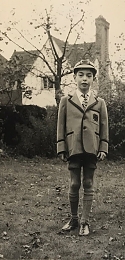
IN 1960, when I was 8 years old, I was accepted as a pupil at the Hall School in London’s Swiss Cottage area. Recently, I received some photographs of me in my newly acquired Hall School uniform. They were taken in the garden of our house in Hampstead Way in the Hampstead Garden Suburb, Maybe, it is fortunate that the photographs are in black and white because the Hall’s uniform was pink trimmed with black. The Hall’s ‘logo’ was a black Maltese cross – also a symbol used by the German army. I remember occasionally, children from other schools used to shout “Nazis” at me and my friends when we were wearing our uniforms in the street. The photographs were taken by my uncle Felix, who was born in South Africa.
When Felix came to London from South Africa in the second half of the 1950s, one of his first jobs was working in a photography shop in London’s Holborn. Like other members of my mother’s family, he was a keen photographer. His grandfather, my great grandfather, opened a photography studio in King William’s Town in the Eastern Cape in 1880. It was while Felix was working in the shop that the photographs of me in my new uniform were taken.
I remember the occasion vividly. Felix arrived at our house in the Suburb, carrying with him a great deal of equipment borrowed from the shop. Most of it was professional lighting on collapsible stands. Felix spent some time setting up a photographic studio in our living room. There were wires all over the place, and every electric socket in the room was used to power the lighting. I was positioned in a suitable pose. When he was ready, my uncle began switching on the lights. Then, it happened. The house’s electrical fuses blew, and all the lights went out. I remember that my parents were not too pleased with what had happened.
Because of the electrical problem, the much-wanted photographs, which were to be sent to relatives in South Africa, had to be taken outside in the garden. Seeing these pictures six decades later brought that occasion to the forefront of my memory.
Felix was a delightful, kindly man. He was everyone’s friend, and never harboured a grudge against anyone. Although he never had any children, I believe that he regarded the whole world as his family.
UNBELIEVABLY, THE ARCHITECT Herbert Baker (1862-1946) demolished a major work of one of England’s greatest architects – Sir John Soane (1753-1837). Imagine the outcry if Sir Richard Rodgers decided to demolish Christopher Wren’s St Pauls Cathedral to replace it with one of his own design. Well, in the 1920s, Baker demolished most of Soane’s Bank of England to replace it with a larger building – the present Bank – which he designed.
There is a small museum in the Bank of England. Some of its rooms have been designed to recreate the kind of interiors that would have existed in Soane’s Bank building. In one of the rooms of the museum, a circular space beneath a glazed dome, there is a framed portrait of Sir Herbert Baker. Baker, who helped design New Delhi, is well known for his architectural work in South Africa. After being commissioned by the imperialist Cecil Rhodes (1853-1902) to redesign Groote Schuur, his house on the slopes of Cape Town’s Table Mountain, he was asked to design many other structures in South Africa.
The portrait depicts Baker standing at a drawing table by a window through which a building in his typical neo-classical style can be seen. At the bottom left corner of the painting, there is a depiction of a framed painting of Cape Town’s Rhodes Memorial, which Baker designed in 1906. If you look carefully at this picture within a picture, an equestrian statue can be discerned. This statue, called “Physical Energy”, was sculpted by George Frederick Watts (1817-1904), who was briefly married to the actress Ellen Terry. The statue was cast in 1902, and placed at the Rhodes Memorial in Cape Town. In 1907, another bronze cast was made, and this stands on a stone plinth in Kensington Gardens almost midway on a line connecting the statue of young Queen Victoria in front of Kensington Palace with the Henry Moore sculpture on the east bank of The Long Water (part of the Serpentine).
When we saw the portrait of Baker, we were viewing an interesting exhibition that explores the Bank of England’s many and varied links with the slave trade. The caption relating to the portrait of Baker concentrated on the small image of the memorial to Rhodes. It correctly pointed out that Rhodes had been a Prime Minister of the Cape Colony, which became part of unified South Africa in 1910. It also mentions that Rhodes: “…held racist beliefs that Africans were inferior.” In 1912, the author GK Chesterton wrote of Rhodes that he:
“… had no principles whatever to give to the world. He had only a hasty but elaborate machinery for spreading the principles that he hadn’t got. What he called his ideals were the dregs of a Darwinism which had already grown not only stagnant, but poisonous … It was not his fault that he “figured out that God meant as much of the planet to be Anglo-Saxon as possible.” Many evolutionists much wiser had “figured out” things even more babyish. He was an honest and humble recipient of the plodding popular science of his time; he spread no ideas that any cockney clerk in Streatham could not have spread for him. But it was exactly because he had no ideas to spread that he invoked slaughter, violated justice, and ruined republics to spread them.”
Well, that is something for recipients of, and those applying for, Rhodes Scholarships to ponder over.
Getting back to the Bank that Baker designed, the museum is well worth visiting not only for its temporary exhibition about slavery but also for its permanent collection of exhibits, all of which have easily understood explanatory labelling.
THE ARTIST WILLIAM Kentridge (born 1955), son of a prominent lawyer, is a South African. His creations are usually highly imaginative and often politically challenging and critical of the subjugation of non-European African people. This is fascinating given his privileged background – having been brought up in a South Africa where the ‘white’ people were a highly advantaged section of the population until the ending of the apartheid regime (and maybe even now to some extent).
His artworks are frequently dramatic, often employing cinematographic and sometimes theatrical techniques. The messages they convey to the viewers can be both disturbing and humorous, sometimes both simultaneously. Whenever I have seen them, I have been both fascinated visually as well as moved emotionally.
The Royal Academy of Art in London’s Piccadilly has a large retrospective exhibition of Kentridge’s work until the 11th of December 2022. Apart from numerous drawings, tapestries, and other static artworks, there are plenty of his cinematographic installations on display. In fact, there are too many of these installations. Each one is amazing to see, but having so many together in one place spoiled their intended impact. Just as the first chocolate from a box is wonderful, eating all of them at once gives one indigestion, and this was the case with the Royal Academy’s crowded assemblage of Kentridge’s works. Too much was crammed together in insufficient space. To be fully enjoyed, each of his installations should be seen on their own in a sufficiently spacious environment – they need ample room to breathe and express themselves.This overcrowding was a pity because the exhibition does not allow his works to shine in their full glory.
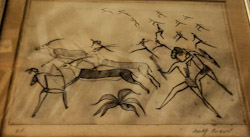
WHILE I WAS STUDYING to become a dentist (in the late 1970s), I used to attend an etching and engraving class in a studio in West Hampstead’s Sumatra Road. The class was supervised by the owner of the studio, my mother’s cousin Dolf Rieser (1898-1983). Like my mother, he was born in South Africa. They were both born in King Williams Town, but he was 23 years older than her.
An engraving by Dolf Rieser
Dolf ‘s childhood memories evoke South Africa as it was at the turn of the century (19th/20th) and are recorded in his unfinished autobiography (dolfrieser.com). Here is an extract that gives a flavour of them:
“The climate of King William’s Town was particularly difficult to bear and my mother suffered greatly especially where her nerves were concerned. I vividly remember her awful attacks of migraine when she had to stay in a darkened room. In the end we decided to leave South Africa, as I shall relate later on . My uncle, my mother’s brother, was at that time living on the border of Basutoland. He was running a small trading post and also kept some horses and sheep. This place was right up on the high plateau and was called Moshes-Ford after the famous Basuto chief, Moshes. My uncle invited us up to him for a holiday and I think we first took a train and then had to continue by horse and carriage, which presumably was also the postal service at the time. I remember well an “ooutspan” for lunch near an immense field full of dried bones and skeletons. These were the remains of the “Rinderpest” which shortly before had nearly wiped out the cattle of South Africa. I played football with a cow or ox skull, very much to the annoyance of the grown-ups. The following night we had to spend at the German Pastor’s home and I remember how impressed I was with the enormous bed and unknown eiderdowns.”
The ’Rinderpest’ was a disease that afflicted cattle.
During his classes at Sumatra Road, he would regale us with stories of Paris in the 1920’s and 1930s, when he was there learning etching an engraving in the studios of both Stanley Hayter and Joseph Hecht. One story that sticks in my mind is how he used to attend the same Parisian café as Pablo Picasso. The great master sat at one table alongside the the other leading artists in Paris, and junior artists like Dolf sat close by at another table.
Dolf was an excellent teacher. He showed us how to etch and engrave. However, what impressed me most is that he had the ability to look at his students’ works in progress, understand what we were trying to achieve, and then provide constructive (rather than prescriptive) advice.
I really miss Dolf, even though it is so many years since he died. He had a wonderful sense of humour, was a wonderful raconteur, and, having once trained as a biologist (before becoming an artist), a wonderfully adventurous approach to his métier.
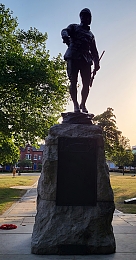
PALMYRA SQUARE IS a delightful rectangular piazza in the heart of Warrington in Cheshire. I use the word ‘piazza’ because the English word ‘square’ includes many squares which are anything but square. The centre of this open space is filled with the pleasant Queen’s Gardens, the Queen in the name being Victoria. It was near the end of her reign that the 2nd Anglo-Boer War (‘Boer War’; 1899-1902), a bloody conflict between the British Empire and the Dutch speaking colonists in what is now South Africa, occurred. In the middle of the eastern half of Palmyra Square there is the statue of a man in a helmet carrying a rifle in his left hand. His right arm points forward, as does his right index finger. The other fingers of his right hand clutch a pair of binoculars. He is wearing knee high boots, standing on a sculpture of a rock, and dressed in an old-fashioned military uniform. As soon as I saw this statue, I guessed (from the style of the uniform) it was connected the Boer War, and when I looked at the plinth upon which the military figure is perched, I discovered that I was right.
The monument was unveiled by General Sir Redvers Henry Buller (1839-1908), in the year before his death. Buller commanded British forces in South Africa during the Boer War. The man depicted on the plinth is Lieutenant Colonel MacCarthy O’Leary (1849-1900). He was killed on the 27th of February 1900 whilst leading men of his regiment (The South Lancashire) during the Battle of Pieters Hill. Richard Danes in his “Cassell’s History of the Boer War” (published 1901) pointed out that the 27th of February was Majuba Day, which was when the British were soundly beaten by the Boers at the Battle of Majuba Hill in 1881. The battle at Pieters Hill, which led to a British victory, facilitated the opening of the road to Ladysmith, which was being besieged by the Boer forces. An informative website (www.alamy.com/stock-photo-statue-of-lt-col-william-mccarthy-oleary-in-queens-gardens-warrington-54385554.html) revealed:
“The Regiment drew many of its recruits from the then-South Lancashire town of Warrington, where Colonel O’Leary was very well known. When the town erected a memorial to the men of the Regiment who died during the war, it chose to feature a sculpture of Colonel O’Leary on campaign in South Africa.”
The statue was sculpted by Edward Alfred Briscoe Drury (1856-1944). Amongst his many other creations is the South Africa Gate on The Mall in London.
The plinth upon which O’Leary stands forever motionless bears a large plaque on which the many members of the 1st and 2nd Battalions of the South Lancashire Regiment, who died during the Boer War, are recorded. These include a few officers and too many men of lower rank. Another plaque records the campaigns in which the regiment was involved. Apart from Pieters Hill, these were: Spion Kop, Vaal Krantz, Colenso Kopjes, Tugela Heights, Relief of Ladysmith, Botha’s Pass, Laings Nek; and the occupations of Wakkerstroom, Utrecht, and Vryheid. In other words, they took part in most of the important struggles during the Boer War.
The monument stands in a peaceful square in a small town, once in Lancashire but now in Cheshire, just about 400 yards from the River Mersey. As I stood looking at it during an unusual heatwave when the air temperature was between 35 and 37 degrees Celsius, I wondered how the brave men recorded on the plinth, who would have been encumbered with military equipment and inappropriate uniforms, managed to keep on going during the hot weather that they would have encountered whilst struggling against the Boers in the south of Africa.
STARING OUT TO sea at Calheta on the Portuguese island of Madeira is a bronze bust of a man wearing 18th century clothing and a bow tie. The sculpture depicts Sebastián Francisco de Miranda y Rodríguez de Espinoza (1750-1816). Born in Caracas in what is now Venezuela, Miranda became a military leader and a revolutionary fighting for his country’s liberation from Spanish rule. Regarded by many as the forerunner of Simon Bolivar (1783-1830), the great liberator of several Spanish South American colonies and born in Caracas, Miranda ended his life in a Spanish prison in Cadiz.
“The Sons of the municipality of Calheta in the lands of Venezuela at the bicentenary of the Independence in honour of its precursor ‘Generalisimo, Sebastian Francisco de Miranda’ ‘The most universal Venezuelan’”
I interpret this as meaning that the bust was erected by descendants of people from Calheta, who had emigrated to Venezuela.
The bust was created by the Venezuelan sculptor Julio César Briceño Andrade, who was born in Caracas in 1950. It was unveiled in Calheta by Lucas Rincón Romero, the Venezuelan Ambassador to Portugal, on the 5th July 2011.
Miranda was the son of a man, who had migrated to Venezuela from the Spanish Canary Islands. His mother was born in Venezuela. Although, he crossed the Atlantic several times, I do not know whether Miranda ever set foot on the island of Madeira.
Like those from Calheta, who migrated to Venezuela, many others have migrated from Madeira to various parts of the world over the years. I have been told that many of the Portuguese speakers in South Africa had their roots in Madeira. Having seen the bust in Calheta, clearly Venezuela was another destination.
Now, with difficulties that Venezuela has been facing, some its citizens with Madeiran heritage are returning to the island as can be seen in an article published on-line (www.euractiv.com/section/global-europe/news/madeira-an-island-of-refuge-for-venezuelans-of-portuguese-origin/):
“No one knows the exact figure but the authorities in Madeira consider that about 6,000 Venezuelans of Portuguese descent have taken refuge on their island, where they found themselves in an extremely precarious situation. “They arrive with nothing, many are sick, these are people lacking a great deal,” said the President of the Portuguese archipelago, Miguel Albuquerque. These people are second or third generation Portuguese, descendants of those who left Madeira decades ago in search of a better life in Venezuela. They are now making the opposite journey.”
Reading this made me think about South Africa, to which many Europeans, including my parents’ families, travelled in search of a better life. After the ending of apartheid, many of their descendants have left the country because they had become concerned about their futures in a land where Europeans no longer hold the upper hand.






 yamey
yamey 