
Playing bagpipes
This must be a pub in Scotland
Wrong, it’s in Soho
The Clachan pub is in Kingly Street, which is close to Carnaby Street

Playing bagpipes
This must be a pub in Scotland
Wrong, it’s in Soho
The Clachan pub is in Kingly Street, which is close to Carnaby Street
IT WAS DIFFICULT to believe that the UK is suffering a cost-of-living crisis and other economic difficulties when we entered Kingly Court on a Wednesday evening in late October 2025. Each of its over 20 restaurants and bars were almost full of diners and drinkers. And many of these establishments are not for those on a tight budget.
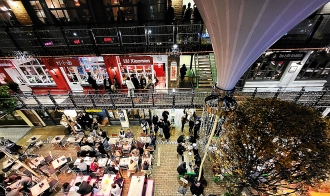
Kingly Court is a three-storey building surrounding a large rectangular courtyard filled with tables and chairs. The courtyard is surrounded by galleries, each of which is flanked by several eateries. There are also restaurants and bars on the ground floor. The place was literally buzzing when we arrived there at about 7.30 pm.
Kingly Court is bounded by Kingly Street, Ganton Street, and Carnaby Street. I can not determine when the place was built for its present purpose as a mecca for hungry people. In the 1890s, the block in which Kingly Court now stands was occupied by buildings of various sizes that surrounded an open space. The redevelopment of Kingly Court was carried out by Rolfe Judd Architects. The initial aim was:
“… the refurbishment and extension of four buildings, with the aim of creating unified, high-quality office spaces on the upper floors while retaining the bar and restaurant uses of the ground floor and basement.” (www.rolfe-judd.co.uk/planning/projects/kingly-street-2/)
However, since that project was undertaken, the Court’s main purpose has become a centre for restaurants and bars.
There is a wide range of food choice available at Kingly Court. There, you can feast on dishes from a multitude of different cuisines from around the world. And it seems to be very popular despite the financial problems afflicting the UK at present.
ACCORDING TO ITS website, the small restaurant in Soho’s Poland Street called The Kati Roll Company (‘KRC’):
“… serves authentic street Kati Rolls just like the ones in Kolkata, India.”
The restaurant is attractively decorated, with its wall covered with fragments of Hindi film posters and a corrugated iron ceiling. It has several tables and chairs. Food is ordered from a counter at the far end of the rectangular dining area, and is delivered a few minutes later. I could not see the kebabs being prepared, but if they are truly kati kebabs, they should have been grilled on bamboo skewers. The roll, wrapped in paper consists of a spicy meat or vegetarian filling enclosed in a rolled-up roti, which the restaurant described as a ‘paratha’.

KRC was, according to its website, started:
“… by Payal Saha shortly after she moved from her hometown of Kolkata to New York City. Without any experience running a restaurant, she let her desire for authentic kati rolls drive her passion.”
Well, it was with great interest that today, 3 September 2025, I visited and ate at KRC in Poland Street. I was curious to see how their rolls compared with those at Nizams in central Kolkata. I have written quite a lot about this restaurant in my latest book “88 Days in India: A Journey of Memory and Discovery”. Here is a short excerpt from my description of the rolls at Nizams:
“The kathi roll consists of a kebab (usually chicken or mutton, or potato for vegetarians) wrapped, with or without a cooked egg (like an omelette), in a rolled up flaky paratha. Onions and chillies can also be included in the roll. The paratha is heated in a large amount of oil on a tava (a circular, concave metal hotplate). It is the same one that was installed when the restaurant first opened. According to an article in The Telegraph Online (dated August 2024), the tava weighed 185 Kg in 1932, but through constant use it has lost weight. By 2024, it weighed 80 Kg. Until 1964, the kebabs were grilled on iron skewers. After that, the metal skewers were replaced by cheaper bamboo sticks, known in Bengali as ‘kathi’. The rolls have always been served, wrapped up in paper so that the customers (often in the early days, British men out on the town with Indian ladies) did not get grease on their fingers whilst consuming them. Interesting as the history is, it pales into insignificance when you bite into one of Nizam’s kathi rolls. I do not know how they achieve it, but the taste of Nizam’s kebab filled rolls surpasses that of every other kebab roll I have eaten. Year after year, Nizam’s manages to maintain the high quality and magical flavour of their products.”
After having eaten at Nizams many times, I waited with great interest for the 4 kathi rolls we had ordered in Poland Street to be served.
The fillings in the KRC rolls were tasty enough, and if you have never eaten at Nizams, you would think that they taste pretty good. The so-called parathas in which KRC’s rolls are wrapped seemed more like rotis than what I was expecting. In contrast, the parathas that enclose the fillings at Nizams are, as mentioned above, flaky, almost as much as Malabar or Kerala parathas, but oilier. Although I enjoyed the rolls at KRC, and will happily eat there again, they are not nearly as satisfying and tasty as those at Nizams. However, it is much easier and quicker for us to reach KRC in Soho than it is for us to get to Nizams in Kolkata.
PS: My book, which contains a chapter about eating in Kolkata, is available from Amazon:
OVER THE YEARS, we have watched several plays, which are best seen after eating rather than when hungry. In all of these, the actors have prepared and even cooked food on the stage. Many years ago, we watched a play about the artist Van Gogh’s stay in London. The stage set for this drama, which we saw over 20 years ago, included a kitchen. During the show, a roast meal complete with meat and vegetables was prepared in front of the audience. It smelled great, but we were not invited to eat any of it.
More recently we saw a play called “The Arab-Israeli Cookbook” on the small stage of the tiny Gate Theatre, which is above a pub in Notting Hill Gate. The audience was seated only a few feet away from two ladies, one of whom was preparing Israeli dishes, and the other Palestinian food. The drama explored the ongoing conflict in that country beset by conflict and tragedy: Israel. What was being prepared on stage was delicious. I am pleased that we had eaten before watching the preparation of mouthwatering food, which we were not offered.

Today, the 21st of September 2024, we watched a play, “My English Persian Kitchen”, written by Hannah Khalil. Starring only one actor, Isabella Nefar, it is showing at the Soho Theatre in Dean Street until the 5th of October 2024. Throughout the 70 minutes of this one act play, Ms Nefar prepares an Iranian herb and noodle soup, Ash-e-Reshteh, on a kitchen unit placed in the middle of the stage. While she tells us the secrets of making this soup, she also relates the problems of being a married woman in Iran and how she fled from the country and her husband. She also describes her arrival in London and how she reacted to life there, and how others reacted to her. Every now and then, she has flashbacks to her difficult marital experiences back in Iran. As the play comes to an end, her soup becomes ready to eat. She invites the audience on the stage to taste what she had prepared while we were watching. All in all, it was a great piece of drama. My wife tried the soup, and said it tasted good. I did not try it because it contains beans and lentils, neither of which I particularly enjoy.
I went to Soho Theatre after having a lighter than usual lunch. As the actress prepared the dish, the cooking smells did increase my feelings of hunger. I should have eaten more before reaching the theatre.
DURING THE LATE 1950s and much of the 1960s, my mother created artworks in the sculpture workshops of St Martins School of Art, which was then located on Charing Cross Road near to Foyles bookshop. My mother was a keen follower of the recipes of Elizabeth David (1913-1992), who introduced Mediterranean food to British kitchens. Near to St Martins in Old Compton Street, there were many food shops that supplied the ingredients that were required to follow Ms David’s recipes accurately. There used to be a French greengrocer between Charing Cross Road and Greek Street. This was one of the only places where ‘exotic’ salads such as mâché (lamb’s lettuce) could be purchased. Further west along Old Compton Street, there was a Belgian butcher, Benoit Bulcke, which cut meat in the French style, which my mother preferred. She claimed that English butchers were not ‘up to scratch’. Both these shops have long since disappeared. Another Soho establishment, which we used to visit regularly, was Trattoria da Otello in Dean Street. We went there so often that we were treated like old friends. Now, sadly, that wonderful restaurant is no more.

Three Old Compton Street shops frequented by my mother are still in business. They are the Algerian Coffee Stores, whose appearance has barely changed since the early 1960s when I first remember entering it; and a supplier of Italian foods: I Camisa & Son. Lina Stores, which my mother also used to visit still exists, but its branch on Brewer Street (and other newer branches) seems to have become more like restaurants than Italian delicatessens.
During school holidays, I used to accompany my mother on trips from Golders Green, where we resided, to the West End. On most of these excursions, food shopping in Soho was on our itinerary. So, as a youngster I got to know these various food shops quite well. As an innocent child, I associated Soho with food shopping rather than its other more colourful activities.
Every visit to Soho involved a stop at Bar Italia on Frith Street. There, I would be treated with a cappuccino while my mother drank an espresso. From when I first knew it in the early 1960s (or possibly the late 1950s), the overall appearance of Bar Italia has barely changed. As a friend remarked on a recent visit, the cracked Formica counter opposite the bar is typical of how cafés would have been fitted out back in the 1950s.
Bar Italia is almost three years older than me. It was founded in late 1949 by Lou and Caterina Polledri. Lou was born in the Italian city of Piacenza. According to the Bar’s website, some of the above-mentioned Formica was put in place in 1949, when the establishment was for its time ‘state-of-the-art’. The floor is that which was laid down by members of the Polledri family in 1949.
When it opened, Soho had a large Italian community, which much appreciated the Bar Italia as a home-away-from-home. At the far end of the small establishment, there is a television that broadcasts Italian TV, mostly sporting events. Each time I visit the place, the screen sems to have been replaced by a larger one. However, I cannot recall whether there was a television in place when I visited as a child. What I do remember is that next door to Bar Italia, there used to be a Greek restaurant called Jimmy’s, which, for some reason, my mother never took us there.
Once a local for the Italian community, Bar Italia has become somewhat of a Soho landmark and tourist attraction. In addition to coffee and alcoholic drinks that would be available in any local bar in Italy, Bar Italia now also serves hot meals. It also sells Portuguese ‘natas’, which are not typical fare in bars in Italy. Apart from this change, the prices of its excellent coffee have shot up to levels higher than most London cafés charge. Whereas one can expect to pay from on average £2.80 to “£3.20” for an espresso, Bar Italia is now charging over £4.20. I mention this, but do not begrudge them because by patronising Bar Italia we are helping to preserve a delightful historical London landmark.
NOW watch this lovely little video about the place:
WALKING ALONG CHARING CROSS ROAD in central London recently, a memory of my childhood sprung into mind. When I was about eight years old, I was told off by my art teacher at school because the horizon on my painting was not straight enough for her. She told me that I should have used a ruler. When I related this incident to my mother, she was quite annoyed because, in her opinion, it did not matter whether a horizon was drawn ruler straight or not. I hoped that she would not complain to the school about her feelings about the ineptitude of the art teacher. I do not recall that she bothered to do so.
My mother was an artist, whose works became increasingly abstract as she grew older. Before WW2, she trained to become a commercial artist at the Michaelis School of Fine Art in Cape Town (South Africa). Her earliest works, which I have never seen, were hand-painted posters, advertisements for the latest films (movies). In 1948, she followed my father from Cape Town to London, where he had taken up an academic post at the London School of Economics. They married in 1948 and, according to my father, Mom took painting classes with the now famous Stanley Spencer (1891-1959). Interestingly, I never heard my mother mentioning these classes.
I was born in 1952, and it was around then that my mother began creating sculpture. One of her earliest sculptures was in terracotta and its subject matter was a mother, seated, holding a child, maybe me. During the late 1950s and early part of the 1960s, my mother worked in the sculpture workshops at St Martin’s School of Art, which was then located on Charing Cross Road. The Sculpture Department was then under the directorship of Frank Martin (1914-2004), whom my mother referred to as ‘Mr Martin’ when talking to us at home. It was there that she worked alongside sculptors, who have since become quite famous. These included Menashe Kadishman (1932-2015), Buky Schwarz (1932-2009), Philip King (1934-2021), and Antony Caro (1924-2013). The latter two helped her learn how to weld and create sculptures in metal, a medium she preferred. It was probably at St Martins that my mother met the sculptor Elizabeth Frink (1930-1993), who also taught in the Sculpture Department. She and Mom became close friends. ‘Liz Frink’, as she was known in our family, was a regular visitor to our home in northwest London.
My mother used to work at St Martins several days a week. She used to do a lot of the family’s food shopping nearby in Soho’s Old Compton Street. Vegetables were bought from a French greengrocer, and meat from a Belgian butcher called Benoit Bulcke. This butcher, according to Mom, knew how to cut meat correctly, unlike most English butchers. As a young child, I accepted that this was the case if Mom said so. The butcher and the greengrocer no longer exist. However, three other stores she frequented are still in business: The Algerian Coffee Store; Camisa; and Lina Stores. My mother was an early disciple of the cookery writer, Elizabeth David (1913-1922), and her encouragement of the preparation of French and Mediterranean dishes. The proximity of St Martins to Old Compton Street was convenient for my mother, as the shops along it provided many ingredients, which were hard to find elsewhere in London in the 1950s and early 1960s.

Yesterday, Sunday the 15th of August 2021, we noticed an attractive wall painting not far from the large Liberty shop on Great Marlborough Street. It is the Soho Mural in Noel Street, the eastern continuation of Great Marlborough Street. With the title “Ode to the West Wind”, it was created in 1989 by Louise Vines and The London wall Mural Group, whose telephone number (on the circular blue patch) was then 01 737 4948 (now, the number would begin with 0207 instead of 01).
More information about this mural and its quote from the poet Percy Bysshe Shelley can be found at http://londonmuralpreservationsociety.com/…/ode-west-wind/
IN SEPTEMBER 1940, a 17th century church in London’s Soho was destroyed by fire because of aerial bombardment by the Luftwaffe. All that remained intact was the tower at the west end of the church, St Anne’s Soho. Today, the tower still stands and overlooks a small but interesting churchyard.

St Anne’s was completed in 1686 during the period when Soho was becoming urbanised as London grew in a westerly direction. It had been designed either by (more likely) Sir Christopher Wren (1632-1723) or by William Talman (1650-1719), or maybe they collaborated (www.british-history.ac.uk/survey-london/vols33-4/pp256-277). According to John Timbs, writing in “Curiosities of London”, published in 1867, when the church was standing:
“The interior is very handsome and has a finely painted window at its east end.”
Sadly, this no longer exists. The tower, which we see today, was built in about 1806 to the design of Samuel Pepys Cockerell (1753-1827), great-great nephew of the diarist Samuel Pepys, to replace an earlier one that had become unstable.
The pleasant rectangular churchyard that extends from the tower to Wardour Street measures approximately 150 feet by 80 feet. It contains several fascinating memorials, some of which used to be inside the church before it was bombed. Standing near the northern edge of the churchyard is the prominent gravestone for the essayist William Hazlitt (1778-1830), one of my favourite writers, who died in a house in Frith Street, not far from the church. His gravestone bears an extremely lengthy inscription, which might have been composed by a lawyer and poet called Charles Jeremiah Wells (c1800-1879; http://www.lordbyron.org/persRec.php?choose=PersRefs&selectPerson=ChWells1879), who had become a “devoted acolyte” of Hazlitt (according to his biographer AC Grayling). Amongst many other positive attributes, the inscription describes Hazlitt as:
“… The unconquered Champion of Truth, Liberty, and Humanity…”
There is a second monument to Hazlitt, which is attached to the wall of the tower. This has less of an inscription, but includes the words:
“Restored by his grandson February 1901”.
Near to this and also attached to the tower, there is a small rectangular metal plate in memory of the Welsh philosopher David Williams (1738-1816), who founded The Royal Literary Fund in 1790, lived in Gerrard Street, and is buried somewhere in the churchyard.
The most curious memorial in the churchyard is to Theodore, King of Corsica. The monument informs that Theodore died in the Parish of St Annes soon after his release from the King’s Bench Prison in 1756. This man, Theodore Anthony Neuhoff, who was born in Prussia, disembarked from an English vessel on the coast of Corsica in Spring 1836. He had with him a considerable supply of arms and money. He led the Corsicans in a successful revolt against their Genoese rulers and was crowned ‘King of Corsica’. After a short time of peace, the Genoese returned, and Theodore travelled around Europe trying to seek foreign supplies and aid. His journey took him to Livonia, France, and Holland, where he managed to obtain a frigate armed with 52 guns and an army of 150 men. Sadly, the Neapolitans arrested him and imprisoned him in the north African town of Ceuta. Unable to help his Corsican subjects, he fled to London, where problems with debt landed him in prison (for full story, see: “The Patrician, Vol. 1”, 1846, edited by Bernard and John Burke). His memorial states that after getting into debt, he “registered the Kingdom of Corsica for use of his creditors”. His memorial was financed by the writer and politician Horace Walpole (1717-1797), whose words about Theodore, who died a pauper, are inscribed on the stone:
“The grave, great teacher, to a level brings
Heroes and beggars, galley-slaves and kings;
But Theodore this moral learn’d ere dead;
Fate pour’d its lesson on his living head,
Bestow’d a kingdom, and denied him bread.”
The bodies of Hazlitt, Williams, and the King of Corsica, are amongst the 60,000 corpses buried in the graveyard, which his why the level of the ground in the churchyard is much higher than the pavement in Wardour Street that runs alongside it.
Hidden from sight because it is below the ground floor of the tower are the ashes of the author Dorothy L Sayers (1897-1957), who was a churchwarden at St Anne’s between 1952 and 1957. I have not yet discovered her connection with Soho.
More recent monuments are also of interest. There is a list of those of the parish, who died in WW1. Beneath that there is one to those who died in active service in WW2, which includes several with probably non-English surnames: Rosenfeld, Grossman, Kosky, and Masser. This monument also remembers those in the parish who died during the Blitz. A small plaque on a post in a flower bed records the names of three young people who were killed on the 30th of April 1999 when the Admiral Duncan pub in nearby Old Compton Street was bombed by a racist homophobe, David Copeland (https://www.bbc.co.uk/news/uk-england-london-47216594). A triangular wooden bench near the monument to the victims bears a plaque that reads:
“This triangular bench represents Brixton, Brick Lane, and Soho, three places brought together by acts of hate, made stronger by acts of love. 17 – 24 – 30 April 1999”.
The three places were all sites of horrific nail bombings that April.
So much for the churchyard, but what about the church? After many years of having used the site of the bombed church as a car park, which I can dimly recall, a new building that contains social housing as well as a small chapel was built in the early 1990s. The new church is entered from Dean Street. Apart from being a site of many historical associations, the churchyard is a peaceful haven in the heart of a normally busy part of central London.
SOHO SQUARE IN London’s West End contains two places for Christian worship: St Patricks Church (Roman Catholic); and The French Protestant Church. After Henry VIII came to the throne, life in Britain began to become awkward and sometimes dangerous for Roman Catholics. At around the same time, the same was the case for French Protestants (the Huguenots) across the English Channel in France. Life for the Huguenots was perilous in their native land. For example, in 1545 several hundred Waldensians, people who questioned the truth of the teachings of the Catholic Church, were massacred in Provence, and about ten years before that, more than 35 Lutherans were burnt elsewhere in France. Things got worse for the French Protestants during The Eight Wars of Religion (1562-1598; https://museeprotestant.org/en/notice/the-eight-wars-of-religion-1562-1598/). Even before the war broke out, Huguenots began fleeing to places where Protestantism was either tolerated or encouraged. England was one of these. Under the Tudors, the country became home to Huguenot refugees from France and Holland.

When the Huguenots began arriving in London, that is during the 16th century, the metropolis covered mainly what is now the City of London and areas just east of it such as Spitalfields. So, it was in what is now the City and East End that the Huguenots settled and added significantly to the richness of London life. Fournier Street in Spitalfields is one of several streets where they worked and lived. As the centuries passed, London expanded westwards and what some now call the West End began to be developed. Soho Square was built in the 1670s. As increasing numbers of Protestant refugees arrived in England, some of them settled in the newly developed western parts of London. Writing in his “Huguenot Heritage” Robin D Gwynn noted:
“If Huguenot taste made an impression in the cramped quarters of Spitalfields, it was stamped more deeply on the life of the nation through the work of the refugee settlement in Westminster and Soho. Here was the centre of French fashion, cuisine and high society in England, located conveniently near Court and Parliament.”
The churches used by the Huguenots in London were mainly in Spitalfields before the West End was built. By the 18th century, there about 14 in Westminster and Soho. By the 18th century, there were 31 Huguenot churches and their number increased to such an extent that the Anglican Church began to feel that its churches were becoming outnumbered in London. A version of the Marriage Act that was in force between 1753 and 1856:
“…required marriages other than those of Jews and Quakers to take place in a Church of England church, and led to the demise of some French churches. Some Huguenots of Spitalfields chose Christ Church as their place of worship. It was also the case that Huguenots gradually assimilated and intermarried into English society during the century since their arrival, eliminating the need for separate French churches.” (www.thehistoryoflondon.co.uk/huguenots/2/)
By the latter part of the 19th century:
“Soho was London’s major French neighbourhood and was therefore the obvious setting to build a new church …” (www.egliseprotestantelondres.org.uk/en/heritage/history-2/huguenot-refuge-england/)
The church that was constructed is that which is located on the west side of the northern edge of Soho Square and was completed in 1893. It was designed by Aston Webb (1849-1930), who also designed a façade on the Victoria and Albert Museum in South Kensington. The ornamental details on the mainly red stone façade were created by William Aumonier (1841-1914), a sculptor with some Huguenot ancestry. A bas-relief in the demi-lune above the main entrance attracted my attention. On the left, there is a depiction of a crowded sailing ship. On the right, there is a man holding a document, which is being signed by a man (a king) holding a quill pen. Both panels are surmounted by angels. The base of the sculpted demi-lune has the following inscription:
“To the glory of God & in grateful memory of HM King Edward VI who by his charter of 1550 granted asylum to the Huguenots of France.”
Edward the Sixth (lived 1537-1553) was only nine years old when he succeeded his father King Henry VIII, yet even at this tender age he was an ardent promoter of Protestantism as the state religion. Following the visits to London by Protestant leaders such as John Laski (Jan Łaski or Johannes à Lasco (1499 – 1560), King Edward VI issued Letters Patent, which permitted the establishment of the (protestant) Dutch and French churches of London. Robin Gwynn wrote that:
“The nature of the letters patent was most unusual. In an age which set great store on stringent religious conformity, they allowed foreigners in London to worship … freed even from the jurisdiction of the Bishop of London.”
A reason that Edward VI might well have sanctioned these foreign Protestant churches was because he hoped that they would be, to quote Gwynn:
“… the model, the blueprint, for a pure, reformed Church of England. The twin refugee churches [i.e. French and Dutch*] offer us a window into the future envisaged by Edward, a future in which there might be superintendents but not bishops.”
Laski had been a superintendent in Emden before he came to England. As such, he:
“… instituted the first example in England of fully-fledged reformed Protestant discipline, based on elected, ordained ‘elders’.”
At the end of Edward’s short reign and his successor Lady Jane Grey’s even shorter one, Queen Mary, a committed Catholic, temporarily put the brakes on the advancement of Protestantism in Britain, and Laski fled to the European mainland with some of his congregation.
The Roman Catholic Church of St Patricks that stands close to the French church was designed by John Kelly (1840-1904) and built between 1891 and 1893 on the site of one of the first Catholic buildings to be allowed in England after the Reformation (which countered Catholicism). It is interesting to note that many of the Catholics who came to London (from, for example Italy and Ireland) over the centuries were economic refugees rather than religious fugitives, as were the Huguenots.
Despite the passage of time, Soho remains a richly cosmopolitan district of London. Although there are fewer than in than in the past, the area is still home to some fine purveyors of imported foods, notably delicious ingredients from Italy. Back in the 1960s, when I was a child, my mother used to do much our food shopping in these stores as well as in French and Belgian shops, which have long since closed. The disappearance of shops such as these is probably partly a reflection of the migration of members of communities such as the Huguenots out from the centre of town to the suburbs.
*Note: the Dutch Church is currently in Austin Friars in the City. It was first established in 1550.
‘SEEDY’ IS A WORD that often springs to mind when the London district of Soho is mentioned. Yet, I was unaware of this when I used to visit the area with my mother during the early 1960s. In those days, she was working in the sculpture studios of the St Martins School of Art, which were then located in nearby Charing Cross Road. My mother, a disciple of the cookery writer Elizabeth David, who helped introduce the Mediterranean cuisine into British kitchens, did much of her food shopping in Soho’s Old Compton Street and Brewer Street. It was with these shops, rather than with ‘adult entertainment’, that I associated the district called ‘Soho’.

Soho Square, which contains a statue of King Charles II (reigned 1660-1685) that stands in front of a half-timbered structure, was laid out in 1681 during the King’s reign. The area around it had acquired the name ‘Soho’ by 1632. Until the streets in Soho began being developed in the late 17th century, Soho was mostly open fields. Both the gentry and working people began living in the houses built in the area. From the very start of its development, the area attracted refugees from continental Europe:
“The first were Greeks escaping the Ottoman invasion of their homeland in the 1670s. Led by their priest Joseph Georgirenes, they began building a chapel from 1677 in Hog Lane. … It continues to be remembered in the name of Greek Street which ran behind the chapel.
The next group of refugees were Huguenots from France who arrived in the district … By 1711 the population of the parish of St.Anne’s, covering the Soho area, was slightly over eight thousand, of which between a quarter and a half were French. The strong cosmopolitan nature of the area continued well into the 19th century.” (https://www.thehistoryoflondon.co.uk/the-development-of-soho/2/.)
The area continues to be cosmopolitan, as has much of the rest of London now become.
From about 1780 until the 1980s, Soho was the heart of London’s ‘sex industry’. The district’s first brothel opened in 1778 (https://en.wikipedia.org/wiki/Soho_walk-up). From then onwards, the profession of prostitution flourished in Soho. In recent years, the police have been closing some of the places that offered the services of prostitutes. Despite this decrease in the ‘industry’, there is still no shortage of shops selling ‘ adult goods’ related to sexual pursuits in Soho.
Frith Street and Dean Street, two roads that connect Soho Square with Old Compton Street, one of Soho’s main thoroughfares, have had several famous residents. Before you ask, I have no idea whether any of them ever visited any of their neighbours who offered sexual services professionally.
The health care reformer Dr Joseph Rogers (1821-1889) lived and worked at 33 Dean Street from 1851 to 1885. He was living in Soho during the outbreak of cholera in 1854, which led to the ground-breaking epidemiological discoveries of Dr John Snow, who established that cholera was spread through infected water. Rogers helped with the local parish’s response to the disease. When Dr Rogers moved into Dean Street, so also did the better-known, indeed world famous, father of Communism as we know it, Karl Marx (1818-1883), who resided in the street until 1856.
Karl Marx lived above what is now the Quo Vadis restaurant (founded in 1926 by the Italian Peppino Leoni). I am certain that my parents must have eaten there at least once because every year they received a Christmas card from the restaurant. Marx, who arrived in London in 1849, worked on the first volume of his “Das Kapital” whilst living in Soho. His accommodation there was far from comfortable. At first, he:
“… had only two rooms on the second floor of the house – a bedroom at the back used by the whole family and a front room which served as a kitchen and living room – but he later rented a third room for use as a study. The whole ensemble was described by Jenny Marx as ‘the evil frightful rooms which encompassed all our joy and all our pain’.” (www.english-heritage.org.uk/visit/blue-plaques/karl-marx/)
I wonder if members of the Marx family crossed the road to buy goods at the shop with a rococo shopfront (constructed 1791: http://www.british-history.ac.uk/survey-london/vols33-4/pp128-141#h3-0025). Currently, it bears the name ‘Rippon’, and is now a stationer and newsagent.
Carlile Street links Dean Street to Soho Square. The Toucan is a bar that celebrates the association of the drink known as ‘Guinness’ with the toucan. It was the writer Dorothy L Sayers (1893-1957), who when working with SH Benson, an advertising agency, dreamt up the use of the toucan to promote the drink. She composed the following lines in 1946:
“If he can say as you can
‘Guinness is good for you’
How grand to be a Toucan
Just think what Toucan do.” (https://historyhouse.co.uk/articles/guinness_toucan.html)
The half-timbered octagonal hut in the middle of Soho Square looks as if it has been there since the late 17th century. At least, that is what I believed until I began writing this today. Described by the architectural historian Nikolaus Pevsner as “… a silly half-timbered summer house …”, it dates from 1875-76 and was probably built by SJ Thacker.
Frith Street, parallel to Dean Street, leads south from the square to Old Compton Street. One of my favourite writers, the essayist William Hazlitt (1778-1830) died at number 6 Frith Street, now a hotel, which was built in about 1718. Hazlitt moved into two rooms on the second floor at the back of the house early in January1830 (see “The Quarrel of the Age: The Life and Times of William Hazlitt”, by AC Grayling). After a brief incarceration in connection with a debt, he returned to Frith Street, where, by now he was suffering from a stomach disorder that was progressing from bad to worse. It was here in Soho that he wrote one of his last pieces “Emancipation of the Jews”, which argued that restrictions and civil disabilities should be lifted from the Jews. This piece was published after his death in mid-September 1830. Hazlitt was buried in the nearby churchyard of St Anne’s. In his essay, he wrote:
“The emancipation of the Jews is but a natural step in the progress of civilisation … We and modern Europe derived from them the whole germ of our civilisation, our ideas on the unity of the Deity, on marriage, on morals. . . The great founder of the Christian religion was himself born among that people, and if the Jewish Nation are still to be branded with his death, it might be asked on what principle of justice ought we to punish men for crimes committed by their co-religionist near two thousand years ago?” (www.victorianweb.org/religion/judaism/gossman10.html).
Further south along Frith Street, we reach the stage entrance of the London Casino theatre (opened in 1930, with its main entrance on Old Compton Street). There is a commemorative plaque above the stage door, which reads:
“In a house on this site, in 1764-5 Wolfgang Amadeus Mozart 1756-1791 lived, played, and composed.”
The young Wolfgang stayed here with his father Leopold and his sister Nannerl. They were lodgers of Thomas Williamson, who made corsets. They had moved to Soho from Ebury Street near Victoria. It is possible that the composer Johann Christian Bach (1735-1782), son of Johann Sebastian Bach, visited the Mozarts whilst they were living in Frith Street. Wolfgang composed several works in London including his First Symphony, which was premiered in London (https://blogs.bl.uk/music/2018/05/mozartinlondon.html). While this was written at bury Street, the Mozarts held concerts, for which the public were charged, at Williamson’s house in Frith Street.
They lived in a time when all entertainment was ‘live’ rather than recorded or transmitted from one location to another. I feel sure that the greatly inventive Wolfgang Amadeus Mozart would have embraced the performance and publicity possibilities of television with great gusto. Back in Dean Street, a few yards from the Mozart’s Soho lodgings, we find the Bar Italia, currently closed. When it is open, it is usually full of mainly Italians watching matches between Italian football teams on a huge TV screen at the back of the café. This seems particularly apt because the Bar Italia is located on the ground floor of the building where John Logie Baird (1888-1946) gave the first public demonstration of his invention, television, in 1926.
As the Bar Italia is currently closed and you will probably be in need of a good coffee after absorbing so much history in such a small part of Soho, head into Old Compton Street and make a beeline for The Algerian Coffee Stores, where you can buy a brilliant inexpensive espresso, macchiato, cortado, cappuccino, or whatever you want.
 yamey
yamey 