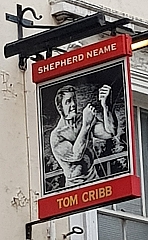
PANTON STREET RUNS between Leicester Square and Haymarket. The Tom Cribb pub, formerly known as the ‘Union Arms’, stands on the corner of Panton Street and Oxendon Street. The pub’s name commemorates a boxing champion Tom Cribb who lived from 1781 till 1848. A small plaque on the exterior of the pub commemorates another boxer, Bill Richmond (1763-1829).
Tom Cribb pub
Richmond was born into slavery at Richmondtown on Staten Island, New York. After witnessing Richmond’s fighting talent during a brawl at a tavern during the American War of Independence, a British commander arranged for his freedom, and took him to Yorkshire in England in 1777. There, he was educated and met his wife, Mary, while he was working as a cabinet maker. By 1795, Richmond and his family had moved to London, where he worked as an employee of Thomas Pitt, 2nd Baron Camelford (1775-1804), who happened to be a boxing enthusiast. According to Wikipedia:
“On 23 January 1804, Pitt and Richmond attended a boxing match featuring experienced boxer George Maddox. After Maddox won the bout, Richmond spontaneously challenged Maddox to a fight, which Maddox accepted. When the fight took place, Maddox defeated Richmond in nine rounds.”
Despite this, after Pitt died, Richmond took up professional boxing, and fought with many of the champions of the time, often winning these contests.
In 1805, after Richmond had defeated the Jewish champion Youssop and Jack Holmes ‘the coachman’, he challenged the great Tom Cribb, but lost. For many years Richmond and Cribb held grudges against each other. However, as the two men got older, they became friends. Often, they used to meet and converse in Cribb’s favourite pub, the Union Arms on Panton Street. It was in this pub on 28 December 1829 that Richmond spent the last evening of his life, relaxing with Tom Cribb. It is this that is recorded on the plaque outside the former Union Arms, now the Tom Cribb pub.
PULICAT IS ABOUT FORTY miles north of the centre of Chennai. It is one of the very few natural harbours on the Coromandel Coast (east coast of India). As early as the third century BC, it was a thriving port. The unknown author of the “Periplus of the Erythraean Sea” wrote that Pulicat was one of only three ports on the east coast of India.
Today, it is a busy little village where freshly caught fish and other seafood are packed with ice before being transported elsewhere. In earlier times, it was an important trading centre.
Between 1502 and 1609, the Portuguese had a trading station (‘factory’) in Pulicat. They built a fort there. In 1609, the Dutch defeated the Portuguese, and took over Pulicat. They controlled it until 1825, when Dutch possessions on the Coromandel Coast were handed over to the British.
The Dutch built a fort, Fort Geldria, at Pulicat. This is in ruins today, and what is left is covered by seemingly impenetrable vegetation. I did not feel intrepid enough to enter the tangled plants that cover the site of the fort. The Dutch also built a gunpowder factory in the town.
Pulicat was a port from which the Dutch exported a wide variety of goods from India, including for example, textiles, coins, and gunpowder. They also exported Indians as slaves to work in some of the other Dutch colonies in places as far apart as Ceylon and the West Indies. It is said that between 1625 and 1665 alone, over 38000 slaves, procured mostly by brokers in Pulicat, were exported in Dutch boats. Many more were carried away from India after that.
Seeing Pulicat today, as we did in January 2025, it is difficult to imagine that this large village was once a thriving centre of international trade, and even more impossible to realise that it was an important market place for selling slaves. However, there is one very visible reminder of the erstwhile Dutch presence in the town: a small cemetery containing many well-preserved graves and mausoleums of Dutch people who died in the district.
Before describing the cemetery, I will mention the small museum near it, and next door to a school named ‘Dutch Academy Nursery and Primary School’. The very basic museum is housed in what must have once been a small shop. Its walls have some interesting informative panels attached to them. These outline the history of Pulicat. As for the exhibits, they are a rather shambolic assembly of unlabelled odds and ends. In one glass fronted cabinet, there were some fragments of ceramic vessels. I wondered whether these were bits of things left behind by the Dutch. On close examination, I noticed one of these broken pieces was labelled “made in Japan”.
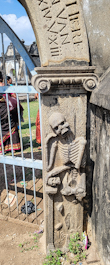
The Dutch cemetery is a fantastic sight. It is well worth making the 2 hour road trip from Chennai to see it. The entrance to the walled graveyard is made of carved stone. On each side, it is flanked by stone carvings of skeletons. One is resting its skull on its right hand and holding another in his left, and the other is balancing a double-sided drum or tabla on its skull. Although there are several obelisks and elaborate mausoleums in the cemetery, most of the graves are marked by horizontal stones upon which there are carved inscriptions. The inscriptions, which are all easy to read, are often framed with decorative floral carvings. Most of the inscriptions are in Dutch. A few are in Latin. The oldest of the deceased died in the mid to late 1650s. At the far end of the cemetery, we found two graves of British people. Although the British took over Pulicat in 1825, they used it more as a place for picnics than as a trading station.
The Dutch cemetery is a reminder that not every Dutch person who came to India to make a fortune returned home. What it does not recall is the vast numbers of Indians who were exported by the Dutch as slaves, and had no hope of ever seeing their homes again.
I BECAME AWARE of William Thomas Beckford (1760-1844) in the late 1960s when my late friend Michael Jacobs and I were fascinated by the gothic revival that began sometime in the 18th century and continued with great vigour into the following century. Although I never read it, the ‘Gothic’ novel “Vathek” was written by Beckford, who also built the (now demolished) gothic revival style Fonthill Abbey. My interest in Beckford gradually drifted into the back of my mind and remained there until we made a visit to Bath (Somerset) in July 2024. Our hosts suggested that we visit the recently restored Beckford’s Tower, which is located on a hill just north of the Lansdown district of Bath. Kindly, they drove us there, and what we saw was interesting.
Beckford had a house in Bath’s Lansdown Crescent. It was set in extensive grounds that spread from his house to where the tower is located. The Italianate neo-classical tower was designed by the Bath-based architect Henry Goodridge (1797-1864), and completed for Beckford in 1827. It is 154 feet high and contains rooms that Beckford used as a library and living rooms. The grounds between Beckford’s house and his tower were landscaped to become Beckford’s Ride. Along the way, there is a manmade grotto, which has been recently restored.
After Beckford’s death, the tower and the land associated with it were donated to Walcot Parish, which used the area to create a burial ground. In 1931, the tower and the rooms at its base were badly damaged by fire. The cemetery was closed in 1992, and the following year, the site – tower and graveyard – were purchased by the Bath Preservation Trust, who have restored it. Between 1997 and 2000, extensive repair work was carried out on the tower. Further work was undertaken between 2022 and early 2024. This rendered the tower structurally sound and safe for it to be opened to the public. Before ascending the elegant spiral (helical, actually) staircase in the tower, the visitor can view exhibits relating to the life of Beckford in the rooms at the base of the tower. Amongst these, I spotted an early edition of “Vathek”, written it the language in which it was first published: French.
The author of “Vathek” was extraordinarily wealthy. His father, Sir William Beckford (1709-1770), was born in Jamaica, and later became Lord Mayor of London (1762-1769). His wealth, and therefore that of his son, was derived from his sugar plantations he owned in Jamaica. These were worked by the hundreds of slaves he owned. Thus, the tower was financed by the labour of these unfortunate unpaid labourers. Unlike several colonial apologists I have met and heard, the website of the restored tower, and many exhibits and notices within the edifice, emphasise the way in which the author of “Vathek” was able to pay for the tower and his extravagant lifestyle. The website (https://beckfordstower.org.uk/about/history/) includes the following:
“Through marriage and ruthless ambition over four generations, the Beckford family became one of the most powerful on the island of Jamaica. Their vast fortune was built on the profits of sugar plantations, directly created through the stolen labour of thousands of enslaved Africans.
William Beckford’s father, Alderman William Beckford, used the family’s wealth to rise through British politics, and was twice Lord Mayor of London. He presented himself as a hero of liberty for British citizens, whilst people on his plantations in Jamaica were trafficked and forced into slavery, stripped of their dignity, traditions, familial ties and African names, and given the surname Beckford.”
The Lord Mayor is commemorated by a statue in London’s Guildhall.
“William Beckford inherited 3,000 enslaved Africans in Jamaica, whom he mercilessly exploited to accumulate great wealth in Britain. His enslaved Africans were victims of routine sexual violence, torture, bodily mutilation and mass murder. Today, we recognise slavery as a crime against humanity and an unresolved stain on the national consciousness. We display this statue not because we wish to honour Beckford, but as a reminder of how we as a nation have sanitised, obscured and neglected racial capitalism and racial terror as foundational narratives of our modern history.”
In 1835, after the British Parliament had abolished slavery, former slave owners were compensated financially as the tower’s website explained:
“In 1835 following the abolition of slavery Beckford [author of ‘Vathek’] received a compensation payment of £12,803 (nearly £1.3 million today), the ‘value’ of the lives of 1,860 enslaved people. He immediately acquired the neighbouring property at 19 Lansdown Crescent and embarked upon a further period of commissioning new furniture and interiors for his home and the Tower.”
Despite its association with slavery, the unusual Beckford’s Tower, is, like the Egyptian pyramids also built with slave labour, interesting both historically and architecturally. It has been beautifully restored. During the latest round of restorative work, care was taken to adapt the tower “… for sustainable energy use …” by installing some solar energy panels on the flat roof of the building that forms the lower part of the tower.
If you are visiting (or living in) Bath, a trip to see and enter Beckford’s Tower is well worth making. And when you are there, do not miss climbing the tower’s dramatic staircase to obtain a superb view of the city of Bath and the countryside beyond it.
LANCASHIRE USED TO be the centre of the cotton processing industry in the UK. Cotton grown in the southern USA and in India’s Gujarat was shipped to Lancashire, where the cotton mills used it to manufacture textiles.
In the heart of the city of Manchester, we were surprised to find a huge bronze statue of the former President of the USA, Abraham Lincoln (in office from 1861 to 1865). Lincoln played a significant role in the abolition of slavery in his country. Many of the slaves worked to grow and harvest cotton, much of which was sent to Lancashire. The processing of the cotton grown by the slaves provided employment for the workers of Lancashire. The statue was created by the American artist George Grey Barnard (1863-1938) in 1919, and is one of three castings – the others being in Louisville, Kentucky and in Cincinnati, Ohio.
Beneath the statue in Manchester and carved in the plinth, there is the wording of a letter sent by Lincoln to the working people of Manchester. Written on the 19th of January 1863, Lincoln thanked the workers of Manchester, who were supporting the abolition of slavery and at the same time suffering because of the blockade that prevented cotton reaching Lancashire from the southern states of the USA. According to one website (https://manchesterhistory.net/manchester/statues/lincoln.html), Lincoln’s blockade of the cotton exporting ports was not universally welcomed:
“To what degree the people of Lancashire gave this support willingly is questionable. Lincoln’s Union Army blockaded the southern ports preventing the Confederate supporters from trading their cotton and causing what was known as the Cotton Famine in the UK. By November 1862, three fifths of the labour force, 331,000 men and women, were idle. The British Government was encouraged to take action to overturn the blockade and riots broke out because of the hardship suffered by the workers. The Confederate Flag flew on some Lancashire mills.”
The American Civil War was not the only time that the Lancashire cotton workers had to suffer because of a freedom struggle taking place many thousands of miles away. In addition to the USA, British India was a supplier of cotton to the mills of Lancashire. Indian cotton was sent to Lancashire, and processed to make textiles that were then sold in India. Because of this, a vast number of weavers in India, who could have made the textiles, were made unemployed and impoverished.
As part of Mahatma Gandhi’s attempt to free India from British rule, he initiated a boycott of cloth and clothing made with textiles manufactured in England. This was sufficiently successful to render a great number of Lancashire textile workers unemployed – at a time when the Great Depression was hitting the country. On the 25th of September 1931, Gandhi travelled from London to Darwen, a small town (with textile factories) north of Manchester. He spent the following days speaking to people of all walks of life, explaining the purpose of his Khadi movement – the boycotting of imported textiles and the encouraging of homespun Indian textile production. Both of my wife’s grandmothers chose to wear only khadi cloth because they supportrd the freedom struggle. James Hunt described Gandhi’s visit to Lancashire in his book “Gandhi in London”, and noted that:
“Everywhere Gandhi explained that whatever the effect of his khaddar movement and boycott might have on Lancashire’s unemployment was a result of his prior concern with the greater sufferings in India. While Britain had 3,000,000 unemployed. India had 300,000.000 villagers idle every year. The average Indian income was a tenth of what the British unemployed worker received from the dole …”
Overall, despite the effects that his boycott was having, the workers of Lancashire welcomed him warmly and supported his cause.
Until we visited the Manchester Museum, which is about 1.3 miles south of Lincoln’s statue, I was unaware of Gandhi’s visit to Lancashire. The museum has a gallery dedicated to the South Asian diaspora, despite being called “the South Asia Gallery”. One of its showcases concentrates on the Mahatma’s brief visit to Darwen.
We visited Manchester in May 2024 to see an art installation curated by our daughter. We also wandered around the city, sightseeing. Little did we expect to discover connections between this vibrant city and both Abraham Lincoln and Mahatma Gandhi.
AFTER BEING DISAPPOINTED by the large temporary exhibition of playful but repetitive works by the artist Sarah Lucas (born 1962) at Tate Britain, we had a coffee and then revisited the rooms containing paintings and sketches by John Mallord Turner (1775-1851). It has been many years since we last viewed these paintings, and seeing them revived our spirits after having had them somewhat lowered by the Lucas exhibition.
One of the Turner galleries contains a particularly fine painting by the American artist Mark Rothko (1903-1970). It hangs amongst a series of Turner’s often unfinished late experiments on canvas. They were mostly items found in Turner’s studio after his death. Without outlines, these almost ethereal paintings are examples of the artist’s experimentation in ways of depicting light and colour. If one did not know when these works were created, one might easily guess that they are the works of an artist working during the age of Impressionism. As an aside, many of Turner’s finished works are extremely impressionistic, and I consider him to be the pioneer of what later became Impressionism, and one of the best creators in this style. These experimental works were displayed at an exhibition in New York City at its Museum of Modern Art in 1966. That year, Rothko remarked:
“This man Turner, he learnt a lot from me”.
The Rothko painting hanging amongst the Turner experiments was created in 1950-52. Later, in 1969, Rothko donated a set of his paintings to the Tate, hoping that they would be hung close to those of Turner. They are not; they are hanging at the Tate Modern.
Moving away from the room in which the Rothko painting is hanging, I came across another Turner painting that interested me, “The Deluge”, which was first exhibited in about 1805. In the bottom right corner, Turner has painted a black-skinned man rescuing a naked white woman. On close examination, the man can be seen to have a chain around his waist. The Tate’s caption to this picture includes the following:
“Painted at a time when the cause for Britain to abolish its enslavement of people of African descent was gaining ground, this detail is significant.”
Some years after it was painted, Turner gave a print of this work to a pro-abolition Member of Parliament.
“The Deluge” is not the only painting by Turner relating to his sympathy for the abolition of slavery. His “The Slave Ship”, first exhibited in 1840, is another powerful example. This painting, now in Boston (Massachusetts), is based on the dreadful incident when, in an attempt to cheat the insurers, the captain of a slave ship, the Zong’, caused 132 slaves to be thrown overboard (in 1781). Turner had learned about this crime from the anti-slavery activists with whom he associated. Although Turner, a liberal, was sympathetic to the abolition of slavery, he was not totally divorced from the benefits that transatlantic slavery brought to Britain, as was pointed out by Chris Hastings in the “Mail Online” on the 28th of August 2021:
“One of Britain’s greatest painters has fallen victim to woke culture, as art-lovers are being warned not to ‘idolise’ J. M. W. Turner because he once held a single share in a Jamaican business that used slave labour.”
The website of London’s Royal Academy gives more detail:
“It would be fair to assume that Turner’s views were strongly pro-abolition at the time he painted this work. However, scholars have pointed out that earlier in his career he apparently had no qualms about investing in a company that ran a plantation … In 1805 Turner invested £100 to buy a share in a business called Dry Sugar Work. Despite the name, this enterprise was a cattle farm on a Jamaican plantation run on the labour of enslaved people. The business was owned by Stephen Drew, a barrister who bought the estate from William Beckford in 1802. The firm went bust in 1808.”
Some many months ago, we saw a play at the National Theatre, “Rockets and Blue Lights” (written by Winston Pinnock). It concerns an ageing Turner seeking inspiration from a remembered incident like the awful event that took place on the “Zong”. During the play, it was alleged that because of his disgust with the slave trade, Turner gave up using sugar. Whether or not this was the case, I cannot say.
Fascinating as are abolitionist and the Rothko ‘connections’ with JMW Turner, the well-displayed paintings in the Turner galleries are all superb and well worth visiting.
HE WAS PASSIONATE about sketching and painting. However, his father, a wealthy Quaker brewer in Hitchin (Hertfordshire), insisted that his son should dedicate himself to working in the family business and use his spare time to create his art. The artist was Samuel Lucas (1805-1870). There is a wonderful exhibition of his creations at the beautifully laid out North Hertfordshire Museum in central Hitchin until the 12th of November 2023.
After schooling and an apprenticeship in London’s Wapping, Samuel worked in the family business in London before returning to work in Hitchin in 1834. As for his artistic ability, this appears to be self-taught. However, he was a keen visitor to the Royal Academy exhibitions in London. In 1837, he married Matilda Holmes, who had been a pupil of the artist John Bernay Crome (1794-1842). She was keen on sketching, but none of her works have survived. I speculate that it is not beyond possibility that Matilda, a water colourist, might have helped Samuel develop his superb water colour techniques.
Samuel’s sketches range from extremely detailed to impressionistic, resembling the work of JMW Turner to some considerable extent. The finished oil paintings, some of which were displayed at the Royal Academy, are beautifully composed, full of detail, and of great visual interest.
Two of the exhibits interested me more than the others. One of them is a pen and ink sketch depicting Thomas Whiting of Hitchin reading Harriet Beecher Stowe’s anti-slavery novel “Uncle Tom’s Cabin” (published 1852) to a gathering of people in a hall in Hitchin. Nearby, there was one of Samuel’s oil paintings. This shows seven men seated around a small table listening to a man standing with his left hand on the table. The standing man is Bishop Samuel Wilberforce (1805-1873). He is addressing members of the Oxford Mission amongst whom is the novelist Lord Lytton of Knebworth (Hertfordshire). The bishop was a son of the anti-slavery activist William Wilberforce. Bishop of Winchester from 1870 until 1873, he was both against slavery and Darwin’s Theory of Evolution. Samuel Lucas’s painting depicts him when he was Bishop of Oxford, which he became in 1845, and remained until he was shifted to Winchester. The Oxford Mission was an Anglican missionary organisation, which became important in Bengal in the late 19th century.
The two pictures described relate to Samuel Lucas’s involvement of the anti-slavery movement. In 1840, he was Hitchin’s delegate to the Anti-Slavery Convention held in London at Exeter Hall on the 12th to 23rd June 1840. During this period, he and his wife hosted some of the delegates who had come from the USA. The convention is portrayed in a painting by Benjamin Haydon (1786-1846), which is now in the National Portrait Gallery. The gallery’s website has a photograph of this painting, which has been displayed so that the viewer can identify each of the people in it. Samuel Lucas can be found near the back of the gathering near a pillar.
Lucas was against slavery, as were many of his fellow Quakers. In addition to this activity, his artistic creations, and his involvement in the family business, he was also an active contributor to the life and development of Hitchin. One of the largest of his paintings in the gallery, but not included in the exhibition, is a depiction of Hitchin’s Market Place. Each of the many people shown in the painting is a portrait of an actual person. The museum has an interactive guide to identify the people. One of them was Isaac Newton (1785-1861). This gentleman was not the famous scientist but the owner of a family firm of painters, plumbers, and glaziers. One of the many folks in the picture has a dark complexion. This is a portrait of Samuel ‘Gypsy’ Draper (1781-1870). He was a violinist, who played for dances and fairs in the area in and around Hitchin for about 20 years. Some of the local Quakers disapproved of him, but Samuel Lucas placed him at the front of the crowd in the centre of the painting. Had we not visited the North Hertfordshire Museum out of pure curiosity, I doubt that we would have ever come across the life and works of Hitchin’s Samuel Lucas. We spent most of our time looking at the superb exhibition about him, so that we had hardly any time left to see the rest of the museum. A fleeting glimpse of the other galleries in the lovely modern building was enough to persuade us that we need to return to see more.
UNTIL FEBRUARY 2022, only very few people with specialised knowledge of history would have been able to point out the house in which Marie-Louise Christophe lived in London between 1821 and 1824. Now, there is a plaque on the house in Marylebone’s Welbeck Street that marks the house in which she resided. And by now, you might well be wondering why anyone might want to know.
Marie-Louise (1778-1851) was born into a free black family, which ran a hotel, in St Dominique (which is now Haiti). In 1793, she married Henri Christophe (1767-1820), who had been one of her father’s slaves before he had earned enough in tips to purchase his freedom. After several years of revolution, in which Henri Christophe was an important freedom fighter, Haiti gained independence from France in 1804. In 1811, Henri was crowned the King of Haiti and the following year, Marie-Louise was given the title of Queen of Haiti. After the death of her husband in 1820 and the assassination of her two sons, she fled from Haiti along with her daughters. Their escape was assisted by the British, and they settled first in Blackheath, where they were hosted by the Anti-Slavery activist (abolitionist) Thomas Clarkson. After several changes of address, the Queen and her daughters settled in number 49 Welbeck Street.
According to the British press of the time, she and her daughters were popular with British people in all the social echelons. In 1824, they left London for Europe. Marie-Louise died in Rome, where she is buried. She never returned to Haiti. It was only in February 2022 that the Nubian Jak Community Trust were able to put up the commemorative plaque which you can see on number 49 Welbeck Street. It correctly describes Marie-Louise as “First and Only Queen of Haiti.”
IT USED TO BE THE CASE that, amongst other things, fancy goods and professional services were priced in Guineas, rather than Pounds Sterling. A Guinea was worth twenty-one shillings. That was, before decimalisation, one Pound and one Shilling (£1.05 after monetary decimalisation occurred on the 15th of February in 1971). Although I was fully aware of the nature and value of one Guinea, I had never given its name a thought until 2023, when we went to an exhibition in the Bank of England’s fascinating museum. The exhibition was about the Bank and its various diverse connections with the slave trade.
One exhibit was dedicated to the Guinea. The first Guinea coin was minted in 1663. Its name derived from the West African Guinea Coast, which was an important centre for the British export of African slaves. It was also a place to obtain gold that had been mined by local Akan miners working in the forests of what is now Ghana, but was the British colony called “The Gold Coast”. Some of this gold used to be obtained by the Royal African Company and transported to London.
So much for the origin of the name of the unit of currency. And now for something I knew already, but have always found fascinating. My father had a book in his study – “The Golden Trade of the Moors” by EW Bovill (published in 1961). In this interesting, scholarly book the author described an important trade between the ‘Moors’ of North Africa and the miners in what is now Ghana and nearby parts of tropical Africa. The North Africans mined salt (NaCl) from beneath the surface of the Sahara Desert. At the same time, Africans were digging up gold in the tropical forest of West Africa. However, there was a severe lack of available salt in the places where the gold was being harvested. Long before the British became involved with Africa, North Africans used to transport salt southward across the desert to the tropical forests where gold was being produced. So valuable was the salt to the gold miners and their families that the only thing that they would accept in exchange for gold was the salt carried from North Africa. Salt, an essential for life, was literally worth at least its weight in gold.
Sadly, after Europeans began their involvement with Africa, gold was not the only valuable commodity that could be obtained from there. For several centuries, another major export was human beings: slaves to work in lands across the Atlantic from Africa. The exhibition at the Bank reveals that many of its personnel were involved in the slave trade, but not all. Some were active in the movement to abolish the slave trade. It is a well designed exhibition and most interesting.
THE TALL GREY GRANITE drinking fountain that stands on the southeast corner of London’s Lincoln’s Inn Fields is no longer in use. The inscription carved on its base reads:
“In memory of Philip Twells. Barrister at law of Lincolns Inn and sometime Member of Parliament for the City of London. 8 May A.D. 1880”
Born the son of a banker John Twells (1776-1866), Philip (1808-1880) attended Oxford University and then was called to the bar at Lincoln’s Inn in 1834. His father was a partner in the private bank of Spooner Attwood & Co. In 1863, that bank was taken over by Barclay, Bevan & Tritton & Co, a precursor of the modern Barclays Bank. It was then that Philip became a partner in the enlarged banking concern. He was MP for the City of London from 1874 to 1880.
A website (www.layersoflondon.org/map/records/philip-twells-mp-banker-and-slave-owner-of-stoke-newington-church-street) recorded that Philip Twells owned 252 slaves in Jamaica, and added:
“The Slavery Abolition Act of 1833 had made the ownership of slaves illegal within the British Empire although servitude was replaced by ‘apprenticeship’ for at least five years. The 1837 Slave Compensation Act provided compensation to owners for the loss of their business assets.”
“Awarded part of the compensation for the Islington estate in St Mary Jamaica with his brother Rev. John Twells …”
The slave-owner compensation awarded to Philip was £4207, which is worth well in excess of £300,000 in today’s money. On his death, Pholip left a substantial fortune to his wife.
The fountain commemorating Twells in Lincoln’s Inn Fields was a gift of his widow, and was erected in 1882. Sadly, this memorial to a former owner of slaves can no longer refresh the passer-by. However, during weekdays, food and drinks can be obtained at a café in the middle of Lincolns Inn Fields. And while you are in the area, do not miss seeing the magnificent Sir John Soane’s Museum on the north side of the Fields.
IN “REGENCY BUCK” by the English novelist Georgette Heyer (1902-1974), we read in chapter II:
““Weighs something between thirteen and fourteen stone,” said Mr. Fitzjohn knowledgeably. “They say he loses his temper. You weren’t at the fight last year? No, of course you weren’t I was forgetting. Well, y’know it was bad, very bad. The crowd booed him. Don’t know why, for they don’t boo at Richmond and he’s a Black, too. I daresay it was just from everyone’s wanting Cribb to win. But it was not at all the thing, and made the Black think he had not been fairly treated, though that was all my eye and Betty Martin, of course. Cribb is the better man, best fighter I ever saw in my life.”
This extract includes two names ‘Cribb’ and ‘Richmond’. Both were boxers of great renown: Tom Cribb (1781-1848) was an English world champion bare-knuckle boxer and Bill Richmond (1763-1829) was more than simply a boxer.
Richmond was an ex-slave born into slavery in Richmondtown on Staten Island, New York (USA). He was then a ‘possession’ of the Reverend Richard Charlton. Hugh Percy, 2nd Duke of Northumberland (1742-1817), an officer commanding British forces during the American War of Independence, saw Richmond involved in a fight with British soldiers in a tavern, and recognised the black man’s skill as a boxer. After arranging fights between young Richmond and other British soldiers, Percy bough Richmond his freedom and sent him to England, where he organised his education, and apprenticed him to a cabinet maker in Yorkshire. Richmond married in England and later moved to London, where, already in his forties, he began his largely successful and lucrative career in boxing. He also owned a pub, The Horse and Dolphin, for a while. Today the Dutch pub in Soho, De Hems, stands on its site.
Soon Cribb was challenging and beating some of the best boxers of the time. However, in 1805, Richmond challenged Cribb, and lost. This led to bad relations between the two men, which lasted for years. Richmond met another former slave Tom Molineaux (1784-1818). Recognising his new acquaintance’s potential as a boxer, Richmond gave up boxing to train Molyneaux. After having narrowly lost two fights with Cribb, in 1810 and 1811, Molyneaux fired his trainer, Richmond.
After losing money on training and sponsoring Molyneaux, Richmond, by then aged 50, took to the boxing ring again. At this advanced age, he challenged and beat two younger champion boxers, Jack Davis and then Tom Shelton. After these two victories, he wanted to challenge Cribb again, but the latter had already retired. In 1820, Richmond founded a boxing academy for training amateur boxers. Amongst those he trained were two now famous literary figures: William Hazlitt and Lord Byron.
As he and Cribb aged, they became friends. It was in the pub that Cribb owned, The Union on Panton Street (near Leicester Square), that Richmond spent the last evening before his death. The Union still exists but is now named the Tom Cribb. A plaque on the outside of this hostelry commemorates Cribb’s achievements and another one records Richmond’s last night out, which was spent with his friend Tom Cribb.




 yamey
yamey 