In January 2025, while visiting the extensive remains of Golconda, which is near Hyderabad in Telangana, I noticed an old artillery piece that bore the letters ‘VOC’, the initials of the Dutch East India Company. This got me curious about possible Dutch connections with Golconda, and I began researching on the Internet. While doing this, I became aware of Pulicat, which is on the coast of the Bay of Bengal, about 70 miles north of Chennai. This small place was under the control of the Dutch for most of the seventeenth and eighteenth centuries. Apart from learning about Pulicat for the first time, I discovered that this now sleepy place was formerly involved in the trafficking of human beings.
Just as the Portuguese had done before them, the Dutch were involved with trading slaves along the Coromandel Coast including at Pulicat. Apart from generating revenues, slaves were needed to provide labour in the Dutch colonies including Sri Lanka and the East Indies. They also exported these poor individuals to the West Indies. Pulicat was a significant centre of the Dutch Coromandel slave trade. An important source of these slaves were boats from the Burmese kingdom of Arakan. These vessels raided Bengal and captured many Indians from that area. They were then shipped to Pulicat (and other Dutch trading posts), where they were bought and trans-shipped to be sent on to places where labour was needed. It was big business. For example, between 1659 and 1661, between 8000 and 10000 slaves were shipped from Coromandel ports including Pulicat. During the heyday of the Dutch occupation of Pulicat, slaves sometimes made up from between 25% to 66% of its population.
Prior to visiting Pulicat in January 2025, I did not know about the slave trading that occurred along the east coast of India. Also, naively, I had not realised that the Dutch had been so deeply involved in the despicable trading of human beings. In July 2023, an Indian publication, ThePrint, noted that the royal house of the Netherlands:
“… had directly earned at least €500 million from the slave trade in modern currency.”
It continued:
“This weekend, King Willem-Alexander of the Netherlands formally apologised for the role of the Orange-Nassau dynasty in enabling the slave trade. The Dutch East India Company slave traders, the King said, had turned individuals into commodities, a kind of oppression that is ‘the most hurtful, the most humiliating, the most degrading’.”
When the British took over Pulicat in 1814, it was a shadow of its former self. This was partly because by then Chennai was becoming a major port. Whereas Pulicat’s population had reached at least 50,000 in the early 16th century, by 1889, it was about 5,000. Under British rule, Pulicat was a fishing village and a British seaside resort and picnic spot. Although its lighthouse was rebuilt in the 1890s, it served not as a beacon to guide traders into Pulicat, but merely to warn mariners of the hazardous shoals near to the place.
In 2011, Pulicat had about 18,000 inhabitants. We saw plenty of them as we drove slowly though the town’s narrow, congested streets. The main road from Chennai runs through the centre of Pulicat and then along a bridge that traverses the mouth of the Kosasthathalaiyar River next to which the town lies. After discovering the town’s poorly marked, not too pleasant, public toilets, we turned down a road that leads past the Dutch Cemetery and a modern school named Dutch Academy Nursery and Primary School, and reached the AARDE Pulicat Museum. This very basic, small museum is housed in what must have once been a small shop. Its walls have some interesting informative panels attached to them. These outline the history of Pulicat. There were also some reproductions of old plans of Fort Geldria built by the Dutch. As for the exhibits, they are a rather shambolic assembly of unlabelled odds and ends. In one glass fronted cabinet, there were some fragments of ceramic vessels. I wondered whether these were bits of things left behind by the Dutch. On close examination, I noticed one of these broken pieces was labelled “made in Japan”.
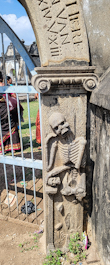
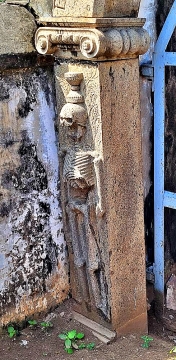
The Dutch Cemetery, which is a few yards away from the museum, is fascinating. The stone archway at its entrance is flanked by a pair of carved stone skeletons. One of them has on its head a spindle-shaped object that looks like a double-sided tabla with a wasp-waist. Actually, it is an hourglass (see below). The other appears to be resting its head on its raised right hand while placing its left hand on a skull. Like many other colonial cemeteries that we have visited in India, there are several obelisks to be seen. However, what makes the Dutch Cemetery extremely fascinating is that the lettering on almost all the gravestones and monuments is crystal clear, easy to read. Hardly affected by centuries of weathering, the inscriptions look as if they were carved yesterday. In “List Of Inscriptions On Tombs Or Monuments Madras Vol 2” by Julian James Cotton (published 1946), I found the following:
“The old Dutch cemetery is perhaps the most interesting of its kind in India; and the artistic merit of the coats of arms carved on the tombstones is such that it has been suggested that they were sent out from Holland, though no authority is known for the statement.”
Regarding the gateway, this source related:
“In front of each of the two gateposts stands a sculptured stone skeleton, almost life size. These figures are said to be male and female. One has a hourglass on his head and the other supports a skull on a column. The native legend is that the former figure holds an eggshell and represents a Dutch Governor who, during a terrible famine, doled out eggshells of rice to the starving poor and made a fortune out of their sufferings. His memory was so execrated that every passer-by used to spit at the effigy…”
This same book also lists the graves and quotes the inscriptions on them, as well as those in a second Dutch cemetery, which we did not see. One of the oldest graves that I spotted was of Dirk Maes van Rees, who had died in 1662. Many of the graves were of people who died in the 18th century. A great number of gravestones had family crests carved above the inscriptions. At the far end of the cemetery, we found two graves of people with British names: Henry Forton, who died at Pulicat in 1864, aged 52 years; and Elizabeth Catherine, wife of Mr William Lodge, who died in 1862, aged 56 years. The Dutch cemetery is a reminder that not every Dutch person, who came to India to make a fortune, returned home. What it does not recall is the vast numbers of Indians who were exported by the Dutch as slaves, and had no hope of ever seeing their homes again. Today, the cemetery is visited by tourists: we met a group of Indian students. And it is populated with goats which graze on the vegetation growing amongst the funerary monuments. Apparently, there had been a Portuguese cemetery, but this was either destroyed by the Dutch when they took over Pulicat or, like the Dutch fort, neglected and left to disintegrate.
The coast of India is dotted with tiny places that were once ruled by Europeans. Before viewing Pulicat, we had already visited Daman, Diu, Goa, Mahe, Karaikal, Tranquebar, and Pondicherry. These are all places that have to some extent become unimportant. Some other former European trading posts have flourished and become great cities, such as Mumbai, Kolkata, Surat, and Chennai. We have visited these places several times and enjoyed spotting relics of their colonial eras. Pulicat, which was once an important trading centre is now a peaceful fishing port – a case of ‘Sic transit gloria mundi’.
Much of the above is a slightly modified excerpt from my book “88 DAYS IN INDIA: A JOURNEY OF MEMORY AND DISCOVERY“, which is available from Amazon:.