THE AUTHOR DAPHNE du Maurier (1907-1989) was born near London’s Regents Park, but spent much of her childhood in Hampstead. In the summer, she travelled with her family for holidays in Cornwall. They also lived there during WW1. In 1926, the family bought the still extant Ferryside, a house next to the ferry landing at Bodinnick. The eye-catching blue and white house can be seen across the River Fowey from many points in Fowey. I believe that one of her descendants still owns, and lives in, the house.
In the centre of Fowey, on the waterfront, there is a modern sculpture of a bird holding a book with one of its claws. Called “The Rook with a Book”, it was created by the Thrussels, a father and son team of sculptors based in Bodmin Moor at a point near to the source of the River Fowey. The sculpture was unveiled in 2018 by Daphne’s son Christian. The book being held by the rook bears the title of one of Daphne’s short stories – “The Birds”, published in 1952. The story was inspired by seeing a flock of gulls attacking a farmer working on a field. It was set in Cornwall soon after WW2. What makes this short story particularly significant is that it inspired Alfred Hitchcock to create his horror film “The Birds”, which was first released in March 1963.
IN 1975 I WENT to the town of Prizren in Kosovo, which was then part of the former Yugoslavia. I visited an old church in the town. Once, its internal walls had been covered with frescos. However, they had been badly defaced up to a certain height above ground level. Above that height and on the ceiling, they were intact. When the Ottoman soldiers arrived in Prizren, they used their spears to destroy the frescos, but only did so as far as they could reach. Being lazy, they did not use ladders to reach the higher parts of the church. So, the frescos beyond their reach survived.
In England, both the Dissolution of the Catholic religious establishments by Henry VIII, and later the defacement of churches by Oliver Cromwell and his followers, resulted in the destruction of many fine works of religious art. During a recent visit to Suffolk, we saw a few fine artefacts, which like the frescos in Prizren, have survived.
Bardwell
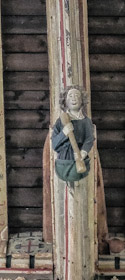
In accordance with Cromwell’s decree, many of the 15th century carved wooden angels that overlooked the nave of the parish church in Bardwell were destroyed. But, a few were left intact. Why was that? Did the workmen lose interest, or were they not paid enough? Who can say? And why was some of the 14th century stained glass left intact? Again, nobody can remember.
Over in the sleepy little town of Eye, the Parish Church contains a wooden rood screen containing beautifully painted panels that should surely have been destroyed by Cromwell’s iconoclastic vandals. Were they covered up with, say, wood panelling before the wreckers arrived, or were they removed and hidden? Luckily for us, these wonderful mediaeval paintings have survived.
Near Eye, there is a tiny church with a thatched roof in the village of Thornham Parva. It contains a rectangular wooden frame containing several mediaeval paintings that were created the 14th century. It was once the retable of an altar. Most likely, it was originally part of an altar in the Dominican Thetford Priory, which was dissolved during the reign of Henry VIII.
It is most probable that when the priory was dissolved, the retable was rescued by a Catholic family who put it in their private chapel. It passed through two other families before it was donated to the church at Thornham Parva in 1927. It is a rare surviving example of 14th century British religious painting. Interestingly, there is another series of painted panels in the Musée Cluny in Paris that resembles the Thornham Parva retable. Comparison of detailed aspects of these two sets of paintings suggests that they were both painted by the same team of artists, and were originally designed for the same location – most probably Thetford Priory.
In the space of three hours, we visited the churches at Bardwell, Eye, and Thornham Parva. All three contain artefacts of great interest and beauty which survived the religious upheavals orchestrated by Henry VIII and later by Cromwell. Once again, touring around in England has opened our eyes to its treasure house of history.
PAINTINGS, PRINTS, AND drawings cannot be fully appreciated by the partially sighted, and not at all by those who are blind. In contrast, sculptures can be enjoyed by those who have problems seeing if they are permitted to touch them. Sadly, most sculptures by famous artists are not allowed to be touched. Today (7th of June 2023), I visited an exhibition of works by the Czechoslovak artist Maria Bartuszova (1936-1996) at London’s Tate Modern gallery.
Many of Bartuszova’s intriguingly original sculptures, often with highly organic shapes are too fragile to be touched. In 1976, the 1st Sculpture Symposium for blind and partially sighted children was held at the Elementary School for Partially Sighted Children in Levoca (Slovakia). A second such event was held at the school in 1983. Bartuszova created a series of hand-sized sculptures, some of which could be taken apart and then re-assembled by the children attending the workshops. The idea was to get the visually handicapped children to appreciate shapes and textures by handling her sculptures. The exhibition at the Tate Modern shows photographs of the youngsters at these workshops, most of them with happy expressions on their faces.
Some of the artworks that these children were encouraged to touch are displayed in glass cases. However, visitors to the exhibition at the Tate Modern are not permitted to touch them.
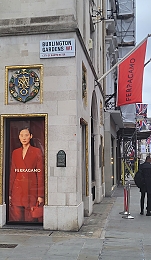
WHERE BURLINGTON GARDENS meets the south end of New Bond Street and the north end of Old Bond Street, there are two things that reminded me of my late mother.
One of them is a shop in a colourfully decorated building. This edifice used to be the home of Atkinson’s – a firm that sold perfumes and beauty products. Founded in 1799, it moved to the building on the corner of Burlington and Old Bond Streets in 1832. The decorative building is surmounted by a carillon of 23 bells, which is played by hand occasionally – to celebrate both public and private special occasions. Currently, the ground-floor is occupied by a branch of Ferragamo’s. And this firm has a connection with memories of my mother.
Salvatore Ferragamo (1898-1960), born in Italy, was a designer of luxury shoes. His clients included the Maharani of Cooch-Behar, Eva Peron, and Marilyn Monroe. He died in Florence (Firenze), where he had a shop on the Via dei Tornabuoni. This shop was close to Via del Giglio, where we as a family used to spend a fortnight in the city every year until I was about 15.
One of my clearest memories of our sojourns in Florence was not the Uffizi or the famous Duomo or the Medici Chapels, or even Michelangelo’s statue of David, but Ferragamo in Via dei Tornabuoni. You might wonder why. It was not that I have a shoe fetish or any great interest in footwear. It was because of my mother. Hardly a day passed without us having to enter Ferragamo’s to watch my mother trying on several pairs of shoes. For a youngster like me this was not an interesting way to spend my precious school holidays. And what is more, I cannot recall my mother ever buying a pair of shoes in that shop.
Facing Ferragamo’s on the corner of New Bond Street and Burlington Gardens, there is a small paved open space. In the middle of it, there is a bronze sculpture of a horse and rider. This was sculpted by Elisabeth Frink (1930-1993). My mother was also a sculptor and met Frink (or ‘Liz Frink’, as we knew her) at St Martins School of Art (in Tottenham Court Road), where they both worked in the Sculpture Department. They became close friends. I used to meet Liz Frink when she was invited to our house for dinner occasionally.
The Frink sculpture has been on Bond Street since 2018. Before that, it was located at the corner of Dover Street and Piccadilly, where it was placed in about 1975. As for the branch of Ferragamo’s that faces it across Burlington Gardens, I am not sure how long it has occupied its present site. However, it was only today that it occurred to me that the intersection of the two Bond Streets with Burlington Gardens has a connection with recollections of my mother.
ELEANOR OF CASTILE (1241-1290) was the first wife of King Edward I. They married in 1254. The pair were devoted to each other. She even travelled to the Middle East with her husband, to the battlefields of the Crusade of 1271-1272. When she died of (possibly) a malarial disease, after having survived sixteen pregnancies, at Harby in Nottinghamshire (close to Lincoln), her husband was at her bedside for the last three days of her life.
Her body was embalmed in Lincoln, and then transported ceremoniously to Westminster Abbey – a journey that took several days. At each of the places where her corpse stopped overnight, Edward ordered memorial crosses to be erected. These became known as Eleanor Crosses. They were placed at: Lincoln, Grantham, Stamford, Geddington, Hardingstone near Northampton, Stony Stratford, Woburn, Dunstable, St Albans, Waltham, Westcheap, and Charing (now a part of central London, but originally a small hamlet close to the Thames). Of the original crosses, only significantly large remnants of three survive.
The cross at Stamford in Lincolnshire was demolished but a small fragment of it is in the local museum. Not much is certain about where the cross stood in Stamford. It is believed that it might have been destroyed between 1646 and 1660 by zealous Parliamentarians (http://stamfordlocalhistorysociety.org.uk/queen-eleanor%E2%80%99s-cross).
Currently, a tall tapering sculpture – a tall, sharp spike with a circular base – stands on the place that was most likely where the Eleanor Cross stood. It was designed by Wolfgang Buttress (born 1965) – a sculptor from Nottingham. His creation, completed in 2009 and made of local Ketton stone, incorporates the kinds of decorative motifs that might have been on the original cross. It is surrounded by a ring of benches. Both the seats and the spike are studded with circular bronze discs, each of which contains a word from a Japanese haiku, so I have read. Sadly, I did not examine the object closely enough to see them because we were close to the expiry time of our parking space.
WHEN I WAS A YOUNG child, I remember going with my parents to south London to visit a Spanish sculptor, who had escaped to Britain as a refugee during the Spanish Civil War. Although we only visited him once, I recall that his name was something like ‘Alberti’. That is all I can remember, and I do not believe that my parents ever spoke about him much since that visit made maybe more than 60 years ago.
Today, the 20th of May 2023, we spent a couple of hours in the Lincolnshire Town of Stamford. This attractive place has several lovely old churches, one of which is St Martins. This edifice contains a chapel filled with glorious funerary monuments of members of the Cecil family, which was of great importance during the reign of Queen Elizabeth I and other Tudors.
When we were about to leave the church, I spotted a modern wood carving of the head of a man with a beard and moustache. Although it was not nearly as attractive as the Cecil monuments, I decided to examine it. I do not know why I did, but I am glad that I did.
I was surprised to discover that the carved head was created by Jose Manuel de Alberdi Elorza (1922-2008). Beneath the head there is a notice with the following words written by Alberdi: “A kind of anti-war protest… The face at the moment just when Christ died on the cross … The deed is done. We have killed.”
The sculptor was two years younger than my mother, also a sculptor. All that I can discover about Alberdi on the Internet is that he was Basque and a refugee from the Spanish Civil War. Also, he taught sculpture at the St Martins School of Art in London from 1948 to 1958 , which is where my mother made sculptures during that time.
Although I cannot be certain, I am pretty sure that this head in Stamford was made by the Spanish sculptor we visited in South London so many years ago.
THE ARTIST RACHEL Whiteread (born in Essex in 1963) sees the world from an original perspective. Her sculptures depict the spaces contained within or around objects. One of her sculptures currently on show in an exhibition in London’s Tate Britain Gallery illustrates her approach well.
The artist has made a plaster cast of the space enclosed by the staircase in the building housing her studio. When you look at the artwork carefully, it can be seen to consist of sections of plaster, rather than one single piece. I am guessing that what Whiteread did was to make plaster casts of parts of the staircase, its walls, and ceiling, and then assembled them to create what is effectively the shape of the space enclosed by them. The result is something that at first glance makes one think of staircases, but after a few moments realisation, you notice that it is not what it first seemed to be.
One of the artist’s first and maybe best known works was created in October 1993. Called “House”, it was a plaster cast of the interior of a whole house, which was about to be demolished, on Grove Road in the East End of London. I remember going to see this unusual artwork during the short time it existed; it was tragically demolished by the local council in January 1994.
In addition to large projects such as described above, Whiteread has created many smaller works, such as plaster casts of the insides of containers (e.g., hot water bottles) and the spaces surrounding objects (e.g., chairs and doors). However, it is the larger works like the staircase and the house that I prefer.
Some people may criticise Whiteread’s work as being, to quote Hans Christian Andersen, the stuff of “Emperor without clothes”, but that is a simplistic view of her creations. What artists like Whiteread (and other much criticised artists such as Picasso) make us do, is to see and consider things in a new way – you might say “with new eyes”.
THIS MARCH (2023), we have seen several exhibitions of works of art and craft involving the use of braiding, knotting, weaving, and other methods of employing threads. We saw the exhibition of Kimohimi braiding at the Japan House in Kensington. At the Tate Modern, we saw the quipus created by Chilean Cecilia Vicuña and the wonderful exhibition of imaginative fabric sculptures made by the Polish Magdalena Abakanowicz. Today, the 26th of March, we visited the Serpentine North (formerly ‘Sackler Serpentine’) Gallery in Kensington Gardens. We visit this place often because it usually has exhibitions which are always of interest and frequently pleasing aesthetically. Until the 10th of April 2023, the Serpentine North has a display of sculptures by the African American artist Barbara Chase-Riboud (born 1939 in Philadelphia, USA). We had never heard of her, but that did not surprise us as the gallery often shows works by artists, who are new to us.
A talented child, she entered the Fleischer Art Memorial School in Philadelphia. This establishment, which was opened in 1898, offered free art classes to children. After a successful school career at the Philadelphia High School for Girls between 1948 and 1952, she was awarded Bachelor of Fine Arts from the Tyler School at Temple University in 1956. By 1960, she had moved to Paris (France). Just before that, her eyes were opened-up to non-European art when she made a trip to Egypt.
The beautifully produced exhibition hand-out related that in Paris, she: “… found herself among a diverse community of socio-politically engaged writers, artists and thinkers including James Baldwin, Alexander Calder, Max Ernst, Dorothea Tanning, Lee Miller,and Man Ray. Moreover, through extensive travelsto Egypt, Turkey and Sudan, she deepened herknowledge and appreciation of global art and architecture, which continued to shape her artistic production from this point onwards.”
The Serpentine exhibition is called “Infinite Folds”. This is a good name because many of Barbara’s works involve the use of folded materials, be they sheets of fabric or of cast metal. In many cases folded sheets of metal are combined with bundles of silk or wool threads, often knotted in places. Some of the metal sculptures appear to have skirts of fabric threads. The artist makes these works seem as if the metal is being supported by the threads – giving, as she said, the impression that the wool has become the stronger material and the folded metal sheets the weaker of the two.
Some of the works are the artist’s interpretations of ancient cultures and traditions of places she has visited such as India and China. Other artworks celebrate famous figures from the past including Josephine Baker, Malcolm X, Nelson Mandela, the Queen of Sheba, and others.
The works in the exhibition are intriguing, well-crafted, and beautiful. They have been placed attractively and well-spaced in the within the old armoury, now the Serpentine North Gallery. When we headed for the exhibition, we had no idea what to expect. What we found was breath-takingly wonderful. Although there is no entry charge, I would have been happy to pay to see this artist’s works.
FORT KOCHI IN Kerala was occupied by three European powers: first by Portugal, then ny the Netherlands, and then by the British until 1947. It was whilst the British were in charge that a small jail was built on what is now Tower Road. Next to a police station and close to a string of roadside seafood restaurants, there is a gate that leads into the Jail of the Freedom Struggle. This prison was built by the British at a forgotten date during the 19th century. One clue to its age is that some of its roof tiles can be dated to 1865. The prison has a row of eight cells, each equipped with a 6 foot long concrete bed.
The prison, which might have been used as a transit establishment for prisoners waiting to be taken elsewhere, is said to have held leading freedom fighters such as Mohammed Rehman, Accamma Cherian, and K J Herschel, A K Gopalan, E M S Namboothiripad, and Abdurahiman Sahib. However, this is not known for certain. The prison, which had become disused and dilapidated, was restored in 2009, and opened as a museum.
In February 2023, we visited Fort Kochi to explore the 2022 Kochi Muziris Art Biennale. Unconnected with this major event, we visited an exhibition of artworks being displayed in the former prison. This included both paintings and sculptures. What made it an usual exhibition is that the exhibits are all contained within the cells behind strong iron doors with vertical bars. The doors that once prevented the prisoners from leaving the cells now prevent visitors from entering them.
BETWEEN A ZOROASTRIAN (Parsi) well and Churchgate railway station, both in central Mumbai, there stands a wonderful steel sculpture, which was financed by the Tata company (named after its Parsi founder).
The sculpture, completed in 2011, is the creation of the architect Nuru Karim and colleagues. Consisting of two closely placed spirals, it rises to a height of 11 metres. The spirals are formed using a set of triangular frames made of a type of Tata steel alloy.
The sculpture is named ‘Charkha’, which means ‘spinning wheel’, and refers to the spinning wheel which Mahatma Gandhi encouraged his followers to use to help make India self-sufficient and less dependent on British imported textiles. Each of the triangles are unique. Combined together in this sculpture, they are supposed to portray unity within diversity, and India’s rich mix of diverse cultures. In other words, the artwork is expressing the idea or hoped-for ideal that although a rich mix of different people, India is one united country.
Whether or not India has achieved this ideal, this sculpture is both aesthetically pleasing and a welcome addition to Mumbai’s incredibly rich mix of visual delights.





 yamey
yamey 