THERE ARE MANY sculptures by Henry Moore (1898-1986) in London’s public spaces (see: https://londonist.com/london/art-and-photography/where-to-find-henry-moore-sculptures-in-london). One of them, “Knife Edge Two Piece”, can be seen on College Green, opposite the Houses of Parliament. Consisting of two huge pieces of bronze, this was created by Moore between 1962 and 1965. Its form was inspired by a fragment of animal bone, as are many of his other sculptures. When we visited Moore’s home in Perry Green (Hertfordshire), we saw display cases filled with bits of bone the artist had collected over the years,
The sculpture outside the Houses of Parliament is one of three casts of the same work. The other two are in Canada and the USA. Moore donated the sculpture that stands in Westminster, to the Nation in 1967. In 2011, it became part of the Parliamentary Art Collection. It is now a listed object. It is one of only 41 post-WW2 sculptures in Britain to have been awarded the listed status.
Henry Moore is one of the greatest of British twentieth century artists. It is fitting that his sculpture should stand amidst buildings that have played, and continue to play, important roles in the life of the country.
THIS SCULPTURE STANDING in the foyer of the ActOne cinema in Acton is labelled “The Urchin” and dated 1968. The sculptor is named Ute Sturch. I have searched the Internet for information about the sculptor, but found nothing. Does anyone have any information about the life and work of this creator?
DURING THE 1950S and the first half of the 1960s, my mother, Helen Yamey, created sculptures in the sculpture workshops of St Martins School of Art, which was then located on Charing Cross Road. Although my mother was not a student at St Martins, she worked alongside one of the school’s teachers of sculpture, the noted sculptor Anthony Caro (1924-2013). Caro became famous for his metal sculptures that consist of pieces of metal either welded or bolted together. While my mother was making sculptures at St Martins, she like other sculptors including Phillip King, Tim Scott, and William Tucker, was undoubtedly influenced by, and learned from, Caro’s work. She learned welding and created several abstract sculptures that consist of pieces of steel welded together. Unlike Caro, who achieved great fame, my mother, who was unambitious and only created sculpture to fulfil a creative urge, my mother and her sculptures became forgotten.
Today, 8 March 2025, we visited the Annely Juda Fine Art Gallery in central London to see a small exhibition of sculptures by Anthony Caro. Unlike many of Caro’s works, the metal sculptures on display, are not enormous. They are small enough to be fitted comfortably into one’s living room or a small garden. Indeed, one of the sculptures, in my opinion the most attractive, has the title “Table Piece CCCXLI”. It was constructed in oxidised steel. The five Caro pieces in the exhibition display a variety of compositional style, and together demonstrate the artist’s versatility. They were all made between 1970 and 1990. My mother left St Martins before this period, sometime in the mid-1960s. I know that she maintained an interest in Caro’s output, but. Sadly, I cannot recall what she thought of its quality.
SCULPTURE CAN BE APPRECIATED by enjoying the light reflected off it or passing through it, by touch, and sometimes by sounds it makes. Today, at London’s Tate Modern gallery, I saw an exhibition of sculpture that can be seen, but cannot be touched or even heard. The exhibits were beams of light projected onto screens through a room filled with the sort of smoke used in theatres to create haziness. All these exhibits were created by the British artist Anthony McCall, who was born in 1946.
The projected light creates often changing patterns on broad screens. What makes the exhibits really exciting is that the slowly moving smoky haze in the room allows the viewer to see the paths taken by the projected light through space. These three-dimensional envelopes of light produce interesting sculptural forms, but unlike most sculptures, the viewer can move through them unimpeded. And while moving through these space-filling light formations, the viewer modifies their shapes and what is projected onto the screens. The results are both intriguing and beautiful, apart from being quite unusual. Words cannot adequately describe what we saw at this show. You need to experience it for yourself to enjoy this intangible but intensely visual sculptural show, which is continuing until 27 April 2025.
DURING OUR RECENT (January 2025) stay in Pondicherry, we passed an interesting looking doorway several times but it was always closed. Above the doorway are the words “Foyer du Soldat”, and these are superimposed on the French tricolour (red, white, and blue).
On the last day of January, we passed the doorway yet again and this time it was open. Through the doorway I saw what looked like a life-sized statue of General Charles de Gaulle. We crossed the road and entered the building. In the hallway, the large statue, which stands on a plinth with small white plastic wheels, is labelled “Charles de Gaulle”. High above his head, there is a framed photograph of French President Emmanuel Macron. His photograph was not the only one. There were others depicting several past Presidents of France, including: Mitterand, D’Estaing, Sarkozy, and Chirac.
Next to these portraits, there is one of Georges Montout, who has eight medals pinned to his chest and is described as “Fondateur du Foyer du Soldat de Pondichéry”.
“Les Foyers du Soldat was one of the three official welfare organizations; the Red Cross and the Y.M.C.A. were the other two. They set up canteens for soldiers to go to while on leave, providing a place to sleep, relax, eat, bathe; they even provided entertainment such as music or films.”
Many men of Indian origin living in French colonies such as Pondicherry fought for France during wars including the two World Wars. A French monument to those Indians who died can be seen near the seafront in Pondicherry. The city’s Foyer du Soldat was restored in 2010. It is housed in a colonial building, but I do not yet know when it was first established in Pondicherry.
When we stepped inside the hallway of the Foyer, there was a meeting in progress in its adjoining assembly hall. Although it was built to serve soldiers from Pondicherry as well as local veterans of wars fought for France, I imagine few of those who fought in these campaigns are still living.
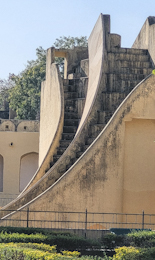
IT LOOKS LIKE MODERN sculpture at first sight. On closer examination, these fascinatingly shaped objects have carefully constructed scales, like the markings on a ruler or a protractor, attached to them. They are astronomical instruments that were constructed for the Rajput king Sawai Jai Singh (1688-1743), and they were completed by 1734. Together, they comprise Jaipur’s Jantar Mantar (literally ‘calculating instruments’). They were used to construct what has turned out to be extremely accurate astronomical tables.
Sawai Jai Singh was very interested in mathematics, astrology, astronomy, architecture, and literature. He studied scientific works by, for example, Ptolemy, Newton, Flamstead, and Euclid. He had Euclid’s “Elements of Geometry” translated into Sanskrit. His interest in astronomy might have been inspired in1702 by his tutor Jagannatha Samrat.
The Jantar Mantar in Jaipur contains 18 separate stone instruments with metal attachments . My knowledge of astronomy is minimal. So, I will not try to explain for what purpose each was, and still can be, used. A Wikipedia page (https://en.m.wikipedia.org/wiki/Jantar_Mantar,_Jaipur) can help with explaining their purposes.
To a visitor, like me, who is unversed in astronomy, and to those who are familiar with modern astronomical instruments, the Jantar Mantar presents the visitor with one of the most extraordinary looking tourist sights that India has to offer. It is not unique. In addition to the one in Jaipur, Sawai Jai Singh built four others in northern India. However, the one at Jaipur is the largest and best preserved.
If one did not know its purpose, the Jantar Mantar observatory compound would seem as if it is one of the world’s most superb sculpture parks.
UNTIL ABOUT 1991, my widowed father resided in my childhood home in northwest London. For as long as I can remember, there was a collection of black and white photographs in a cardboard Kodak photographic paper box. The photographs contained images of sculptures, which my mother Helen Yamey (1920-1980) had created at St Martins School of Art in London during the later 1950s and first half of the following decade. In 1991, my father married again, and moved from our childhood home to another address. Every now and then, after my father moved, I used to ask him what had happened to the photographs. He used to reply that he did not know where they were. Maybe, he suggested, they were stored somewhere in the garage of his new home. He died in 2020. After that, I thought that it was extremely unlikely that I would ever set eyes on the photographs again.
A year or two after my father’s demise, his widow, my stepmother, arranged to meet me at a café. When she arrived, she was carrying a plastic carrier bag, which she handed to me. To my great delight, I found that it contained the Kodak box filled with photographs of my mother’s sculptures. I posted a few of these images on the Internet. Some months after that, my friend Edesio mentioned that he was impressed by the images of my mother’s sculptures, and suggested to me that I should write something about my mother and her art. This I have done.
When I began writing my mother’s biography, our daughter Mala, who is an art historian and a curator, sent me a pdf file containing the contents of a catalogue of an exhibition held at London’s Grosvenor Gallery in the 1960s. It contained mention of some of my mother’s work that appeared in the exhibition. Mala did a little more research and discovered the existence of catalogues of other exhibitions in which my mother’s sculpture was included. I investigated these catalogues and came across a few more, I was surprised by what I discovered.
During the first half of the 1960s, my mother’s sculptures were selected to appear in exhibitions alongside artworks created by artists, many of whom are now quite famous. These include, to mention but a few, David Hockney, Henry Moore, Barbara Hepworth, Howard Hodgkin, Bridget Riley, Kim Lim, and LS Lowry. These exhibitions were held when I was between 8 and 13 years old. In those days, I was not particularly interested in my mother’s artistic activities and was too young for the names of these artists to mean anything to me. In addition, I do not recall even having been told that my mother was participating in exhibitions, let alone showing her work alongside that of these now famous creators. So, until I studied these catalogues more than 40 years after my mother died, I had no idea that for a while she was in the vanguard of 20th century British sculpture. Had I not been stimulated into beginning to write about her, I would not have known that my mother, who never boasted about her achievements, had been an artist of such a high calibre.
I have written my memories of my mother in a book called “Remembering Helen: My Mother the Artist” (available from Amazon: https://www.amazon.co.uk/dp/B0DKCZ7J7X/) . In it I have tried to describe her upbringing; what she was like as a mother; and her achievements in the world of sculpture. I have included many of the images I found in the box of photographs, and our daughter has written some insightful notes on her grandmother’s sculptural styles and the techniques. I hope that my book will help bring my mother’s artistic achievements out of obscurity. Modest as she was, I feel that it would be good if she were to get at least a little of the fame she deserved.
My mother, HELEN YAMEY (1920-1980) was born in South Africa. In 1948, she came to the UK, and by 1952, she had become a sculptor. In the 1950s and ‘60s, she worked in the Sculpture Department of London’s St Martins School of Art alongside now famous sculptors including Elisabeth Frink, Anthony Caro, David Annesley, Eduardo Paolozzi, Menashe Kadishman, William Tucker, and Phillip King. Helen’s work was of a sufficiently high quality for it to be selected for showing in exhibitions that included the above-mentioned artists as well as others including David Hockney, Henry Moore, Barbara Hepworth, Paula Rego, Bridget Riley, Duncan Grant, and Jean Arp. Yet, unlike the artists listed, she and her work have become largely forgotten.
In my biography of Helen, “Remembering Helen: My Mother the Artist”, I describe her career as an artist, what she was like as a person, and explore why she did not make a reputation like those with whom she worked and exhibited. The book contains illustrations of many of Helen’s sculptures, and my daughter, Mala Yamey, an art historian and curator, has written notes about my mother’s sculptural works.
EVERY TIME WE visit the town of St Ives in Cornwall, we come across something we have not seen before. On our most recent visit at the end of June 2024, we came across three sculptures by Barbara Hepworth (1903-1975), which were new to us. I will describe two of them in this essay, and leave the third for another time.
Hepworth migrated from Hampstead (in north London) with her second husband, the artist Ben Nicholson (1894-1982), and children, to St Ives in Cornwall at the outbreak of WW2. She lived there until the end of her life. From 1949 onwards, she lived and worked in Trewyn Studios, close to the busy heart of St Ives. This building is now a Barbara Hepworth Museum and Sculpture Garden maintained by the Tate Gallery. Visitors can see Hepworth’s studio and her garden next to it. The garden was laid out to designs created by Hepworth and her friend, the composer Priaulx Rainier (1903-1986). The garden contains works by the sculptor, which are arranged exactly as their creator had planned. We pay a visit to this lovely place every time we visit St Ives.
On our latest visit, we took a wrong turning, and headed down a narrow, sloping street. To our great delight we found a large outdoor sculpture by Barabara Hepworth, standing outside the front of the town’s Guildhall. Entitled “Dual Form”, this large abstract artwork made of cast bronze was created in 1965. It is part of an edition of 7 castings. The artist presented it to the town in 1968. It has blueish hues.
The other sculpture that we had not seen before is in a side chapel of St Ives’s gothic parish church of St Ia. Unlike “Dual Form”, it is figurative rather than abstract, and it is carved in shiny white stone. It depicts the Madonna and Child. Hepworth created this work following the death of her elder son, Paul Skeaping, who was an RAF air pilot. He was killed in an accident in Thailand in February 1953. The sculpture was unveiled in the church, where she found peace during her grieving, in 1954.
The two sculptures described above give a good idea of the breadth of Hepworth’s artistic talent. More evidence of her amazing creativity can be discovered in her former home, now a museum. In another piece, I will describe another sculpture and something I had not realised about Hepworth’s connection with St Ives.