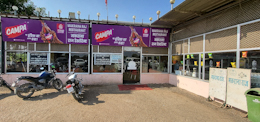
Dining with the dead in Ahmedabad

IN CENTRAL AHMEDABAD, a large city in India’s state of Gujarat, there is a curious café called Lucky. This popular eatery, founded in 1950, is unusual not because it does not serve coffee but because its tables and chairs are placed between Moslem graves. Also, the trunk of an old tree is contained within the restaurant. Its base is within the eatery and it passes out of the place through a hole in Lucky’s ceiling.

Tree trunk and a grave at Lucky

Lucky’s is sited on an old Moslem graveyard, but this does not put off a steady flow of customers from enjoying a wide variety of vegetarian meals and snacks in this eatery. Closer to home, near the south side of London’s Lambeth Bridge, there is another café sited on a former graveyard.

Churchill in Cornwall (England) and Maharashtra (India)

WE OFTEN VISIT Wadebridge in Cornwall. It contains an establishment called Churchill Bars. Actually, it is also the headquarters of the local Conservative Club. Until 2025, this place had a restaurant that served well-prepared meals, which included very tasty roast pork belly. Sadly, since early 2025, the Churchill Bars have ceased serving meals.


Fortunately, far away from Cornwall in South Bombay, Churchill Cafe is still in business. Located in Colaba and owned by Parsis, this tiny restaurant serves superb European-style dishes, as well as a few Parsi gastronomic offerings. Decorated with photographs of London landmarks and a portrait of Winston Churchill, this bustling restaurant is well worth visiting.

From Cairo to Kent and Karl Marx

IN RECENT YEARS, the seaside town of Margate in Kent has become much more of a “trendy” destination than it used to be. From being yet another coastal resort, it has become a magnet for those interested in contemporary art. This is because of the presence of the Turner Contemporary Gallery, Tracey Emins’s gallery, and the Carl Freedman gallery … to mention but a few places. With the influx of tourists with sophisticated tastes, the town has become home to a range of restaurants, which is more varied than in many other seaside towns in north and east Kent.

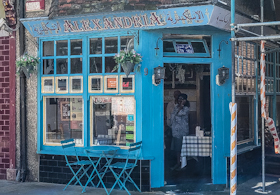
About 6 years ago, a husband and wife from Cairo (Egypt) set up a tiny restaurant on a corner plot in the old centre of Margate. It is called Alexandria Café. The owners chose the name not because they come from Alexandria, but because like the Egyptian city, Margate is by the sea.

Only open on Fridays, Saturdays, and Sundays at present, this restaurant serves beautifully prepared, tasty Egyptian dishes at very reasonable prices. We tried koshari, falafel, baba ganush, pickled tomato salad, and mint tea. Although these are all without meat, non-veg dishes are also available.

The tiny, comfortable eatery is decorated with photographs of Egyptian film stars. A small television screen was showing old Egyptian films.

A few doors away from the lovely Egyptian cafe, there is an ice cream parlour. What makes it special is that in 1866, Karl Marx stayed in the building.

We did not try the ice cream, but I can safely say that of all the places I have eaten in Margate, having visited the place many times, Alexandria is the best.

Do not expect to get your prescription honoured at this pharmacy

LOVE HIM OR HATE him, there is no denying that the artist Damien Hirst (born 1965) has plenty of imagination. Between 1997 and 2003, he created a restaurant in London’s Notting Hill Gate. It was called Pharmacy, but had to change its name after the Royal Pharmaceutical Society of Great Britain objected to it. Its new names were anagrams of the old: first Achy Ramp, and then Army Chap. Its decorative theme was pharmaceutical. For example, its walls were lined with cupboards containing (empty) drug and medicine packaging, as well as clinical equipment. It gave the visitor the impression of being in part of a busy hospital or clinic. From what I can remember of the place, its décor was vastly more exciting than the costly fare served to its customers. I was sad when it closed as it was a distinctive landmark in the area.

In 2016, Damien Hirst opened Pharmacy 2 on the first floor of his recently completed Newport Street Gallery (near Lambeth Palace). For a few years, this pharmacy themed restaurant offered a range of food and drinks, none of which were cheap. The interior of Pharmacy 2 follows on from the original art-installation-cum-restaurant design of the Notting Hill Gate version. An online article (www.dezeen.com/2016/02/18/damien-hirst-pharmacy-2-restaurant-mark-hix-newport-street-gallery-caruso-st-john-london/) describes the place well:

Similar to its predecessor, which was designed by Barber & Osgerby’s interiors company Universal Design Studio, the interior follows a clinical theme inspired by Hirst’s 1992 artwork Pharmacy. Images of tablets and brightly coloured pills have been embroidered onto leather banquettes and embedded into the marble floor. Bar stools are topped with pastel-coloured pill-shaped seats. Walls are covered with a silver-coloured wall chart of pills and pharmaceutical products first produced for the original Pharmacy restaurant … A neon prescriptions sign hangs above the bar, along with a series of sculptures based on molecular structures. Windows are covered with dark-coloured translucent vinyls. Stark lighting is used to reaffirm the restaurant’s pharmaceutical theme.”

These words give some idea about this fantastic place, but it must be seen to be believed. 

Pharmacy 2 has not been functioning as a restaurant for several years. When we visited Newport Street Gallery in May 2025, Pharmacy 2 was open to the public, and visitors can serve themselves with tea and coffee without charge. On each of the restaurant’s tables, there are art books for visitors to browse. The young man, an invigilator, who was keeping an eye on the place told us that occasionally the restaurant is revitalised for feeding visitors participating in special events. At these ‘pop-up’ events, meals are costly.

Pharmacy 2, like its predecessor in Notting Hill Gate, is an art installation. It is appropriate that the canteen of the Newport Street Gallery is not merely a restaurant but also an amazing work of art.

A café with a history on the seashore at Pondicherry

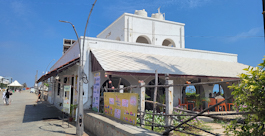
BEACH ROAD RUNS alongside the seafront of Pondicherry.  It is just over 1.3 kilometres in length. There are many buildings lining the landward side of the road (its west side), including hotels, restaurants, a memorial to BR Ambedkar, the lighthouse and the Customs House. However, there is only one  on the seaward side, close to the seashore.  Today, this building with a veranda on its sea facing side is a pleasant refreshment outlet called Le Café.  It stands a few metres south of the tall statue of Mahatma Gandhi,  also on the seaward side of Beach Road. 


The café contains some historical photographs of Pondicherry. One of them shows the long pier that commenced where Gandhi now stands. The pier was irreparably damaged during a terrible storm in the early 1950s, probably 1952. All that remains of it are some wooden stumps projecting from the sea some considerable distance away from the shore. Where Gandhi stands today was Place de la République when Pondicherry was a French colony. 


There has been a building on the site of Le Café since at least the end of the 17th century, as can be seen on a map published in 1793. For many years, the building housing the café was the Port Office of Pondicherry.  It can be seen quite clearly in a photograph taken before 1870. Then, it had only a single storey. A small upper storey has been added since then.


Sometime after the pier was polished off by the storm, the building was remodelled to serve as a café.  Run by a state managed concern, food and non-alcoholic drinks can be obtained here at reasonable prices. In the intense heat of midday and the early afternoon,  the veranda of Le Café is a pleasant place to relax in the breezes that pass through it.

A Swiss hut in the centre of Chennai

OPPOSITE THE APOLLO Hospital in the Thousand Lights district of Chennai, my eyes alighted on a sign I was least expecting to see in southern India.  The sign adorned the panel beneath the eaves of what resembles a Swiss chalet. It read “Swiss Hütte”. It is a restaurant. It was closed when I first spotted it, but we returned the same evening when it was open. We decided that it was such an unusual find that we had to eat something there.


The restaurant was founded about 19 years ago by a chef Joe Lobo. He lived in Switzerland for 25 years, working as a prize-winning chef. On returning to India, he established the Swiss Hütte restaurant. It is located in the verdant grounds of his family’s home.


The restaurant has an extensive menu with dishes inspired by various national cuisines, both European and Asian. We ate at the Hütte  several times, and everything we ate was delicious and perfectly prepared.


We asked Joe if he ever served Swiss food. Occasionally, if given sufficient notice, he will make fondue. However, in his opinion, Swiss food is bland and tasteless. These adjectives can not be used to describe what Joe cooks in the kitchen for his guests. Eating Joe’s food, it is easy to see why he has won prizes for his cooking.

Dining with a view of the fortress in Jodhpur

 THE MEHRANGARH FORTRESS rests on massive rock overlooking the city of Jodhpur in Rajasthan.  At night the walls of the fort are brightly illuminated and can be seen from many places in the city. The older districts of Jodhpur  cling to the lower slopes of the rock upon which the fort rests. To take advantage of the splendid views of the fort, many restaurants in the old parts of the city are located high above street level on rooftops. Some of these eateries are as much as five storeys above street level, and none of them have lifts to reach them.

A restaurant is at the TOP

 One rooftop restaurant, which we have visited twice, is on the second floor of an old building. Called Indigo, we have eaten excellent Rajasthani meat dishes there, and were looking forward to visiting it a third time today (the 3rd of December 2024).

 At about 4 am. on the 3rd of December, I  awoke briefly and noticed that there was no electricity in the hotel and the alley next to it. By 7 a.m., the electrical supply had been restored.  At breakfast,  which is always served on the fourth floor rooftop of our guest house,  Mr Manu, the owner of the place, told us that there had been a fire in the kitchen of the Indigo restaurant,  which we had begun to enjoy. Burn marks were clearly visible from our guest house’s rooftop.

The reason the power had failed early in the morning was that the Indigo restaurant is located close to an electricity transformer, and the authorities were concerned that the fire might spread ⁷to it. Luckily,  it did not.

 After breakfast, we decided to walk to Indigo to offer our sympathy to its charming owner. When we arrived, we found his wife and a few other women seated in the restaurant’s ground floor courtyard. Each of them had very sad expressions on their faces. I felt that it was like visiting the bereaved soon after a loved one had passed away. They asked us to sit with them, and soon after that, the owner arrived.  We told him how sorry we were about the disaster which had befallen him and his family. I believe that he appreciated our brief visit.


Had the fire not happened,  we would have eaten all the rest of our evening meals at Indigo during the remaining few days of our stay in Jodhpur. I hope that Indigo will recover soon and that anyone who happens to read this and is visiting Jodhpur will eat at this excellent restaurant.

Tomato soup in the tandoori oven by the roadside in Rajasthan

WHEREVER I HAVE BEEN in India, both in big cities and in small rural places, tomato soup is often available at eateries be they humble or grand. What is more, everywhere I have consumed this soup in India, it always been flavoured differently. It always tastes of tomato, but the detailing of the taste is never the same. This is because the soups are prepared in the kitchens of the restaurants, and not in a factory.

Makrana Raj restaurant

Today (29th November 2024), we were travelling along the six lane highway between Jaipur and Ajmer when we stopped for a light lunch at the roadside Makrana Raj restaurant. This unpretentious, well-run place is not far from Ajmer. We ordered a light lunch including a paratha stuffed with cauliflower, a garlic naan, and a bowl of tomato soup. The excellent paratha was served with a garlic chutney and butter churned in the restaurant.

As usual, the tomato soup had a unique flavour. It tasted slightly smoky and was delicious. We asked the waiter how it was prepared because we had never before come across smoky tomato soup. He told us that the soup is cooked in the wood fired tandoori oven, which is why its taste reminded me of the flavour of charcoal-grilled meats and fishes.

While I would not recommend making a special detour to visit the Makrana Raj, if you happen to be travelling by road between Ajmer and Jaipur, then look out for the place, and have something to eat there.

The artist Mark Rothko in Cornwall

MANY PEOPLE MEDITATE profoundly in front of paintings by the American artist Mark Rothko (1903-1970). I am not one of those people. I can recognise his work and appreciate its originality, but he is not amongst my favourite 20th century artists.

When visiting the branch of the Tate Gallery in Cornwall’s St Ives at the beginning of July 2024, I viewed a small exhibition of painted panels created by Rothko. In 1958, he was commissioned to paint them for the Four Seasons restaurant in the Seagram Building in New York City. In the summer of 1959, he took a break from painting this series of pictures, and visited England. The painter Peter Lanyon invited Rothko to his home in St Ives in Cornwall. During his stay, he met other artists based in the West Country including Alan Davie, Paul Feiler, Patrick Heron, and Terry Frost. Rothko’s visit to St Ives was a factor that helped change his mind about displaying the paintings he was creating for the Four Seasons restaurant. It has been recorded that he said that the restaurant was:

“… a place where the richest bastards of New York will come to feed and show off.” (theartnewspaper.com, 4th of April 2024).

In 1969, Rothko donated nine of the paintings, originally destined for the restaurant, to the Tate Gallery. Seven others can be viewed at the Kawamura Museum of Modern Art in Japan, and another thirteen are housed at the National Gallery of Art in Washington DC. The rest are owned by his children.

Usually, the paintings currently being displayed at the Tate in St Ives are to be found in a dedicated room in London’s Tate Modern. Currently, the room where they are usually stored in Tate Modern is being used to host an exhibition by another artist (Joan Mitchell). The Seagram murals will remain in St Ives until January 2025.

We visit St Ives regularly. Its branch of the Tate is one of several artistic attractions we visit in the town. Although it contains some great artworks, I am not fond of its architecture. I am glad we visited again because had we not done so, I would not have known about Rothko’s holiday in St Ives, and the influence it had on his decision not to display his paintings in a fancy restaurant in New York City.

Some things never seem to change

DURING THE 1970s and 1980s, we used to make visits to a restaurant in north London’s Willesden Lane. Founded in 1964 and specialising in South Indian cuisine, it was called Vijay. It still exists at the same address. Out of curiosity and ‘for old times’ sake’, we paid it a visit last night (the 29th of February 2024).

Entering Vijay was like stepping back in time. It was uncanny; nothing seemed to have changed. The walls are still lined with raffia work panelling, the wooden Kerala-style ceiling, and the pictures on the wall (mostly colourful depictions of Hindu deities) looked exactly as we remembered. Naturally, none of the staff were recognizable.

Back in the ‘70s and ‘80s, we used to eat at Vijay to enjoy South Indian dishes that were not easy to find elsewhere in London. If I remember correctly, in those days Vijay only had this kind of food on its menu. Today, the menu still has South Indian dishes, but also many offerings of food that is definitely not typical of South India. It offers a wide selection of North Indian dishes – such as most British people would hope to find in an ‘Indian restaurant’. One of the hors d’oeuvres, which you would never find on India, but is common in British Indian restaurants is fried pappads (poppadums) served with a  tray of chutneys and pickles to accompany them, Vijay now offers this. Probably, Vijay has added North Indian dishes to their menu because, for many potential customers, South Indian dishes are far less familiar.

Yesterday, we ordered a few dishes. They were enjoyable enough but not outstanding, However, it was great fun sitting in a place that had hardly changed since we last visited it at least 30 years ago.