How much would you spend to own a giant gogotte?

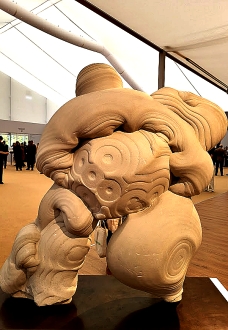
THE MOST FASCINATING exhibit I saw at the Frieze Masters art fair in London’s Regents Park, was unlike most of the other exhibits, not man-made. The item was about four feet high and slightly less wide. At first sight, it looks like a piece of modern sculpture, and one side of it resembles a vorticist version of the famous Michelin Man. But it is neither modern, nor made by human hands. It is between 300000 and 50000 years old, a fine example of a gogotte.

Made of silica, gogottes are (see https://www.robertsimon.com/gogotte-first-journey):

“… natural creations formed out of sands deposited in Northern France during the Oligocene Period, approximately 30 million years ago. Much later, in a process that has only recently become understood, groundwater rich in silica flowed through the sands, creating swirling organic shapes and cementing the sand into the fluid forms that we see today. This geological process took place during two cold periods of the Quaternary—one approximately 300,000 years ago, the other more recent, during the last glaciation, between 30 and 50,000 years ago.”

Apart from being interesting looking geological specimens, they have attracted the attention of artists. Some of them collected gogottes, and they and others have been influenced by their forms. These artists included: Henry Moore, Jean Arp, Constantin Brancusi, Barbara Hepworth, the Surrealists, and others. In addition, the curious gogottes have attracted the interest of collectors since as early as during the Song Dynasty (960–1279).

Gogottes are quite easily available. Their price depends on size. The specimen on display at Frieze is large. I asked one of the gallery assistants working on the stand where it was displayed for how much it was being sold. Sadly, she did not know.

On display outdoors in London’s Regents Park

I ENJOY VIEWING sculptures displayed in the open air. Every autumn, there is an exhibition of sculptures in London’s Regents Park.  It is part of the annual Frieze art fair. Sculptures by various artists are provided by the commercial galleries who deal with them.

This year’s exhibition was small and somewhat disappointing. It seemed to me that the galleries had not exhibited their better works or works by their better-known artists. Maybe they are worried about them being vandalised or stolen. Whatever the reason, the 2025 outdoor show is not nearly as exciting as similar shows in previous years.

A walk in the sunshine on a Saturday morning in north London

AFTER DAYS OF GREY skies, the sun shone without pauses today (the 30th of March 2024). This was lucky because come rain or shine, we had decided to walk south from Primrose Hill through Regents Park to Marylebone Road. Much of the way we passed places with fond memories for us. The first of these was Chalk Farm Underground station. It was near here that my wife used to live in a flat on Fellowes Road long before we married.

From the station, we walked across a graffiti-covered iron bridge that crosses the mainline railway tracks from Euston. This brought us to the eastern end of Regents Park Road (‘RPR’). Lined with shops and eateries, this curving road is where we met with our friends frequently. One of our favourite places was Lemonia – a Greek restaurant. When it first opened, it was on the south side of the road. Now, it occupies larger premises on the north side of RPR. After having coffee at Roni’s, an Israeli café that did not exist in the 1980s when we often visited the area, we walked towards the base of Primrose Hill. Today, being the Easter weekend, the road was far less busy than it is on other weekends.

Looking down from Primrose Hill

Fortified with coffee and a croissant, we ascended the steep path leading from opposite the house where Friedrich Engels once lived to the summit of Primrose Hill, which had attracted a crowd of people who had come out to enjoy the sun and the magnificent view of London to the south of the hill. While we were descending the hill towards Regents Park, a young lady, who was ascending the hill with her husband and two children, greeted us. I did not recognise her as I had not seen her for 21 years, and (then only briefly) when she was a young teenager. She is the daughter of one of my cousins, and the great-great granddaughter of my ancestor Franz Ginsberg, who was a Senator in the parliament of South Africa between the two world wars.

After reaching the bottom of Primrose Hill, we crossed Prince Albert Road, and then walked over a bridge that traverses the Regents Canal. At the south end of the bridge, we passed some enclosures (containing what looked like large wild boars or warthogs) of the London Zoo.  Then, we walked along a straight path between grassy playing fields – not particularly scenic. In the distance we could see the minaret of the Regents Park Mosque and the domes on the roof of the London Business School, where my wife studied. Eventually we reached a more attractive area close to the eastern edge of the Boating Lake, over which we crossed on a bridge. Soon, we arrived at the circular road, appropriately named the Inner Circle. It seemed to being used as an unofficial racetrack for cyclists on expensive looking bicycles. Having safely crossing the road without being hit by a cyclist, we entered the round heart of Regents Park, which contains the famous Queen Marys Rose Garden.

We took refreshments at the strange-looking Regent’s Bar & Kitchen. In plan, it is a collection of identical adjacent hexagons. The roofs of some of these have sharp conical pinnacles. From there we passed beds of rose plants. All of the roses were without flowers, A small wooden bridge crosses a stretch of water – part of a larger pond – to reach the attractive Japanese Garden Island from which you can see a man-made rocky waterfall designed as it would be in gardens in Japan.

After wandering around the Japanese garden, we headed towards the Inner Circle, which we crossed before walking south along a road called York Bridge because it crosses a body of water by means of of a similarly named Bridge. Before reaching the bridge, we passed the buildings of Regent’s University. These used to house a part of the University of London – Bedford College. Founded in 1849, it was for the higher education of women. From 1878 onwards, women studying there were awarded degrees by the University of London. In 1984, after Bedford College had merged with Royal Holloway College, its premises in Regents Park became the home of Regent’s University, which is not affiliated to the University of London. Interestingly, the wrought iron gates to Regent’s University’s grounds still bear the crests of its predecessor – Bedford College. In the 1920s, my wife’s maternal grandmother, Benabai Bhatia, who had come from India with her husband Haridas, who was studying for an FRCS, studied at Bedford College. On her return to India and after she was widowed at a young age, she became a superintendent of schools in Bombay.

After crossing York Bridge, we soon reached Marylebone Road, having had a thoroughly enjoyable walk.

An international annual fair of art in a London park and an artist from Uganda

WE WERE FORTUNATE to have been given a couple of entry tickets to the Frieze art fair held every year in London’s Regents Park. The fair consists of the elaborate stalls (or booths) set up by commercial art galleries and dealers from London and all over the world. It is divided into two sections, each housed in enormous temporary structures. Frieze Masters displays artworks and other artefacts (many of them antiques) created before the year 2000 AD. Although many of the pieces on display are fabulously beautiful and for sale, walking around Frieze Masters is rather like exploring a large museum. The stall by Jonckheere was especially wonderful with its display of paintings by Hieronymus Bosch and others of his era.

South of the Frieze masters pavilion is the Frieze London pavilion which showcases mainly works created after 2000. I found this to be far more exciting than the Frieze Masters. Many of the exhibitors’ displays had a vibrancy that I found lacking at Frieze Masters. Many of the booths had works by the brilliant, versatile Nigerian British artist Yinka Shonibare, whose works I have seen recently in several other galleries around London. Many other well-known artists such as Grayson Perry had works on display. Three booths, operated by galleries based in India, exhibited works by artists from not only India but also Pakistan and Bangladesh. Amongst the many eye-catching exhibits, there was a collection of works by the artist Patrick Goddard (born 1984). What made this display most interesting was that both the walls of the booth and the artworks were covered by life-like models of snails (see photograph above).

Having seen several exhibitions of contemporary art by African artists during the three days before we visited Frieze, I was attracted to the booth set up by the Stephen Friedman Gallery (London). It contained paintings and sculptures by an artist, Leila Babirye, born in Kampala, Uganda in 1985. She studied art at Makerere University in Kampala, and then participated in the Fire Island Residency (New York State) in 2015. The Residency is a meeting place for visual artists who are (to quote the Residency’s website): “… lesbian, gay, bisexual, transgender, non-binary, intersex and queer …” Ms Babyre is a member of the LGBTQ+ community, which is frowned upon in her native land. Because of this, she received asylum in the USA in 2018, and now both lives and works in Brooklyn, New York City. On display at Frieze, is her collection of colourful portraits, which sre described as “queer identity cards”. A director of the gallery explained that these are a reaction to the formal format of official identity card photographs in which the subject has to remove spectacles, headwear, and tie back their hair. In addition to these, and more interesting visually, there were several sculptures by Ms Babirye. Beautifully crafted, most of them incorporate a variety of different materials – often discarded objects. The point of embellishing her sculptures with what is basically ‘trash’ is to illustrate the word used in the Luganda language to describe homosexuals – ‘ebisiyaga’ meaning ‘sugar cane husk’, in other words ‘it’s rubbish’.

There was plenty more that I found exciting at Frieze London, but the stalls exhibiting artists from the Indian Subcontinent and that showing Leila Babirye wer for me the most interesting. A visit to the Frieze art fair is both exhilarating and exhausting. Luckily, the prices of the artworks were way beyond our budget. Had they not been so costly, I am sure that we would have brought home quite a few of them.

Visiting an exhibition of outdoor sculptures in a London park

I ALWAYS ENJOY seeing sculptures displayed in the open-air. Until the 29th of October (2023) the annual outdoor Frieze Sculpture exhibition is being held in the south-east corner of London’s Regents Park. As with all the Frieze Sculpture exhibitions I have seen, this one is no exception – it displays a ‘mixed bag’ of artworks. Although many of this year’s exhibits are colourful, creative, and often playful, few of them are exceptional.

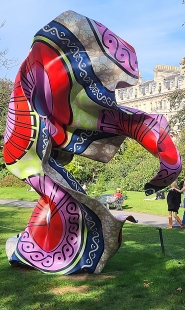
Two works struck me as standing out from the crowd. One of them, created in 2023 by Yinka Shonibare, is a folded work called “Material (SG) IV” (see photograph). This shape of this work resembles a flickering flame frozen in time. Covered in colourful patterns, the artist wanted to depict a piece of printed fabric, such as a sail, blowing in the breeze.  According to the Frieze Sculpture 2023 website, this artist:

“… creates work that explores issues of race and class through the media of sculpture, painting, photography, film, pictorial quilts and public works.”

The website explained that in the work in Regents Park:

“The fabric was originally inspired by Indonesian designs, mass-produced by the Dutch and eventually sold to colonies in West Africa. In the 1960s the material became a signifier of African identity and independence and, in Shonibare’s hands, the ‘perfect metaphor for multi-layered identities’.”

Even though it is interesting to know what was in the artist’s mind when he created the sculpture, it is a visually fascinating and satisfying piece in its own right.

The other work that particularly attracted me was created in 1976 by the artist Louise Nevelson (1899-1988). Born in a city now in Ukraine, she emigrated to the USA in the early 20th century. It was in the States that she studied art, and then created most of her artworks. Painted black, and called “Model for Celebration II”, it is a tall abstract piece, which was:

“… Inspired by the cubist innovations of Pablo Picasso and Henri Matisse, Nevelson reimagines painterly cubism as a sculptural opportunity.” (see https://viewer.mapme.com/frieze-sculpture-2023/location/ca758a4f-1328-48d2-a3cf-6c6b65edf794).

Unlike the other works on display in the park, Nevelson’s work has stood the test of time. So, maybe it was unfair of the curator to include such a work amongst the works of so many newcomers to the ‘art scene’. However, I was pleased to see it, as it is one of the only exhibits that I felt had profundity rather than the immediate and often short-lasting aesthetic appeal of many of the other exhibits.

Late bloomers in London’s Regents Park

THE BEST TIME to see flowering roses in the Queen Mary’s Garden (‘QMG’) in London’s Regent Park is in the first half of June. At that time most of the 12000 rose plants in the gardens, created in 1934, are likely to be in bloom. So, it was with some trepidation that we took our friends to see the QMG, Although I did not say so, my feeling was that as far as blooms were concerned, this would be a disappointing visit. To my great surprise, it was not such a pointless visit as I had feared. There were a substantial number of rose plants either in bud or in full bloom.

Seeing the roses in bloom in November made me do a little research. I discovered that there are several varieties of rose plants that flower in autumn in the northern hemisphere. These varieties include (according to an American website): Hybrid Tea, Floribunda, Grandiflora, and Climbing Roses. According to another source, some roses have a very long flowering season that can extend into October and November.

I have no idea what kind of roses we saw during our late November visit to the QMG. However, seeing these attractive flowers made me realise that a visit to this garden as late as November need not be a disappointment if seeing flowers is your desire.

A bridge near Regents Park

PARKWAY LEADS GENTLY uphill from Camden Town Underground station to a short road called Gloucester Gate, which leads to the Outer Circle that runs around Regents Park. Much of Gloucester Terrace runs along what looks like a bridge, which is lined on its north side by red-coloured, decorative stone parapet.

St Pancras, Regents Park, London

The bridge traverses a grassy dell that does not appear to contain any kind of watercourse. I wondered why such an elaborate bridge had been built to traverse what appears to be merely a grassy hollow. Well, when it was built, it did cross a waterway, the Cumberland Market Branch of the Regent’s Canal  known as ‘The Cumberland Arm’ (www.londonslostrivers.com/cumberland-arm.html). This waterway, built in 1816, ran for about half a mile from the Regents Canal to a basin near Euston Station, running for most of its length parallel to Albany Street. During WW2, the Cumberland Arm, which had up until then been used to transport freight, was used to supply water to firefighting appliances. By the end of the war, the canal had been filled with rubble from buildings destroyed by bombing and then covered with topsoil. All that remains of the Cumberland Arm is a short blind-ending stretch of water near Regents Park Road, on which there is a large floating Chinese restaurant and a few moorings for narrow boats.

The Gloucester Gate bridge with its decorative parapet and elaborate cast-iron lampstands also includes two interesting memorials. One of these relates to the fact that the bridge was constructed by the St Pancras Vestry, the then local authority governing the area (www.andrewwhitehead.net/blog/the-most-pointless-bridge-in-london). There is a bronze bas-relief depicting the martyrdom of St Pancras. It was a gift of William Thornton and sculpted by the Italian Ceccardo Egidio Fucigna (c1836-1884), who died in London. St Pancras (c289-303/4) was born a Roman citizen. He converted to Christianity and was beheaded for his beliefs when he was 14 years old (https://en.wikipedia.org/wiki/Pancras_of_Rome). The bronze relief on Gloucester Gate bridge shows a young man being mauled by an animal, possibly a lion. Why this motif was chosen when the saint was beheaded puzzles me.

Near the St Pancras panel, also on the bridge, there is an old but elaborate drinking fountain. A metal plate attached to it has faded letters that read:

“Saint Pancras Middlesex.

This fountain and works connected therewith were presented to the Metropolitan Drinking Fountain Association on the (?) day of August 1878 by

Matilda

Richard Kent esq. Junior Churchwarden 1878.

The figure … cast in bronze was designed by Joseph Durham ARA.” (https://victorianweb.org/sculpture/durham/1c.html)

The fountain, known as ‘The Matilda Fountain’, is part of a miniature cave made with granite boulders. A sculpture of a milkmaid stands above the cave. At her feet, there is a wooden pail with two handles. The girl with a rich crop of hair on her head is depicted shielding her eyes from the sun with her right hand as she stares into the distance. Cast in bronze, the female figure and the pail were sculpted by Joseph Durham (1814-1877). Matilda might possibly have been Richard Kent’s wife, but the plaque does not specify this. The sculpture is not unique; several other copies of it, all by Durham, exist. One of these, dated 1867 and called “At the Spring/Early Morn”, can be seen in Blackburn’s Town Hall (https://victorianweb.org/sculpture/durham/1d.html).

Today, the bridge is redundant since the canal was filled-in long ago. However, it is used by many people walking to and from Regents Park and its zoo and a steady stream of vehicular traffic crosses it. Although it has outlived its original purpose, the bridge serves as a reminder of a once important element of London’s continuously evolving transportation system.

From Bombay to London

MY MOTHER-IN-LAW STUDIED medicine at the Grant Medical School in Bombay. One of her fellow students, Perin, was her good friend. Perin, a member of Bombay’s Parsi religious community, was related to the Readymoney family, Parsis, who were prominent and successful in Bombay. You might be wondering why I am telling you this and what it has to do with anything of greater interest. Well, bear with me and join me in Regents Park.

Cowasji Jehangir Readymoney

The Broad Walk is a long straight promenade that stretches from the Outer Circle near Marylebone Road at the south of Regents Park northwards through the park to Outer Circle next to the London Zoo. Near the south eastern corner of the Zoo, there is a gothic revival style Victorian water fountain on the Broad Walk. Well-restored recently, it is no longer working. The structure, which is made of pink granite and white stone, looks like a typical flamboyant 19thy century public drinking fountain that can be found in towns all over England, but closer examination reveals that this is not so typical. Amongst its many decorative features there is a cow standing in front of a palm tree; a lion walking past a palm tree; the head of Queen Victoria looking young; and the head of a moustachioed man wearing a cap of oriental design.

The man portrayed on the drinking fountain was its donor, Sir Cowasji Jehangir Readymoney (1812-1878), who was related to my mother-in-law’s friend from medical school. Readymoney was born into a wealthy family that had moved to Bombay from the Parsi town of Navsari (in present-day Gujarat), close to where the first Parsis might have landed in India many centuries earlier. Cowasji began working as a warehouse clerk at the age of 15. Ten years later, he had become a ‘guarantee broker’ in two leading British-owned firms in Bombay, a lucrative position. By the age of 34, he was trading on his own account. In 1866, he was appointed a Commissioner for Income Tax. This form of taxation was new and unpopular in Bombay, but Cowasji made a success of its collection.

In recognition for his services to the British rulers of India, Cowasji became a Justice of the Peace for Bombay and, soon after, was made a Companion of The Most Exalted Order of the Star of India. He was a great philanthropist, providing money for building in Bombay: hospitals; educational establishments; a refuge for the destitute; insane asylums; and decorative public drinking fountains. In addition to these good causes in Bombay, he made donations to the Indian Institute in London. In recognition of his philanthropic works, he was made a Knight Bachelor of the United Kingdom in 1872.

Three years before being knighted, Readymoney financed the construction of the drinking fountain in Regents Park. It is his face that appears on it.  It was, as a noticed affixed to it reveals, his:

“… token of gratitude to the people of England for the protection enjoyed by him and his Parsee fellow countrymen under British rule in India.”

The Parsi community in India, like the Jewish people in that country, was and still is a tiny proportion of the Indian population as a whole. It felt that its survival would be ensured by showing allegiance to whomever was ruling India, the British in Readymoney’s lifetime. The fountain was inaugurated by Princess Mary of Teck (1833-1897), a granddaughter of King George III, under whose watch the USA was detached from the British Empire.

The fountain, which makes for an eye-catching garden feature, was designed by Robert Keirle (1837-1914; https://borthcat.york.ac.uk/index.php/keirle-robert-1837-1914-architect?sf_culture=en), architect of The Metropolitan Free Drinking Fountain and Cattle Trough Association. Keirle also designed a drinking fountain for another Indian, The Maharajah of Vizianagram. This was erected in 1867 at the northern edge of Hyde Park, close to Marble Arch, but it was removed in 1964 (https://theindiantrip.com/uk/vizianagaram-city/info). All that remains of it today is a small stone memorial, which I have walked past several times.

Usually, we spend several months in India, the country where my wife was born, but because of the current pandemic we will have to delay our next trip, for goodness knows how long. Seeing things in London with Indian association, like the Readymoney Fountain in Regents Parks helps us, in a strange way, to maintain out ties with a country for which both of us have great affection.

A hill of memories

PRIMROSE HILL IN NORTH LONDON is a delightful place to take exercise. From its summit at 210 feet above sea-level, it is possible to enjoy a superb panorama of London if the weather permits. At its summit, a low concrete construction is inscribed with the words the poet William Blake (1757-1827) told the lawyer, diarist, and a founder of University College London, Henry Crabb Robinson (1775-1867):

“I have conversed with the spiritual Sun. I saw him on Primrose Hill”

In one of his poems, Blake wrote:

“The fields from Islington to Marybone,

To Primrose Hill and Saint John’s Wood,

Were builded over with pillars of gold,

And there Jerusalem’s pillars stood.”

On a recent visit to Primrose Hill in January 2021, when the temperature was at the freezing point of water and London was covered by low cloud, we had no sight of the sun, spiritual or otherwise. Nevertheless, we had an enjoyable stroll that evoked many memories. One of these was when I studied at University College London. If I felt energetic, I used to walk the five or so miles to college from my home in Hampstead Garden Suburb. Part of my route was up and over Primrose Hill.

The gardens on the south side of Elsworthy Road back on to the northern base of the hill. It was on this road that my parents, newly married in 1948, lived briefly in a flat that they rented from the economist Ronald Coase (1910-2013). My mother told me that amongst the furniture in the flat there was a record player with a gigantic horn as its speaker. 46 years later, my father and my stepmother bought a house on the road. He lived there until he died last year.

Elsworthy Terrace, a cul-de-sac, leads from Elsworthy Road to Primrose Hill. The botanist and first female botanist to be elected a Fellow of the Royal Society, Agnes (née Robertson) Arber (1879-1960), lived at number 9 between 1890 and 1909, when she married the paleobotanist Edward Alexander Newell Arber (1870–1918). The Terrace leads to one of the many footpaths that form a crisscrossing network all over the grassy hill that has well-spaced trees of varying shapes and sizes. Plenty of these were covered with frost. Many of the paths meet at the treeless summit of the hill where, if you are lucky with the weather, you can enjoy a good view.

Primrose Hill, first opened to the public in 1842, was part of land appropriated for hunting by King Henry VIII. The earliest mention of its name was in the 15th century. In October 1678, the body of the anti-Catholic magistrate Sir Edmund Berry Godfrey (1621-1678) was found on Primrose Hill, marked with signs of strangulation and other bruises. The identity of his killer(s) remains a mystery. The hill was also the site of duels including one in about 1813 when the Italian patriot Ugo Foscolo (1778-1827) faced Mr Graham, the editor of the “Literary Museum”. The dispute that led to this was about his ‘Three Graces’:

“The Three Graces were his maidservants; two of them turned out to be prostitutes, and one of them ran off with his former translator. This led to a duel, whether in Regent’s Park or Primrose Hill is not clear; fortunately no blood was shed.” (www.regentsparklit.org.uk/authors_e_i.htm#Foscolo)

The southern edge of the hill is bounded by the Regents Canal, designed by John Nash (1752-1835), first used in about1816. We walked eastwards along the towpath from the elegant bridge number 10 to the point where the canal makes a right angle and heads under the Water Meeting road bridge and towards Camden Lock. This stretch of the canal has the London Zoo on both of its banks. On the north side of the canal, we passed the aviary designed by Lord Snowdon in 1964. One of Snowdon’s collaborators was Frank Newby, who was a colleague of my uncle Sven Rindl, a structural engineer at the Felix Samuely company.  On the opposite bank we passed the Giraffe House and the wild hunting dog’s enclosure, where we spotted several of these beasts prowling about. Moored at the corner where the canal changes direction, you cannot miss seeing an old-fashioned boat that looks as if it has sailed from China. This houses the ‘Feng Shang Princess’ floating Chinese restaurant, which was already built by the 1980s.

The Victorian gothic St Marks Church is flanked on two sides by the canal and on another by a short street, St Marks Square. The church, which is not particularly attractive, was consecrated in 1853, damaged during WW2, and rebuilt by 1957.  The northern edge of the church’s ground is on the southern side of Regents Park Road.

Heading west away from the church, we reach number 52 Regents Park Road. It was here that four of my good friends including the author and art historian Michael Jacobs (1952-2014) lived as ‘house-sitters’ for its then owner Rudi ‘G’ during the 1970s. The road flanks the north-eastern edge of Primrose Hill before curving eastwards and becoming an upmarket shopping street.

Since 1979, a Greek restaurant called Lemonia has been flourishing in Regents Park Road. Originally, this was housed in premises on the east side of Regents Park Road. Then, it moved to larger premises across the road in 1992. For a while, its original premises, remained part of the restaurant but renamed ‘Limonaki’. This has disappeared. The lady, who has become my wife, lived for a few months during the spring of 1983 in an avant-garde dwelling in Eglon Mews, close to the shops in Regents Park Road. It was then that she ‘discovered’ Lemonia, which became one of our favourite restaurants for several years. We held a few birthday parties there. Much later, when my father came to Elsworthy Road, he and my Greek stepmother became keen users of this friendly eatery. Nearby, is the independent Primrose Hill Books shop, a handy source of reading matter for the many local inhabitants with intellectual leanings, real or imagined.

These long-established businesses are in the midst of a good range of shops, offering a wide variety of goods. as well as cafés and restaurants and a pub. I can heartily recommend taking some physical exercise on Primrose Hill before acquiring something to stretch your mind at the bookshop (sadly not open at the moment), and taking refreshment in a pleasant, faintly Bohemian but distinctly bourgeois environment.

An almost secret garden

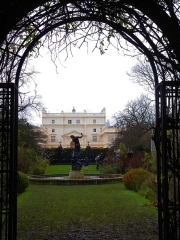
ONE COULD EASILY MISS it whilst walking around the Inner Circle at London’s Regent’s Park. Had I not noticed a couple of people emerging from the discreet gap in a fence, I would have dismissed this as one of the numerous private entrances on the outer circumference of the Inner Circle. The gap in the fencing is near the northernmost point on the circular road. A small notice, framed by vegetation, within the gap in the fencing gives a short history of The Garden of St John’s Lodge. Follow the pathway away from the road, take a left turn and walk between two manicured hedges and then turn right, and you enter a lovely formal garden replete with a pond, several sculptures, and a lawn that gives a fine view of one side of St John’s Lodge. Brave the slippery mud and explore the various separate parts of this almost secret garden. You will not be disappointed.

St John’s Lodge was the first ‘villa’ to be built in Regent’s Park. Completed between 1817 and 1818 (https://historicengland.org.uk/listing/the-list/list-entry/1277478), it was designed by John Raffield (1749-1828), who had worked for the Adam brothers before setting up his own architectural practice. It was later modified and enlarged both by Decimus Burton and Charles Barry. The house was built for the politician Charles Augustus Tulk (1786-1849).  Subsequent owners of the private residence have included Lord Arthur Wellesley, Duke of Wellington (1769-1852) who served in India; John Crichton-Stuart, 3rd Marquess of Bute (‘Bute’;1847-1900), whose heart was buried at The Mount of Olives in Jerusalem; and Baron Sir Isaac Lyon Goldsmid (1778-1859). It was Wellesley who employed Decimus Burton to enlarge the house in 1831-32.

Goldsmid was a philanthropist and one of the leading personalities in the emancipation of British Jews. He made his fortune as a partner in the bullion brokers firm of Mocatta & Goldsmid (founded as ‘Mocatta Bullion’ in 1684), brokers for both The Bank of England and The East India Company. It was due partly to Goldsmid that my alma-mater, University College (London), was able to come into existence. Albert Hyamson, author of “A History of the Jews in England” wrote that:

“University College, London … was established in 1826, largely by the efforts and through the munificence of Isaac Lyon Goldsmid …”

Goldsmid paid for the land on which the university was later built.

In connection with Jewish emancipation, the online Jewish Encyclopaedia (www.jewishencyclopedia.com/articles/6765-goldsmid) writes of Goldsmid:

“The main effort of his life was made in the cause of Jewish emancipation. He was the first English Jew who took up the question, and he enlisted in its advocacy the leading Whig statesmen of the time. Soon after the passing of the Act of 1829, which removed the civil disabilities of the Roman Catholics, he secured the powerful aid of Lord Holland, the Marquis of Lansdowne, the Duke of Sussex, and other eminent members of the Liberal party, and then induced Robert Grant to introduce in the House of Commons a similar measure for the Jews. During more than two years from the time when Jewish emancipation was first debated in Parliament, Goldsmid gave little heed to his ordinary business, devoting himself almost exclusively to the advancement of the cause.”

In 1841, Goldsmid became the first Jewish person, who had not converted to Christianity, to become a Jewish baronet.  His son, Sir Francis Henry Goldsmid (1808-1878), worked with him for Jewish emancipation and was the first Jewish barrister in England, having been called to the Bar at Lincolns Inn.

Clearly, St John’s Lodge has had some noteworthy residents. Of these, it was Bute who commissioned the Scottish Arts and Crafts architect and landscape designer Robert Weir Schultz (1860-1951) create a garden “… fit for meditation”. Bute at St John’s Lodge, which he acquired in 1888, was one of Schultz’s first major clients (http://www.scottisharchitects.org.uk/architect_full.php?id=200199). Bute had taken an interest in Schultz’s studies, having financed his visit to the British School at Athens in the late 1880s. The garden was created in the early 1890s. It was refurbished and some of its original features restored in 1994, but it has been open to the public since 1928 (https://londongardenstrust.org/conservation/inventory/site-record/?ID=WST108).

Apart from its vegetation, the garden features sculptures, a pond, and a giant urn. The sculptures include “Goatherds daughter” by Charles L Hartwell (1873-1951); “Hylas and the Nymph” by Henry Pegram (1862-1937); an “Awakening” by Unus Safardiar (born 1968), commemorating Anne Lydia Evans (1929-99), a local medical practitioner. There are two stone piers, one on each side of a lawn, bordered by scalloped hedges,  leading up to the house. Each of these is topped with a stone cherub holding a fading painted stone shield, the coat-of-arms of Crichton-Stuart. These were made by William Goscombe John (1860-1952).

St John’s Lodge remained in private ownership until World War I, when it became a hospital for disabled officers and then became the HQ of St Dunstans (now known as ‘Blind Veterans UK’) with its workshops from 1921 to 1937. Then, it became the headquarters of the Institute of Archaeology from 1937 to 1959. In 1959 it was occupied by Bedford College (now ‘Regent’s University’).  It was vacated and since 1994, it has been leased for private residence to the Royal Family of Brunei.

Had I walked past the small passage leading off the Inner Circle,  I would have missed experiencing the almost hidden, delightful garden of St John’s Lodge, which is a building that has housed persons who have influenced the history of Britain significantly. We visited the garden in late December when few plants were in flower. We hope to return a few months later when not only the garden will be filled with blooms as will the nearby Queen Mary’s Rose Gardens within the Inner Circle.