The superfast express train from Ahmedabad to Bhuj

THE EXPRESS TRAIN, Indian Railways number 22903 (the Bhuj AC Superfast Express), runs between Bombay and Bhuj (in the Kutch district of Gujarat). On its way, it stops at Ahmedabad Junction Station at 630 am. To catch the train, we arrived at Ahmedabad Junction at about 530 am – I always prefer being early at the departure point of a train, aeroplane, bus,  etc.


It was dark as our autorickshaw drove speedily along the empty streets of central Ahmedabad. The sun only rises after 7 am in the west of India.


Ahmedabad Junction Station

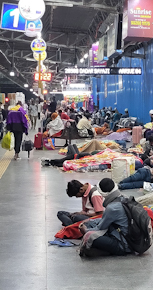
The well-lit station platforms were covered with rows of people wrapped in blankets, sleeping on the floor. The sight of these sleepers reminded me of the images that Henry Moore made of people sleeping on the platforms in London’s deep Underground stations during WW2. Of course, the people sleeping in Ahmedabad’s Station were awaiting trains, not sheltering from bombs dropped by the German’s Luftwaffe.


These sleepers were not disturbed by the endless series of train announcements, each of them were made in three languages: Hindi, English,  and Gujarati. One of them that was repeated at regular intervals informed those who were listening that the Shalimar Superfast Express (it runs between Kolkata and Bombay) was running 12 hours and 50 minutes late. Fortunately, our train 22903, pulled into platform 3 almost exactly on time.


We had reserved places in the first class, air-conditioned carriage, and had a coupé (compartment) to ourselves. Although comfortable,  it was a rather spartan little cabin. I believe that first-class rail travel in India is aimed at those who wish to travel secluded from the ‘madding crowd’. Frankly, I prefer travelling in a carriage in which one can see and, sometimes,  interact with one’s fellow travellers and the endless stream of vendors, who move up and down the trains in India.


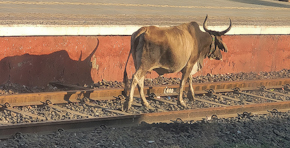
The six-hour journey from Ahmedabad to Bhuj is through terrain as flat as in the Netherlands,  but much dustier. All along the route we passed factories, both small and large, many with chimneys emitting smoke. For the first half of the journey,  we travelled past well-tended fields in which crops were growing. After crossing into Kutch, we passed numerous vast water features containg seawater that was being dried to produce salt. Every now and then, white, conical mounds of salt could be seen. The train runs for a long way parallel to a main highway in Kutch.  This connects Kutch and its important port Kandla with the rest of India. An endless stream of large trucks moves along this road.


At Gandidham in Kutch, the train’s engine was changed. We began moving in a different direction as we travelled along the stretch of rail track between Gandidham and Bhuj, where we disembarked.  Outside the station there was a sea of men offering to drive us in taxis, jeeps, and autorickshaws.


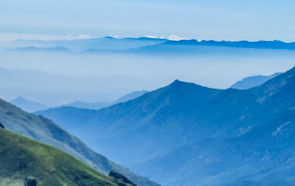
Eventually, our driver met us, and drove us through the hilly, almost arid hills between Bhuj and Kutch Mandvi, where we were going to stay with my wife’s cousins.


Even though train 22903 traverses terrain that few would regard as picturesque, I always enjoy long land (rather than air trips) journeys through  the countryside of India.

Coffee in a railway signal cabin

THE TRAINS THAT used to run into Folkestone Harbour station have not done so for many years. The station has been restored and repurposed as a pleasant, tasteful leisure amenity.

The signal box that used to regulate rail traffic in and out of the station still stands. It is now used as a café. With fine views of the harbour and Folkestone town, the signal box now contains equipment for making coffees and seats for customers. Apart from being an interesting old building, the old signal box contains the levers that used to operate the points within the station and on the bridge across the small harbour that connects it to the main land.

The café is not only housed in an original building, but also the coffee made there is above average in quality.

Residences close to the railway tracks in north London

LIVING NEAR BUSY railway lines can be a noisy experience. The American-born architect Neave Brown (1929-2018), who worked for the London Borough of Camden, understood this when he designed a housing estate that is situated beside a curve of the railway between Kilburn High Road and South Hampstead stations. Six parallel tracks carry trains regulatly past this site. So, living alongside these tracks could be far from peaceful.

Side of the block facing the railway tracks

Neave Brown designed a public housing estate next to this curve. Called the Alexandra and Ainsworth estate, it was designed in the Brutalist style of architecture, but in such a way that the buildings themselves muffle the sounds coming from the railway tracks. How he did this is well explained in a Wikipedia article:

“The higher, eight-story block directly adjacent to the railway line is organised in the form of a ziggurat, and acts as a noise barrier that blocks the noise of the trains from reaching the interior portion of the site, and its foundations rest on rubber pads that eliminate vibration.”

This step-like construction is both impressive and sculptural. Far from being inhuman as many Brutalist constructions can be, the estate, which is rich in vegetation, looks like a pleasant place to live. This contrasts with the pairs of tower blocks that stand on the other side of the tracks. As one of its residents, the architect Lefkos Kyriacou wrote (http://alexandraandainsworth.org/history/):

“… Alexandra Road still retains its cinematic wonder but having suffered the problems that have blighted much of Britain’s post-war social housing it is emerging from the shadows, not only as a valuable part of our national heritage but as a viable example of how mass housing can succeed.”

What is more, and this is a measure of its success, I have read that Neave Brown’s estate has suffered far less from vandalism than almost all of Camden’s other residential estates.

Lloyd George on the railway tracks at Paddington station

IT IS NOT UNCOMMON to find that transport vehicles such as trains, boats, and aeroplanes, are given names. They are often named to honour noteworthy people. While strolling along platform 1 at London’s Paddington station today (21st July 2024), I noticed a train bearing the name ‘Megan Lloyd George CH’. You will, I hope, excuse my ignorance when I tell you that although I have heard of David Lloyd George (1863-1945), a former Prime Minister, Megan Lloyd George was not a name with which I am familiar. I wondered why the Great Western Railway (‘GWR’) had chosen to put her name on one of its trains. When I got home, I found out why.

Megan Lloyd George (1902-1966) was the youngest child of the Prime Minister David Lloyd George. She was born in Criccieth, Wales. Until she was four years old, she could only speak in Welsh. Between the ages of 8 and 20, she spent much of her life in the Prime Minister’s residence, 10 Downing Street. It is not surprising that the young lady became interested in politics. With some help from her father, Megan became the Liberal party candidate for the Welsh constituency of Anglesey, and in May 1929, she was elected as its Member of Parliament (‘MP’). She became the first woman MP from Wales. She was re-elected in the general elections of 1931 and 1935.

According to a biography (https://liberalhistory.org.uk/history/lloyd-george-megan/), Megan accompanied her father:

“… on his visit to Hitler in 1936, and opposed the policy of appeasement, urging him to press for Chamberlain’s resignation in May 1940.”

She served in Parliament throughout WW2, and was re-elected in 1945 and 1950, but with greatly reduced majorities. In 1952, she lost her seat.

For various political reasons, Megan and several other members of her party left the Liberal Party and joined the Labour Party in April 1955. In 1957, she became the Labour MP for Carmarthenshire, with a majority of 3000 votes. Always a popular figure, she took Carmarthenshire again in 1966, with a majority of 9000. By then, she was suffering from cancer, and died soon after the election and a few days after having been awarded the Companion of Honour (‘CH’) by Prime Minister Harold Wilson. In 2016, she was nominated as one of the ‘50 Greatest Welsh Men and Women of All Time’ (www.walesonline.co.uk/news/wales-news/50-greatest-welsh-men-women-11431779).

GWR trains run from Paddington to the west of England and parts of Wales including its capital, Cardiff. So, we should not be surprised to find Megan’s name on one of them. Having said that, I am not sure where the train with her name on it was heading as it left platform 1.

No longer can you travel overland from this station to Leipzig or Marseilles

THE FIRST BLACKFRIARS railway station was opened in 1886. This station has been replaced by a 21st century station that now serves trains of the Thameslink network, which connects places north of London with places south of the city – no further north than Peterborough, and no further south than Brighton. Originally, when it first began serving passengers in the 19th century, trains carried people to overseas destinations including Leipzig, Naples, St Petersburg, and Marseilles.

The ticket hall of the current Blackfriars Thameslink station contains a reminder of the days when passengers departed for places much further afield than Brighton and Peterborough. It is a section of the original station’s facade, on which a list of destinations once reachable from the station is inscribed . The list includes many places on the European mainland as well as places in southeast London and Kent, through which travellers heading towards foreign lands had to pass.

I do not recall the old Blackfriars station, but the current one is an elegant example of modern architecture. What is particularly nice is that the platforms are on a bridge spanning the Thames. While waiting for a train, passengers can enjoy splendid views up and down the river.

An unusual Victorian funicular still working by the sea

STEEP CLIFFS OVERLOOK Hastings Old Town and the beach immediately east of it. Although there are roads that lead from these parts of Hastings to the rest of the town on top of the cliffs, a more interesting way of travelling between the bottom and the top of the cliffs is by using either the East Hill Lift or the older West Hill Lift. Both are funiculars. We travelled up and down on the West Hill Lift, which travels between the west end of the Old Town and the ruins of Hastings Castle high above on the top of the cliff.

The West Hill Lift (‘WHL’) is 500 feet long and ascends a height of 170 feet, a gradient of 33% (1 in 3). It comprises two tracks, each 6 feet in gauge. It is powered by electricity. The two carriages, which can each hold up to 16 people are raided and lowered along the tracks by steel cables attached to them. They are equipped with a mechanism that automatically applies brakes to the wheels should the cable break. I did not know this when we made a trip up and down the cliff in the creaky old carriages, which are those that were supplied when the system was originally installed.

The construction of the WHL began in 1899 (the year that the Eiffel Tower was built). But it was only completed in 1891, when the cable winders were operated by a gas-powered engine. The funicular system was built by Messrs A H Holme & C W King of Liverpool, who later built the Snowdon Mountain Railway. In 1894, after the Hastings Lift Company went ‘bust’, the WHL was taken over by the Hastings Passenger Lift Company. This company ran it until 1947, when the Lift was bought by Hastings Borough Council. In 1924, the gas engine was replaced by a diesel engine, which was later replaced by an electric motor (in 1971).

Despite having been refurbished in 1991, the WLF still operates with its original 1890s carriages. Admission to these is via an old-fashioned metal turnstile operated by the ticket seller. Apart from looking archaic, a special feature of the WHL is that most of it travels in a brick-lined tunnel burrowed through the cliff. Its neighbour, the East Hill Lift, runs through an uncovered cleft cut in the cliffs. Apparently, few other funiculars in Britain were built, like the WHL, to run through tunnels, and those that were, are no longer in use.

Although Hastings is not nearly as elegant as other British seaside towns such as Eastbourne and Brighton, it is an intriguing place rich in places of historical and visual interest. The existence of the superb Hastings Contemporary art gallery and the two working funiculars adds to the fascination of the place. It is not a place to be ‘sniffed at’.

A not so peaceful garden of peace

TODAY, OUR FRIEND took us to see a part of Hampstead, which I never knew existed. Called The World Peace Garden, it is located on a sliver of sloping ground bounded to the south by Hampstead Heath Overground station and to its north by a short stretch of the western end of the road called South Hill Park. Its dimensions are approximately 95 feet in length with a maximum width of about 29 feet. It is entered by a discrete opening on South Hill Park. Some steps lead downward to a couple of paths that wind their way through the dense vegetation and past small ponds to a tiny seating area at the garden’s eastern end. The miniscule park is rich in flowers, bushes, and trees. It is a lovely place.

The World Peace Garden began to be created in about 2014 on waste land between South Hill Park and the railway station. Inspired by a local estate agent, Jonathan Bergman, the garden was designed by  Tony Panayiotou and Michael Wardle, and created by gardeners Keiko, Hugh, Laurence, Miki, and Mer. In 2016, it was awarded the ‘Time Out Love London Award for Local Culture in Hampstead’. Today, it is still delightful, although slightly overgrown. During our midday visit, we saw several people enjoying lunch in shady nooks.

Although the garden is to celebrate the idea of world peace, it is not exactly a peaceful place. Every few minutes, the peace of the garden is disturbed by noises coming from trains passing through the station beneath it. Despite speaking to many people about Hampstead, until today nobody has mentioned the Peace Garden to me.

A bell at Byculla railway station

THE RAILWAY LINE between Bombay(Mumbai) and Thane was opened in 1853. Byculla Station was one of its original stations when trains began running along this stretch of track. At first a wooden building, it was soon replaced by the present stone structure, which was ready for use in 1857. This historic station, the oldest surviving railway station in India. was beautifully restored recently.

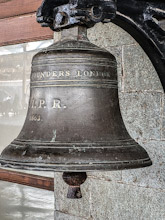
On platform 1, I spotted an old bell hanging close to one of the station’s offices. It is marked with the initials “GIPR”and the date 1863. The letters are the initials of the Great Indian Peninsula Railway company, which was incorporated in 1849. In contract with the British East India Company, its aim was to link the British Presidencies by rail. The first stretch to be built was that between Bombay and Thane.

The bell carries the name of its manufacture – “Mears & Co. Founders London”. This bell foundry, first established in the 16th century, moved to London’s Whitechapel Road in the very early 18th century. It was where one of the largest bells in St Paul’s Cathedral was made. The Mears family ran the foundry between 1784 until 1873.

The foundry ceased working in 2017. The bell at Byculla Station has by now long outlived the bell foundry in Whitechapel and the British Empire, during whose existence it was manufactured.

A strange notice in a railway station

BE THEY LARGE OR SMALL, I always enjoy railway stations. Today, the 7th of January 2023, we visited the Central Station in Chennai (Madras). This huge edifice is also known as ‘Puratchi Thalaivar Dr. M.G. Ramachandran Central Railway Station’. It is the busiest station in southern India. When we visited it at about 11 am, it seemed rather sleepy even though there were many people waiting for their trains.

The station was designed by a British architect George Harding. Its distinctive exterior has neo-Romanesque decorative features. It was first opened in 1873, but was rebuilt twice: in 1959 and 1998.

We bought coffees to drink in a canteen within the station. After paying at the cash desk we were given two small plastic discs, like counters used in board games. Each disc had the word “coffee” printed on one side of it. We handed these to a lady who prepared excellent South Indian filter coffee.

The walls of this small café-cum-restaurant are decorated with murals depicting Chennai and the Central Station. Numerous informative notices were also displayed in the walls. One informed customers that all of the water used had been filtered. Another forbids the eating of “outside food”, which means food not bought in the canteen. Yet another reassured customers that “medium refined” cooking oil was used in the kitchen. And another warned clients that they are under cctv surveillance.

One notice puzzled us. It reads: “NO BILL FOOD IS FREE”. Grammatically, it made no sense to us. We asked another customer, who was standing close to us, if she could explain. She smiled, revealing a set of teeth that would have benefitted from orthodontic treatment, and then, as quick as a flash, she explained that these words mean that without paying, no food will be served.

A station, a friend, a cousin

BEFORE I LEARNED TO drive, I began visiting a friend who lives in the heart of the Cornish countryside, a few miles away from Bodmin. I used to travel by train from London’s Paddington to Bodmin Parkway station, which is a short distance away from the town of Bodmin. My friend, Peter, used to collect me from this small station and drive me to his family’s smallholding deep in the countryside. After passing my driving test in 1982, I began driving to Cornwall. Today, the 10th of October 2022, we dropped off our daughter at Bodmin Parkway station to catch a train to London. This was my first visit to the small station since the early 1980s. It brought back memories of my early visits to see Peter and his family.

Bodmin Parkway station

I met Peter through mutual friends. We clicked. In the years following our first meeting, we saw each other regularly, considering how the great the distance is between our homes. On one visit to Peter’s home, I spotted a photograph of his mother, and remarked that her appearance reminded me of my mother. We thought nothing of this at the time.

In the late 1990s, I began researching the history of my parents’ families. An enquiry to a relative, who lived in Zimbabwe led me to contacting another relative, who worked for New Zealand’s diplomatic service. He got in touch with me and was able to supply information that was missing on one of the family trees connected to my mother’s family. I looked at what he had sent me, and my eyes nearly popped out of my head. For, amongst the people listed in that branch of the family tree were Peter and his children. It turns out that Peter is both my fourth and fifth cousin. The reason for this double relationship is that my mother’s parents were second cousins once removed; they shared a common ancestor. So, it turns out that not only is Peter a good friend but also a cousin. It is interesting that although Peter and I were already good friends, knowing that we are related has enhanced our relationship. Standing on the platform at Bodmin Parkway, waiting for our daughter’s train to arrive, brought back memories of my first encounters with Cornwall, a good friend and his mother’s photograph, and my discovery that he is part of my family.