YOU CAN NO LONGER ENJOY a tankard of ale at the Sun Inn in the Essex town of Saffron Walden. However, you can still enjoy the fine pargetting (moulded sculptured plasterwork) that adorns it.
The building that housed the former Sun Inn was built in the 15th century. Late in the 16th or early in the 17th century, an upper floor was added. Indeed, one of the gables with fine pargetting bears the date 1676. This might have been the date when the present pargetting was created or when the upper floor was added, or even both. The former inn has an opening that allowed wagons and other traffic to enter the yard behind it.
The pargetting is described well in a website (www.british-history.ac.uk/rchme/essex/vol1/pp228-260) as follows: “… in the middle bay are two late 17th-century panels in plaster, one with a design of foliage and birds, and the other with a stocking; in the S.W. gable is a design of the same date in plaster, which consists of a circular panel divided into twelve segments; on each side is the figure of a man in a long coat, knee-breeches and high-heeled shoes; one figure holds a sword and buckler, the other a long club.”
One of the panels, that with the man with a sword and the other with a long club, respectively represent Thomas Hickathrift and the Wisbech giant (https://heritagerecords.nationaltrust.org.uk/HBSMR/MonRecord.aspx?uid=MNA108635). Thomas (‘Tom’) Hickathrift was a mythical East Anglian giant-killer, a giant of a man, whose exploits included slaying the Wisbech Giant.
Today (late 2020), the group of beautifully decorated houses that includes the former Sun Inn is empty. The ground floor of part of the building bears a shop sign ‘Lankester Antiques & Books’. Run by Paul Lankester of Thaxted in Essex, the shop closed after 48 years of business in July 2015. Another sign near it reads ‘The 14th century Old Sun Inn. Oliver Cromwell’s Headquarters 1647’. In 1647, when Cromwell’s New Model Army had won the first civil war for the Parliamentarians, they gathered in Saffron Walden. For various reasons the war weary army was becoming dissatisfied. Cromwell and his officers arrived in Saffron Walden on the 2nd of May 1647 to try to satisfy the troops’ various demands and to deal with their grievances (www.saffronwaldenreporter.co.uk/news/a-lasting-place-in-history-1-377880). He was unable to do so and returned to London after staying in the town for 19 days.
Although the town has many other attractions, seeing this old building with its exquisite external decorations is on its own an excellent reason to pay a visit to Saffron Walden.
KIT KAT CONFECTIONERY BARS are familiar to many people and I enjoy eating them occasionally. The ‘Kit Kat’ and ‘Kit Cat’ tradenames were registered by the Rowntree’s confectionery company in 1911, but the first chocolates bearing this name only appeared in 1920. Had you wanted to eat a Kit Kat in the early 18th century London, you would not have been served a chocolate item but a type of mutton pie. The Kit Kat mutton pie was the creation of Christopher Catling (aka ‘Katt’ and ‘Cat’), who had a pie house in Shire Lane near Temple Bar, which used to stand near the present-day Royal Courts of Justice on London’s Strand.
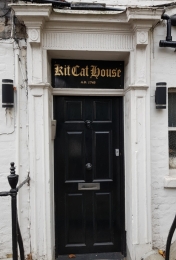
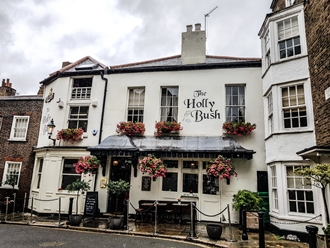
When walking in Hampstead Village recently, we saw something I had never noticed before during at least 60 years of visiting the area. It was wording above the doorway of a house on the corner of Heath Street and the much narrower Holly Bush Steps. The words are: “Kit Cat House” and (below them) “A.D. 1745”. Above one of the ground floor windows, that which is nearest to Heath Street but on the wall facing Holly Bush Steps, there are some painted letters, which I will discuss later.
The Kit Cat Club (also sometimes spelled as ‘Kit Kat’) was an 18th century club whose members were of the Whig political persuasion. Members included literary men such as William Congreve, John Locke, Sir John Vanbrugh, and Joseph Addison; and politicians including Duke of Somerset, the Earl of Burlington, Duke of Newcastle-upon-Tyne, The Earl of Stanhope, Viscount Cobham, Abraham Stanyan and Sir Robert Walpole, who was Prime Minister between 1721 and 1742. The painter Sir Godfrey Kneller (1646-1723) was yet another member. He painted portraits of 48 members of the club, which are now kept in the National portrait Gallery.
The club is commonly believed to be named after Christopher Catling and his mutton pies, but this is not known for certain. The club’s meetings were held at first in Catling’s tavern in Shire Lane (which no longer exists). Then, they were held at the Fountain Tavern on the Strand, which stood where today stands Simpsons on the Strand, and then later at purpose-built premises at Barn Elms (between Barnes and Fulham). In summer, the members met at the Upper Flask in Hampstead.
The Upper Flask, which was demolished long ago, was a pub located on the corner of East Heath Road and Heath Mount, that is on the south corner of East Heath Road and Heath Street, about 190 yards north of the present Kit Cat House on Holly Bush Steps. It was on the site of the now closed Queen Mary’s Maternity Home that received patients between 1919 and 1975.
Edward Walford, writing in his encyclopaedic “Old and New London” (volume 5, published in 1878), noted:
“The ‘Upper Flask’ was at one time called ‘Upper Bowling-green House,’ from its possessing a very good bowling green … when the Kit-Kat Club was in its glory, its members were accustomed to transfer their meetings in summer time to this tavern, whose walls – if walls have ears – must have listened to some rare and racy conversations … Mr Howitt in his ‘Northern Heights of London’ gives a view of the house as it appeared when that work was published (1869). The author states that the members of the Kit-Kat Club used ‘to sip their ale under the old mulberry tree, which still flourishes, though now bound together by iron bands, and showing signs of great age…’”
During the later year’s of the Club’s existence, in the first quarter of the 18th century, some of those members who sipped ale under this tree included the poets Shelley and Keats, who lived in Hampstead. Another member, who enjoyed meetings at the Upper Flask, the poet and physician Richard Blackmore (1654-1729), penned these lines about them in his poem “The Kit-Kats” (published in 1708):
“Or when, Apollo-like, thou’st pleased to lead
Thy sons to feast on Hampstead’s airy head:
Hampstead, that, towering in superior sky,
Now with Parnassus does in honour vie.”
So, the Kit Cat Club had an association with Hampstead, but was there any connection between the Club and the house on Holly Bush Steps, which bears the date 1745? The house was built in about 1800 (https://historicengland.org.uk/images-books/photos/item/IOE01/15805/21), which is after the period between 1696 and 1720, when the Club was active (https://doi.org/10.1093/ref:odnb/73609). It is also after the date above the door, ‘1745’.
An old postcard, published sometime between 1903 and 1930, reveals that the house was once a shop belonging to ‘Francis’. This was J Francis of number 1 Holly Bush Steps. What J Francis sold is not certain but above the whitewash that covers the wall of the ground floor, the remains of an old painted sign can be seen on the brickwork. It reads:
“Libraries” and also “S ?? D”, the two question marks represent letters that have disappeared. Other letters below the word ‘libraries’ have also gone. I wonder whether it once read ‘Libraries bought and sold’. Interesting as this is, it does not explain to me why the house is so named or the significance of the date 1745. So far, and this might be purely coincidental, the only connection I have found is that Robert Walpole, a member of the Kit Cat Club, died in 1745. However, I am not at all sure that this is why the date appears below the name above the door of the house on Holly Bush Steps.
I enjoy chance findings like that which I noticed in Hampstead and investigating their histories. I am not sure that I am much the wiser about the naming on the house on Holly Bush Steps, but whilst trying to find out about it, I have learnt a little more about the history of Hampstead, a part of London that was important to me during my childhood and which I continue to enjoy visiting. And as for Kit Kats, I would prefer that you offer me the chocolate version, rather than the mutton one.
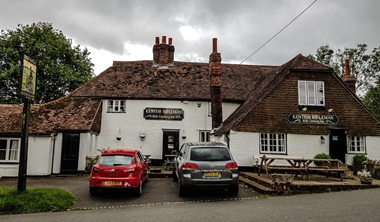
WE HAD JUST CROSSED the River Stour, leaving the county Essex and entering neighbouring Suffolk when we felt the need for coffee. We pulled up next to what seemed to be the only pub in the tiny village of Stoke by Clare and entered.
The village’s name includes the word ‘stoke’, which when used as a geographical term means hamlet or small settlement dependent on a larger place nearby. Stoke by Clare, which was in existence by the 12th century AD if not before, is only about two miles from the far larger and once important town of Clare. In 1124, Richard de Clare, the first Earl of Hertford, moved the Benedictine priory that had been established in his castle at Clare (now in ruins) to Stoke by Clare, thus giving some importance to the place. Today, Stoke is a picturesque, sleepy little village (population less than 500) with a few old houses, some with thatched roofs and some decorated with pargetting. Some of the thatched roofs are adorned with straw animals’ One has three dogs and another a pair of boxing hares. There is also a fine old church that was established at the time the Benedictine Priory moved to Stoke.
Entering the pub was like stepping back more than seventy years except that the diligent publican had equipped the interior with transparent plastic sheets, hanging like shower curtains, to prevent the covid-19 virus from being spread from one table to another. There was one elderly gentleman nursing a pint of beer and no other customers.
We asked the publican if coffee could be obtained. To our surprise and relief, he said that it was available although from the quaint old appearance of the place, which seems to have remained unchanged despite the passage of the centuries, we feared it might not be. My wife asked him:
“What kind of coffee do you make here? Espresso? Cappuccino? Cortado?”
The publican looked bewildered. Then, he replied:
“Coffee … just coffee.”
The coffee he produced was unexceptional, but it was just what we needed, and we enjoyed it in the lovely garden behind the pub. Before we left, we asked him if business had picked up since the easing of the pandemic ‘lockdown’ rules. He told us that it had not. I felt sorry for him as he has done everything to make his delightful old establishment safe for customers including providing hand sanitisers and instituting a one-way system through his tiny pub.
It always amazes me how often one misses the obvious when wandering around London. A few days ago, my friend, the author Roy Moxham, took us to a delightful pub, The Angel, near to Tottenham Court Road Station in central London.
Just before we entered the pub, Roy pointed at a stretch of pavement outside it. The usual paving stones had been replaced by granite slabs surrounded by granite cobble stones (see illustration above).
The reason for these harder stones is that they are less likely than paving stones to be damaged when heavy barrels are dropped on to them by the men delivering beer to the pub.
Since having been shown this localised special surface outside The Angel, I have checked outside other pubs and seen the same thing. For over 25 years (maybe over 7000 times) I have walked past the Churchill Arms in Kensington and NEVER noticed that it also has this arrangement, an area of tough stones close to the pavement entrance of its cellar. And, I consider myself to be more observant than average! It pays to keep your eyes open and to be curious – you never know what you might discover!
The City of London, the traditional business district of London that stands on the site of the old walled London of Roman and mediaeval times, is full of delightful surprises. Although much of the area was destroyed by the Great Fire in 1666 and the aerial bombing in the 1940s, what has persisted to a remarkable through the ages is the mediaeval street layout.
Another charming feature are the narrow alleyways that pass between or even through buildings. Step through some of these, and suddenly you find yourself stepping back into history.
Recently, we ‘discovered’ Ball Court, which leads south from Cornhill just a few yards west of the Church of St Michaels Cornhill. A narrow alley leads beneath a building to a wider courtyard open to the sky. Two sides of this rectangular space are occupied by Simpsons Tavern, a pub (and chop house) established in 1757. Ball Court itself is even older than the tavern, appearing on a map dated 1746.
I can not tell you why Ball Court has that name, but I feel sure that there must have been a good reason, but it had no name on the 1746 map. In any case, when in London, leave the main streets, explore, and enjoy!